
Our beloved goddess Athena: From antiquity to modern times
- Goddess Athena is one of the brightest and most dear forms of Greek mythologyAs goddess of wisdom, strategy, knowledge, justice and creative thinking, not only inspired its people ancient GreeceBut it continues to be a symbol for millions of people around the world. Its form combines power with reason, courage with restraint and determination with deep understanding. These very values make the Athena timelessly timely and explain why the goddess still holds a special place in the collective memory of humanity.
Athena in ancient Greece
In ancient Greek tradition, Athena stood out because she represented a different way of exercising power. He did not seek conflict for conflict, but used wisdom, strategy, and logic to resolve difficult situations. That is why the ancient Greeks honored her particularly, considering that real power stems from the mind and not just from the weapons.
Its relationship with the Athens is one of the most famous stories of Greek tradition. According to legend, Athena and Poseidon claimed protection of the new city. THE Poseidon offered a source of seawater, while Athena donated it Olive of Athena, a tree that offered food, oil, wood and prosperity. The inhabitants chose the gift of the goddess, recognizing the importance of peaceful progress and creation. So the city was named after her and the goddess became her eternal protector.
At the top of the Acropolis still dominates Parthenon, the imposing temple dedicated to Athena, which remains one of the most important monuments of world civilization. It was not only a place of worship, but also a symbol of the power of knowledge, democracy and artistic creation.
Athena also became a valuable ally of great heroes. THE Odysseus She managed to overcome countless trials thanks to the intelligence and insight she strengthened. THE Perseus, before facing the Medusa, he accepted the help of the goddess, who offered him valuable advice and guided him to complete his mission successfully.
Unlike Mars, symbolizing the violence and uncontrolled momentum of battle, Athena represented the organized design, discipline and fair use of power. This difference explains why people saw her as a protector not only of warriors, but also of craftsmen, philosophers, scientists and those who sought to improve the world through knowledge.
Its symbols
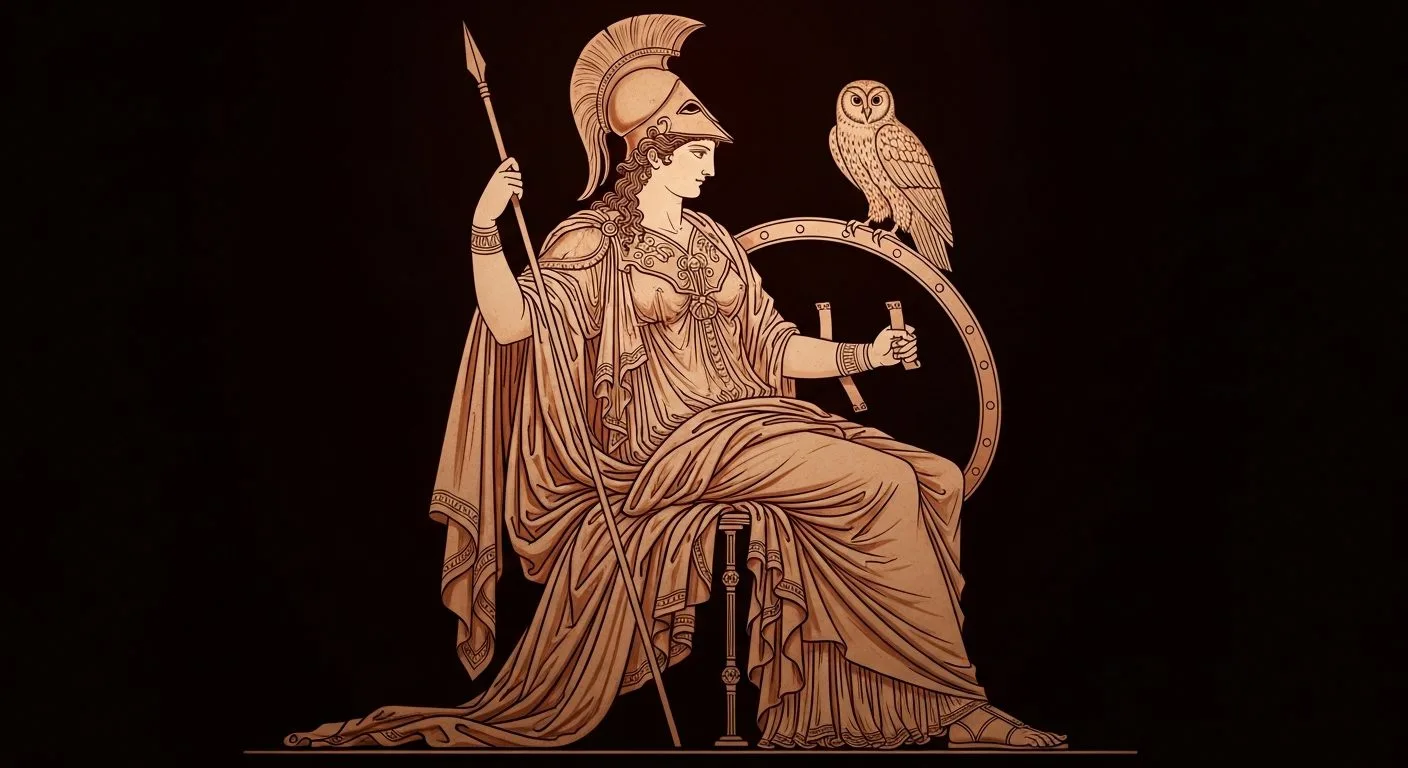
Every symbol of Athena carries a deeper message that remains identifiable to this day.
- Athena’s owl is probably her most famous symbol. This nocturnal bird was associated with insight, observation, and ability to discern the truth even in the darkness of ignorance. For this reason it still appears in universities, educational organisations and knowledge-related publications.
- Olive of Athena symbolizes peace, prosperity, fertility and steady growth. From ancient times until today, the olive tree is a symbol of life and cooperation, while it remains an integral element of Greek identity.
The helmet recalls that wisdom does not rule out readiness to face difficulties. Athena was always ready to protect those who were right, but without seeking unnecessary conflicts.
Her shield, which brought Medusa's head, functioned as a symbol of protection against fear and threats. He did not express aggression, but the ability to face the danger with calmness.
Finally, the spear represented the force guided by reason. It was a tool to defend justice and not a means of enforcement.
Why Athena remains dear today
The values Athena symbolizes hard to lose their meaning. In every era, people seek wisdom more than violence, knowledge more than ignorance and cooperation more than conflict.
Athena reminds us that great successes are not only based on power, but mainly on sound thinking and strategy. The ability to design, predict the consequences of our actions and to make fair decisions is the foundation of all healthy society.
At the same time, the goddess is directly associated with education and lifelong learning. Knowledge is not presented as a privilege of few, but as a force that can improve everyone's life. This is why its form is often used as a symbol of schools, libraries and educational institutions.
Creativity and innovation are also key elements of its personality. In today's world, where science, technology and new ideas shape the future, Athena's example becomes even more important. Progress is born when imagination works with reason and when knowledge is used for the benefit of society.
At the same time, Athena symbolizes self-control and justice. It shows that real leadership is not based on fear, but on responsibility, calm and ability to protect the common good. These values remain extremely topical in a world that constantly faces new challenges.
Athena in modern culture
Athena's presence is not limited to ancient texts or museums. Its name appears in universities, research institutions, public buildings, squares and streets in many countries. Its statues adorn cities around the world, recalling the timeless value of knowledge.
In literature, cinema, and television series, Athena is often presented as the wise guide that inspires heroes to choose the difficult but correct path. At the same time, its form appears in comic books, video games, and digital art works, proving that its charm remains alive even in younger generations.
Modern creation does not merely reproduce an ancient myth. It highlights Athena as a universal symbol of reason, culture and creative thinking, adapting its timeless values to the needs of each era.
Her timeless legacy
Athena is not just a deity of antiquity nor just an important form of Greek tradition. It is a universal symbol that reminds that true power is born of knowledge, reason, justice and creativity. From ancient Greece until the modern digital era, its message remains unchanged: progress is achieved when people choose wisdom instead of violence and cooperation instead of conflict. As long as societies seek new ideas, better education and creative solutions for the future, Athena's form will continue to inspire, proving that some symbols do not belong only in the past, but are constantly lighting the way to tomorrow.
- Goddess Athenadaughter of Zeus and Metis, is one of the most important deities of Greek mythology. Goddess of wisdom, strategy, war and justice, Athena combines power and intelligence, making it unique in the powerful world of Olympian. Her myths show how reason and strategy outweigh raw power and how wisdom can guide the actions of men and gods.
“Speaking so he stirred up Athene, who was eager before this,
And she came down at lightning speed from the peaks of Olympus.
As when the son of devious-devising Kronos casts down a star, portent to sailors or widespread armies of peoples
And out of it burst bright and dense sparks of fire,
in such likeness Pallas Athene swept flashing earthward”
— Homer, The Iliad of Homer
It's Athena strategy and biasNo neutral fair.
- In her myth Spider:
- Punishes too much, even when Spider tells the truth
- In Odyssey:
- Helps selectively to Odysseus
Athena in Greek Mythology
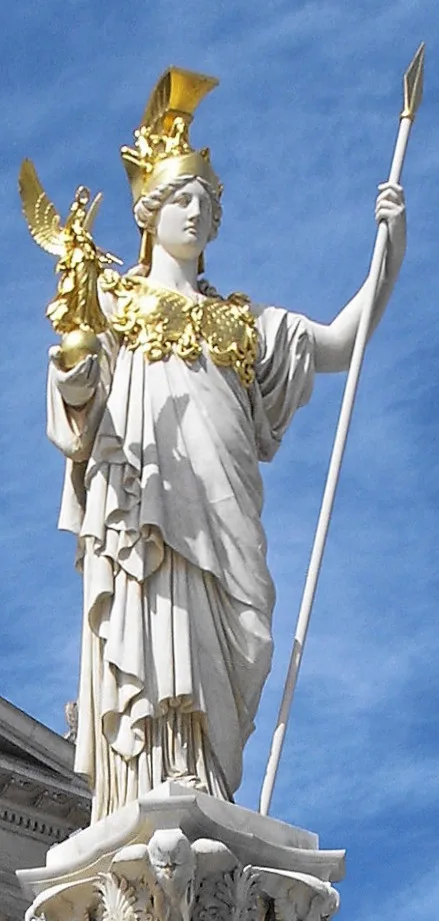
Athena is one of the most important deities in the Greek pantheon and symbolizes wisdom, strategic thinking, and just authority. The daughter of Zeus, she was born, according to myth, from his head, already armed with a helmet, shield, and spear. Her birth symbolizes divine wisdom that comes directly from the divine intellect.
Unlike Ares, who represents the violence and raw power of war, Athena symbolizes strategy, organization, and rational thought. For this reason, the ancient Greeks honored her as the protector of cities, rulers, and heroes.
The goddess was particularly associated with the city of Athens, which was named after her. According to legend, Athena won the city's protection in competition with Poseidon, offering people the olive tree – symbol of peace, wisdom and prosperity.
Goddess Athena is actively involved in the lives of people and gods:
Hero Guide: Protect him. Hercules, Perseus and Odysseus, giving them advice and strategy to overcome difficulties.
City protector: Athens was named after Athena, who gave the Athenians the first olive tree as a symbol of peace and prosperity.
Protector of justice: Through the myths, Athena advises and guides, bringing balance and fair results, without arbitrary punishment.
Symbols and Powers of Athena
Athena combines power and wisdom through her symbols:
Spear and shield: They represent strategy and rational battle.
Helmet: It symbolizes wisdom and readiness.
Glaucus: The bird of wisdom, who notices everything from above.
Olive: A symbol of peace, prosperity and culture.
Athena is the goddess who shows that strategy, knowledge, and reason are stronger weapons than brute power.
Sacred Sites and Worship
Athena was not merely a goddess of war, but a symbol of civilization and progress. The ancient Greeks regarded her as the patroness of knowledge, the arts, and craftsmanship.
The goddess was associated with the development of philosophy, architecture, and science, as she symbolized the power of reason and creative thought.
For this reason, Athena remains to this day one of the most recognizable figures in Greek mythology and a timeless symbol of wisdom, strategy, and civilization.
Athena was worshipped throughout Greece, with the most important sanctuaries being:
Acropolis of Athens: At the temple of the Parthenon were sacrifices and the feast Panathenea.
Sparta: Protector of soldiers and political wisdom.
Olympia and other cities: Smaller sanctuaries linking Athena to education, art and culture.
Her worship connected the citizen with the city, knowledge, and moral order.
The Birth of Athena
Athena's birth is unique: Zeus swallowed pregnant Mitida fearing that her child would overcome him in wisdom. This is how the Hesiod He achieved two purposes: he set aside the danger of being dethroned because of a prophecy and, also, by swallowing Metida he would learn what good and evil are, and he would gain all wisdom. In him, however, Athena grew until a headache forced Zeus to seek the help of Hephaestus. From Zeus' head was born Athena, fully armed, holding a spear, shield and wearing a helmet.
As the Homeric Hymn says, Athena "leapt forth fully armed from the immortal head, brandishing a sharp spear. Mighty Olympus shook to its foundations beneath the weight of the blue-eyed goddess, and all around the earth resounded with a terrible roar. The sea was also stirred, and its dark waves rose—but they soon subsided, and the glorious son of Hyperion held his horses, until the young virgin Pallas —Athena—removed her divine weapons from her shoulders—and the wise Zeus rejoiced."
This myth is not just impressive· sends the message that wisdom and strategy are born of reason and experienceNot by the simple force.
Athena in Contemporary Thought
Athena continues to inspire:
- wisdom and strategy as a guide to decisions.
- balance of power and logic as an example of leadership.
The connection Human, city and culture as a lesson in society management.
In art, philosophy and literature, Athena remains a symbol of wisdom that guides action.
Educational Summary
Athena is the goddess of wisdom, strategy, war with a just purpose and justice. Through their myths, the ancient Greeks taught that knowledge and reason can guide power, that strategy is essential for success, and that wisdom can bring peace to a world full of chaos.
Questions & Answers About the Goddess Athena
In Greek mythology, the Athena had several important sanctuaries throughout Greece, as she was the goddess of wisdom, strategy, justice and city protection. The most famous and important were:
Main sanctuaries of Athena
Acropolis of Athens – Parthenon
Athena's most famous and iconic shrine.
In the Parthenon were the great sacrifices and celebrations of Panathinaeans, who honored Athena as patron of the city.
Athena Virgin symbolized the wisdom, peace and protection of the Athenians.
Sparta
Sacredly dedicated to Athena as a goddess of war and strategy.
The Spartans worshiped Athena to guide them in battle and make wise decisions.
Olympia
Smaller sanctuaries in the area, where Athena was worshipped along with other Olympian gods.
It was mainly related to the justice and well-being of cities.
Arcadia and Thebes
Locally sacred dedicated to Athena, where believers sought guidance, wisdom and protection from dangers.
Other local shrines
Many Greek cities had smaller temples of Athena, linking the goddess with education, art, politics and community protection.
Athena, through these shrines, was associated with city, culture, education and strategic thinking, making it one of the most respected and multipersonal deities of Greek mythology.
- Athena, as a goddess of wisdom and strategy, he did not fight with brute force like Mars, but actively participated in battles providing strategic instructions, wisdom and guidance to heroes and armies. In Greek mythology, he appears in several important battles and war stories:
Battles and military intervention of Athena
Trojan War
Athena was a staunch supporter of the Greeks (Greek Achaeans).
He strategically led Ulysses and Achilles to critical moments.
He gave ideas and advice, as for his construction Trojan Horse, which led to the fall of Troy.
Battle of the Persian War (mythological representation)
In myths representing the epic conflicts of Greeks and Persians, Athena often appears as a patron of generals and cities, providing wise advice.
Support for heroes
Athena helped him Hercules in several of his twelve feats, as in the struggle with the Leo of Nemea and the Kernitic Elafi, giving him instructions requiring strategy and patience.
Help him. Perseus In his battle with the Medusa, By giving him the sword and shield, so that he can defeat her without looking directly.
In Odysseus, guided and protected him on his journey back to Ithaca, in particular against Bitch and Harybdi.
Olympic War conflict
In myths about the conflict of gods and Titans, Athena provided strategic support to the Olympians, especially Jupiter, helping to maintain the secular order.
Summary
Athena was not a "goddess of war" with the violence of Ares, but the goddess of strategy, wisdom and victory through cunning and strategic thinking. The battles involved show that wisdom and reason can determine the outcome of any war conflict, not just physical force.
Frequently Asked Questions About Goddess Athena
How powerful was Athena in Greek mythology?
Athena was considered one of the most powerful deities of Olympus. She embodied wisdom, strategy, and military might, and often aided heroes and cities with divine guidance.
Why is Athena a goddess of wisdom?
Athena is associated with wisdom because she symbolizes rational thought, knowledge, and strategy. In ancient Greek tradition, she was considered the patron goddess of philosophers, artisans, and people who used reason rather than force.
What were Athena's main weapons?
Athena's main weapons were her spear and shield. She is often depicted also holding patronage, a magical shield with the head of Medusa.
What was Athena's relationship with Zeus?
Athena was his daughter. Zeus And she was considered his favorite. Zeus trusted her for her wisdom and strategy and often commissioned important missions.
What was Athena's best-known story?
One of the most well-known stories is her dispute with Poseidon to protect the city AthensAthena won by offering the olive tree to the inhabitants.
What was Athena's relationship with the owl?
The owl was Athena's sacred animal and symbolized wisdom and knowledge. In ancient Greece its image often appeared in coins and vases.
Why is Athena called Pallas Athena?
The last name «Pallas» used frequently to honor the goddess. In the ancient Greek secretariat the name is associated with myths that highlight its power and wisdom.
What were Athena's most important temples?
Her most important temple was Parthenon in Athensdedicated to Athena Virgin.
Who was the Virgin Athena?
Athena Virgin is a form of the goddess that emphasizes its purity and independence. The famous statue of Athena Virgin was created by Phidias.
What's Athena's difference from Ares?
Athena represents strategy and wisdom in war, while Ares symbolizes the violence, chaos, and power of battle.
What inventions are attributed to Athena?
According to tradition, Athena taught people many arts, such as weaving, pottery and tool making.
What was Athena's relationship with the heroes?
Athena helped many heroes of mythology, such as Odysseus and Perseus, giving them advice and protection.
Why is Athena connected to the olive tree?
The olive tree is a symbol of Athena because, according to legend, the goddess gave the first olive tree to humans, offering food, oil and wood.
Where did Athena live according to mythology?
Athena lived in Olympus along with the rest of the gods of Greek mythology.
Why is Athena considered city protector?
Athena was considered city protector because she symbolized wisdom, justice, and organized society. Ancient Greeks believed that the goddess protected political order and culture.
OLYMPIAN GODS
ZEUS | HERA | ATHENA | ARES | ARTEMIS | DIONYSUS | HERMES | HADES | Apollo | POSEIDON | HEPHAESTUS | APHRODITE
Some less known elements about the goddess Athena >
Who is the Greek god of knowledge? >
Olympian Gods: The 12 Gods of Olympus in Greek Mythology >
Do you like Athena? See selected jewels inspired by Greek mythology. >

- Resin status of Athena goddess of wisdom and war strategy
- Know as Minerva in Roman mythology symbolizing intellect and course
- Handcrafted with gold-painted shield Spear and armor details