
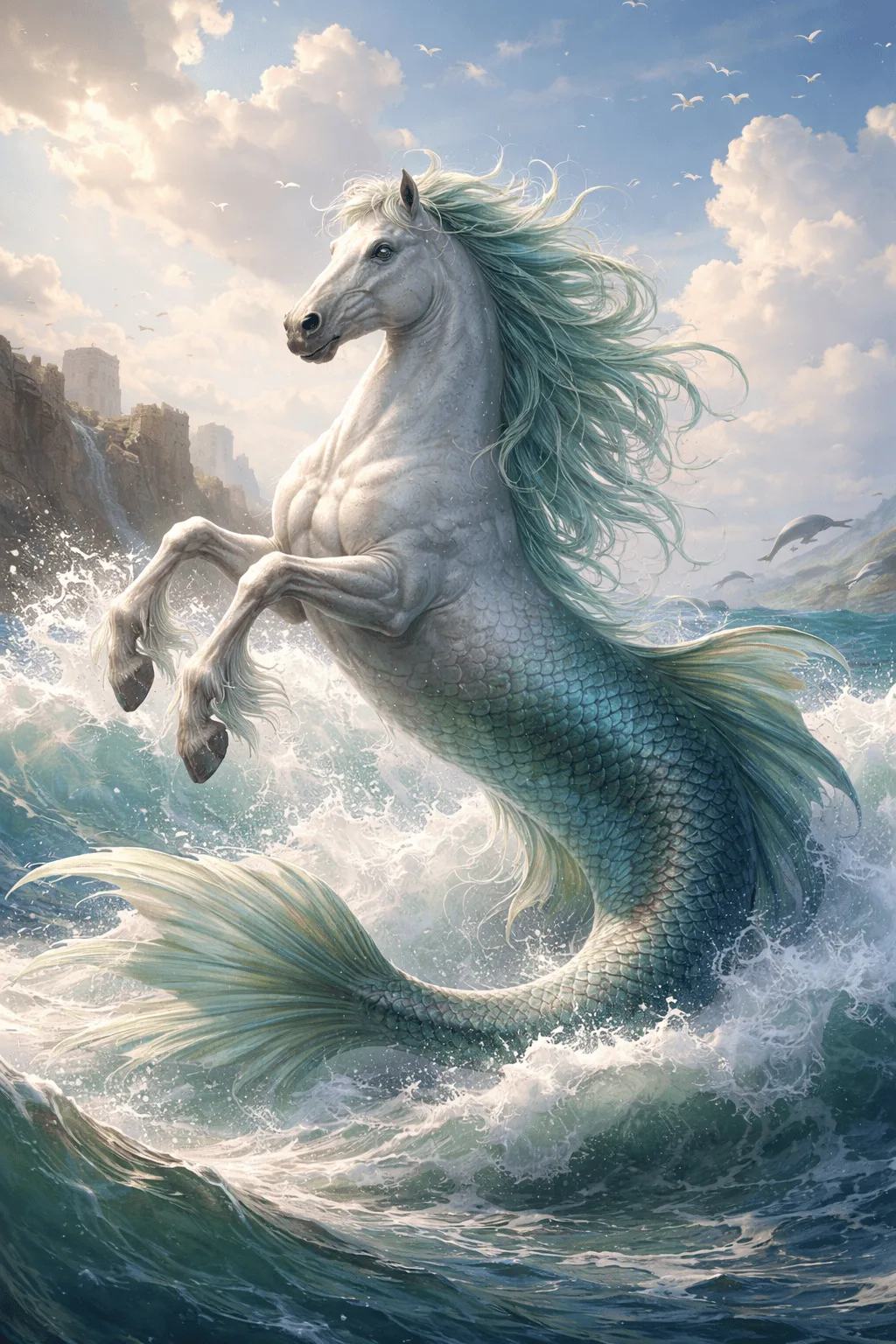
Hippocampus are among the most impressive and less known mythological creatures in ancient Greece. They combined two elements that held a separate place in the imagination of the ancient Greeks: the power of the horse and the mystery of the sea. With the front looking like a horse and the rear ending up in a fish or sea being tail, the Hippocampus were considered creatures of the god of the sea, PoseidonAnd they symbolized his dominance over the waves and oceans.
What were the Hippocampus?
The word «Hippocampus» comes from the Greek words «horse» and «plain» (sea monster or sea creature). In ancient art, Hippocampus are usually depicted with a head, neck, and front horse legs, while the back of their bodies results in a large fish or dolphin tail.
Ancient Greeks considered them residents of the deep seas and attendants of sea deities. They often appear to emerge from the waves or drag the chariots of the gods of the sea.
The Hippocampus and Neptune
The most important connection of Hippocampaans is with Poseidon, the god of the sea, earthquakes and horses. According to Greek mythology, the Hippocampans dragged the golden chariot of God as he traveled into the waters of the world.
The ancient poets describe Poseidon crossing the seas on a brilliant chariot that was dragged by sea horses with golden manes. As he passed, the waves calmed down and sea creatures followed him with respect.
This relationship explains why the Hippocampus were considered symbols of the strength, speed, and sovereignty of the seas.
The Hippocampus in ancient art
Although mythological accounts of Hippocampus are relatively limited, their performances in ancient art are numerous. They appear in vases, reliefs, mosaics and sculptures from the Archaic to Roman period.
They often accompany Poseidon, his wife Amphitrites and other sea deities, such as Nereids and Tritons. In many performances they are depicted moving between dolphins, sea monsters and waves, creating images that exude power and magnificence.
Particularly popular were their depictions in coastal sanctuaries and cities dependent on trade and navigation.
The Hippocampus in Roman tradition
The Romans adopted the Hippocampus through Greek mythology and incorporated them into their own artistic traditions. They appear in mosaics, sarcophagus, and public buildings, often accompanying the god of the sea Neptune, the Roman form of Poseidon.
During the Roman era the Hippocampus gained even greater popularity as decorative symbols of the sea, abundance and protection of sea travel.
The Symbolism of the Hippocampans
The Hippocampus symbolize the union of two worlds: land and sea. The horse represents the strength, speed, and courtesy, while the fish tail symbolizes the unknown, deep and mysterious element of water.
For the ancient Greeks, the Hippocampans expressed the infinite power of nature and especially the sea, which could offer wealth and prosperity but also cause disasters. As servants of Poseidon, they were symbols of divine authority over the waters.
At the same time, the harmonious composition of their characteristics reflected the Greek perception that natural forces can coexist in balance, even when they seem to be opposed to each other.
The legacy of the Hippocampans
The icon of Hippocampus survived far beyond antiquity. In medieval and Renaissance art they often appear as decorative elements in fountains, emblems and sea performances. In modern times artists, writers and creators of fantasy worlds continue to inspire.
Although not as well known as Pegasus or Medusa, Hippocampus are a unique example of the creativity of Greek mythology. As Neptune's sea horses, they remain symbols of the power of oceans, freedom and constant connection of man to the sea.
The hippokampos are among the most characteristic marine hybrid creatures of Greek mythology. With a horse body on the front and a fish or dolphin tail on the back, they embodie the close relationship of ancient Greeks with the sea and its mythological personification. Their presence is mainly pictorial, but deeply symbolic, associated with the strength and splendor of the liquid element.
Etymology and Name
The term Hippocampus comes from the words:
? (horse)
plain (sea monster or wave)
The name clearly attributes the hybrid nature of the creature: a compound of land speed and sea power.
Morphology and Natural Characteristics
The Hippocampus are depicted as:
horse front (head, neck, chest)
rear part fishy (fish or dolphin tail)
common with corrugated mane
Their form exudes:
Move
courtesy
dynamic
Origin and Mythological Inclusion
Equicats have no specific genealogy, but are considered as:
Sea demons
creatures of the environment of Poseidon
They often appear as:
Attractive animals of the chariot of Neptune
escorts of Amphitrite
members of the sea procession of gods and brides
Hippocampus and Neptune
- Poseidon is often depicted:
to drive a chariot that's drawn to it.
crossing the waves with their escort
This link underlines:
God's sovereignty over the sea
harmony between divine will and natural forces
Symbolism
The Hippocats symbolize:
the power of the sea
speed and movement
the transition between land and water
the balance of nature and mythology
At educational level, they are a typical example hybrid thinking of ancient world perception.
hippokampos in Ancient Art
They are depicted:
in vases of the classical period
in mosaic Roman times
in sculptures and reliefs
in coins of coastal cities
They often accompany:
Comparative Mythology
Hippocampus can be compared to:
Sea horses of other cultures
mythical creatures that combine animals and elements of nature
They are precursors of later marine fantasy beings.
Ancient Sources
The Hippocampians respond mainly:
in iconography
in descriptions of later authors
in angiographical and archaeological evidence
The absence of extensive literary narrative enhances the their symbolic character.
Educational Adaptation
Suitable for:
Primary & High School students
courses in mythology and art
cross-thematic activities (myth – environment)
Conclusion
The hippokampos They are not merely decorative mythical beings, but symbols of the marine worldview The ancient Greeks. Through their hybrid form, they reflect the deep need for understanding and domesticating nature through myth.
Ancient Sources
- Iliad, 13.20–31 (the chariot of Poseidon and the divine horses of the sea).
- Theogenia (generation of marine deities).
- Transformations (sea transmitters of Neptune/Neptonia).
- Argonauts (sea mythological traditions).
Modern Bibliography
- The Complete World of Greek Mythology.
- The Routledge Handbook of Greek Mythology.
- Greek Religion.
- Early Greek Myth.
- Dictionary of Classical Mythology.