
Titan Family Tree | Free Interactive PDF & Complete Genealogy
The Titans They represent one of the most important generations of divine beings in Greek mythology. Long before Zeus and the Olympian gods appeared, the world was ruled by ancient cosmic forces that symbolized the foundations of creation, nature, time, and order. Although Cronus is perhaps the most famous of them, most Titans remain relatively unknown to the general public, despite their decisive role in shaping the mythological world.
Their genealogy is remarkably complex. Through marriages among themselves, the Titans gave rise to new generations of gods, Titanides, nymphs, and demigods, and nearly all the major deities of the Greek pantheon trace their ancestry back to them. For this reason, understanding their family relationships is essential for anyone who wishes to study Greek mythology in depth.
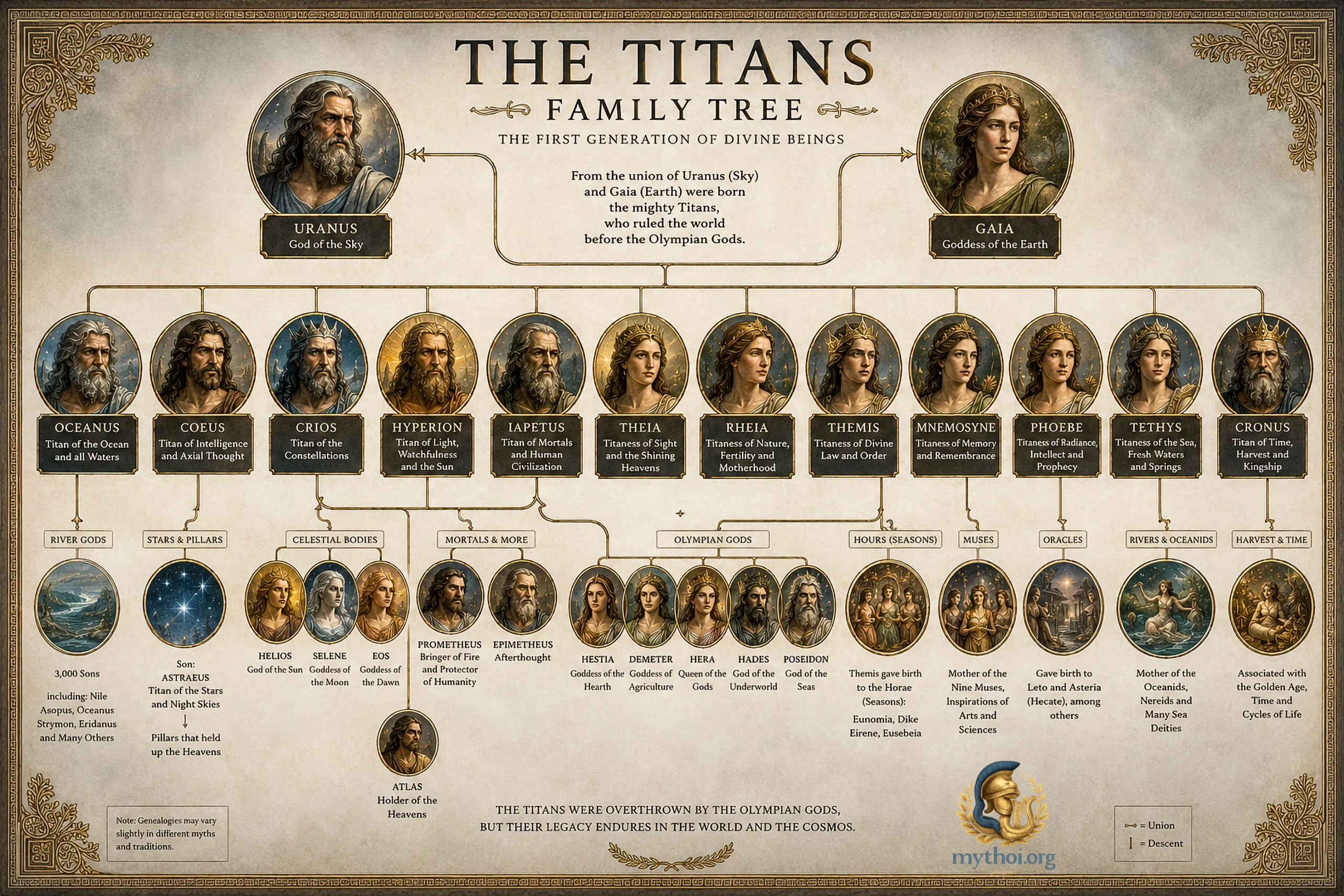
To make this complex genealogy easy to understand, we created a interactive Titan Family Tree, in which each form acts as a link to the corresponding detailed article of Mythoi.org.
Free Download of the Interactive Family Tree
The genealogical chart is available completely free in format Interactive PDF high resolution.
The file includes:
- high resolution for viewing and printing
- active links to related Mythoi.org articles
- full depiction of the affinity of Titans
- historical illustrations inspired by ancient Greek art
- easy-to-use layout for students, teachers and friends of mythology
Whether you are studying Greek mythology for the first time or looking for a useful educational tool, interactive PDF will help you understand the genealogy of the first gods at one glance.
Why is a Titan family tree useful?
- Greek mythology has hundreds of deities, personifications, heroes and mythical beings. But most accounts start with a small group of primordial deities, from which almost all others came.
The family relationships among the Titans are so extensive that even experienced readers often struggle to remember who is the son or daughter of which deity.
An organized genealogical chart allows the reader to:
- easily understand the origin of each deity;
- monitor relations between different generations;
- See how the Titans are connected to the Olympian gods,
- recognize the families that star in the most important myths,
- use the diagram as a quick guide when reading other articles.
The interactive family tree works as one «map» of Greek mythology, helping the reader place every deity in the right place within the wider mythological universe.
The first deities of the world
According to the Theogony Hesiod, at first there was Chaos. From this emerged the first cosmic forces, among them Gaia, the personification of the Earth.
Gaia, without any external intervention, gave birth to Uranus, who stretched above her and became the heavenly dome. The union of Earth and Sky is considered the first great creative act in Greek mythology and became the starting point for the birth of an entire generation of divine beings.
From this union they were born:
- the twelve Titans,
- the three Cyclops,
- the three Hecatoncheires
The Titans were the first to take over the world's power and were the ancestors of almost all the gods that followed.
The Twelve Titans
Titans are divided into six males and six females.
The male Titans
Oceanus
Oceanus was the eldest of all the Titans and personified the vast cosmic river believed to encircle the Earth. Together with his wife, Tethys, he fathered thousands of River Gods (Potamoi) and Oceanids, who were associated with every river, spring, and body of water in the world.
Coeus
Coeus was associated with knowledge, wisdom, and the axis of the heavens. Together with Phoebe, he fathered Leto and Asteria, from whom Apollo and Artemis were descended.
Creus
Crius is one of the lesser-known Titans, yet through his descendants he is connected with important cosmic forces and celestial deities.
Hyperion
Hyperion personified heavenly light. Together with Theia, he fathered Helios, Selene, and Eos—the deities who governed the cycle of day and night.
Iapetus
Iapetus is considered the ancestor of many figures directly connected with humanity. Among his children were Prometheus, Epimetheus, Atlas, and Menoetius.
Cronus
Cronus is the most famous of the Titans. Guided by Gaia, he overthrew his father Uranus and became the ruler of the cosmos. Later, fearing that he would lose his own power, he swallowed his children until Zeus managed to overthrow him, marking the beginning of the age of the Olympian gods.
The Female Titans
The six Titanides had an equally important role in the formation of Greek mythology.
- Rhea became the mother of the six great Olympian gods.
- Theia She gave birth to the Sun, the Moon and the Eo.
- Mnemosyne became the mother of the nine. Muses.
- Themis personified divine justice and natural order.
- Tethys was considered the mother of the river gods and of Oceanids.
- Phoebe She was associated with prophecy and, through her daughter Leto, became the grandmother of Apollo and Artemis.
More than just a genealogical chart
The interactive family tree is not merely a beautiful illustration. It was created as an educational tool that combines the visual presentation of genealogy with direct access to knowledge.
Each form of the diagram leads to the corresponding Mythoi.org article, allowing the reader to deepen into every deity without having to carry out a new search. Thus, the chart turns into an interactive guide to exploring Greek mythology.
In the next part of the article we will follow the weddings of Titans, meet their descendants and see how the Olympian gods that dominated the Greek mythological universe emerged from this generation.
Titan families: Weddings that shaped the Greek pantheon
The Titans were not merely a generation of powerful deities. Through their marriages and descendants, they shaped almost the entire genealogical tree of Greek mythology. From them descended the Olympian gods, the Muses, the Horae, the Moirai, Prometheus, Atlas, the River Gods, the Oceanids, and many other divine beings who play central roles in ancient myths.
The interactive family tree of the Titans presents these relationships in a clear and accessible way, allowing readers to easily follow the transition from the first generation of gods to the formation of the well-known Greek pantheon.
Most important Titan weddings
Oceanus and Tethys
Oceanus and Tethys were the quintessential divine couple of the waters. According to mythological tradition, they had thousands of children, known as the Oceanids and the River Gods (Potamoi).
The Oceanids personified springs, lakes, streams, and every form of freshwater, while the River Gods (Potamoi) were associated with the great rivers of the known world at the time.
From this generation come known forms such as:
- Styx
- Dione
- Clymene,
- Doris
- Electra
- Mitis (in certain traditions)
Oceanus, unlike Cronus, did not actively participate in the Titanomachy, which allowed him to retain his position even after Zeus's victory.
Hyperion and Theia
Hyperion and Theia personify the power of light.
Their three children are among the most important deities of heaven:
- Helios, the sun god.
- SeleneThe moon goddess.
- EosThe goddess of dawn.
These three gods explained to the ancient Greeks the daily cycle of day, night and dawn, even before Apollo was later associated with the sun in popular tradition.
Coeus and Phoebe
Coeus and Phoebe are associated with knowledge, wisdom, and prophecy.
Their two daughters were:
- Leto
- Asteria
Leto acquired from Zeus two of the most important deities of Olympus:
- Apollo
- Artemis
Thus, even after the fall of the Titans, their generation continued to be a key part of the new divine world.
Iapetus and Clymene
Iapetus is considered the Titan most closely connected with the history of humanity.
His four famous sons are:
- Prometheus
- Epimetheus
- Atlas
- Menoetius
Prometheus gave people fire.
Epimetheus became the husband of Pandora.
Atlas was punished to keep the sky forever.
Menoetius was crushed by Zeus during Titanic combat.
No other Titan family influenced the fate of humanity as directly as that of Iapetus.
Cronus and Rhea
The most important couple of Greek mythology.
They had six children:
- Hestia
- Demeter
- Hera
- Hades
- Poseidon
- Zeus
Cronus, fearing the prophecy that he would be overthrown by one of his children, swallowed them immediately after their birth.
However, Rhea saved her youngest son, Zeus, by hiding him in Crete and giving Cronus a stone wrapped in swaddling clothes instead.
This act changed the course of Greek mythology forever.
Most important descendants of Titans
Most known gods originate directly from the Titans.
The Olympian Gods
Zeus, Poseidon, Hades, Hera, Demeter and Hestia are the second great divine dynasty.
After their victory in the Titanomachy, they established themselves on Mount Olympus and took over the governance of the world.
The Muses
Mnemosyne, the personification of memory, united with Zeus and gave birth to the nine Muses, the protectresses of:
- of poetry,
- of music,
- history,
- of astronomy,
- the dance,
- of tragedy,
- of comedy,
- Lyric poetry,
- of rhetoric.
According to the ancient Greeks, without Mnemosyne, there would have been no civilization.
The Fates
In several traditions, the Moirai are considered to be the daughters of Themis and Zeus.
The three sisters:
- Clotho
- Lachesis
- Atropos
regulate the life of every man from birth to death.
The Hours
Themis also gave birth to the Horae, who personify:
- Justice,
- the Order,
- Peace.
Their presence symbolizes the smooth functioning of the world after the establishment of Zeus' authority.
The transition from Titans to Olympians
The succession of power is one of the basic patterns of Greek mythology.
Gaia overturned Chaos as a creative force.
Uranus ruled over the world.
Cronus overthrew Uranus.
Zeus overturned Cronus
Every new generation replaces the previous generation, but it does not completely destroy what existed before. Rather, it incorporates elements of the oldest secular class, creating a new balance.
This succession cycle is one of the most important symbols of Greek mythology.
The Titanomachy
The conflict between Titans and Olympians is known as Titanomachy and lasted ten years.
The Titans, led by Cronus, fought from Mount Othrys.
The Olympians, led by Zeus, were fortified in Olympus.
The victory was decided when Zeus freed the Cyclopes and the Hecatoncheires, whom Uranus had imprisoned.
The Cyclops built the divine weapons:
- Zeus lightning,
- Poseidon's trident
- Hades' hound.
The Hecatoncheires, with their immense strength, tipped the balance in favor of the Olympians.
After victory, most Titans were imprisoned in Tartara, while Atlas was punished to hold the sky on his shoulders.
Genealogical table of the main families
| Titan | Consort | Known descendants |
|---|---|---|
| Oceanus | Tethys | Oceans, River Gods |
| Hyperion | Theia | Sun, Moon, Oos |
| Coeus | Phoebe | Leto, Asteria |
| Iapetus | Clymene, | Prometheus, Epimetheus, Atlas, Menotius |
| Cronus | Rhea | Zeus, Poseidon, Hades, Hera, Dimitra, Estia |
| Zeus | Mnemosyne | Nine Muses |
| Zeus | Themis | Fatigues, Hours |
Explore every Titan individually
The interactive family tree turns genealogy into a living exploration experience. With just one click on each form you can go to the corresponding Mythoi.org article and read in detail about the history, myths, symbols and significance of each Titan.
In the third and final part of the article we will present how to use interactive PDF, tips for printing in high resolution, frequent questions (FAQ), bibliographic sources and SEO practices that will make the page one of the most complete Greek guides for the genealogy of Titans.
How to use the interactive Titan family tree
Greek mythology is an extensive universe of stories, deities and genealogical relationships. Often, when reading a myth, names associated with each other appear with complex kinship ties. A god may at the same time be the son of a Titan, grandson of a primal deity and ancestor of a new generation of heroes.
The interactive Titan family tree was created to simplify this very complexity.
It is not just an image, it is an educational tool that combines genealogy with digital exploration. Each form of the diagram is an active link to the corresponding Mythoi.org article, allowing you to go directly to detailed information about each deity.
In this way, the family tree functions as an interactive map of Greek mythology, facilitating understanding of relations between Titans, Olympian gods and subsequent generations.
How Interactive PDF works
The PDF file keeps all the details of the original image in high resolution and offers additional features that do not exist in a simple print.
PDF includes:
- active links to the relevant Mythoi.org articles,
- a net depiction of the titan genealogy,
- quality illustrations inspired by classical art,
- ability to enlarge without loss of clarity,
- easy use on computers, tablets and mobile devices.
Once you open the file to a PDF reader that supports hyperlinks, it is enough one click on each format to transfer to the corresponding article.
For whom it was created
The interactive family tree can be used by:
Students
It is a handy tool for understanding Greek mythology, literature and ancient history.
Teachers
It can be used as visual material during the course or as an accompanying educational tool.
Students
It facilitates its study Theogeny and ancient sources, offering an overall picture of the succession of divine generations.
Friends of Greek mythology
Even experienced readers often find it difficult to remember all the families. The diagram acts as a quick reference guide.
Print in high resolution
PDF is designed to be used both digitally and in print.
Featured print sizes:
- A4 for personal study
- A3 for school rooms
- A2 for educational spaces
- Poster for libraries, offices or collections
High resolution allows to maintain the purity of portraits and legible printing even in large dimensions.
Why did we create this family tree?
At Mythoi.org we believe that knowledge becomes more accessible when combining reliable content with modern visual tools.
Greek mythology is not just a collection of stories· is a complex system of related relationships, symbols and narratives ranging from the creation of the world to the great heroes of antiquity.
The family tree was created with the aim of gathering this knowledge into a single picture, facilitating both young readers and those who wish to deepen their study of mythology.
Download the interactive PDF for free
File available free, without registration or account creation.
By taking it you get:
- the whole Titan family tree,
- interactive links to the relevant articles,
- high resolution version for study and printing,
- a handy reference guide for Greek mythology.
📥 Download button: Download Interactive PDF
FAQ
Who were the Titans?
Titans were the second generation of gods of Greek mythology, children of Gaia and Heaven. They preceded the Olympian gods and ruled the world before Zeus' victory.
How many Titans were there?
According to Hesiod's Theogenia, there were twelve: six Titans and six Titanides.
Who was the leader of the Titans?
After the overthrow of Heaven, Saturn became the ruler of the Titans and dominated the universe until Titan fighting.
Are the Titanic gods?
Yeah. Titans are divine entities and are an earlier generation than the gods of Olympus.
What is the difference between Titans and Olympian gods?
Titans belong to the previous generation of gods and are more associated with the primal forces of nature and the world. The Olympian gods, led by Zeus, succeeded them after Titan fighting and established a new divine order.
Is Prometheus a Titan?
Yeah. Prometheus was the son of Japetus and belongs to the Titan generation, although he distinguished himself for the help he offered to humans.
Is Atlas a Titan?
Yeah. Atlas was the son of Japetus and was punished after Titanic fighting to keep the sky eternally on his shoulders.
Who were Zeus' parents?
Zeus was the son of Saturn and Rea, two of the most important Titans.
What Is the Most Important Source on the Titans?
The basic ancient source is Theogony of Hesiod, which describes the creation of the world, the birth of Titans and the succession of divine generations.
Why would I use interactive PDF?
PDF gathers the genealogy of Titans in a single image and provides direct access to the related Mythoi.org articles through active links, making the study of Greek mythology easier and more enjoyable.
Bibliography
Ancient sources
- Hesiod, Theogony.
- Apollodorus, Library.
- Homer, Iliad.
- Homer, Odyssey.
- Pausanias, Greece Tour.
- Pindar, Epinic.
- Young man, Fabulae.
Modern studies
- Timothy Gantz, Early Greek Myth.
- Robert Graves, The Greek Myths.
- Jenny March, Dictionary of Classical Mythology.
- Karl Kerényi, The Gods of the Greeks.
- Walter Burkert, Greek Religion.
Continue exploring Greek mythology
If you are interested in the genealogy of Titans, you can continue your tour of Mythoi.org's detailed articles on:
- Gaia
- Uranus
- Cronus
- Rhea
- Oceanus
- Hyperion
- Iapetus
- Themis
- Mnemosyne
- Phoebe
- Coeus
- Creus
- Prometheus
- Atlas
- Zeus
- Titanomachy
- The Twelve Gods of Olympus
- Greek Mythology
Each article is linked to the interactive family tree, creating an integrated knowledge network that allows you to explore the world of Greek mythology step by step.
Conclusion
Titans are the foundation stone of Greek mythology. From their generation came the gods of Olympus, many of the most important deities and several of the myths that still inspire literature, art and culture to this day.
The interactive family tree was created with the aim of making this complex genealogy easily understood and accessible to all. Whether you are a student, educator, researcher or simply a fan of Greek mythology, free PDF will offer you a reliable and practical guide to discover the relationships between the first gods and browse the related Mythoi.org articles with just one click.
Download it, explore it and let it become the starting point for an exciting journey to the beginnings of the Greek mythological world.