
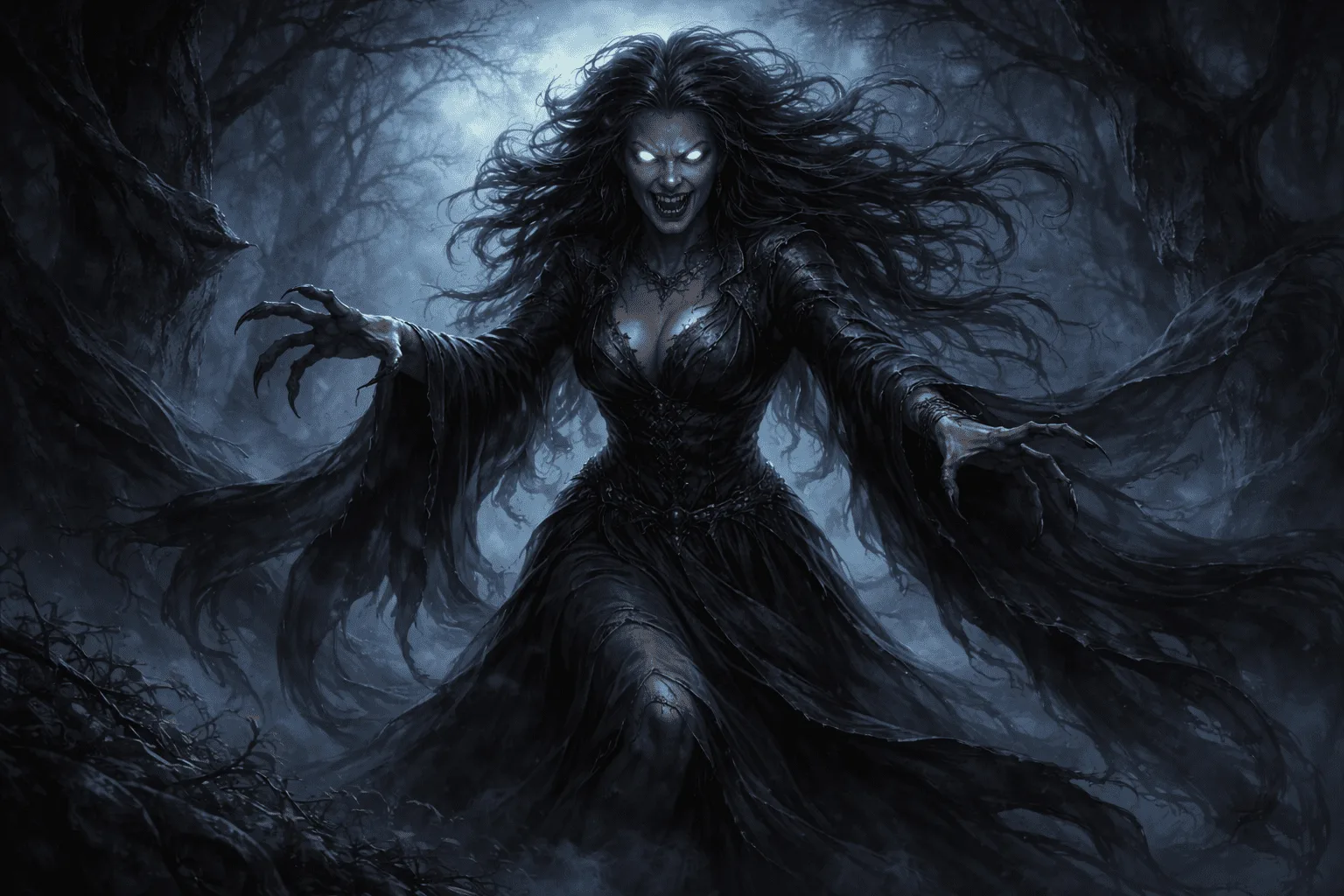
Mormo is a terrifying female demonic form of Greek mythology and ancient folk tradition. They were mainly used as a scare for children, while in some traditions it is associated with Lamia, the Empousa and Hecate.
- Mormo (or Mormolyke, Mormolukeia) is one of the most dark and enigmatic forms of Greek mythology, joining the total of chthonic demonic beings. Her presence is primarily rooted in popular religiosity, demonology, and the mythological tradition associated with the fear, child-rearing, nightmares, and punishment.
Mormo was not worshiped as a deity with formal ceremonies, but acted as a deterrent and educational approach, symbol of threat and fear, especially in the children's world.
Greek mythology is not inhabited solely by the great gods, heroes, and monsters of the epics. In the shadowy fringes of ancient imagination, we find smaller, more folk-like figures—spirits that do not always have a complete myth, but live on in language, proverbs, childhood fears, and everyday habits. One of these is Mormo, a dark female spirit of fear, closely tied to ancient Greek folklore and to the way adults spoke to children about danger, obedience, and the unknown.
Mormo is not one of the central figures of the Olympian world. She does not have a genealogy like the Titans, no heroic circle such as Medusa or Lamia. However, its presence in ancient sources is significant because it reveals how the ancient Greeks understood childhood fears in antiquity. It was a name heard in homes, in comic texts, in philosophical dialogues, and in lexicographical works as a symbol of terror, threat, and imaginary punishment.
What was Mormo?
Mormo was a terrifying female figure from ancient folklore, a kind of demonic creature or ghost used primarily to scare children. She belongs more to the realm of folk belief than to strictly organized mythology. For this reason, when studying her, we must distinguish mythology from folk tradition. Mormo does not appear as a deity with a cult, temples, or formal religious rituals. Instead, she is presented as a bogeyman, a name that strikes terror, one of the mythical spirits that inhabited everyday imagination.
In the wider world of the demons of Greek mythology, Mormo is near forms such as Lamia, - Empousa and Gello. All these forms are related to darkness, death, children or the night threat. The Mormo But she stands out because she seems to have been acting primarily as a personification of fear rather than as a protagonist of a certain mythical narrative.
The origin and meaning of the name
The etymology of the name Mormo is not entirely certain. Ancient lexicographers and commentators associated it with terror and a fearsome visage. The word seems onomatopoeic, as if it were rendering a dark, muttering, or threatening sound. In such words, language does not merely describe a creature, but attempts to convey the very emotion it evokes: a tremor, a whisper, a dark warning.
The word “mormolykeio” also comes from the same root; it refers to a scarecrow, a terrifying mask, or a contraption designed to instill fear. A “mormolykeio” is not necessarily a living creature; it can also be a mask, a scarecrow, or an image of terror. Thus, the name “Mormous” became associated with anything that caused fear without necessarily having a real existence.
Mormo in ancient Greek tradition
In ancient Greek tradition, Mormo appears primarily as a bogeyman for children. Mothers, nannies, and the women of the household could invoke her name to make a child be quiet, stay put, or obey. This usage does not mean that everyone literally believed in her existence. It does mean, however, that her name was well-known enough to serve as an immediate warning signal.
Mormo is a prime example of how ancient Greek folklore coexisted with high mythology. Alongside the tales of Zeus, Athena, and Apollo were the little stories of home, the nighttime fears, the names whispered to calm a child’s anxiety. These figures are no less important to the scholar, for they reveal the psychology of everyday life.
How its form was described
The sources do not provide us with a consistent and detailed description of Mormous. We do not know for certain whether anyone imagined her to have a specific body, face, or features. She is usually depicted as a fearsome female figure—ugly, menacing, and sinister. In some traditions, she is confused with or associated with other terrifying creatures, suggesting that her image was fluid.
This ambiguity is an essential part of her power. A fully defined monster has limits. Mormo, on the other hand, could take on whatever form a child’s imagination gave her. She was the face lurking in the darkness, the threat outside the door, the unknown that might appear when a child disobeyed.
Her relationship with children and fear
Mormo's relationship with children is the most enduring aspect of her tradition. Children's fears in ancient times were not dealt with as they are today. Darkness, animals, strangers, the streets, illnesses, and sudden deaths were real threats. In such a world, frightening names served as a means of protection, even if only through the threat they posed.
Mormo could be used to prevent a child from going out alone, approaching dangerous animals, or disobeying orders. It wasn’t just a monster; it was a tool of authority. With a single name, adults condensed an entire warning: be careful, obey, don’t test the limits of the unknown.
Mormo as a means of discipline
The use of the mormos as a means of discipline reflects a pedagogical practice based on fear. In the ancient world, discipline was considered essential for survival and social order. Children had to learn to listen to their elders, avoid recklessness, and respect the boundaries of the home and the community.
Mormo, like other similar figures, was a concise pedagogical symbol. The phrase “Mormo is coming” could replace lengthy explanations. From today’s perspective, this method seems harsh. From a historical perspective, however, it shows how societies used the imagination to enforce rules and protect children from real or imagined dangers.
The connection to Mormolyceium
The word “mormolykeio” is related to “Mormo” and means a scarecrow, a mask, or a terrifying contraption. In ancient literature, “mormolykeio” can refer to something that instills fear without having any real power. For this reason, it is often used figuratively to describe false threats or terrifying images that lose their power when examined rationally.
The connection between Mormos and the mormolychion is significant because it illustrates the transition from a demonic entity to a symbol of fear. Mormo is the person; the mormolykeion is the medium or the image. Both belong to the same world: the world where fear acquires a name, a form, and a social function.
Mormo in comedy and ancient literature
Ancient comedy often drew on well-known popular beliefs. Aristophanes and the comic poets used such names to elicit laughter, irony, or a sense of recognition from the audience. When a comic character refers to ghosts or terrifying figures, the audience understands that these are familiar, almost childlike fears.
In literature, Mormo does not appear as a central myth, but as a cultural point of reference. Plato, in the *Phaedo*, uses the word *mormolykeia* to refer to the fears that must be overcome through philosophical thought. The image is revealing: even adults can be afraid like children in the face of death if they have not been spiritually educated.
Ancient sources and testimonies
Accounts of Mormo and the mormolykia come from various types of texts. Theocritus, in his *Idylls*, depicts a mother or wet nurse using the Mormo to frighten a child, showing just how commonplace this practice was. Aristophanes and his commentators preserve the use of this vocabulary within the comic and popular milieu of Athens.
Strabo, in his *Geography*, refers to terrifying figures such as the Lamia and the *mormolykeia* as examples of tales used to instill fear and impart lessons. The Suidas, the great Byzantine dictionary, records entries related to Mormo and the mormolykion, explaining them as a bogeyman or terrifying figure. Similar information can be found in the works of lexicographers such as Hesychius and in commentaries on ancient texts.
Similar creatures and demonic forms
Mormo belongs to a broader family of dark female figures in Greek folklore. These figures are often associated with the night, motherhood turned into a threat, infant mortality, and the fear of the stranger. In Greek mythology and ancient Greek folklore, such figures serve as explanations for what the community finds difficult to control.
The terrifying creatures of this kind are not always “evil” in the same way. Some have a specific mythological background, others are simply folk bogeymen, and still others are associated with magic or deities such as Hecate. This comparison helps us understand what makes Mormo unique.
| Figure | Role |
|---|---|
| Mormo | a bogeyman for children |
| Lamia | child-eater |
| Empousa | demon |
| Gello | harms infants |
| Hecate | goddess of magic |
Comparison with Lamia
- Lamia She is a much more fully developed mythological figure than Mormo. According to later traditions, she was a beautiful queen of Libya and the beloved of Zeus. - Hera, out of jealousy, either took her children away from her or cursed her, and the Lamia was transformed into a monster that threatened other people’s children. Thus, the Lamia became closely associated with infanticide and with jealous, unhappy motherhood.
Mormo, on the other hand, does not have such a clear biography. She is more a name that strikes fear than a mythical figure. Lamia has a narrative, passion, and transformation; Mormo has a function. Both, however, were used to frighten children and express a society’s anxiety about the vulnerability of childhood.
Comparison with Embousa
Ebusa is often associated with Hecate and the world of ghosts. She is described as a shape-shifting and deceptive figure, capable of changing her appearance, appearing at night, and frightening or misleading people. In some traditions, it has strange physical characteristics, such as a bronze or animal-like foot, which makes it more monstrous and more theatrical.
Compared to Embusa, Mormo is less complex and less closely tied to magical narratives. Embusa operates in the realm of nocturnal terror and demonic deception. Mormo remains primarily at home, in the mouth of the mother or wet nurse, as an immediate threat to the disobedient child.
Comparison with Gello
Gello or Gyllo is yet another terrifying figure associated with children, particularly infants. In ancient and Byzantine traditions, she appears as a demonic woman who threatens newborns and new mothers. Her figure was linked to fears surrounding childbirth, the fragility of infants, and sudden deaths that earlier societies could not explain medically.
Gello is more closely associated with the demonology of the infant threat, while Mormo is a more general source of fear. The former explains misfortunes and deaths; the latter disciplines and frightens. Nevertheless, both demonstrate how deeply the ancients linked fear to the protection of children.
The Symbolism of Mormo
Mormo symbolizes fear that has no distinct form. It is the voice that warns that danger lies beyond familiar boundaries. As a symbol, she does not require a fully developed mythological identity. Her power lies precisely in the fact that she can be anything that frightens: a shadow, a noise, a mask, a ghost, or a menacing tale.
On a deeper level, Mormo reflects the way people give form to the unknown. When fear is given a name, it becomes easier to convey, but also easier to control. The child is afraid of Mormo, but the adult who invokes her controls the narrative.
What it represented for ancient Greeks
For the ancient Greeks, Mormo primarily represented childhood fear and the power of the imagination. She was not an object of worship, but part of a shared language of fear. If someone spoke of Mormo or a “mormolykion,” listeners immediately understood that it referred to something terrifying—perhaps exaggerated, perhaps childish, but certainly effective.
Her form also suggests that the ancients did not make a strict distinction between the world of myth and everyday life. Mythical spirits could dwell not only in forests, caves, and sanctuaries, but also in a cradle, on a doorstep, or in a dark room. Mormo was a small but vibrant part of that world.
Fear as a social control tool
In Mormus’s case, fear serves as a tool of social control. Through fear, adults convey rules of behavior. The child learns not to wander off, shout, disobey orders, or touch dangerous objects. The threat of “Mormous” replaces explanation because it acts quickly and emotionally.
This practice is not limited to the Greeks; almost all peoples have similar forms. However, the Greek case is particularly interesting because it is preserved in literary, philosophical, and lexicographical texts. Thus, we can see how a popular fear finds its way into high literature and becomes the subject of irony, philosophical reflection, and interpretation.
Mormo in later folk tradition
In later folk tradition, Mormo was not always known by the same name, but her role survived in many forms. Communities continued to use fearsome female or undefined figures to keep children in line. The exact name varied from place to place, but the mechanism remained the same: an invisible creature lurks and punishes disobedience.
This continuity does not mean that there has been an unbroken tradition of worship or a consistent myth surrounding Mormos from antiquity to the present day. Rather, it means that the archetype of the childhood bogeyman is enduring. Mormos is an ancient example of a broader folkloric phenomenon.
Influences on Byzantine and modern Greek tradition
During the Byzantine era, the ancient language of the demons of Greek mythology intersected with Christian demonology. Dictionaries such as Suidas, commentaries, and patristic or exegetical texts preserved names such as Lamia, Gello, and Mormo, often as examples of ancient superstitions. The ancient form was not worshipped, but was commemorated as a word and as a cultural memory.
In modern Greek tradition, this same need has been expressed through other names and forms. The childhood bogeyman, the nighttime menace, and the personification of danger have continued to exist. Mormo, even though her name has become less well-known, remains the progenitor of these figures in terms of her folkloric function.
Its place in modern study of mythology
Today, Mormo is of interest to scholars not because it has a rich mythology, but because it sheds light on the boundaries between mythology, folklore, language, and pedagogy. It is a short form with great interpretive value. Through it, we come to understand how the ancient Greeks used narratives to manage fear, children’s behavior, and social order.
Mormo reminds us that Greek mythology isn’t just the great epics of the poets. It also includes the words that frightened children, the figures who needed no statues to remain alive, and the shadows that were passed down by word of mouth. In this sense, it serves as a valuable record of ancient Greek folklore.
FAQ
What was Mormo in Greek mythology?
Mormo was a terrifying female spirit or folk bogeyman associated primarily with children. She does not belong to the pantheon of major gods or central myths, but rather to the realm of mythical spirits and childhood fears. Her name was used to instill fear, particularly by mothers and nannies.
Was Mormo a deity or a demon?
Mormo was not a deity with official worship. More correctly it can be described as a demonic or spectral form of popular tradition. It belongs to the demons of Greek mythology in the broad sense, namely supernatural forms that are not gods but affect people's imagination and behavior.
What's the difference between Mormo and Lamia?
Lamia has a more specific mythological background and is associated with child abduction or threat, often through a history of punishment and transformation. Mormo is more of an indefinite fear, no stable biography. Lamia is a monster with myth· Mormo is a name of fear with folklore function.
What is the Mormolykeio?
A “mormolykeio” is a bogeyman, a terrifying mask, or an image that instills fear. The word is also used figuratively to describe threats that seem terrifying but may be empty or exaggerated. It is directly associated with Mormo and with the idea that fear can take on a visible form.
Why did ancient Greeks use Mormo to scare children?
They used it because fear was an immediate and effective means of discipline. In a world full of real dangers, adults wanted to keep children close, quiet, and obedient. Mormo served as a quick warning, an imaginary threat that served practical purposes.
Conclusion
Mormo is one of the most distinctive dark figures in ancient Greek folklore. She did not need to become a goddess, nor did she need to be the subject of a grand myth, to leave her mark on tradition. Her power lay in her name, in the whisper, in the threat directed at the child that stirred up fear of the unknown.
By studying Mormo, we gain a better understanding of the everyday aspects of Greek mythology. We see how terrifying creatures were not merely subjects of poetic narratives, but also tools of social education. Mormo represents fear personified, tradition passed down through the home and language, and the deep human need to give form to that which cannot easily be explained.
Name and Etymology
Name Mormo is probably derived from the root morm- stating Scary or threatening sound.
Related terms:
Mormolyke
Mormolukeia
Mormolukeion (fearing)
The use of the name in the language is directly linked to the concept of scary, a form that causes horror without requiring a clear physical standing.
In some traditions it is presented as following or view of Hecate, strengthening its ethic and night character.
Relationship to Other Forms
Mormo is closely related to:
Lamia – child-eating demonic form
Empousa – transformative ghost
Hecate – goddess of night and crosses
Gorgons – scary female figures
In some sources Mormo is considered one of the forms or names of Hecate, which enhances its ceremonial and deterrent character.
Ancient Sources
- Theogenia, p. 346–370 and 965–1020.
- Odyssey, various references to Nymphs and Nymphea.
- Hymns, especially the hymns to Mercury and Venus.
- Metamorphosis.
- Tour of Greece.
Modern Bibliography
- The Greek Myths.
- Early Greek Myth.
- The Complete World of Greek Mythology.
- Greek Religion.
- Dictionary of Classical Mythology.