
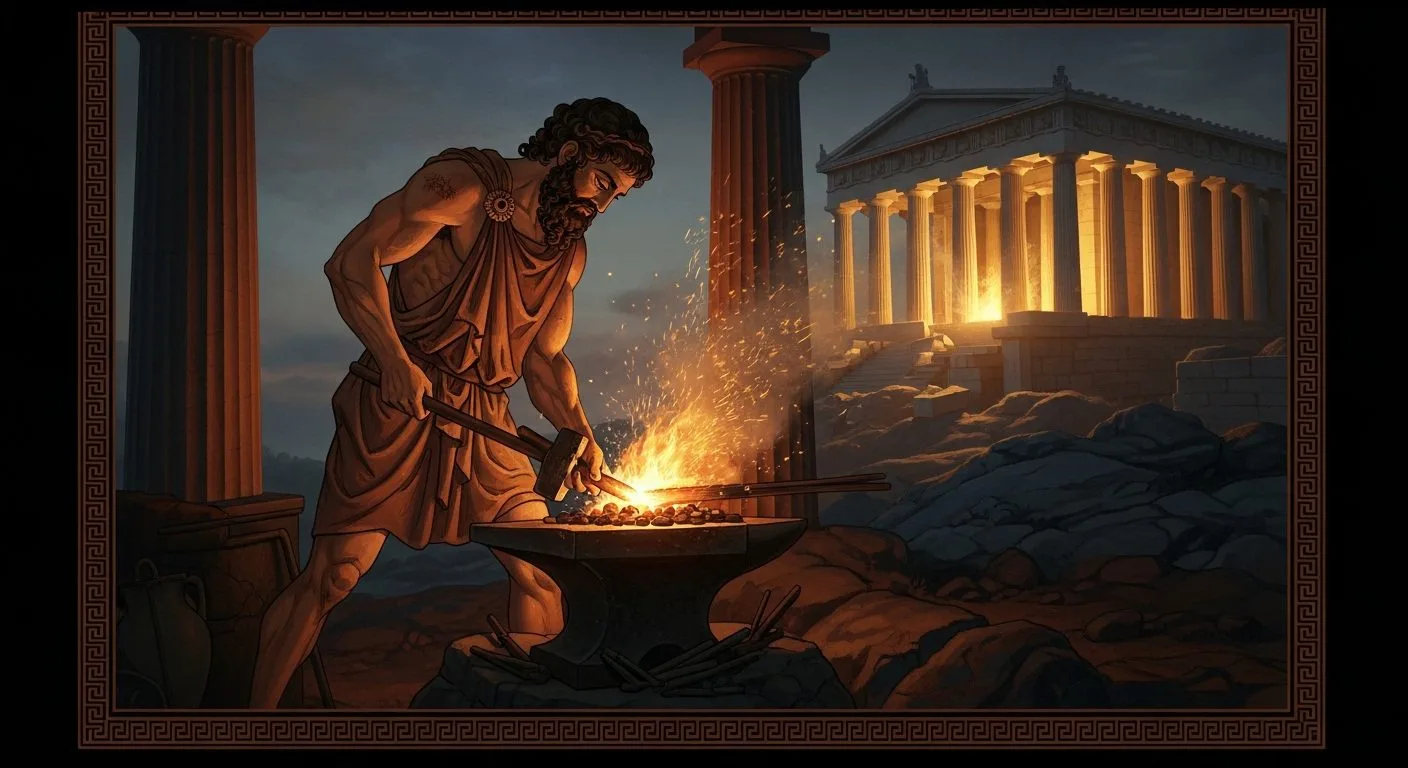
Hephaestus is one of the most special and complex deities of the Greek pantheon. God of fire, metallurgy, volcanoes, technology and craftsmanship, represents the creative power of work and technical skill. Unlike other Olympian gods who stood out for their beauty or war power, Hephaestus distinguished himself for his intelligence, resourcefulness, and ability to create wonderful objects.
Its form is deeply connected to the concept of creation through the fire and forging of metal. In his workshops were constructed the most powerful weapons of the gods, the most impressive jewels and the most wonderful mechanical creations of mythology. His story is also full of symbolism for overcoming weakness, as despite his physical disability he became the most important artisan of Olympus.
Origin and Birth of the Hephaestus
Ancient sources present two basic traditions for the birth of Hephaestus.
According to the best known version, he was the son of Zeus and Hera. However, there is another version that states that the Hera She gave birth to him alone, without Zeus' participation. This tradition is associated with the goddess's desire to compete with Zeus, who had given birth to Athena alone from his head.
When Hephaestus was born, his appearance caused aversion. Legends say he was lame or deformed, which led his mother to reject him. Hera, disgraced by her child's ugliness, threw him out of Olympus.
The Fall From Olympus
The fall of Hephaestus by Olympus is one of the most dramatic episodes of mythology.
In a version of the myth, Hera threw him out of heaven immediately after his birth. God fell for many hours before he ended up in the sea, where he was found and cared for by two sea deities: Thetis and Eurynome. There he grew up in an underwater cave for nine years.
In another version, Hephaestus had already grown up on Olympus when he tried to defend his mother in a fight with Zeus. THE Zeus He was furious and threw out of heaven. Hephaestus fell to the island of Lemnos and was seriously injured in the leg, which explains his lameness.
Breeding and First Creation
During his upbringing at sea, Hephaestus began to develop his unique skills in metallurgy and creation of objects.
In the cave where he lived he built his first laboratory. There he learned to melt metal, forge gold and silver and create jewelry. His first creations were so impressive that they caused the admiration of even the deities that raised him.
One of his most famous early creations was a gold throne he sent as a gift to his mother, Hera. However, the throne was a trap. When Hera sat upon him, she was trapped by invisible shackles and none of the gods could free her.
The Return to Olympus
The gods tried to convince Hephaestus to return to Olympus and free his mother, but he refused.
Eventually, Dionysus managed to convince him. According to legend, he got him drunk with wine and led him back to Olympus on a donkey. This scene was a favorite subject in ancient Greek art.
When he returned, Hephaestus released Hera and reconciled with the gods. Since then he settled in Olympus and became the official artisan of the gods.
The Hephaestus Laboratory
The lab of Hephaestus was considered one of the most impressive parts of mythology.
According to myths, it was either in Olympus or under volcanoes, such as those of Lemnos, Sicily or Aitna. There he worked with the help of the Cyclops or mechanical assistants he had created.
His chimney fire symbolized the creative power of nature. With hammers, anvils, and furnaces he made objects of unparalleled beauty and power.
The Marvelous Creations of the Hephaestus
Hephaestus was the creator of many of the most important objects of Greek mythology.
Among his most famous works are:
- His shield Achilles
One of his most elaborate creations. The shield depicted the whole world with scenes of life, war, and peace. - Achilles' weapons
They were built at the request of Thetis after Patrocle's death. - Zeus sceptre and lightning
The symbols of the absolute authority of the king of gods. - His armor Hercules
A powerful set of weapons that helped the hero in his battles. - Prometheus’ chains
With these Zeus ordered that the Prometheus In the Caucasus. - The first woman, the Pandora
Hephaestus created it from clay, giving it human form.
Mechanical Wonders
Hephaestus is also considered the first creator of mechanical beings in Greek mythology.
Build:
Golden maids who moved and spoke like living creatures
Self-propelled tripods moving themselves to Olympus
Talos, a giant copper guard of Crete
These creations are considered by many to be the first mythological forms of automatics or robots.
Marriage to Aphrodite
Despite his ugliness, Hephaestus married her AphroditeThe goddess of beauty.
This marriage, according to some myths, was arranged by Zeus to prevent conflicts between the gods who desired Aphrodite.
However, Venus was not faithful. The most famous story is about her relationship with Ares. When Hephaestus discovered it, he set a trap: he built an invisible steel net and trapped the couple in their bed. Then he called on all the gods to see the scandal.
This myth is often interpreted as a conflict between beauty and technique, passion and creation.
Worship and Sacred Places
Hephaestus was especially worshipped in areas with intense metallurgical activity.
Important centers of worship were:
The Limnos
Athens
Sicily

In Athens there was the famous temple of Hephaestus, known today as Thesio, one of the best preserved ancient temples in Greece.
Technicians, bronzers, and metalworkers considered their Hephaestus protector.
Symbolism of the Hephaestus
Hephaestus symbolizes many deeper concepts:
- the power of creation
the importance of technical knowledge
the value of the work
the transformation of matter through fire
overcoming weakness through skill
Unlike other gods representing power or authority, Hephaestus embodies human ability to create.
Hephaestus in Modern Interpretation
In modern times, Hephaestus is often considered a symbol of technology, engineering and innovation. Its form is linked to the progress of industry and the development of technical sciences.
In addition, many scholars see in his myth an early recognition of the value of craftsmen and creators, who in ancient society held an important role.
Conclusion
Hephaestus is one of the most human forms of Greek mythology. Despite his rejection and weakness, he managed to become the most important creator of the gods. His story shows that real power lies not only in beauty or physical strength, but in perseverance, intelligence and creativity.
Through the fire of his chimneys and the hammer hitting on the anvil, Hephaestus transforms matter into works of art and power. That is why it remains to this day a symbol of creation, technique and human ingenuity.
Frequently Asked Questions About Hephaestus
Who was Hephaestus in Greek mythology?
Hephaestus was the god of fire, metallurgy, and technology. He was the patron of artisans, blacksmiths, and the manufacture of weapons and tools.
Who were Hephaestus' parents?
According to legend, Hephaestus was her son Hera, while in other traditions he is considered the son of Hera and Zeus.
Where was Hephaestus born?
mythology says that Hephaestus was born in Olympus, but Hera threw him into the sea because he thought he was ugly or weak.
Who was Hephaestus' wife?
His wife was the AphroditeThe goddess of beauty and love.
What were the symbols of Hephaestus?
Its symbols were anvil, hammer and fire, associated with metallurgy and creation.
What was the role of Hephaestus in mythology?
Hephaestus was considered the divine craftsman who made armor, weapons and objects for the gods of Olympus.
Where was Hephaestus worshiped?
His worship was particularly strong in Athens, where there were sacred dedicated to the god of fire and technology.
How is Hephaestus portrayed?
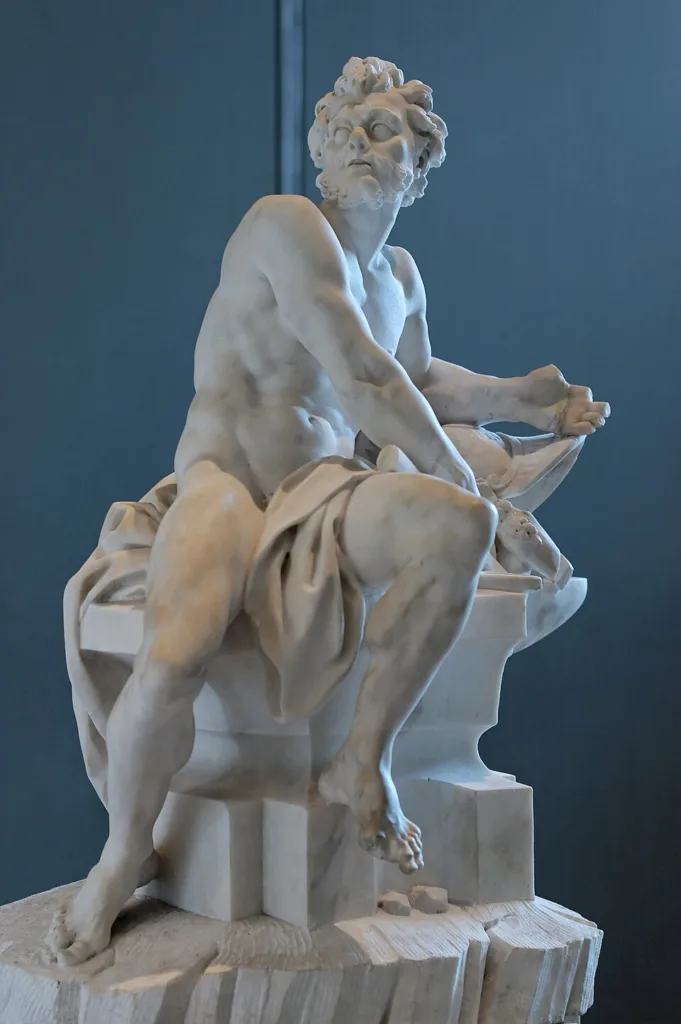
In art he is usually presented as a lame but powerful craftsman, with tools of blacksmith and simple clothing.
What was the meaning of Hephaestus?
Hephaestus symbolizes the power of human creation, technology and craftsmanship.
Why is Hephaestus considered important?
Because it is linked to the progress of metallurgy and the development of technical knowledge in ancient Greece.
Ancient sources
Hesiod – Theogenia & Works and Days | Primary Sources
Primary Sources of Greek Mythology | Hesiod, Homer, Orphic Hymns
Primary Sources of Greek Mythology | Ancient Texts
Perseus Digital Library is a reliable academic database with ancient Greek texts and historical sources, particularly useful for the study of Greek mythology and Elefsinian Mysteries.