
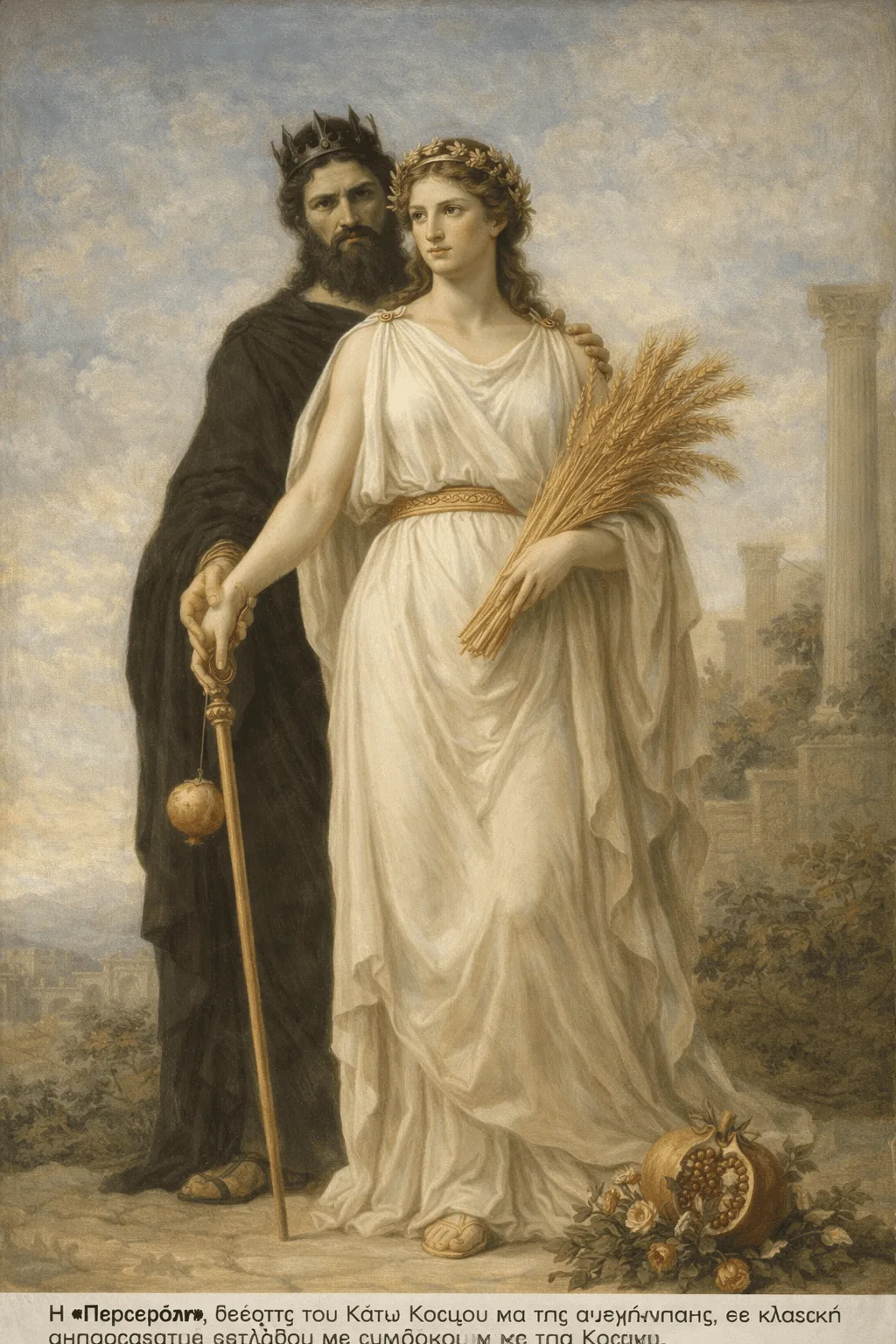
Persephone as a Symbol of Life, Death, and Renaissance
Persephone is one of the most complex and symbolic forms of Greek mythology. Its history transcends the boundaries of a simple myth about the snatching of a goddess and touches deeper issues that employed ancient Greeks: the relationship between life and death, the succession of times, the regeneration of nature and the mystery of human existence. As her daughter Demeter and Zeus, but also his wife Hades, Persephone acts as a bridge between two worlds – the world of the living and the world of the dead.
Its dual nature is reflected even in its names. As Daughter represents his youth, innocence and spring, while as his queen Underworld symbolizes the knowledge, transformation and acceptance of the inevitable cycle of life. Ancient Greeks saw in Persephone the personification of nature itself, which every year «He dies.» and reborn. When the goddess returns to her mother, the earth blooms and the crops thrive. When he returns to Hades, nature enters a period of inactivity and fertility hiding beneath the surface of the earth.
The importance of Persephone was particularly high in Eleusinia Mysteries, one of the most important religious ceremonies in the ancient Greek world. Mysteries believed that the cycle of descent and return of the goddess revealed deep truths about the soul and existence after death. Her annual reappearance on earth not only symbolized the rebirth of nature but also the hope that death is not the end, but a stage of transition to a new life form.
At the same time, Persephone is not just presented as a passive victim of Hades’ abduction. In many later myths she appears as a strong and respected queen of the Underworld, with authority over the souls of the dead. It is the one who accepts Orpheus when he attempts to recover Eurydice and the one that allows Hercules to lead Cerberus to the world above. Her presence in these myths reveals that Persephone evolved from innocent daughter to deity with autonomy, power and wisdom.
The timeless charm of Persephone is due to this transformation. She is the goddess who embodies change, maturation and transition from light to darkness and again to light. Through its myth, the ancient Greeks expressed their belief that every end hides a new beginning and that life and death are interrelated parts of a perpetual cycle.
- Persephone is one of the most important figures in Greek mythology, known as the Queen of the Underworld and the daughter of Demeter and Zeus. The myth of her abduction by Hades is one of the most symbolic and enduring stories of antiquity, linking the cycle of life, death, and rebirth to the changing seasons of nature.
In ancient Greek tradition, Persephone represents the transition from innocence to adulthood, as well as the eternal balance between light and darkness. As both the goddess of spring and vegetation and the ruler of the Underworld, she embodies a dual role that makes her unique among the gods of Olympus.
Deity of the Underworld and Eternal Renaissance
- Persephone is a central form of ancient Greek mythology, known as deity of the Underworld and simultaneously as deity of regeneration and vegetationAs her daughter Demeter and Zeus, Persephone connects the cycle of life and death, representing the rotation of seasons and the cosmic balance between light and darkness.
The mythological tradition of Persephone affects religious practice, the tragedy, philosophy, but also later interpretations of psychology and mystical rituals.
Etymology and Conceptual Framework
The word Persephone ( Persephone / Persephone) probably comes from the composition perso («Destroy») and phone («I kill»), indicating destruction or power over death, although other theories link the name to concepts such as protection or regeneration.
In ancient Greek thought, Persephone is not merely the daughter of the goddess Demeter or wife of Hades, but person of secular and religious symbolism, which embodies the cycle of life and times.
Genealogy and Mythological Origins
ParentsDimitra (the goddess of agriculture) and Zeus.
Consort: Hades, god of the Underworld.
Role: Queen of Underworld and goddess of rebirth.
Persephone also appears on Secret ceremonies of Elefsinian Mysteries, where the rotation of its presence in Hades and on earth symbolizes rebirth and spiritual cleansing.
The Myth of Kidnapping
The most famous myth of Persephone describes Her abduction by Hades, which they transferred to the Underworld without its consent. Demeter, in a sign of grief and anger, causes drought and famine on earth, forcing Zeus to negotiate the return of her daughter.
Finally, Persephone returns to earth for a few months each year, while the rest of the months remain in the Underworld. This rotation symbolizes:
Spring/summer: regeneration and vegetation.
Autumn/winterDeath and silence.
Persephone in Eleusinian Mysteries
Persephone is a central face of Elefsinian Mysteries, the most important religious ceremonies in ancient Greece. The initiates knew her secrets life, death and regeneration, which were incorporated into ritual practice, and Persephone represented mental clearance and eternal hope for rebirth.
Symbolism
Death and Renaissance: the rotation of presence in Hades and on earth.
Seasons and Nature: cycle of seasons, vegetation, fruitage.
Moral and Fair PunishmentAs the daughter of Demeter, it maintains order and secular balance.
Mysticism and Mysticism: symbolizes spiritual knowledge and psychological clearance.
Worship
Persephone is highly valued:
The Eleusinia Mysteries (Eleucina, Attica).
In local cults in areas of Macedonia, Thessaly and Peloponnese.
As Protector of souls, mainly in burial ceremonies.
Her worship is linked to agricultural circles, mystical rituals and religious events.
Image
In art, Persephone is depicted:
Holding rose or ear (symbol of vegetation).
With Hades or Hades mother Dimitra.
As Top form of mysterious deity, in vases, statues and murals.
Conclusions
Persephone is one multidimensional deity, incarnates life and death cycle, regeneration, initiation and natural order. Its position in the pantheon of Greek mythology connects secular order with human experience, making it the central face of Greek religious and philosophical thought.
See also
If you were fascinated by her form Persephone, you can explore the following relative deities and myths:
- Demeter – The mother of Persephone and goddess of fertility and agriculture
- Hades – The King of the Underworld and her husband
- Eleusinia Mysteries – Sacred ceremonies dedicated to Demeter and Persephone
- Live – Father of Persephone and supreme god of Olympus
- Hermes – The god who accompanied her behind Hades into the world of the living
- Oceanids – Nymphs associated with the cycle of nature and life
- White Paper – Area of the Underworld where souls reside
Who's Persephone?
- Persephone is a goddess of Greek mythology, her daughter Demeter and LiveAnd Queen of the Underworld.
Why does Persephone live in the Underworld?
Kidnapped by Hades, who took her as his wife in the world of the dead.
What does the myth of Persephone symbolize?
It symbolizes the cycle of life, death and rebirth, as well as the rotation of times.
How is Persephone connected to the seasons?
When in the Underworld, Demeter It mourns and the earth becomes barren (fall-winter). When he returns, nature blooms (spring-summer).
What are pomegranates in her myth?
The pomegranate seeds he ate in the Underworld tie her to Hades and determine her return every year.
Who helped Persephone return?
- Hermes sent by Live to escort her back.
What is its significance in Eleusinian Mysteries?
The Eleusinia Mysteries, Persephone symbolizes hope for life after death and spiritual regeneration.
Discover more Greek deities in our collection.
Bibliography
Ancient Sources
- Homeric Hymn in Demeter
- Theogenia – Hesiod.
- Library – Apollodoros.
- Transformations – Ovid.
Modern Bibliography
- Burkert, Walter. Greek ReligionHarvard University Press, 1985.
- Kerenyi, Karl. Eleusis: Archetypal Image of Mother and DaughterPrinceton University Press, 1967.
- Nilsson, Martin P. A History of Greek ReligionOxford University Press, 1964.
- Grimal, Pierre. The Dictionary of Classical MythologyBlackwell Publishing, 1996.
- Larson, Jennifer. Ancient Greek Cults: A Guide. Routledge, 2007.
- Foley, Helene P. The Homeric Hymn to Demeter: Translation, Commentary and Interpretive EssaysPrinceton University Press, 1994.