
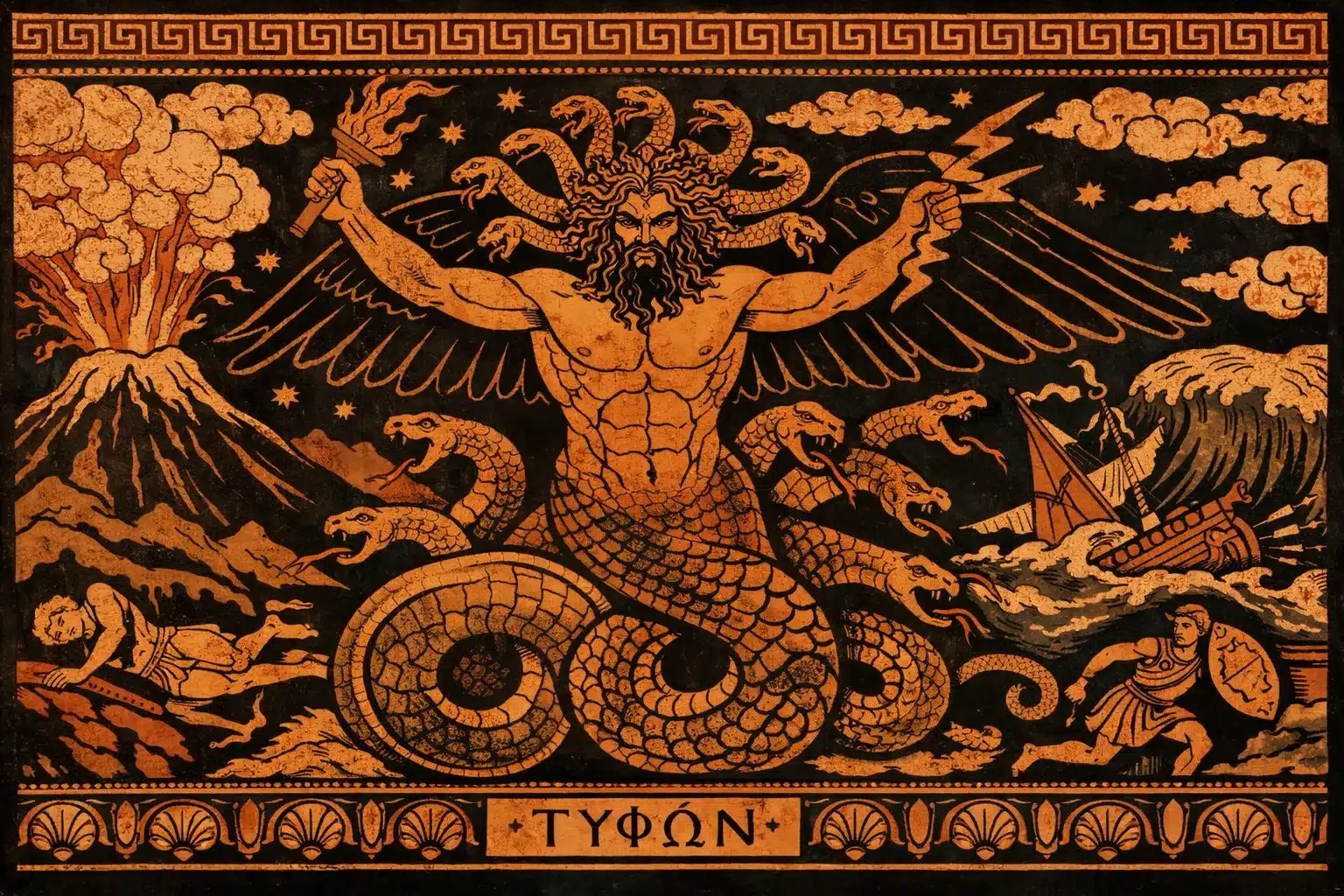
- Typhoon or Typhoeus He is the most extreme embodiment of chaos in Greek mythology. He was not merely a gigantic monster, but a cosmogonic force that threatened the very order of the universe and the authority of the Olympian gods. His form is associated with catastrophic natural phenomena and the primordial conflict between chaos and divine order.
«When the gods defeated the Giants, the Earth, whose wrath had become even greater, met with Tartarus and gave birth to Typhon in Cilicia. He was half human and half beast, and both in size and in power surpassed all other children on Earth. Until his thighs he had a human form, but was so huge that he rose higher than all the mountains and often touched the stars with his head. With hands spread out, he could reach the West on one side and the East on the other.· And at his hands, a hundred dragon heads emerged.
Under his thighs, he had huge viper threads, which, when fully stretched, reached his head and broadcast violent whistles. He had wings all over his body, and dirty hair sprung from his head and cheeks hovered around him in the wind, while fire was shining out of his eyes. Such was the appearance of Typhon and such his size when he launched an attack on heaven himself, hurling flaming rocks toward him, whistling and screaming at the same time, and launching powerful streams of fire from his mouth.
Seeing him rushing against heaven, the gods fled to Egypt, and when he pursued them, they transformed themselves into animals. While Hurricane was still at a distance, Zeus He bombed him with thunderbolts, but as the monster approached, Zeus struck him with an adamantian scythe, and then chased him when he left, until they reached Mount Cassion, rising above Syria. And there, seeing that Typhon was seriously wounded, he faced him in battle
— Apollodoros, The Library of Greek Mythology»
Origin & Genealogy
Typhon was born to Gaia and Tartarus, as the last attempt of Earth to avenge them Olympians for the defeat of Giants.
According to sources:
was the younger and stronger by her descendants Gaia
brother or ally of other enemy forces
father of many monsters, such as Chimera, - Lernaean Hydra and Cerberus (in certain deliveries)
Format & Show
Ancient descriptions depict Typhon as one monstrous hybrid:
a gigantic body that touched the sky
One hundred heads of fire-emitting snakes
Eyes shining like lightning
feathers or spiral-shaped protrusions that caused storms
His voice shifted in tone, from a thunderous roar to the howls of wild beasts, striking fear even into the hearts of the gods.
Powers & Skills
Fire, wind and storm control
Challenge of earthquakes and volcanic eruptions
Supernatural power of cosmic scale
Resistance to divine weapons
Creating chaos and destruction
Typhon is considered to be the primary cause of catastrophic natural phenomena.
Clash with Zeus
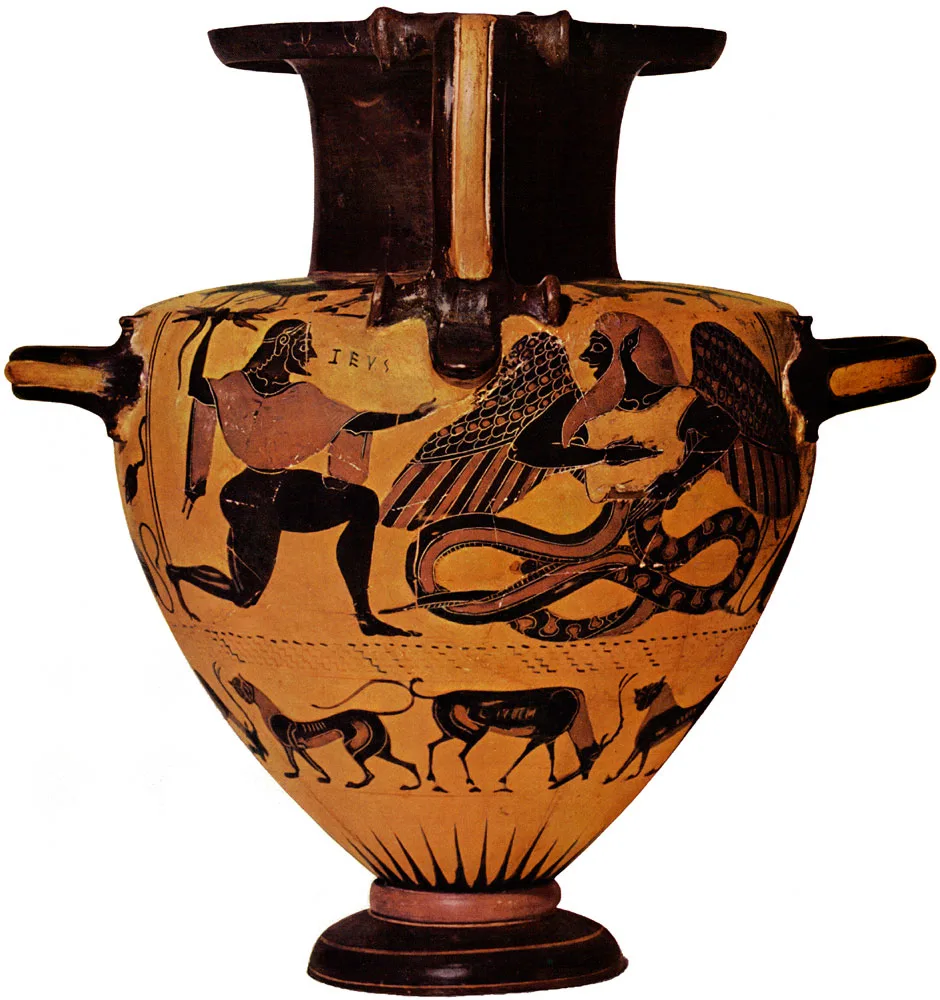
The battle between Typhoon and Zeus is one of the most decisive conflicts of Greek mythology.
Typhon initially managed to defeat Zeus and disarm him
With the help of other gods, Zeus was regrouped
Finally, Typhon was crushed and imprisoned under the Mount Etna
The eruptions of the volcano were interpreted as the breaths and convulsions of the imprisoned monster.
Hesiod, Theogonia 820-880:
But when Zeus drove the Titans out of heaven, the vast Earth gave birth to its youngest child, Typhon, from the love of Tartarus, with the help of golden Venus. From his shoulders he grew a hundred heads of snake, a terrible dragon, with dark, trembling tongues, and from under the eyebrows of his eyes on his marvelous heads glowing flames, and fire burned from his heads as he looked with resentment. And there were voices on all his terrible heads expressing all sorts of unspeakable sound· Because sometimes they made sounds that the gods understood, but sometimes, the noise of a bull roaring loudly with proud, uncontrolled fury· And then, the sound of a lion, relentless heart· And sometimes, sounds like puppies, fans to hear· Once again, he whistled so that the high mountains reverberated... But Zeus raised his power and grabbed his weapons, lightning and lightning and horrible lightning· He jumped off Olympus and hit him, and burned all the monster's wonderful heads... The Hurricane was hurled down, a mutilated ruin, so that the vast land moaning... And a flame was fired by the thunderous lord in the dark, harsh valleys of the mountain when he was struck.
Role in Mythology
Typhon marks:
The final consolidation of the Olympic order
the submission of chaos to divine legitimacy
the end of the cosmogenic conflict
It is the last major obstacle before Jupiter's absolute domination.
Symbol & Interpretation
Typhon symbolizes:
the uncontrollable force of nature
fear of earthquakes and volcanoes
the threat ahead of order and culture
In the philosophical interpretation, the opposing force of the Word.