
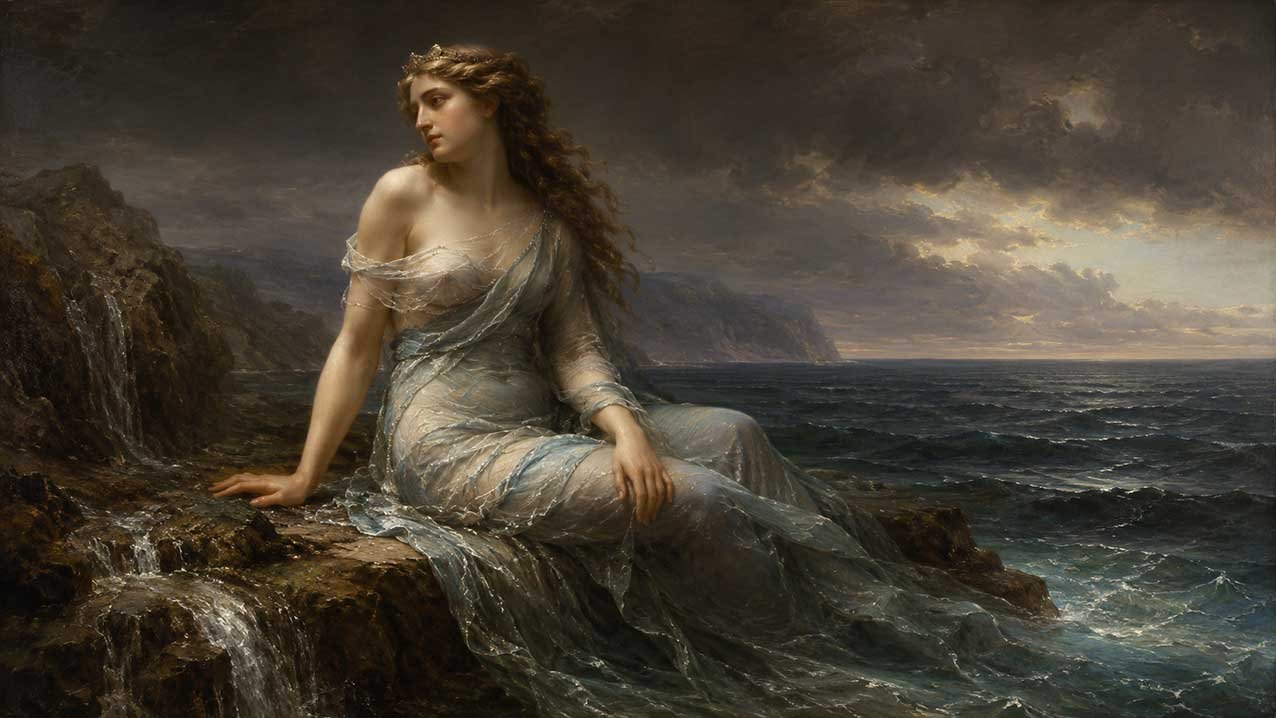
Styx – The Oceanid, Daughter of Oceanus and Tethys, and the Myth of the Sacred Oath
There are forms of Greek mythology that have not only history, but also weight. The Stix belongs to that category. It's not just another one. OceanNot just the name of a dark river that separates the world of the living from its kingdom Hades. It is a symbol of the unresolved oath, the sanctity of promise and power that even the gods had to respect.
Daughter of Oceanus and Tethys, Styx holds a unique place in the ancient Greek imagination. Her presence is associated with cosmogony, the divine order, and the power of Zeus, but also in the sense of a boundary: between life and death, the visible and the invisible, the human and the divine. That is why her myth remains so powerful to this day. Styx is not merely a mythological figure. She is an idea that has passed from antiquity into literature, language, and contemporary culture.
Who is Styx in Greek mythology?
Styx is one of the oldest and most revered figures in Greek mythology. She belongs to the Oceanids, the three thousand daughters of Oceanus and Tethys, divine figures who personify the waters surrounding the earth and the world’s generative aquatic power. Within this extensive family, Styx stands out not because she is the best known of them all, but because her role is decisive.
Unlike many other Oceanids, who are associated with springs, streams, or local natural landscapes, Styx is associated with the great mythological river of the Underworld. Her name came to denote both the deity herself and the river that marks the passage to Hades. This dual nature is characteristic of Greek mythology: deities and natural phenomena are often identified with one another, with the result that myth functions simultaneously as a narrative and as an interpretation of the world.
Her most well-known attribute is the sacredness of her waters. The gods swore oaths by the waters of Styx, and such an oath was considered the most powerful and irrevocable. If a god lied or broke his oath, he was punished severely. Styx, therefore, is not merely a mythical figure standing on the sidelines of the action; she is the guarantor of the divine order.
Styx as a deity and as a river
Mythology does not always strictly distinguish the deity from the place or element it represents. Thus, Styx is at once a person and a landscape, an allusion and a reality, an idea and a boundary. The River Styx is one of the most recognizable elements of the Underworld. It is associated with the path of souls, with Charon, and with the entrance to the world of the dead.
In Homeric and later tradition, the Styx is portrayed as a sacred boundary that no one can ignore. It is not merely a watery boundary, but a metaphysical one. On one side lies the realm of the gods and the living; on the other, the silence of death. The Styx is the point where the world ceases to be shared.
The origins of Styx: daughter of Oceanus and Tethys
Styx’s origins are important for understanding her place in the Greek mythological system. Oceanus and Tethys are one of the primordial couples of ancient cosmogony. Oceanus is not merely a sea, but a cosmic force that surrounds the world; Tethys is the corresponding feminine principle, mother of rivers and springs. From them is born a vast host of water deities, the Oceanids and the Rivers.
Styx, as their daughter, belongs to this ancient and revered family tree. In antiquity, the genealogies of the gods were viewed not merely as family records, but as a map of the cosmic order. The fact that Styx is the child of the primordial water forces reinforces her prestige. She is not a minor figure; she is a descendant of the very generative water principle of the world.
Her connection to water
In ancient Greek thought, water had a dual nature. It gave life, but it could also take life away. It purified, but it also brought things to an end. Styx embodies precisely this dual nature of water. It is not the water of spring or fertility, but the water of final transition and absolute commitment.
The aquatic nature of the Styx is linked to the idea of immutable truth. Just as water flows without ever returning in exactly the same form, so too can an oath sworn on the Styx not be revoked. The element of flow becomes a guarantee of irreversibility. It is this contradiction that makes the Styx so interesting mythologically and symbolically.
Styx and the Oath of the Gods
The most famous aspect of the Styx myth is undoubtedly the oath of the gods. In Greek mythology, when the gods wanted to commit in the most sacred way, they swore in the water of the Styx. This oath had absolute power, because even the immortals could not punish him unpunishedly.
This tradition does not only attribute prestige to the Styx. It also shows something deeper about Greek thinking: power does not always stem from power, but from order keeping. Even Zeus, the supreme god, was bound by the Styx. This means that there is something above will, even for the gods: the law of faith in speech.
The punishment of breaking the oath
According to mythological tradition, the god who broke his oath in Styx lost his powers for a long time and was isolated from the community of gods. This punishment was not accidental.· It functioned as a deterrent mechanism within the divine system. A violation of the oath was not a mere offense, but an insult to the secular order itself.
At symbolism level, the Styx highlights the principle that the word has weight. In the ancient world, where honor and fame were vital, the oath was a key social tool. The Styx, therefore, does not belong to mythology alone· It is also associated with the ethics of trust.
Styx as Zeus's guarantor
In some versions of the myth, Styx helps Zeus in his encounter with the Titans. Because she was one of the first deities to stand by him, Zeus honored her by recognizing that her children would have a prominent place in the new divine regime. Thus, Styx is indirectly linked to the victory of the new order over the old.
This act strengthens its importance as a form associated not only with the limit and death, but also with the legalization of power. The Styx is not just a river of Hades· is also power that validates the kingdom of Olympus.
The children of the Styx and their relationship with Zeus
In certain mythological traditions, Styx is the mother of important divine personifications: Nike, Kratos, Bia, and Zelos. These figures are associated with concepts of power, victory, coercion, and competition. Their selection is not random. It reflects Stygia’s role as a deity who embodies not sweetness or fertility, but the power of the established order.
This motherhood is pivotal, because the children of Styx are directly linked to Zeus. Zeus, as the supreme god, entrusts them with important missions and incorporates them into his cosmic governance. Nike becomes a symbol of triumph, Kratos of power, Bia of coercion, and Zeal of the intensity that accompanies competition.
Symbolization of the descendants of the Styx
The descendants of the Styx show how Greeks understood abstract concepts: not as theoretical ideas, but as active characters. Victory, power, and violence acquire form, become faces and join a wider secular drama.
Stix, as the mother of these forces, acts as a source of power. It produces not only deities, but mechanisms that support the divine regime itself. This is one of the reasons why its form has such a great endurance in time.
The Styx in the Underworld and the path of souls
The River of Styx is closely bound to the Greek Underworld. The soul of the dead, to pass to its final destination, had to cross the waters that operated as a border. Haron, the boatman of Hades, carries souls, and the Styx is the water frame of this transition.
The image is strong because it combines motion and stillness. The soul leaves the world of the living, but it does not return. Passing is not just moving· It's a final separation. The Styx, thus, becomes a kind of natural and metaphysical threshold.
The Styx as a border between life and death
In almost every culture we meet rivers that symbolize passage to the other world. In Greek tradition, Styx is one of the most intense examples. It's not just a geographical or poetic pattern. It is a symbolism that reflects the human experience of death as a passage to unknown territory.
This idea explains why the Styx stayed so alive in collective memory. He doesn't just describe a myth.· gives form to one of the most basic human questions: what happens when life ends?
The Stix at the ancient secretariat
The Styx appears in various ancient texts, from Homer to Hesiod and later poets. In the epic and theogenic tradition, her name always bears a feeling of rigour and sanctity. Homer refers to Styx as a place of oath and divine confirmation, while Hesiod highlights its origin and meaning within the genealogical system of the gods.
Her presence in the secretariat is not only mythological, but also hyphasological. The name "Stitch" sounds like a sense of cruelty and dark gravity, which fits perfectly with the function of myth. Ancient writers did not randomly choose their words· Their sound quality strengthened the meaning.
From epic poetry to philosophical reading
Later, the Styx was not limited only to the field of myth. It can also be read philosophically, as a symbol of irreparable, absolute and irrevocable. In the thought of ancient Greeks, such figures helped organize the relationship of man with the great concepts: commitment, death, power, sanctity.
Thus, Stix did not simply stay in the sphere of account. It was converted to a timeless point of reference on how people perceive the boundary between human and divine discourse.
The symbolic and cultural significance of the Styx
Styx possesses a rare cultural resilience. From antiquity to the present day, its name has been used to denote something dark, powerful, merciless, or absolute. In literature, art, and everyday language, “Styx” continues to function as a synonym for the forbidden crossing and strict commitment.
The modern reader recognizes in it much more than a mythical river. They recognize the symbol of an irreversible decision, of the defining moment that separates the before from the after. Styx remains relevant precisely because it speaks to experiences that are never fully overcome: loss, commitment, crisis.
The Styx in literature and modern culture
In modern literature, the Styx myth often appears as an insinuation to stories about death, memory, and transition. Even when not directly named, the idea of "stygian" dimension survives in descriptions of dark waters, extreme emotions or irrevocable decisions.
In modern culture, Styx has also been through fictional literature, comic books, cinema and video games. Her name is used for immediately carrying atmosphere, intensity, and mysterious depth. This shows that ancient myths are not merely historical remains, but living cultural tools.
Etymology, linguistic influence, and the power of a name
The name “Styx” holds linguistic interest beyond mythology. Its etymology is often linked to notions of coldness, revulsion, or horror, although its exact origin remains elusive and a subject of study. This in itself is revealing: the name retains an ancient, almost primal weight, as if it originated from a layer of language that predates clear categorization.
In Modern Greek and other languages, the word “stygnos” also has a semantic connection to the cold, the harsh, and the merciless. Although the linguistic connection requires caution, the cultural relevance is obvious: Styx was associated with that which does not bend, does not soften, does not yield.
The name as a cultural imprint
The survival of the name “Styx” in various contexts shows just how powerful mythological symbols are when linked to fundamental human experiences. A name does not survive simply because it is ancient. It survives because it still means something.
In the case of Styx, this “something” is the irrevocable commitment and the final crossing. That is why the name remains alive, even though most people encounter it today in figurative or artistic contexts.
A modern look at Styx: what does it teach us today?
Styx, viewed from a modern perspective, is a wonderful example of how myths function as intellectual tools. It shows us that the ancient Greeks did not make a strict distinction between nature, religion, and morality. A river could become a deity, a boundary could become a law, and an oath could acquire transcendent power.
Today, at a time when the concept of commitment is often put to the test, Stygia reminds us of something very simple yet essential: words have consequences. Speech, when used responsibly, builds trust. When broken, it disrupts order. This moral dimension is perhaps the most timeless core of the myth.
Why the Styx Remains Relevant
Styx remains relevant because it speaks to boundaries. And boundaries never cease to preoccupy humanity. Boundaries between desire and duty, life and death, power and responsibility, promise and betrayal. Styx is the mythological symbol of all these transitions.
Even from a scientific or anthropological perspective, her study demonstrates how societies organize the concepts of the sacred and the forbidden. The metaphor of the river as a boundary is no accident: water, as a fluid and unstable element, becomes the ideal medium for expressing the most permanent of all human realities—final separation.
Conclusion
Stix, the Oceanic daughter of Ocean and Tethyus, is one of the most important figures of Greek mythology. As a deity, river, boundary and guarantor of the divine oath, it combines within it the power of nature and the seriousness of sacred law. Her place in cosmogony, her relationship with Jupiter, her children and her connection to the Underworld make up an image deep and multi-level.
The Styx is not just an ancient myth. It is a way to talk about faith in reason, the limits of power and the inevitable passage from one state of existence to another. That is why she remains alive, strong and charming. From the Homeric epics to modern culture, the Styx continues to symbolize the absolute weight of the promise and the invisible frontier that no one goes through impunity.