
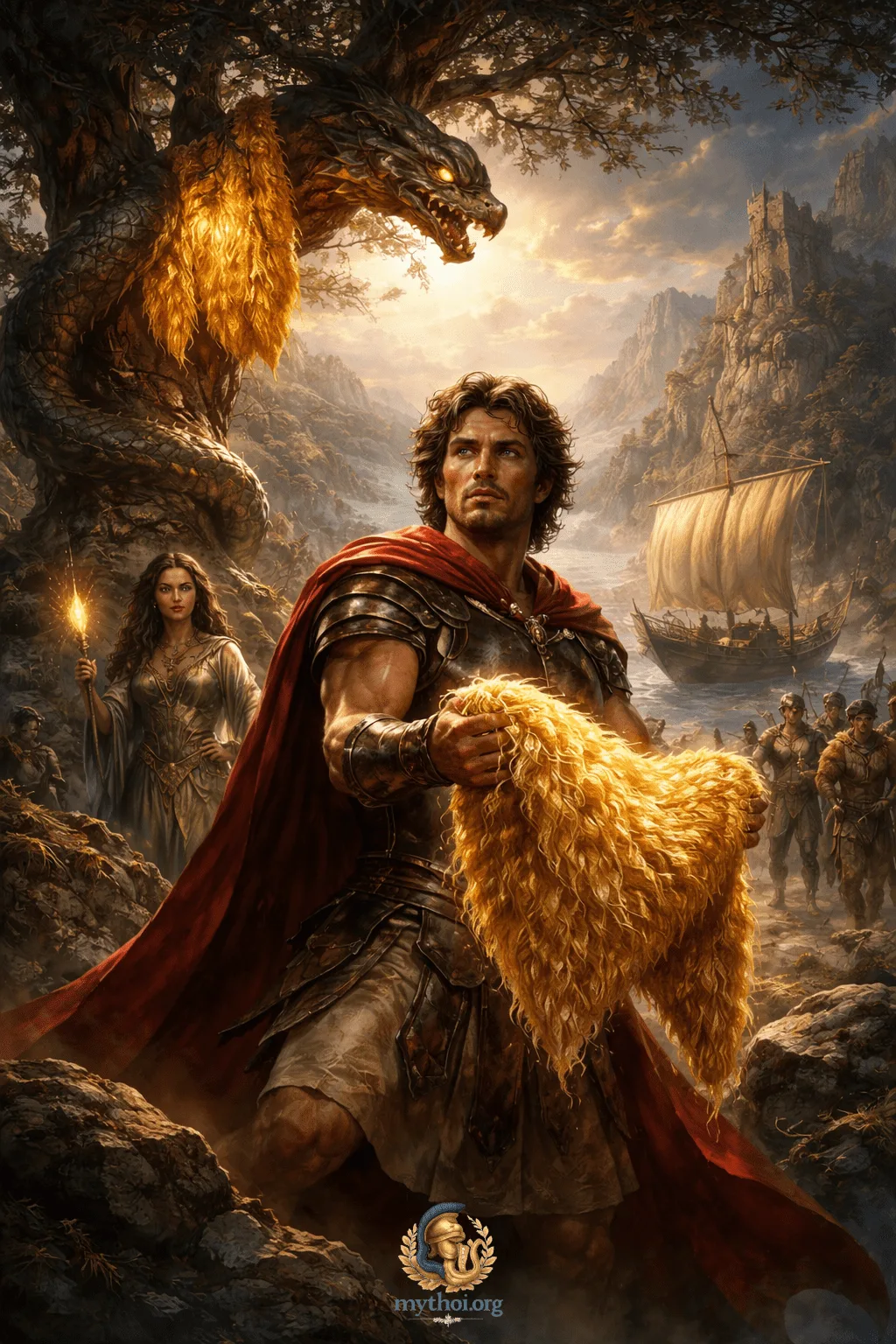
- Argonaut Campaign is one of its most important accounts Greek mythology and is among the fundamental myths that shaped the collective memory of the ancient Greeks. Long before Trojan War And at the time of the Homeric epics, his myth Jason and his companions described the first major national mission, in which the most prominent heroes of the time participated for a common purpose: the search for the famous Golden Fleece in the distant Colchis, on the east coast of the Black Sea.
Unlike many other Greek myths, where the protagonist acts alone, the Argonaut Campaign highlights the power of cooperation. Jason does not manage to complete the mission thanks solely to his own bravery, but because he gathers heroes around him with different gifts: the mighty Hercules, the musician Orpheus, Distillates, Peleas, Melegros, the winged Northerns and many more. The success of the mission results from the collective effort, divine favor and wisdom, elements that are constantly returning to the Greek mythological tradition.
At the same time, Argos' journey reflects the geographical knowledge and maritime experience of ancient Greeks. The stations of the route, from Lemnos to the Black Sea, are connected to areas that later gained a significant commercial and colonial role. For this reason several scholars consider that the myth retains memories of early sea explorations, although there is no evidence that the campaign took place as a historical event.
The influence of the Argonaut Campaign has been enormous. It influenced poetry, theatre, angiography, sculpture and later the literature of Rome and Renaissance. But most importantly he established one of the most timeless patterns of world mythology: the journey of the hero being tested, transformed and returned having acquired not only a valuable object, but also a deeper knowledge of himself and the world.
What is Argonaut Campaign?
One of the most important Greek myths
The Argonaut Campaign is the myth of the mission that Jason organized to acquire the Golden Fleece and retrieve the throne of Iolkou, which King Pelias had usurped. History combines elements of epic narrative, sea adventure, divine intervention and heroic achievements.
The earliest references already appear in Homer and Hesiod, but the fullest narrative is preserved in Argonauts of Apollonio of Rodius, a work of the 3rd century BC, which is the most important literary source for myth.
Its place in Greek mythology
The Argonaut Campaign belongs to the so-called heroic cycle of Greek mythology. The heroes of history constitute the previous generation of its protagonists Trojan War.
Typical examples are:
- Peleus, his father Achilles,
- Laertis, his father Odysseus,
- The Telamonas, his father Ajad,
- the Hadmit, king of the Ferons,
- The Pears, Beaver and Polyphek.
Thus, the myth acts as a link between the older generations of heroes and the world that the Homeric epics will later present.
Why is he considered a harbinger of the Trojan War?
Many ancient writers treated the Argonaut Campaign as the first major nationwide expedition.
For the first time:
- collect heroes from different Greek kingdoms,
- a joint naval operation is organised;
- a single leadership is created;
- the gods are actively interfering with the evolution of events,
- alliances between cities and kings are developing.
These elements will later be repeated in the campaign against Troy, which makes Jason's myth a precursor to the Homeric epics.
Jason
Its origin
Jason was the son of her legitimate king Iolku, Aesona, and according to most traditions of Polymede or Alkimede.
When Aeson's half-brother, Pelias, seized the throne, the newborn Jason was in danger of being murdered. To protect him, his parents secretly removed him from Iolko.
Childhood in Pelion
Jason grew up in Mount Pelion, away from the political conflicts and ambitions of the royal courts.
There he was raised near nature, learned the value of self - control and justice and acquired the characteristics that would later highlight him as a leader.
Pelion holds a special position in Greek mythology, as it was considered a place of training of many heroes.
Training from Chiron
Jason’s teacher was the wise one Centaur Chiron.
Unlike most Centaurs, presented as savages and violent, Chiron was a symbol of wisdom, education, and healing knowledge.
Jason was taught:
- combat art,
- use of weapons,
- medicine,
- music,
- respect for the gods,
- leadership and self-control.
The same teacher also trained Achilles, Asclepius, and several other mythical heroes.
The prophecy about Pelias
Pelias had received a ominous oracle according to which he had to look after a man who would appear wearing only one sandal.
This prophecy would determine the whole evolution of the myth.
The lost sandal
When Jason became an adult, he returned to Iolco to claim his father's throne.
On the way he met an elderly woman who had difficulty crossing a rushing river. Not knowing that she was the goddess Hera transformed, she helped her pass across.
During the crossing he lost one of his sandals.
When presented in front of Pelias, he wore only the other, fulfilling exactly the oracle.
The king immediately realized that the young man was the man meant to cause his fall.
Why did he take over the mission?
Pelias could not openly kill Jason without causing reactions.
So he resorted to a trick.
He promised that he would grant him the throne as long as he brought the Golden Fleece from Kolchis, a feat that was considered practically impossible.
Jason accepted the challenge.
His decision was not only dictated by ambition to become king. According to the heroic ideology of ancient Greeks, the acceptance of such a dangerous mission was proof of valor, honor and faith in the fate that the gods had appointed.
The Golden Fleece
The Legend of Frixos and Helle
His story Golden Fleece begins one generation before Jason.
King Athamas had two children, Frixos and Ellie. After his second marriage, their stepmother Ino planned their death.
To save them, Goddess Nefeli He sent a wonderful ram with golden hair and flying ability.
The two children went up the back of the animal and flew eastward.
During the route Ellie fell to sea, according to legend giving her name to Hellespont.
Frixos continued the journey to Colchis.
The golden ram
Upon reaching Colchis, Frixos sacrificed the ram to Zeus Or, in other traditions, to Zeus Phyxis.
His golden skin was dedicated to King Aetis and hanged in a sacred grove dedicated to Ares.
The Colchis
Kolchida is placed on the eastern coast of the Black Sea, in the area of today's western Georgia.
For ancient Greeks it was a distant and almost mythical place, rich in precious metals, timber and exotic goods.
Choosing this area as a destination strengthened the character of the campaign as a journey to the limits of the then known world.
King Aetis
Colchis was ruled by Aeitis, son of the sun god and brother of the Circe witch.
He is presented as a powerful but skeptical king, determined to protect the sacred relic of his kingdom.
The dragon guarding the Fleece
The Golden Fleece was guarded by an unspoiled dragon, who never slept.
His presence indicated that the sacred object could not be acquired only by physical force; divine help, intelligence, and magical knowledge were required.
The Symbolism of the Golden Fleece
The Golden Fleece is not just a precious treasure.
In modern research it has been interpreted as a symbol:
- legal royal power,
- of divine favor,
- knowledge,
- of abundance,
- successful completion of a test.
Some scholars have associated the myth with ancient gold collection techniques through sheep skins in rivers in the Caucasus region, but there is no definitive proof that this practice was the direct source of the myth.
The construction of Argos
The first great ship of Greek myths
The success of the Argonaut Campaign would not be possible without the construction of a ship capable of crossing seas that for the Greeks of the time were at the limits of the known world. The Argo It wasn't an ordinary ship.· It was a creation of human skill and divine guidance, which gave it almost a sacred character.
In Greek tradition it is considered the most famous ship of mythology, such as the Trojan horse is the most famous martial trick. Argo became a symbol of exploration, cooperation and boldness and her name was forever associated with every great sea voyage.
Argos, the ship's creator
According to Apollonios, Rhodes and Apollodorus, the famous craftsman took over the construction Argos, son of Frixus or, according to other traditions, of Arestor.
Argos was known for his excellent knowledge of shipbuilding. Jason chose him because he could create a ship light enough to move fast, but at the same time strong enough to withstand the unknown Black Sea seas.
The name itself Argo is usually attributed to either its creator or the Greek word «Argus», related to brilliance and quick movement.
The contribution of the goddess Athena
The construction of Argos was not limited to people's abilities.
- goddess Athena, protector of wisdom, technique and craftsmen, is considered to have personally guided Argos. Divine intervention was of particular importance, as Jason's mission served, according to several traditions, the design of the gods for the evolution of the hero generation.
Athena's participation symbolizes that human success depends not only on power, but also on knowledge, judgment and technical skill.
The Oracle Wood of Dodoni
The most special feature of Argos was its bow.
Athena placed there a piece of wood from oak of Dodoni, Jupiter's oldest oracle.
This sacred wood had the ability to speak or warn travelers of imminent dangers. The Argonauts is presented as a kind of divine guide protecting the crew at critical times.
This detail reveals how closely, in the mythological thought of ancient Greeks, navigation with divine guidance was associated.
Because Argo became legendary
Argo is considered the first ship to make such a long sea voyage to Greek mythology.
Her reputation is due to many reasons:
- transferred the greatest concentration of heroes that had existed until then,
- traveled beyond the usual boundaries of the Greek world,
- connected to a number of fan incidents,
- became a symbol of collective effort and exploration,
- gained almost sacred status thanks to the protection of Athena.
According to later traditions, after the campaign was completed Argo was dedicated to Poseidon or placed by the gods in heaven as a constellation. Although today's constellation Argo Navis It has now been divided into the constellations Karina (Carina), Rhyme (Puppis) and Histia (Vela), the connection of the ship to the sky bears witness to the timeless significance of the myth.
Who were the Argonauts?
The greatest meeting of heroes of Greek mythology
The Argonautic Campaign stands out because it gathered the most prominent heroes of the earlier generation.
Lists of Argonauts vary according to the ancient source. THE Apollonius Rodius lists about fifty heroes, while other writers increase or decrease their number.
Although there are variations, some persons appear in almost all traditions.
Hercules
- Hercules is undoubtedly the strongest of all Argonauts.
Although he participates at the beginning of the campaign, he never arrives at Colchida. His departure is explained differently in the sources. According to the prevailing version, he abandons the mission when his beloved companion Ylas is lost.
His absence allows Jason to remain the central hero of the narrative.
Orpheus
The famous musician and poet from Thrace is not distinguished for his physical strength but for the power of music.
With his lyre:
- calms the crew,
- It synchronizes the rowers,
- appeases supernatural forces,
- He later faces the Sirens' song.
His presence recalls that wisdom and art are as important weapons as physical power.
Castor and Polydeuces
Dioscuri are among the most popular heroes of Greek mythology.
- - Beaver He's distinguished in cavalry.
- - Polyduc is considered an invincible boxer.
During the campaign Polydecakis defeats the giant Amykos in a boxing match, saving his companions.
Peleas
Achilles' future father is presented as one of the mission's most prudent and experienced warriors.
His participation directly links the Argonaut Campaign to the cycle of the Trojan War.
Custom
Telamonas, king of Salamina and father of Aiada, is among the bravest warriors in the crew.
The Argonauts He often appears to defend Jason when disagreements arise between heroes.
Melegar
The hero of Calydonian Capru brings to the campaign the reputation of an already renowned hunter.
It is a model of bravery and self-restraint.
Seeker and Kalais
Borea's two sons had wings and could fly.
Their ability proves decisive when they pursue the harpies that torment the seer Phineas.
Laertis
Ulysses' future father participates as a new hero.
His presence acts as another link between the Argonaut Campaign and the Homeric epics.
Unwrought
The king of the Ferans was known for his hospitality and justice.
Later he will star in the well-known myth of Alcesti.
Atalanti
Its participation Atalanti is one of the most interesting issues of mythological tradition.
THE Apollonius Rodius reports that Jason did not take her with him, fearing that a woman's presence might cause controversy among men.
However, later writers, such as Diodorus Siciliotis and Hygino, include the Atalanti among the Argonauts.
This difference shows how alive and evolving Greek mythological tradition remained.
Other important Argonauts
Among the other heroes mentioned in the various sources are:
- Euphemus
- Ida
- Lyguey
- Nafplio
- Bucket
- Workers
- Form
- Tiffish
- Paleeon
- Same
- Iphicle
- Bald
- Canthus
- Boat
- Almenos
- Amphiaraus (in some traditions)
- Eggs (in later versions)
The different lists reflect the importance of the campaign for the entire Greek world. Many cities wanted to link their local heroes to this glorious journey.
The journey to Kolchida
The departure from Iolko
After preparations were completed, the Argonauts offered sacrifices to Apollo and the rest of the gods asking for favorable winds.
Jason took command of the mission, while Governor of Argos was experienced Tiffys.
With the blessings of the gods, the ship sailed from Iolko, marking the beginning of the first great sea epic of Greek mythology.
The Limnos
The first important station was Lemnos.
The island was inhabited exclusively by women, because, according to legend, they had killed all their men as punishment for their infidelity.
Queen was the Highgate, who friendlyly welcomed Jason.
The Argonauts remained on the island for a long time, until Hercules He reminded them that their purpose was not the comfortable life but the completion of the mission.
The country of the Dolions and the Kyzikos
Continuing the journey, Argo arrived in the Dolion country, where the young Kyzikos reigned.
The hospitality has been warm and cordial. However, a night storm swept Argo back to the same shores. In the dark, both sides did not recognize each other and collided.
Jason himself unwittingly killed the Cysian.
When the tragic mistake was revealed, the Argonauts performed a magnificent burial and remained several days mourning the unjust loss of the young king.
The journey to Kolchida
Matter and the loss of Hercules
After leaving the Dolion country, the Argonauts arrived in Mysia. There occurred an event that permanently changed the course of the campaign.
The young man Matter, faithful companion and follower of Hercules, removed from the camp to bring water. According to the most dominant version of Apollon of Rhodes, Nymphs of a source dazzled by its beauty and lured him into the waters, where he disappeared forever. Other traditions claim it was lost in the forests or captured by residents of the area, but the version of the Bridesmen prevailed in later literature and art.
THE Hercules began a desperate search for Yla, refusing to leave the area. Polyphemus stayed with him. Meanwhile, Argo sailed, either because the rest did not realize their absence or because the sea god Glaucus appeared and revealed that Hercules' fate was different: he had to return to complete his famous feats.
Hercules' departure is of particular importance to the structure of the myth. The strongest hero of Greek mythology is withdrawn, so Jason will emerge as the true leader of the campaign.
The seer Phineas
The next major episode unfolds in Thrace, where Argonauts meet the old seer Phineas.
THE Phineus had been punished by the gods —sources differ as to the cause, yielding it once to the excessive use of his prophetic gift and sometimes to his disrespect toward the gods. His punishment was particularly harsh: every time he attempted to eat, Harpies, winged creatures in the form of a woman and predatory bird, grabbed or contaminated his food, condemning him to slow death from hunger.
Moved by his condition, the Argonauts decided to help him.
The Harpies and the Northerns
The pursuit of the harpys was undertaken by the winged brothers Seeker and KalaisSons of the god Borea.
Grace At their speed they managed to hunt them in the air. According to Apollonios, they did not kill them because the Goddess Iris, which promised that the Harpies They would never bother Phineas again.
As a reward, the fortune teller revealed to the Argonauts how they would pass the most dangerous point of their journey: the famous Collisions Stones.
The Complications
The Complegades or Blue Stones were, according to tradition, at the entrance of the Black Sea.
There were two huge rocks that collided with each other with terrifying force, crushing every ship that attempted to cross between them.
THE Phineus He advised Jason to release a pigeon first.
- If the bird managed to pass, Argo would have to follow immediately.
- If it were destroyed, the mission should be abandoned.
Jason faithfully followed the counsel.
The pigeon crossed the alley losing only a few wings from its tail. Immediately the Argonauts rowed with all their strength. With her help Athena, Argo spent the last moment, losing only a small portion of her stern.
Since then, according to legend, the Complegandas have remained still forever, allowing safe passage of ships.
This episode is one of the most typical examples of cooperation between human effort, wisdom, and divine help.
The Black Point
After overcoming the Complexes, the Argonauts entered into Black Pound, an area that for ancient Greeks represented a world distant and full of unknown peoples.
Along the route, various races and places meet, which reflect both mythological traditions and early geographical knowledge of the Greeks on the Black Sea coast.
After a long journey, Argo finally arrives at ColchisWhere the hardest part of the mission begins.
The feats imposed by the Eagle
Jason’s test
The King Eagle did not immediately refuse to hand over the Golden Fleece.
Instead, he suggested that Jason first prove that he was truly worthy of it. His trials were so dangerous that they actually amounted to a death sentence.
The bulls with the bronze legs
The first test required Jason to live two supernatural bulls.
These animals had:
- copper legs,
- copper hoofs,
- breath that sparked fire,
- A huge power.
The bulls were dedicated to the god Hephaestus and no man had been able to tame them.
The plowing of the field
After kneading the bulls, Jason had to plow a sacred field dedicated to Mars.
The test required not only physical strength but also enormous resistance to bull flames.
The Seeds
The third test was even more dangerous.
Aeite handed Jason the dragon's teeth that Cadmus had previously killed.
Jason had to sow them in the field.
From the ground came immediately the Seeds, fully armed warriors.
The situation seemed hopeless.
Then Jason followed Medea’s advice and threw a large stone among them.
The Spartans believed they were attacked by each other and began killing each other until no one was left alive.
The Golden Fleece Dragon
Despite Jason's success, Aetus refused to keep his promise.
The Golden Fleece It was still guarded by a huge doveless dragon.
Without Medea's help, Jason could never complete his mission.
Medea
The princess of Colchis
- Medea She was the daughter of King Aetis and granddaughter of the sun god.
In most traditions he is presented as priestess or follower of the goddess Hexate, from which he had been taught the magic, botany and secrets of drugs.
Its form combines two worlds: royal power and occult knowledge.
Love for Jason
The Argonauts of Apollo of Rhodes, Medea's love is not born by chance.
- Hera and Athena the Aphrodite help Jason.
The Aphrodite assigns Love to strike Medea with one of his arrows.
The young princess falls madly in love with the foreign hero and is faced with a painful dilemma: to remain faithful to her father or to help the man she loves.
Its internal conflict is one of the most psychographically developed elements of ancient epic poetry.
The magic filters
Medea prepares a powerful magic ointment from herbs dedicated to Hecate.
With this Jason acquires temporary protection from:
- fire,
- copper weapons,
- bull attacks.
At the same time he reveals to him the trick with the stone that will eliminate the Spartans.
Without this help, none of the trials could be completed.
The Grab of the Golden Fleece
At night, Medea leads Jason to the sacred grove.
With spells and sleeping herbs it sleeps the still dragon guarding it Golden Fleece.
Jason removes the precious relic and the two young men rush to Argo, where Argonauts are already ready to sail.
This concludes the main goal of the Argonaut Campaign, but the most difficult phase of the journey may just begin: the return and angry pursuit of Aetis.
The Return of the Argonauts
Fleeing from Colchis
With Golden Fleece Now in Jason's hands, the Argonaut mission was theoretically completed. However, leaving Colchis proved to be as dangerous as their arrival.
The King Eagle, realizing that his daughter had helped the foreign hero acquire the sacred relic, he was furious. The loss of Deratos meant not only the theft of a precious object, but also the questioning of the validity and divine protection of his kingdom. He immediately ordered his fleet to pursue Argo and restore both Deras and Medea.
Jason and his companions sailed in a hurry, knowing that a long and uncertain return journey was waiting for them. Unlike the march to Kolchis, which was characterized by exploration, the journey of return is full of persecution, moral dilemmas and actions that will mark forever the lives of the protagonists.
The pursuit of Haiti
In most ancient traditions, Aetis equips many ships and assigns the leadership of pursuit to his son Unwrought (or Assyrto). The young prince, brother of Medea, begins to recover his sister and the Golden Fleece.
Ancient sources do not agree on the route that Argo followed on the return. THE Apollonius Rodius describes a complex course through rivers in Europe, while other writers propose different routes around the Mediterranean. These divergences reflect the constant evolution of the myth and the changing geographical knowledge of the ancients.
The unpretentious and different traditions
The most famous version
The most widespread account states that Medea lured Afsyrtos into a meeting with Jason, supposedly to negotiate peacefully.
When the young prince reached the predetermined point, Jason killed him unexpectedly.
This act was considered to be a serious emblem, as it violated the unwritten rules of hospitality and honorable encounter.
For this reason, according to Apollonio, the Argonauts later had to be cleaned from the Circe, Theia of Medea, to rid them of the religious burden of crime.
The oldest tradition
Some ancient writers present an even more dramatic version.
According to her, Medea took her younger brother with her during the flight from Colchis. As the Haitian fleet approached, she killed him herself, dismembered his body and successively threw his members into the sea.
Aetis was forced to stop the pursuit, to collect and bury his son's body, according to burial customs.
This version, already known from earlier mythological traditions, highlights the extreme character of Medea and prepares its tragic role in later myths.
The importance of the episode
The two traditions differ in detail, but agree on a key point: from that moment Jason and Medea are no longer merely triumphant heroes.
Their return is accompanied by guilt, blood, and religious pollution. The myth now acquires intense tragic features, which will culminate later in Corinth.
The great wanderings
A journey that differs from source to source
The route back is one of the most complex issues of Greek mythology.
Unlike the trip to Kolchis, for which most sources agree, the return shows significant deviations. THE Apollonius Rodius takes advantage of the geographical knowledge of the Hellenistic era and describes a course through rivers and seas of Europe, while Apollodorus And Yygin prefer shorter narratives.
Despite differences, some episodes occur consistently in mythological tradition.
The Sirens
On the return, Argo passes near the island of Sirens, the mythical creatures that charmed the sailors with their song.
Anyone who heard their voice drifted to the rocky shores, where his ship crashed.
Then take action Orpheus.
With his lyre he played music so strong and harmonious that he covered the Sirens' song. The Argonauts continued to row without succumbing to their charm.
Only Buddha, according to Apollonio, was fascinated by the song and jumped into the sea. The Goddess Aphrodite He saved him before he was lost.
This episode preceded chronologically the respective adventure of Ulysses in Odyssey and probably affected the later epic tradition.
The perilous passage between Scylla and Charybdis
In some later traditions, Argo also passed through the alley where the Skylla and Charybdis.
Scylla is presented as a terrible sea monster with many heads, while Harybdi personifies a huge turbine that swallows and launches the waters of the sea.
Argonauts are saved Grace to help her Thetis and Nitrides, which drive Argo safely between the two risks.
This episode shows that many adventures we know from Odyssey had already been incorporated into the wider mythological cycle.
Talos in Crete
One of the last dangers occurs when Argo approaches Crete.
The island is guarded by Talo, a giant copper guard who, according to most traditions, had built the Hephaestus And he had donated to King Minos.
Talos constantly patrolled around Crete and launched huge rocks against every foreign ship.
In his body there was only one vulnerable point: a unique bronze mole on his ankle, which held back the divine fluid that gave him life, ichor.
Ancient sources differ as to how he was defeated.
- According to Apollonios Rodius, Medea charmed him with spells and hypnotic invocations, causing confusion to the bronze giant.
- Other traditions say that Poias or Peleus removed the bronze sun.
- There is even a version according to which Talos was injured by an arrow.
Whatever the version, the result is the same: ihor is poured out of his body and the giant collapses.
Talo's story is considered by many researchers one of the first mythological accounts describing one artificial guard, which has caused particular interest in the modern study of ancient technological imagination.
The return to Iolko
After years of wandering, Argo finally returns to Iolco.
Jason presents the Golden Fleece as proof that he completed the mission Pelias had commissioned.
However, the usurper king has no intention of surrendering the throne.
His refusal leads to a new episode, in which Medea is again starring. With her intelligence and knowledge of magic she will cause Pelia to fall, but also the exile of the couple itself from Iolko.
Pelia’s death
Pelia's refusal to surrender the throne
Despite Jason returning to Iolkos having completed the impossible mission Pelias had commissioned him, the usurper king had no intention of keeping his word. The return of Chrysomallus Deratos was an undeniable proof of the success of the Argonaut Campaign, but Pelias feared that his resignation from power would lead to the loss of influence and prestige.
According to Apollodorus and other novelists, Aesonas, Jason's father, had already suffered the consequences of Pelia's tyranny. In some traditions it is reported that the elderly king was led to suicide or murdered by the usurper, which further strengthened Jason and Medea's desire for revenge.
The conflict would no longer be solved by heroic feats, but by the intelligence and magic of Medea.
The Trick of Medea
Medea knew that Pelia's power could not be easily overturned by force. Instead of attacking immediately, he chose to use persuasion and psychological deception.
To prove her miraculous abilities, she slaughtered an elderly ram, placed it inside a large copper boiler along with magical herbs and filters and, shortly thereafter, a young lamb was presented from the vessel.
This marvelous sight convinced Pelia’s daughters that Medea could really give youth back to the elderly.
Most researchers consider that this episode reflects Medea's reputation as a knowledger of medicine and ritual magic, while at the same time highlighting the power of deception towards human desire for immortality or eternal youth.
Pelia’s daughters
After gaining their trust, Medea convinced Pelia's daughters that they could renew their old father in the same way.
He urged them to cut him up and boil his body inside a large boiler, ensuring that she would complete the ritual.
The daughters, believing that they were acting for their father’s sake, executed her instructions.
Medea, however, never added the supposed magic herbs.
Pelias died and his reign came to an end.
This episode is among the most dramatic scenes of Greek mythology, as it combines the deception, family tragedy and inevitable punishment of the hybrid.
The consequences
Although Pelias was punished, Jason did not acquire the throne he so desired.
Pelia's son, Acastos, took power and exiled both Jason and Medea from Iolko.
So the hero who had crossed unknown seas and conquered Golden Fleece He was once again found without a home.
This development is a feature of Greek mythology: even the greatest successes do not guarantee a happy outcome.
The tragic end of Jason and Medea
The installation in Corinth
After their exile from Iolko, Jason and Medea fled to Corinth, where they lived for several years and had children.
This period is presented in most traditions as relatively peaceful. However, Jason's ambition had not faded.
In seeking to strengthen his position, he decided to enter into a new marriage with Glaucus (or Creusa), daughter of King Creon.
This decision essentially meant abandoning Medea, the woman who had sacrificed her country, her family and even her brother to help him.
The Revenge of Medea
This abandonment is the core of tragedy «Medea» of Euripides.
The heroine, wounded by treason, plans a revenge that will remain unsurpassed in ancient dramatism.
He sends to Glauke as a wedding gift an elaborate veil and a gold diadem soaked with strong poison.
Once the young princess wears them, the flames burn her body. Her father, the king Creon He tries to save her, but he dies too.
This scene highlights Medea not only as a witch but also as a tragic form that transforms her personal suffering into a destructive force.
The death of children
The most shocking episode of the myth is undoubtedly the murder of the children of Jason and Medea.
In Euripides' version, Medea herself kills her children, believing that this will cause the greatest possible pain in Jason.
However, ancient traditions do not all agree.
Other writers say the children were killed by angry Corinthians, while there are local traditions that attribute their death to an accident or divine punishment.
Euripides' version prevailed mainly because of the enormous impact his tragedy had on European literature.
Jason’s death
Jason himself knew no glorious end.
Most later traditions say that, aged and isolated, he visited the abandoned now ArgoThe ship that had marked his life.
As she sat in her shadow, a rotting beam was detached and crushed, causing his death.
This end has profound symbolism.
The hero who had conquered Golden Fleece and had traveled to the ends of the world he died from the very ship that had led him to his greatest glory.
His fate reminds the ancient Greek notion that luck is variable and that even the most glorious heroes remain mortal.
Symbolization of the Argonaut Campaign
The Argonautic Campaign is not just an exciting adventure story. Since ancient times it has been interpreted as a multi-level myth dealing with the test, the search for knowledge, the exercise of power and the constant relationship of man with fate and divine. As with most major Greek mythological works, events gain deeper meaning when considered beyond their literal dimension.
Jason's course from Iolko to Kolchida and back is not just a geographical journey· is an internal transformation process. The hero begins as a legitimate successor seeking to regain his throne, but returns having known friendship, betrayal, love, guilt and loss. The fact that he ultimately fails to enjoy the fruits of his achievements highlights a basic ancient Greek idea: human success is never absolute or permanent.
Travel as a course of self-knowledge
In many modern literary and comparative approaches, the Argonautic Campaign is considered one of the oldest examples of the so-called «The hero's journey». Each station of the route acts as a test that requires different virtues: courage, patience, cooperation, prudence or restraint.
The meeting with Phineas teaches the value of solidarity. The Compliments show that success requires proper judgment rather than reckless boldness. The feats imposed by Aetis reveal that even the bravest hero is not enough by himself, while the return proves that the difficulties do not end when the original goal is achieved.
In this sense, Argos' journey symbolizes the transition from youth to maturity and from simple ambition to a deeper understanding of the consequences of human choices.
The Golden Fleece as a symbol of knowledge and power
The Golden Fleece is the central object of the narrative, but its importance far exceeds its material value.
In ancient thought, Deras symbolized:
- legal royal authority;
- divine favor,
- the wealth and the Prosperity,
- the completion of a major test.
Modern scholars have proposed other interpretations. Some connect it to ancient gold collection techniques through sheep sheep sheep sheep sheep's sheep's sheep's sheep's sheep's sheep in the rivers of the Caucasus. Others view it as representing the knowledge gained only after painful effort and personal sacrifices.
Regardless of interpretation, Deras is never presented as a mere spoil. His conquest radically changes the life of all those involved in his quest.
The cooperation of heroes
Unlike Hercules' feats or Ulysses' personal adventure, the Argonaut Campaign is based on collective action.
Jason is not the strongest or wisest of his companions. What distinguishes him is his ability to unite people with different gifts around a common purpose.
The mission works because:
- The Orpheus uses his music when the power is not enough,
- The Polydeuces confronts Amy,
- The Northerns pursue the harpies,
- Tiffys leads the ship,
- Medea offers the knowledge no one else has.
The myth thus highlights a timeless idea: great successes are not the work of a single man but the result of cooperation, trust and complementation.
The Conflict of Man and Destiny
Fate is one of the most important axes of Greek mythology.
Pelias tries to avoid the oracle that heralds his fall, but all his actions lead exactly to his fulfillment.
Jason conquers Golden Fleece But he does not manage to maintain either his authority or family happiness.
Medea, seeking to save her loved one, is eventually led to total isolation.
The gods do not negate human freedom, but define a framework within which acts have inevitable consequences.
The concept of leadership
Jason is of particular interest as a leader.
He does not possess Hercules' mythical power or Ulysses' strategic genius. Its value lies in its ability to inspire, coordinate, and make difficult decisions.
His leadership is based more on consensus than enforcement. The Argonauts follow him because they recognize the mission's common purpose and not because he forces them.
On the other hand, his inability to remain faithful to Medea reveals the limits of his character. Greek mythology avoids presenting its heroes as infallible· Even the most important of them remain people with virtues and serious weaknesses.
The role of divine intervention
The Argonautic Campaign is constantly evolving under the eyes of the gods.
Hera protects Jason because he helped her when she appeared transformed into an elderly woman. Athena contributes to the construction of Argos and guides the ship to the Syplegades. The Aphrodite and Love challenge Medea's love, while the Sun is directly connected to the generation of Aetis.
Despite continued divine presence, people still bear the responsibility of their choices. The gods open roads or create obstacles, but do not rid heroes of the consequences of their actions.
The coexistence of divine intervention and human responsibility is one of the most characteristic features of Greek mythological thought.
A timeless myth
The timeless value of the Argonaut Campaign is due to the fact that it combines adventure with meditation. Argos' journey can be read as an exploration narrative, as a political myth about legal authority, as a history of adulthood or even as an allegory for the constant human quest for a goal that seems inaccessible.
Perhaps that is why the myth still inspires writers, historians, psychologists and artists more than two thousand years after its first recording.
Conclusion
- Argonaut Campaign holds a unique position in Greek mythology, as it is the first major national heroic epic to precede Trojan War And prepare the ground for the great narratives of the Homeric epics. It is not just the story of a journey to Kolchis to acquire the Golden Fleece, but a complex narrative combining adventure, naval exploration, politics, love, magic and tragedy.
Jason, though not possessing Hercules' superhuman power or Ulysses' crafty intelligence, emerges as leader Grace in his ability to inspire and unite around him the most important heroes of his time. The success of the mission is not the work of just one man, but the result of the cooperation of many personalities with different skills, as well as the constant intervention of the gods. At the same time, the form of Medea gives the myth an intense human and tragic element, recalling that great victories are often accompanied by heavy personal costs.
The route of Argos, from Iolko to the coast of the Black Sea and back, also reflects the increasing geographical knowledge and maritime experience of ancient Greeks. It is no accident that several scholars see in the myth of echoes of real sea explorations and commercial contacts with the Caucasus regions, but without confusing the mythological narrative with historical fact. The power of myth lies not in its literal historicality, but in its ability to transform real experiences, fears and expectations into a timeless narrative.
On a symbolic level, the Argonaut Campaign talks about the constant human quest for a precious goal. The Golden Fleece can be interpreted as knowledge, legal authority, personal integration or even the ideal that requires courage, perseverance and sacrifices to be conquered. The Complegades, the dragon, the Sirens and the rest of the trials symbolize the obstacles that each man encounters in the course of his life, while Argo becomes an image of the collective effort that allows their transcendence.
Perhaps that is why the Argonautic Campaign continues to move more than two thousand years after its first record. The myth of Jason and the Argonauts relates not only a heroic mission to a distant world· It tells of man’s timeless journey to the unknown, the search for knowledge and justice, conflict with fate and awareness that every great conquest is accompanied by responsibility and price. For this reason, the Argonautic Campaign remains one of the greatest and most multidimensional works of Greek mythological tradition, continuing to inspire literature, art and contemporary thought throughout the world.
Ancient sources
- Apollonius Rodius. Argonauts. Reviews:
- Vian, F. (Ed.). Apollonii Rhodii ArgonauticaCollection Budé. Paris: Les Belles Lettres.
- Hunter, R. (Ed.). Argonautica. Cambridge Greek and Latin Classics. Cambridge University Press.
- Apollodorus. Library, Book I, chap. 9. Review version: Frazer, J. G. (Loeb Classical Library). Harvard University Press.
- Pindar. Pythionic, IV (Pythian 4). Critical version: Race, W. H. (Loeb Classical Library). Harvard University Press.
- Euripides. Medea. Critical version: Diggle, J. (Ed.). Oxford Classical Texts.
- Young man. FabulaeVersion: Marshall, P. K. (Ed.). K. G. Saur.
- Diodoros Siciliotis. Library Historical, Book IV.
- Strabo. Geographical.
- Pausanias. Greece Tour.
- Ovid. Transformations, Book VII.
- Valerius Flackos. Argonautica. Met. J. H. Mosley. Loeb Classical Library.
Modern Greek publications
- Apollonius Rodius. ArgonautsTranslation and comments from Greek literary publications (Cactos, Zetros or other critical publication).
- Euripides. Medea. Translation C. H. Myris or other modern literary publication.
- Apollodorus. Library of Greek Mythology. Cactus Publications.
- Pindar. Pythionic. Modern Greek translation.
- Kerény, Charles. The Heroes of the Greeks. Kardamitsa Publications.
- Beremes, Th. (ed.). Greek Mythology. Publications Greek Letters.
Foreign language academic studies
- Bremmer, Jan N. Greek ReligionCambridge University Press, 2021.
- Burkert, Walter. Greek ReligionHarvard University Press, 1985.
- Graf, Fritz. Greek Mythology: An IntroductionJohns Hopkins University Press, 1993.
- Gantz, Timothy. Early Greek Myth: A Guide to Literature and Artistic SourcesJohns Hopkins University Press, 1993.
- Hunter, Richard. The Argonautica of Apollonius: Literary StudiesCambridge University Press.
- Clauss, James J. The Best of the ArgonautsUniversity of California Press.
- Green, Peter. The ArgonautikaUniversity of California Press.
- Vian, Francis. Apollonios de Rhodes: ArgonautiquesLes Belles Lettres.
- Lordkipanidze, Otar. The Land of the Golden Fleece: Ancient Colchis and the Black SeaThames & Hudson.
- Boardman, John. The Greeks OverseasThames & Hudson.
- West, Martin L. The East Face of Helicon: West Asian Elements in Greek Poetry and MythOxford University Press.
- Buxton, Richard. The Complete World of Greek MythologyThames & Hudson.
- Hard, Robin. The Routledge Handbook of Greek MythologyRoutledge.
- Grimal, Pierre. The Dictionary of Classical MythologyBlackwell.
- Ogden, Daniel. Magic, Witchcraft, and Ghosts in the Greek and Roman WorldsOxford University Press.
Selected online scientific resources
- Theoi Greek Mythology – Gathered ancient sources for Jason, Medea and Argonauts.
- Perseus Digital Library (Tufts University) – Original ancient Greek and Latin texts with translations.
- Loeb Classical Library – Digital reviews editions of ancient writers.
- Oxford Reference – Encyclopedic articles on Greek mythology.
- Cambridge Core – Contemporary academic studies on ancient Greek religion and mythology.
Documentation note
This Article is based mainly on Argonauts of Pomegranate Apollone, while making additional use of its accounts Apollodorus, Pindar, Euripide, Hygiene, Diodoros Siciliotis and Valerius Flakku. Where ancient sources disagree on facts or genealogies, different traditions are presented comparatively, according to modern literary and historical research.