
The history of Greek ethnogenesis (3000–700 BC) in Greece requires careful distinction between four different types of data:
1. **Archaeological data**: settlements, burials, pottery, metallurgy, linear writing systems.
2. **Linguistic data**: comparative Indo-European reconstruction, Mycenaean Greek, place names, human names.
3. **Historical testimonies**: Homer, Hesiod, Herodotus, Thucydides, Strabo, later ethnographers.
4. **Mythological traditions**: genealogies, heroic ancestors, theogenies, local myths.
The word «nation» in ancient times it did not necessarily mean «biological breed» In the younger sense. He often stated a community of origin, language, customs, and political memory. Therefore, the ethnicogenesis of Greeks is better understood as a long process of convergence of populations, languages and symbolic traditions, not as a momentary one. «arrival» of a single people.
In modern research, the term **Prehellens** is usually used for Aegean populations before the establishment of the speakers of Early Greek. The term **Early Greeks** declares the early carriers of the Greek language before the historically identifiable Greek groups of the 2nd millennium BC. Discrimination is useful, but should not be dismissed: in many areas there has been cultural interaction and linguistic assimilation (Renfrew 1987)· Bintliff 2012· Shelmerdine 2008).
| Term | Use | Note |
|---|---|---|
| Prehellens | Populations before Greek language rule | They are not a single people |
| Early Greeks | Early Greek speaking populations | Investigation Working Case |
| Greek | Panhellenic self-name | Established gradually |
| Sex | Historical-social group | Not a biological race |
Conclusion
The history of Greek ethnogenesis (3000–700 BC) is not only explained. It is a product of a long historical process, in which archaeology, linguistics and mythology offer additional but not identical testimonies. The distinction of Pre-Hellenic-Proto-Greeks is functional, provided that it is treated as a scientific case of work rather than an absolute scheme.
The first inhabitants of the Aegean (3000–2200 BC)
Neolithic populations, Cycladic culture, Early Minoan Crete, Continental Greece, non-Indo-European languages
Analysis
During the period 3000–2200 BC the Aegean does not display a single ethnological map. Instead, we observe multiple local cultures with common elements of maritime communication and differentiated technological traditions. The Neolithic populations of mainland Greece are the deepest demographic substrate. Cyclades develops a special marine culture, while in Crete the proto-Minoan environment is formed that will lead to the Minoan world.
The language of these populations is unknown. However, the existence of toponyms and substrategic words in Greek that are not explained indo-European suggests that there were non-Greek language communities. This does not mean that we can safely name their languages, but that the Greek space was already before the arrival of the Greek speakers a multilingual cultural space (Chadwick 1976)· Hooker 1980· Davis 2012).
| Region | Culture | Date | Characteristics |
|---|---|---|---|
| Continental Greece | Early Helladic | 3000–2200 BC | Settlements, fortifications, metallurgy |
| Cyclades | Protocyclic | 3200–2000 BC | Navigation, figurines, exchanges |
| Crete | Protominoic | 3000–2100 BC | Early administration, ceramics |
| Thessaly / Boeotia | Neolithic residues | Previous and synchronic | Long habitation continuity |
Description Map 2.1
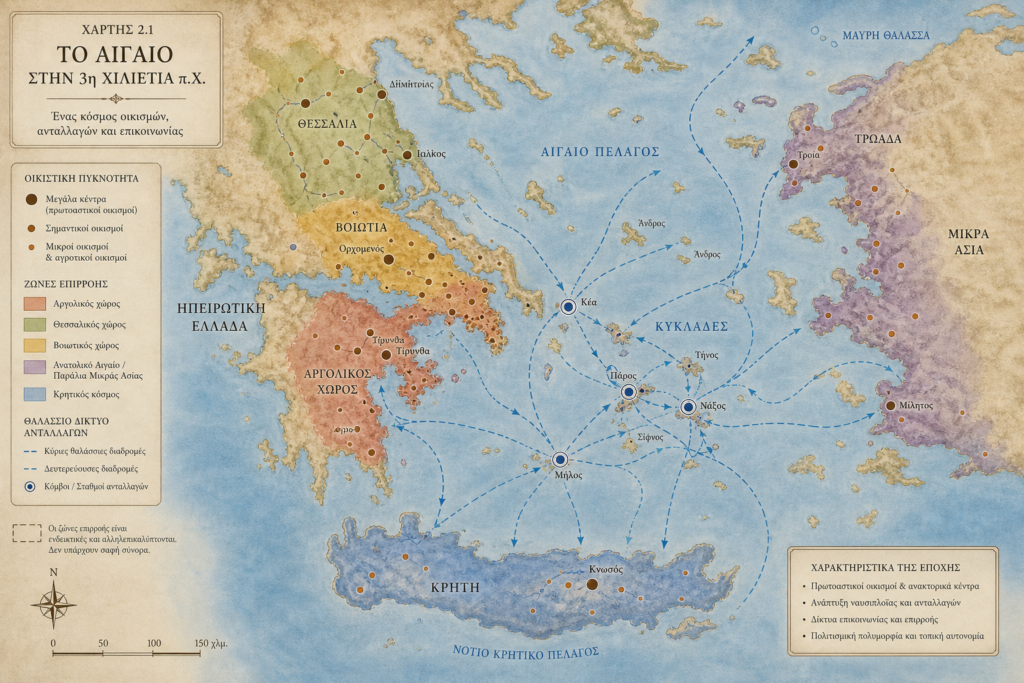
The map depicts the Aegean as a network of marine contacts, with Crete as a separate cultural centre, Cyclades as a navigation hub and mainland Greece as a core of Neolithic and early copper-plated continuity.
Conclusion
The Aegean of the 3rd millennium BC was multiforme and multilingual, without yet Greek language rule.
3. The arrival of the Early Hellenes (2200–19900 BC)
Analysis
The arrival of the Early Greek groups is one of the central issues of prehistoric research. The prevailing view places the gradual spread of Early Greek in the Greek area between 2200 and 1900 BC, although there is no consensus for accurate «Input wave»Many researchers prefer a long penetration and interaction model rather than a violent one. «Invasion» (Mallory 1989)· Anthony 2007· Luraghi 2008).
Early Greek was an Indo-European language. This event is retrospectively documented by Mycenaean Greek and comparison with other IE languages. Relative figures for water, home, patriarchal organization, his religion «Uranium father» and heroic vocabulary reveal a common Indo-European horizon, not meaning that Greeks «They're ready.» as a closed unit.
Greek mythology preserved, in fragmentary form, memories of these transformations: genealogies descended from divine fathers, heroes-residents, symbolic domination of heaven on earth, and emphasis on oath, hospitality and gender.
| Model | Description | Comment |
|---|---|---|
| Invasion | Input of a new population | Older view |
| Gradual diffusion | Long language transition | Most acceptable |
| Elitist sovereignty | Small groups require language | Possible scenario |
Conclusion
The Early Greeks seem to have brought a form of indo-European language and some common religious and social patterns. But the Greek identity is not exhausted in this arrival· It is later formed, through a meeting with the pre-Greek substrate.
4. Indo-European religion and Greek mythology
Analysis
The relationship between Greek mythology and Indo-European religion is one of the most fertile areas of comparative study. THE Zeus corresponds linguistically and partly functionally to the Indo-European *Dyeus Pater («heavenly father»). However, the matching is not a mere identification: Greek religion develops in a particular polytheistic and poetic context, where the political and cosmological dimension of the deity is stronger than indo-European common elements.
In Greek cosmogony, as reflected in Hesiod, the shape of the Chaos to the Gaia, Uranos, Titans and finally Olympians can be read not as «history file», but as a mythological coding of relationships of generation, power and secular order. The family ratio of gods and people offers the basis for city, kingdom, and law.
| Indo-European pattern | Greek equivalent | Operation |
|---|---|---|
| *Dyeus Pater | Live Father | Heavenly sovereignty |
| Goddess of dawn | Eos | Cosmic Circle |
| Hestia | Hestia | Household stability |
Conclusion
Greek mythology incorporates ancient indo-European patterns, but transforms them into a particularly Greek form. THE Zeus, - Themis, - Hestia And the cosmogenic order of Hesiod is not simply «copies» foreign standards· are Greek recompositions of common older shapes.
5. The Pelasgos
Analysis
Pelasgians are among the most widely discussed ethnic names of antiquity. In Homer, Herodotus and other writers appear as ancient inhabitants of various areas, often associated with pre-Greek antiquity. But the name does not necessarily correspond to a single people. It can function as an indefinite ethnographic label for an old, «non-Greek» population or as a myth of indigenousity.
Modern research remains cautious. There is no archaeologically identifiable «Pelasgian culture» With clear boundaries. More likely is the word «Pels» became in ancient times a flexible name for various communities that Greeks perceived as older or foreign. Its use in sources must therefore be read on a case-by-case basis, not generally (Gimbutas 1963 no longer followed as a universal interpretation· Drews 1993· Hall 2007).
| Source | Note |
|---|---|
| Homer | Archaic reference |
| Herodotus | Ethnographic use |
| Thucydide | Retrospective history |
| Strabo | Collection of deliveries |
Conclusion
Pelasgos cannot be identified with a single archaeological culture or with a single language. It is mainly a historical-mythological category of Greek memory, useful to declare antiquity, alienity or pre-Greekity.
6. Other pre-Greek peoples: You said, "Cares, Tyrrene, etc."
Analysis
Leleges, Cares and Tyrrens appear in the sources as peoples of the Aegean and the eastern Mediterranean with an unclear ethnic position. The Leleges are often associated with islands and coastal areas, the Kares with the southwest Asia Minor, while Tyrrins/Tyrsins with a wider set of traditions that later led to the Etruscan debate.
Modern science treats these names as historically fluids. Some may reflect actual population groups· others may be labels used by Greeks for foreign or mixed communities. There is no need to integrate them into nationalist schemes or simplistic narratives. «Greekity from always».
| Name | Region | Comment |
|---|---|---|
| You were saying | Aegean | Age Label |
| Kares | Karia | Most likely historians |
| Tyrrene | Aegean / West | Advanced delivery |
Conclusion
The names Leleges, Kares and Tyrrens testify that the Greek and Aegean sites were from an early field of multiple population and cultural contacts. Their historical use is true, but their ethnic concept remains often unclear.
7. The Danes: Mythology, origin, use of term in Homer, etymological questions
Analysis
The term «Loans» is one of the most important Homeric nations for Greeks, along with «Slow» and «Achaeans»To Homer, «Loans» They are not a separate people compared to Greeks, but a poetic name of the Greek army and the Achaean warriors. The exact origin of the term remains doubtful.
Mythologically, Danaus is associated with Egypt and Danaides, which shows that myth is used to interpret movements, families and cultural contacts. There is no historical evidence that the Danes are a special ethnic layer before the other Greeks. On the contrary, the term seems to function as an archaic poetic nation (West 1997)· Hall 2002).
| Term | Use |
|---|---|
| Achaeans | Main Name |
| Loans | Poetry name |
| Slow | Local-poetic name |
Conclusion
The Danes are primarily an epic term for the Greeks. Their mythological form enriches traditions of origin, but it is not enough to establish a separate historical ethnogenesis.
8. The root *dan/dānu in Indo-European tradition
Analysis
The Indo-European root *dānu- has been associated with the concept of «river» or water current in various traditions. From it are interpreted rivers such as the Danube (Danuvius) and Don, as well as divine forms or demon forms in Indian tradition (e.g. Dānu in Vedic mythology). The theory is linguistically interesting, but its application to the Danes of Greek tradition is not safe.
The Loan Connection–*dānu is proposed because the name «Loans» sounds similar and because Danau's mythology includes moving from newer/eastern areas to the Greek area. However, form similarity is not sufficient as proof. They need historical-linguistic intermediate steps we do not have.
| Example | Region |
|---|---|
| Dānu | India |
| Danuvius | Balkans / Roman geography |
| Don | Eastern Europe |
Conclusion
The root *dānu- illuminates broader indo-European hydronomic and mythological patterns, but its connection to the Danes remains a working hypothesis rather than a proven fact.
9. The Greek tribes before the end of the Bronze Age
Analysis
The terms Achaeans, Ionians, Aeoles and Arcadias have different historical significance. Achaeans, especially in epic language and Mycenaean references, are widely associated with the Greek-speaking populations of the late Bronze Age. Ions and Aeoles are more clearly recognized in the 1st millennium BC as linguistic-dialogue and geographical groups. Arkades are considered one of the most conservative bodies in the Greek language, with particular importance for the continuity of linguistic history.
The oldest testimony about the Greeks of the Bronze Age comes from the signs of Linear B, where we encounter Greek names, gods and institutions. However, the conditions «Achae» and «Loan» are Homerics, while the tribal identities of the classical era are the result of later political-language maturation.
| Sex | Region | Source |
|---|---|---|
| Achaeans | Mycenaean Greece | Homer, Linear B |
| Ion | Attica, Evia, Asia Minor | Late deliveries |
| Oilers | Thessaly, Boeotia | Language history |
| Bears | Peloponnese | Local continuity |
| Donors | Northwest Greek area | Historical memory |
Conclusion
Greek tribes are historically formed through a long course of differentiation and contacts.
10. The appearance of the term «Greek»
Analysis
The Greek sexes of late prehistory are not static «nations», but networks of related groups with common language and different historical routes. The Mycenaean period is the safest core of early Greekness.
The term «Greek» It evolved from a local or limited nation name to a nationwide self-name. First, the «Others» in Homer states mainly a region of southern Thessaly, while «Greek» may be a local team. In the course of the Archaic era, however, the name expands and identifies with the Greeks as a whole.
This transition is crucial: it shows that Greek identity was not in the first place given, but was gradually shaped through common language, epic tradition, sports and religious institutions, and opposition to them «Barbarians» (Hall 1989)· Herodotos I· Thucydides).
| Period | Meaning |
|---|---|
| Hostage | Limited |
| Archaic | Expanded |
| Classic | Panhellenic |
Conclusion
Name «Greek» does not appear as self-evident from the beginning of Greek history. His semantic expansion is a decisive step towards the unification of Greek identity.
11. From Greek to Hellenism
Analysis
In mythological genealogy, Ellen is his son Deucalion And Pyrra. From his descendants comes Doros, Xuthos and Aeolus, while from Xuthos the Ionians and Achaeans through mythical branches. This genealogy is not a historical tree with biological accuracy· is a cultural tool for organizing Greek groups in a common narrative.
Political significance is clear: common origin by an ancestor allows for the construction of affinity between different cities and dialects. The myth acts as a symbol of unity without eliminating diversity. In the Greek world, affinity is both real, imaginary and institutional.
The mythological genealogy of the Greek, Doros, Xuthos and Aeolus acts as a symbolic pattern of affinity between the Greek groups.
| Person | Role |
|---|---|
| Deucalion | Regenerator of mankind after the flood |
| Greek | Genarch of the Greeks |
| Gift | Surnamed ancestor of the Donors |
| Wood | Father of Ion and Achaus, chief prince of Ion and Achaion |
| Aeolus | Surnamed ancestor of the Aeoles |
Conclusion
The Greek of mythology is not biological evidence, but an ideological core of a common Greekness that will become historically visible in archaic and classical times.
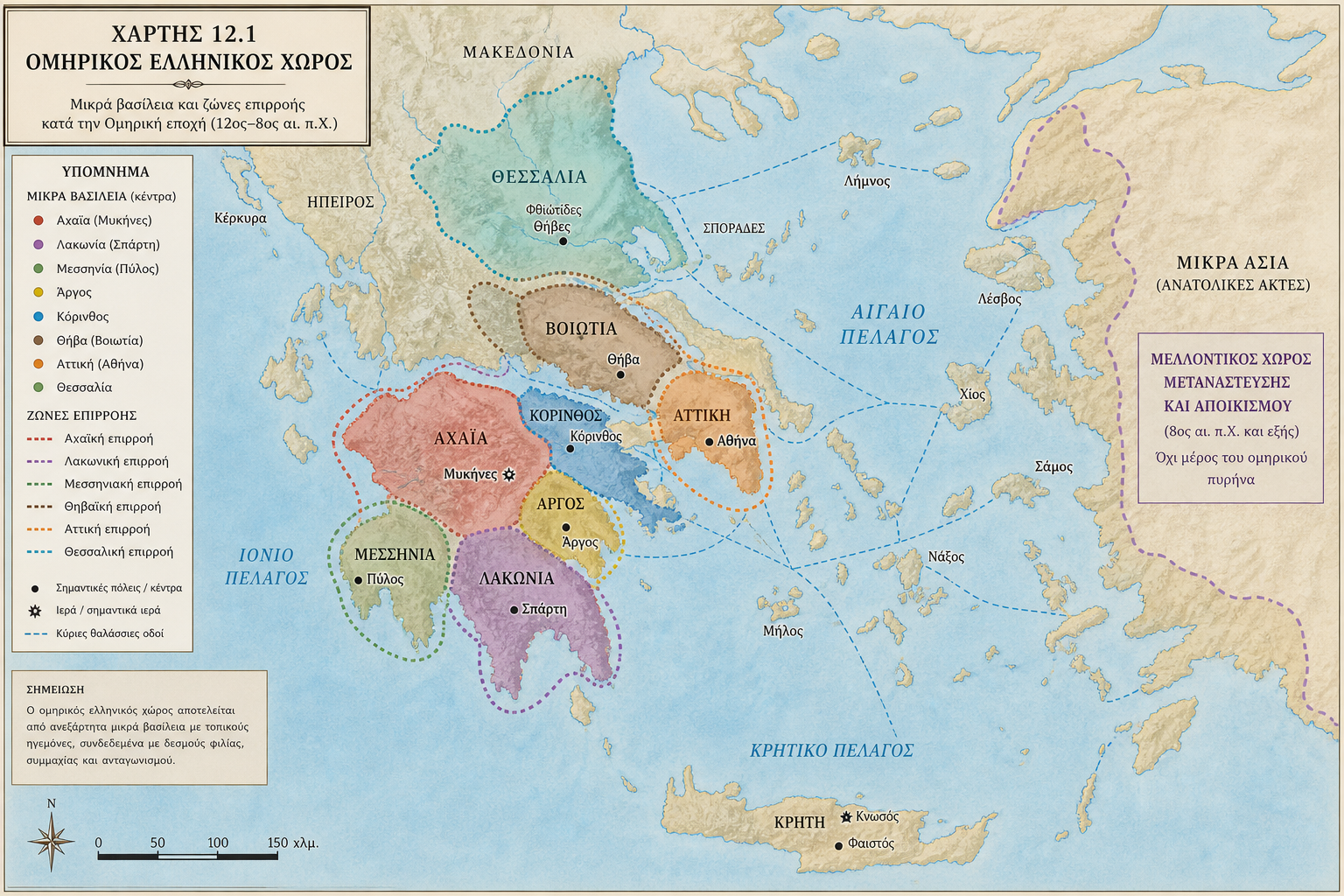
12. Homeric geography of the Greek sexes
Analysis
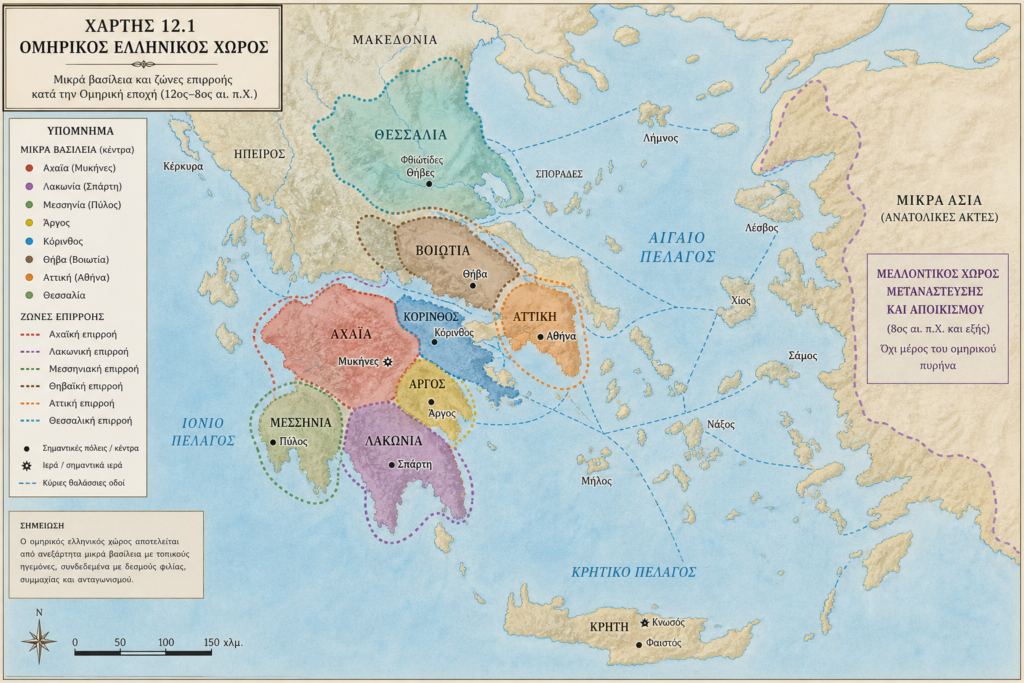
Homer is fundamental not only to Greek mythology but also to the ethnic geography of the Greeks. The «List of Youths» in Iliad provides a poetic, but precious, panorama of the regions and rulers of the Mycenaean/Epic world. But we must recognise that the list is not entirely historical: it reflects memory, reorders and aristocratic ideology of the 8th–7th century BC.
| Sex | Region | Hero |
|---|---|---|
| Achaeans | Argolida | Agamemnon |
| Bears | Arcadia | Dearer |
| Boilers | Boeotia | Chiefs of Staff |
| Lacedimoniums | Laconia | Menelaus |
Conclusion
Homeric geography is the foundation of the Greek ethnomemymi. It links genders, heroes and places to a poetic map that heralds the nationwide consciousness.
13. The collapse of the Mycenaean world
Analysis
The collapse of the Mycenaean world around 1200–1050 BC was not a unique event, but a long process of disintegration of the palace system. The signs of Linear B stop, palaces are destroyed or abandoned, the international exchange system is disrupted and population organization is reformed.
The «People of the Sea» are an important but not fully adequate explanation. Egyptian sources testify to turbulence in the eastern Mediterranean, but do not allow a mere identification with causal monomerity. Research discusses earthquakes, internal social tension, trade break, climate change and chain conflicts (Cline 2014· Dickinson 2006).
| Case | Comment |
|---|---|
| External attacks | Partly possible |
| Climate crisis | More and more discussed |
| Internal decomposition | Possible |
| Multifactor model | Most acceptable |
Conclusion
The Mycenaean collapse marks the end of the first great Greek state experiment. But it does not destroy Greekness· It transforms it into a more local, decentralised and oral form.
14. Gender movements
Analysis
The traditional narratives about «sex movements» They are based on late historical memories and dialectic differences. The so-called «Dorian descent» has long been a dominant figure, but today it is treated with scepticism. There is no clear archaeological moment that proves violent Dorian invasion across the Peloponnese. More likely is a gradual rearrangement of populations, political alliances and linguistic varieties (Hall 2002· Malkin 1998).
The Aeoles and Ionians in Asia Minor reflect a process of colonization and movement from mainland Greece to the eastern coast. These movements are historically more recognizable, as they are associated with cities, dialects and sanctuaries.
| Group | Move |
|---|---|
| Oilers | Towards the North Aegean and the Aeoliida of Asia Minor |
| Ion | Towards the coast of Asia Minor and the Aegean Islands |
| Donors | To the Peloponnese and later to Crete and Dodecanese |
Conclusion
The interpretation of gender movements must be historical rather than ideological. Greek groups are formed through continuous contact, not by simple «descents» or «cleared».
15. Early Iron Age
Analysis
After the collapse of the palace world, Greece enters the Early Iron Age (c. 1050–900 BC). Society becomes less central, more local and more based on small communities. Burning or burial, heroic memories and local cults begin to play a greater role.
Religion does not «born» then, but it acquires a form more compatible with the multicentre city. The worship of the dead, the emergence of heroes and the first sanctuaries are associated with the formation of memory and community (Snodgrass 2000).
| Field | Trend |
|---|---|
| Settlements | Small and scattered |
| Economy | Agricultural |
| Religion | Local cults |
| Burial | A variety of customs |
Conclusion
The Early Iron Age is not «dark» in the sense of inactivity, but transitional: it creates the social conditions for the Greek city and the epic.
16. Geometric Period
Analysis
During the Geometric Period (c. 900–700 BC) we see rejuvenation of populations, the development of ceramic decoration, the formation of cities and the strengthening of sacred places. The site acquires a new political form: the city emerges as a community of citizens, while the sanctuaries function as nationwide nodes of meeting and memory.
Olympia, the Delphi, the Delos and its great sanctuaries Hera and Poseidon are shown as places of hyperlocal coexistence. Here Greek identity passes from the level of affinity to the level of ritual and public community.
| Centre | Deity |
|---|---|
| Olympia | Live |
| Delphi | Apollo |
| Delos | Apollo |
Conclusion
Geometric period is crucial for the formation of the historical Greek world. From the local communities we go to a wider Greek inhabited institutions and priests.
17. The appearance of the Greek alphabet
Analysis
The Greek alphabet results from an adjustment of the Phoenician system around the 9th–8th century BC. The word «alphabet» comes from the names of the first two letters, alpha and beta. Greek innovation lies in the introduction of vowels, which allowed a more precise representation of the Greek language and, finally, poetry and law.
The first written samples —the vessel of Dipylos, «Nestor's glass» and other early inscriptions— They testify that the new system spread rapidly in commercial and festive environments. Writing did not just make the language visible· changed politics, memorization and literature.
| Inscription | Date |
|---|---|
| Inscription of Dipylos | 8th century BC |
| Nestor Cup | 8th century BC |
Conclusion
The Greek alphabet has been a technological and cultural incision. It made possible the transition from oral memory to historical writing, without eliminating the validity of oral tradition.
18. Homer and Hesiod
Analysis
Homer and Hesiodos are the two great poets of the formation of the Greek collective identity. Homer encodes the heroic world, gender names, honors, foreignness and war excellence. Hesiod, with Theogonia and the Works and Days, organizes the genealogy of the gods, the secular order and the morality of toil.
Their historical contribution is not that «recorded» precise facts, but that they gave common linguistic and sign language context to Greeks. They strengthened the idea that Greeks share gods, ancestors, heroes and values, even though they remain politically divided.
| Poet | Contribution |
|---|---|
| Homer | Epistle and common heroic identity |
| Hesiod | Theogenia and secular order |
Conclusion
Homer and Hesiod are not just literary monuments· are institutional bodies of Greek self-understanding. Through them, Greek mythology becomes a common language of Greekness.
19. Genealogy of the gods
Analysis
The genealogy of the gods in Hesiod should not be read as a simple family list. It is a cosmological mapping of order: from the amorphous Chaos to Gaia, from Gaia to Heaven, from the Titans to Zeus, and from there to solid Olympic domination. This figure explains why power must be legalized, measured and shared.
Chaos
↓
Gaia
↓
Uranus
↓
Titans
↓
Cronus
↓
Live
↓
Olympian Gods
Conclusion
The divine genealogy of Hesiod is a cultural theory of the world. It explains order, succession and legitimacy, while at the same time it acts as a mythological map of Greek thought.
20. Timetable (3000–700 BC)
The following chronological table composes archaeological, linguistic and mythological data. It must be read as a synthetic tool, not as absolute certainty. Dates are approximate and often subject to scientific discussion.
| Period | Evolution |
|---|---|
| 3000–2200 BC | Pre-Greek populations and Aegean cultures |
| 2200–1900 BC | Possible appearance and installation of Early Hellenes |
| 1900–1600 BC | Middle Helladic period |
| 1600–1200 BC | Acre of the Mycenaean World |
| 1200–1050 BC | Collapse of Mycenaean palaces and transitional era |
| 1050–900 BC | Early Iron Age |
| 900–700 BC | Geometric period and transition to the Archaic era |
Conclusion
The timeline shows that the birth of the Greeks is slow and multilayered. Language, archaeology and mythology are gradually composed into a new historical ensemble.
21. Conclusions
Analysis
The march from the Prehellens to the birth of the Greeks is not linear. It begins with local Neolithic and early copper-lithic populations, passes into the gradual spread of Early Greek, forms the Mycenaean world and is reconstructed after the 12th century BC collapse. In this course, mythological traditions —Pelasgos, Danes, Greeks, Achaeans— is not «wrong story»But how the Greeks thought of their origins.
Language has been the most stable background of unification. The mythology provided genealogies and legalizations. Poets, especially Homer and Hesiod, turned the local into a nationwide. The alphabet made this memory written and transmitted.
Conclusion
The Greek identity did not arise from a race or a moment, but from the long interaction of pre-Greek substrates, proto-Greek speakers, Mycenaean political organization, epic tradition and archaic institutional unification. In the context of Greek mythology, genealogies and heroes are not marginal ornaments: it is the very language with which the Greek world narrated its historical birth.
FAQ
1. Were there really Prehellens?
Analysis
Archaeological and linguistic indications show pre-Greek layers in the Greek area.
Answer
Yes, as earlier populations, but not as a single people with clear boundaries.
2. The Early Greeks were Indo-Europeans?
Analysis
The Early Greek language is clearly indo-European.
Answer
Yes, the Early Greeks are the early carriers of Greek, an Indo-European language.
3. The Pelasgos were Greeks?
Analysis
Sources are unclear and contradictory.
Answer
We cannot identify them with certainty with the Greeks.
4. What were the Danes?
Analysis
In Homer it is a poetic name of the Greeks.
Answer
They are not a separate historical nation.
5. When the name appears «Greek»?
Analysis
The use is initially limited and local.
Answer
As a nationwide self-name it is established mainly in the archaic era.
6. Based on the «Dorian descent»?
Analysis
The classic version is not fully confirmed.
Answer
These are more likely complex movements and restructurings.
7. Zeus comes from *Dyeus Pater?
Analysis
Language and functional correspondence is strong.
Answer
Yes, at the level of Indo-European comparative religion.
8. Did the Minoans speak Greek?
Analysis
The writing and language of Linear A have not proved to be Greek.
Answer
Not with today's data.
9. Homer is a historian?
Analysis
Homer is a poet who incorporates memories, not a historian in the younger sense.
Answer
Not literally, but he's priceless for historical memory.
10. Why is Hesiod so important?
Analysis
Because he organizes divine genealogy and the moral world.
Answer
It gives the Greek world a coherent cosmological framework.
11. What does it mean? «Mycenaean World»?
Analysis
It is the palace system of the late Bronze Age.
Answer
The world of palaces, Linear B and Achaean aristocracy.
12. Why is Mycenaean civilization falling apart?
Analysis
The causes are multiple.
Answer
Because of a combination of internal and external factors.
13. When does the Greek alphabet appear?
Analysis
In the 8th century BC.
Answer
Around the 9th–8th century BC, with early specimens in the 8th.
14. Have Greeks always been united?
Analysis
Unity was cultural, not political.
Answer
No. No.· They joined mainly through language, religion and traditions.
15. What is the basic conclusion on Greek ethnogenesis?
Analysis
Greek identity is gradually formed by multi-level influences.
Answer
The Greeks arise as a historical synthesis of pre-Greek and proto-Greek elements.
Bibliography
Ancient Sources
- Hesiod, Theogonia
- Hesiod, Works, and Days
- Homer, Iliad
- Homer, Odyssey
- Herodotus, stories
- Thucydides, stories
- Strabo, Geographic
- Pausanias, Greece Tour
Modern Bibliography
- Anthony, D. (2007). The Horse, the Wheel, and Language.
- Bintliff, J. (2012). The Complete Archaeology of Greece.
- Burkert, W. (1985). Greek Religion.
- Chadwick, J. (1976). The Mycenaean World.
- Cline, E. H. (2014). 1177 B.C.: The Year Civilization Collaborated.
- Dickinson, O. (2006). The Aegean from Bronze Age to Iron Age.
- Hall, J. M. (2002). Hellenicity.
- Hooker, J. T. (1980). Linear B: An Introduction.
- Luraghi, N. (2008). The Ancient Messengers.
- Malkin, I. (1998). The Return of Odysseus.
- Mallory, J. P. (1989). In Search of the Indo-Europeans.
- Renfrew, C. (1987). Archaeology and Language.
- Shelmerdine, C. W. (2008). The Cambridge Companion to the Aegean Bronze Age.
- Snodgrass, A. (2000). The Dark Age of Greece.
- West, M. L. (1997). The East Face of Helicon.