
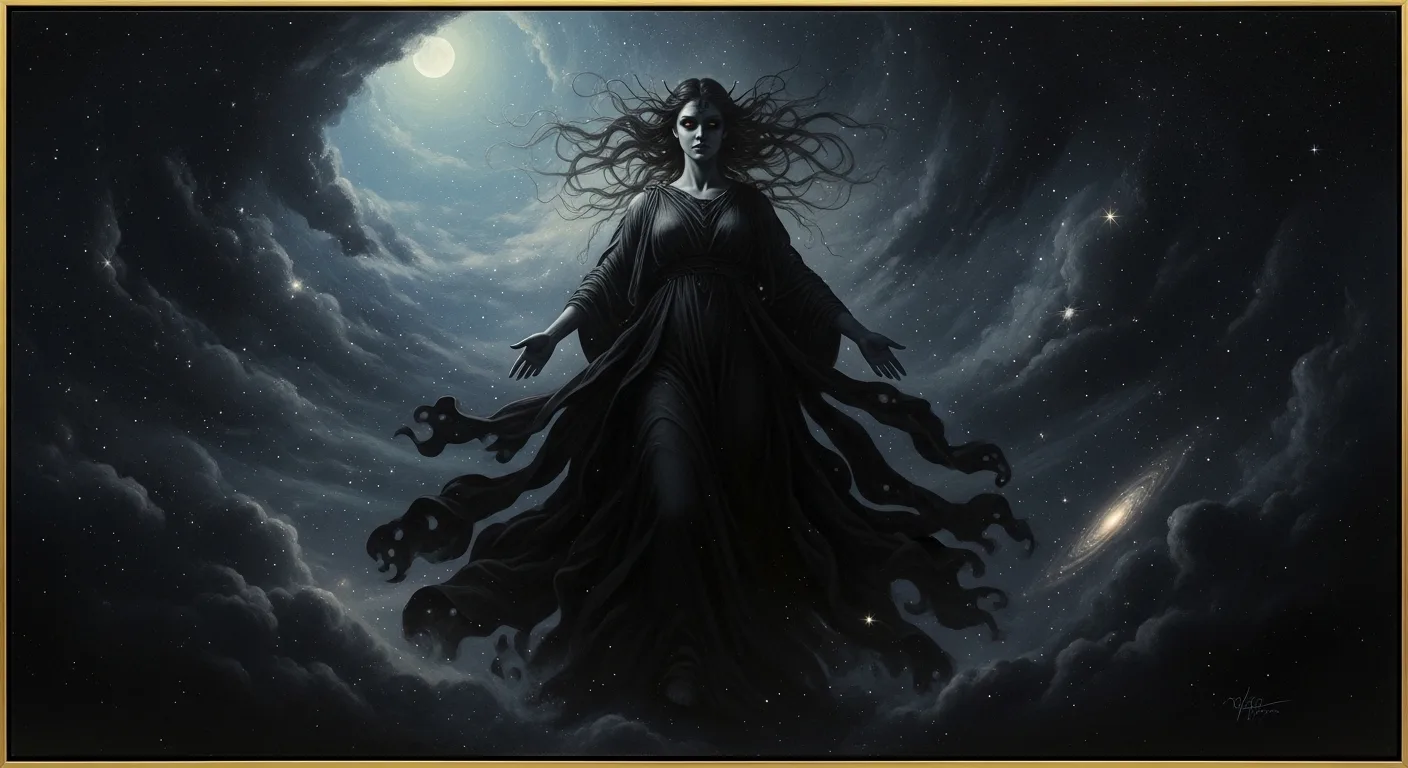
Nyx is one of the oldest and most powerful primary deities of Greek mythology. It appears immediately after Chaos and personifies the Night, darkness, and silence that preceded the secular order.
Who was Nyx in Greek mythology?
Nyx was one of the oldest and most mysterious deities in Greek mythology; a force as ancient as the universe itself. She was not merely the personification of night, but a cosmic being born from the primordial Chaos, before the Olympian gods even appeared, before the sky was filled with stars, and before the earth took shape. Her presence was associated not only with darkness, but with the unknown, the eternal, and the profound mystery that accompanies every human soul when the silence of night falls.
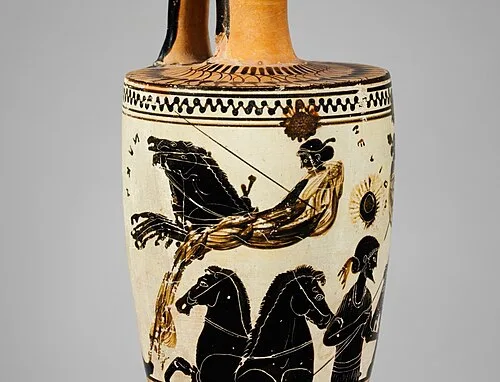
The ancient Greeks imagined her as a majestic goddess draped in black veils, crossing the sky in a chariot and casting her shadow over the earth. With her arrival, the colors of the world faded, the noises subsided, and the boundaries between dream and reality became blurred. She was not an evil deity; on the contrary, she inspired awe and respect. Even Zeus himself, the almighty king of the gods, hesitated to challenge her, a fact that reveals her power and antiquity.
- Nyx She lived with her husband, ErevoIn the dark depths of the world. From their union were born many deities associated with the human experiences and mysteries of life. Among her children was Hypnos, which brought rest to mortals, Death, The Oneiroi, but also forms that represented fate, sorrow and revenge. Through these children, Nyx became the mother not only of darkness, but also of the invisible forces that rule the lives of men.
In literature and poetry, Nyx is often portrayed as a calm yet all-powerful presence. Her night was not only a source of fear; it was also a refuge. In her darkness, people’s dreams, thoughts, prayers, and secret desires are born. The silence the goddess spreads over the world seems almost sacred, as if inviting people to look deep within themselves.
The figure of Nyx retained her allure even in later centuries. Painters, poets, and writers drew inspiration from this dark deity, seeing in her not merely the night, but the very power of the unknown. It is the moment before dawn, the silence before a truth is heard, the veil that hides what humans cannot explain.
This is why Nyx remains one of the most enigmatic forms of Greek mythology. — a goddess who doesn't need light to impose, for her power is born just through darkness.
The Theogony of Hesiod, Nyx is not just a natural phenomenon, but a cosmic force that breeds concepts, deities and states of human existence.
Origin and cosmogonic role
Origin: Born directly from Chaos
Wife/partner: Erebus (the Darkness), with whom he gave birth Ether and Hemera
Nyx symbolizes the transitional stage between the primordial void and the creation of the world.
Nyx Children (Deities & Concepts)
Nyx is considered the mother of many deities expressing dark, but fundamental aspects of life:
Moros – Death Fate
Keres – Spirits of violent death
Thanatos – The same death
Hypnos – Rest and oblivion
Oneiroi – Dreams
Nemesis – Divine punishment
Eris. – Discord
Apati – Deception
Giras – Old age
Nyx, more than any other deity, is associated with the invisible forces that affect the fate of humans.
The power and respect of the gods
Nyx was so strong that even Zeus respected her and avoided her.
According to Homer, Zeus hesitated to punish Sleep for having fled to his mother, Nyx.
This shows that Nyx:
precedes the Olympic power
represents secular laws superior to gods
Symbolization of Nyx
Nyx symbolizes:
the darkness before creation
silence and secrecy
birth through the unknown
the transition from day to day to sleep and death
In Greek thought, night is not only fear, but also a womb of creation.
Nyx in art and philosophy
It refers extensively to the Theogenia of Hesiod
Inspirations philosophical concepts about the unknown and unconscious
It is depicted as a dark, majestic form with veil or wings
References to Nyx
Homer, Iliad 8. 485 c.e. (Greek epic 8th c.c.):
“And now the brilliant light of the sun (Helios) was sinking into the ocean (Okeanos), allowing the black night (Nyx) to spread over the land that yields grain.”
Hesiod, Theogonia 744 et seq. (Greek epic 8th or 7th century BC):
“And there [at the ends of the earth, where the sky meets the earth], in their proper order, lie the sources and the ends of the dark earth and the misty Tartarus (Tartarus) and the barren sea and the starry sky, loathsome and damp, which even the gods shun… There stands the fearsome abode of dark Nyx (Night), shrouded in dark clouds. Before it stands motionless the son of Iapetus [Atlas], supporting the vast sky upon his head and his tireless arms, where Nyx and Day approach and greet one another as they pass the great bronze threshold: and while one prepares to descend into the house, the other steps out the door. And the house never hosts them both at once; but one is always outside the house, passing over the earth, while the other stays in the house and waits until the time comes for her journey; and one holds the all-seeing light for them upon the earth, but the other holds in her arms Sleep, the brother of Death, and even the evil Night, wrapped in a misty cloud. And there dwell the children of dark Nyx (Night), Hypnos (Sleep) and Thanatos (Death), fearsome gods. The radiant Sun (Helios) never shines his rays upon them, neither when he rises into the sky nor when he descends from the sky.”
Frequently Asked Questions about Nyx in Greek Mythology
What is Nyx in Greek mythology?
Nyx is one of the primordial deities of Greek mythology and personifies at night. She is considered an ancient and powerful goddess born from Chaos.
Where does Nyx come from?
According to Hesiod's Theogeny, Nyx originated directly from Chaos, one of the first secular powers of the universe.
Who are the children of Nyx?
Nyx gave birth to many deities, such as Hypnos, Thanatos, Oneiros, Moira, Moros, Nemesis, and other dark or cosmic forces.
Who's Nyx's brother?
Her brother is considered Erebus, the deity that symbolizes deep darkness.
Who's Nyx's partner?
In some myths, Nyx is united with Erebus, with whom she gives birth to deities such as Aether and Hemera.
Where did Nyx live?
Nyx is said to have resided in the Underworld, in a dark palace near Tartarus.
What does Nyx symbolize?
Nyx symbolizes the night, darkness, mystery, and invisible forces of nature.
How powerful was Nyx?
Nyx was considered so powerful that even Zeus, the king of the gods, respected and feared her power.
How is Nyx described in the ancient secretariat?
It is often described as a dark goddess covering the sky with a veil of darkness and bringing night into the world.
What is the relationship between Nyx, Hypnos, and Thanatos?
Nyx is considered the mother of Hypnos and Thanatos, two deities who represent rest and the end of life.
What's Nyx's relationship with Hemera?
Nyx is mother of the Day. According to legend, the two deities never meet, as when one leaves one appears the other.
Was there a worship of Nyx in ancient Greece?
Nyx did not have extensive worship like the Olympian gods, but refers to mystical and cosmogenic texts.
What's Nyx' position in cosmogenicity?
Nyx belongs to the first generation of deities and is a key element of the creation of the world in Greek mythology.
How is Nyx portrayed in art?
In ancient art he is often portrayed as a dark winged goddess covering the sky or traveling with chariot in the night.
What is the meaning of Nyx in myths?
Nyx represents the primal powers of the universe and the mystery of the night surrounding the world.
Primordial Gods
Chaos | Gaia | Tartarus | Eros | Nyx | Erebus | Aether | Hemera
Read more
The Forgotten Personifications of Greek Mythology
Deities of Death in Greek Mythology