
Ichor in Greek Mythology
Brief answer: Ihor (ichor) is, according to Greek mythology, the fluid flowing into the veins of immortal gods instead of human blood. The oldest reference is in the Iliad of Homer, where Aphrodite Injured by Diomede and then loses ichor, not blood—proof that the gods, who do not feed on bread and wine, are “bloodless” and imperishable.
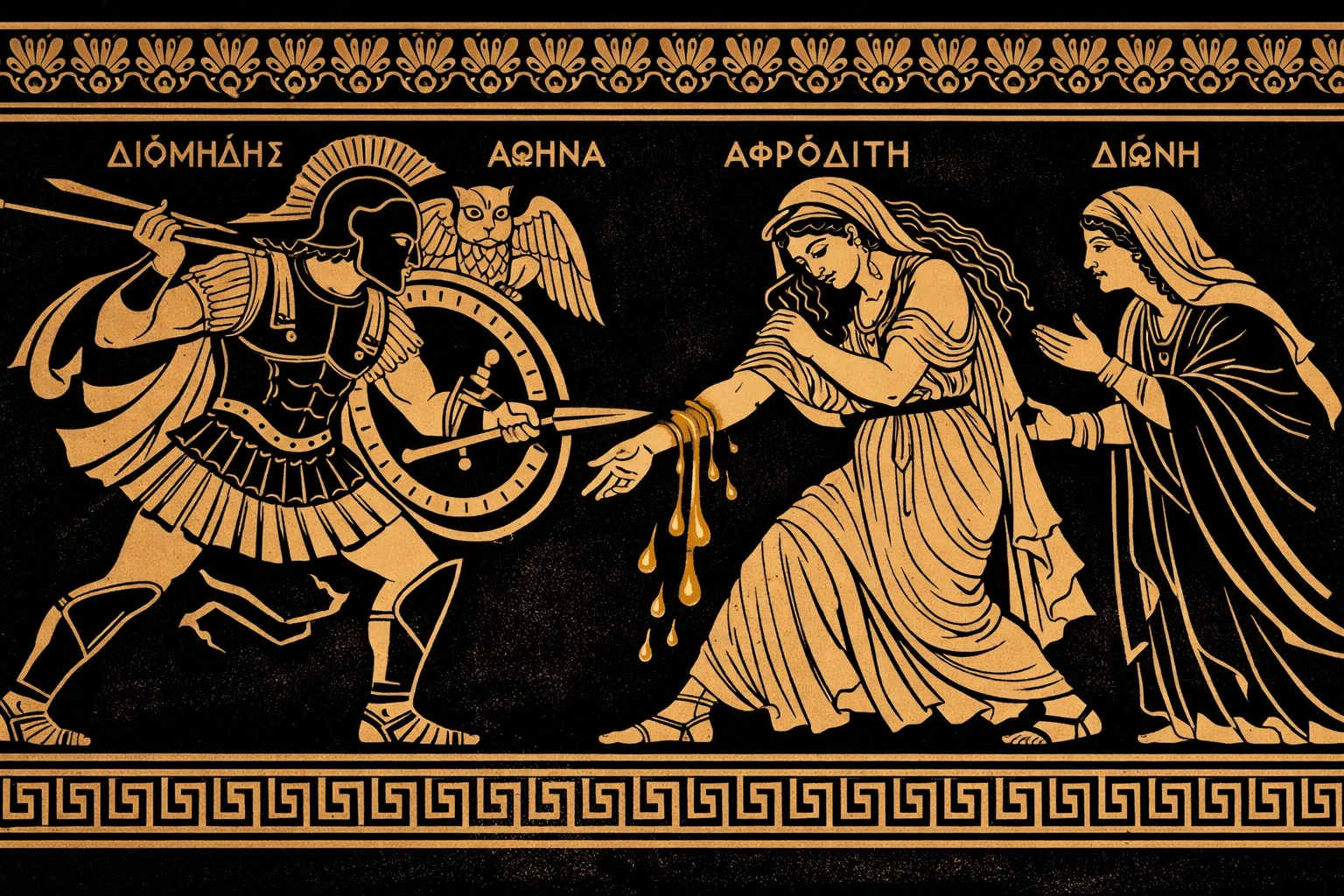
In the *Iliad*, Book V describes something we do not encounter elsewhere in the Homeric epics with such clarity: a god in pain. Aphrodite is wounded in the arm by Diomedes, and from the wound flows not blood, but ἰχώρ—a word that Homer stops to explain, as if he knew his audience would need clarification.
This moment is far more than a simple narrative detail. It raises one of the most fundamental questions in ancient Greek religious thought: if the gods resemble humans so closely—they become angry, fall in love, suffer wounds, and feel pain—what is it that truly makes them immortal? The ancient Greeks answered this question in biological terms, according to their own understanding of the world: the gods do not have human blood; instead, they possess ichor, the divine fluid that marks their immortal nature.
What is Ichor and what does the word mean?
In ancient Greek literature, ichor refers exclusively to the fluid that circulates through the bodies of immortal beings—primarily the Olympian gods, but also certain supernatural figures such as Talos. It is not merely another word for blood; rather, it is its very opposite. Whereas human blood symbolizes a life destined to end, ichor represents an existence that lies beyond the law of death. It is the defining substance of immortality, setting divine beings apart from all mortals.
Homer makes this point clearly in the scene where Aphrodite is wounded: the gods are called “blessed” because they neither eat bread nor drink wine; for this reason, they have no blood and are called immortal. The logic is purely causal—divine food (ambrosia, nectar) produces divine “circulation” (ichor), and divine circulation produces immortality.
In later authors, and especially in the popular reception of Greek mythology, ichor is often described as golden or luminous. The earliest ancient texts, however, do not explicitly assign it any particular color—a point we will revisit later in this article.
Etymology
The etymology of the word ichor (Ancient Greek: ἰχώρ) remains an open question among linguists. No convincing derivation from known Greek roots has been established, leading a number of scholars—most notably Robert Beekes—to suggest that the term may be Pre-Greek, meaning it likely originated from a language spoken in the Aegean before the arrival of Greek speakers. Etymological Dictionary of Greek...to regard it as likely originating from the Pre-Greek linguistic substrate—that is, from languages spoken in the Greek mainland and Aegean region before the arrival of Greek-speaking populations.
Earlier proposals linking the word to Indo-European roots associated with water or moisture have not gained wide acceptance. The conclusion that can be safely drawn is that the term was already a specialized, technical word when it first appeared in Homer—it does not appear to have originated from ordinary vocabulary referring to liquids or blood.
In the new Greek the word is used metaphorically to state the essence, inspiration or vital power of a creator or an idea.
Early References in Ancient Sources
The first and most important reference to ichor is found in Book V of the *Iliad*, lines 339–342 and 870, where her injuries are described in succession Aphrodite and Ares. Homer does not invent this word at this point; he uses it as if it were already familiar to his audience, which suggests an earlier oral tradition.
The same book also mentions two additional instances of gods being injured, though without any explicit reference to ichor: Hades, struck by Hercules in Pylos, and Hera, who was also wounded by the hero with a three-pronged arrow in the chest. Both deities are in pain and need the healing touch of Paeon, the divine physician of Olympus—yet another indication that the Olympian Gods They're not invulnerable, they just don't die.
After Homer, the motif of “divine blood” survives indirectly in Hesiod and is later developed further by later authors, such as Apollodorus in Library The Apollonius Pomegranate in Argonauts, with reference to the myth of Talos. Pindar and Pausanias occasionally mention related themes concerning divine nature and immortality, but they do not add any new elements specifically regarding ichor.
| Ancient Source | Reference to Ihor |
|---|---|
| Iliad E 339–342 | Aphrodite's Injury |
| Iliad E 855–870 | Ares injury |
| Argonautica D | The Ichor of Talos |
| Apollodorus Library | The myth of Talos |
Aphrodite's Wounding in the Iliad
The scene unfolds at the peak of heroic excellence: Diomedes, empowered by Athena with the ability to recognize even the gods on the battlefield, attacks the Trojan army. When Aphrodite rushes to save her wounded son Aeneas, Diomedes does not hesitate; he strikes her in the wrist.
From the wound does not flow blood but ichor, “such as flows in the blessed gods” (οἷός πέρ τε ῥέει μακάρεσσι θεοῖσιν)—this is precisely how Homer describes the substance that runs through the immortal gods. Aphrodite screams, abandons Aeneas, and runs away in tears seeking refuge, first with Ares and then on Olympus, where her mother, Dione, comforts her.
What makes the scene so powerful is not the wound itself, but the goddess’s reaction. She feels pain, she is afraid, and she flees like a mortal woman. And yet, the ichor flowing from her wound serves as a reminder that, no matter how human her response may appear, she does not belong to the world of mortals.
Ares and Ichor
Shortly afterward in the same book, Diomedes—again with the assistance of Athena, who this time guides the spear herself—strikes Ares in the abdomen. The god of war, described by Zeus himself as the most violent and hated of the Olympians, lets out a cry that Homer compares to the roar of nine or ten thousand warriors.
Ares ascends to Olympus to complain to Zeus, who, instead of sympathizing with him, rebukes him, calling him the most hateful of his children. The scene functions almost comically in contrast to that of Aphrodite, yet it conveys the same message: even the god who embodies violence itself can be wounded, can suffer, and can be humiliated. The ichor he loses does not bring him closer to death—it brings him, paradoxically, closer to the human experience of pain, without in any way compromising his immortality.
Talos and His Single Vein of Ichor
The most unusual appearance of ichor in Greek mythology concerns not an Olympian god, but Talos, the bronze guardian of Crete. According to Apollonius Rhodius in the Argonauts, Talos was a gigantic bronze being, a gift of Hephaestus or, according to another version, a remnant of Hesiod’s Bronze Race of men, tasked with patrolling the island three times a day and hurling rocks at enemy ships that approached its shores.
Talos’s body was made of solid bronze, with a single vein running through him from his neck to his ankle, sealed at the lower end with a nail or plug. Within this vein flowed ichor—the source of his “life.”
When the Argonauts, returning with the Golden Fleece, approached Crete, Talos prevented them from landing. Medea, skilled in magical arts, confronted him not through force but through cunning: with magical spells and the “evil eye,” she drove him into a state of confusion, causing him to strike his vulnerable point against a sharp rock. The nail came loose, the ichor began to flow out like molten lead, and Talos collapsed lifeless. In some versions of the myth, the same outcome is attributed to an Argonaut pulling out the nail himself rather than to an accidental injury.
The story of Talos reveals something important: ichor is not exclusively a “divine” substance in the narrow religious sense, but rather a broader symbol representing “life beyond mortal nature”—whether that life belongs to an Olympian god or to a creation of Hephaestus.
Ichor and Human Blood: The Basic Differences
| Feature | Human Blood | Ichor (Divine Blood) |
|---|---|---|
| Origin | Food for mortals (bread, wine) | Ambrosia and nectar |
| Injury effect | Possible death | Pain, not death |
| Contact with mortals | Hazardous | In certain traditions, lethal or corrosive |
| Symbolism | Mortality, heredity | Immortality, higher order of existence |
| First literary reference | Dissemination in all epics | Homer, Iliad V |
This distinction is not merely a biological curiosity. It functions as a theological argument: the immortality of the gods is not an abstract quality, but something inscribed into their very bodies, becoming visible at the very moment when they are wounded.
Ichor’s Relationship with Ambrosia and nectar
Ichor does not stand alone within the mythological logic of the Olympian gods; it is closely connected with ambrosia and nectar, the food and drink of the immortals respectively. Homer is clear: because the gods do not eat bread or drink wine like humans, they do not develop blood—they develop ichor.
Ambrosia is often described as the food that grants or preserves immortality, while nectar serves as its corresponding divine drink. Both substances appear repeatedly in the Homeric epics as elements that distinguish the gods: they are used to keep a body incorruptible (such as those of Patroclus or Hector), to nourish divine horses, or to confirm the divine nature of a being.
The relationship, therefore, is causal within the mythological system: ambrosia and nectar as the “fuel,” and ichor as the result. These are not three independent concepts, but rather parts of a single mechanism that explains, in terms understandable to a society familiar with the importance of food and blood, why the gods neither age nor die.
Is Ichor Golden?
The image of golden, shining ichor is one of the most widespread ideas in the modern perception of Greek mythology — and yet it is difficult to support it with precision in the earliest texts. Homer, when describing the wounding of Aphrodite, does not explicitly mention any color. His focus is on the nature of the substance (divine and not blood) rather than on its appearance.
The idea of «gold» where it appears to have been gradually reinforced through:
- the general association of gold with the divine in Greek iconography (gold thrones, gold chariots, gold garments of the gods)
- the later literary and artistic tradition, which needed a visually identifiable picture of something abstract
- the modern pop culture, where «golden blood of the gods» has become almost visual clichés in movies, books and video games
In other words: golden ichor is not “wrong” — it is an interpretive extension that fits the spirit of the myth, but it is not explicitly attested in Homer or in other early sources in the way it is often presented.
Ichor’s Symbolism
The ichor works at multiple levels within the mythological system:
- Limit between mortal and immortal. It is not merely another fluid; it is the material proof of a different order of existence.
- Explanation of immortality. It provides a “biological” explanation for a theological question: why the gods do not die.
- Indication of vulnerability without mortality. The gods suffer, are humiliated, and feel fear — but they do not perish.
- A symbol of superior origin. The idea of a special substance that distinguishes the “chosen” has reappeared throughout human imagination across the ages, from the divine spark of philosophical traditions to the modern metaphor of “blue blood” for aristocracy.
Through this symbol, the ancient Greeks achieved something difficult: they created gods human enough to be understood, yet different enough to remain worthy of awe.
Ichor in Modern Literature and Pop Culture
The word ichor survived far beyond antiquity. In 18th- and 19th-century English medical terminology, the term “ichor” was used to describe a thin, foul-smelling fluid discharge from wounds or ulcers — a usage that borrowed the “unnatural,” almost unsettling connotation of the ancient word, while no longer carrying any divine association.
In modern fantasy literature and video games, ichor has made a powerful return as a narrative device. Series such as Rick Riordan’s Percy Jackson novels explicitly use the term to describe the blood of gods and monsters, while video games inspired by Greek mythology — such as titles from the God of War series or Hades by Supergiant Games — employ the same imagery to build worlds in which gods are both powerful and vulnerable. In many of these contemporary narratives, ichor is almost always portrayed as having a golden or luminous color, reinforcing the image discussed above.
Did Ichor Influence Other Mythologies?
The idea that gods do not bleed like humans is not exclusively Greek, although the word ichor itself remains a distinctly Greek invention. In Egyptian religion, for example, it was believed that the flesh of the gods was made of gold, their bones of silver, and their hair of lapis lazuli — a parallel logic of “material” differentiation between gods and humans, expressed through precious substances rather than a special fluid.
In many religious traditions of Asia, such as Hinduism, deities are also not subject to the same biological laws as mortals, although their iconography and theology follow a different logic from the Greek one. We cannot speak of a direct “influence” of ichor on these traditions, but rather of a broader human tendency: divinity is almost always expressed, in part, through something materially different within the body.
Common Misconceptions
- «Ichor is always gold.» As we have seen, this is primarily a later and modern convention, not a Homeric description.
- “All the gods are explicitly stated to have ichor.” In reality, the explicit Homeric reference is limited to Aphrodite and Ares; other injuries of gods (Hades, Hera) are described without ichor being specifically mentioned.
- «Ichor and ambrosia are the same thing.» Ambrosia is food.· ihor is the result of this food within the divine body.
- «Ichor automatically kills every mortal who touches it.» This idea is more pronounced in later and modern accounts than in explicit ancient testimony.
Interesting Facts Few People Know
Although Ares lets out the most dramatic cry in the Iliad, it is Aphrodite — the goddess of love, not war — who is the first deity to be wounded in battle within the epic.
The word ichor passed directly into English (ichor) and other European languages as a loanword, retaining its mythological connotations even in scientific contexts.
Talos is the only case in which ichor is associated with a non-divine, artificially constructed being, a fact that expands the concept beyond the Olympian gods.
The scene of the wounded Aphrodite in the Iliad is considered by philologists to be one of the earliest literary examples of the “humanization” of a god through suffering, without this making her mortal.
Bibliography
Ancient sources
- Homer, Ilia, Rhapsody V (Venus and Mars injury, verses 330-430, 855-909)
- Hesiod, Theogony and Works and Days (generation of gods, generation of copper)
- Apollodorus, Library (mythological traditions for Talos)
- Apollonius Rhodium; Argonauts, Book IV (Death of Talo)
- Pindar, Epinikia (references to divine nature and immortality)
- Pausanias, Greece Tour (local traditions related to deities)
Modern bibliography
- R.S.P. Beekes, Etymological Dictionary of Greek, Brill, 2010
- Oxford Classical Dictionary, Oxford University Press
- M. Finley, The World of Odysseus
- W. Burkert, Greek Religion, Harvard University Press


Frequently Asked Questions About Ichor
What Is Ichor in Greek Mythology?
Ichor was the divine fluid that flowed through the veins of the immortal gods instead of human blood. According to ancient Greek tradition, ichor symbolized the gods' divine nature and their immortality, setting the Olympian deities apart from all mortal beings.
Ichor vs. Human Blood
The ancient Greeks believed that mortals possessed blood, while the gods had ichor. Human blood was associated with mortality and the limited nature of human existence, whereas ichor symbolized immortality, divine power, and the superior nature of the gods. This sacred fluid represented the essential difference between mortals and the Olympian deities, marking the gods as beings beyond the boundaries of human life and death.
In Which Ancient Texts Is Ichor Mentioned?
The most famous reference to ichor appears in Homer's Iliad, where it is described as flowing from the wounds of Aphrodite instead of blood. This divine fluid also appears in other mythological traditions associated with the Olympian gods, reinforcing its connection with their immortal nature and supernatural existence.
Which Gods Had Ichor?
All the immortal gods of Olympus were believed to possess ichor. In the Iliad, Aphrodite and Ares are specifically mentioned as being wounded, and from their injuries flows not human blood but this divine fluid, emphasizing their supernatural nature and immortality.
Why is Ichor associated with immortality?
Ichor was considered fundamentally different from human blood and served as a sign of the divine nature of the Olympian gods. Its existence emphasized that the gods were not subject to the same physical limitations and mortality as humans, but existed beyond the boundaries of ordinary life and death.
Do half-gods have Ichor or human blood?
Most demigods are portrayed as mortal beings and are associated more closely with human blood than with ichor. Although they possess divine ancestry, they are not considered fully immortal in the same way as the Olympian gods. Their dual nature reflects the connection between the divine and human worlds: they may inherit exceptional abilities, strength, or favor from their divine parent, yet they remain subject to human limitations and, in most cases, mortality.
History of Greek Ethnogenesis 3000–700 BC
Ichor: The Immortal Blood of the Gods in Greek Mythology
Ajax the Telamonian: The Great Hero of the Trojan War
Bibliography
Ancient Sources
- IliadHomer.
- OdysseyHomer.
- Aias, Sophocles.
- Library, Apollodorus.
- Transformations, Ovid.
Modern Studies
- Grimal, Pierre. The Dictionary of Classical MythologyBlackwell Publishing.
- Hamilton, Edith. Mythology: Timeless Tales of Gods and HeroesLittle, Brown and Company.
- March, Jennifer. Cassell Dictionary of Classical MythologyCassell.
- Woodford, Susan. Images of Myths in Classical AntiquityCambridge University Press.
- Garland, Robert. The Greek Way of LifeDuckworth Publishing.