
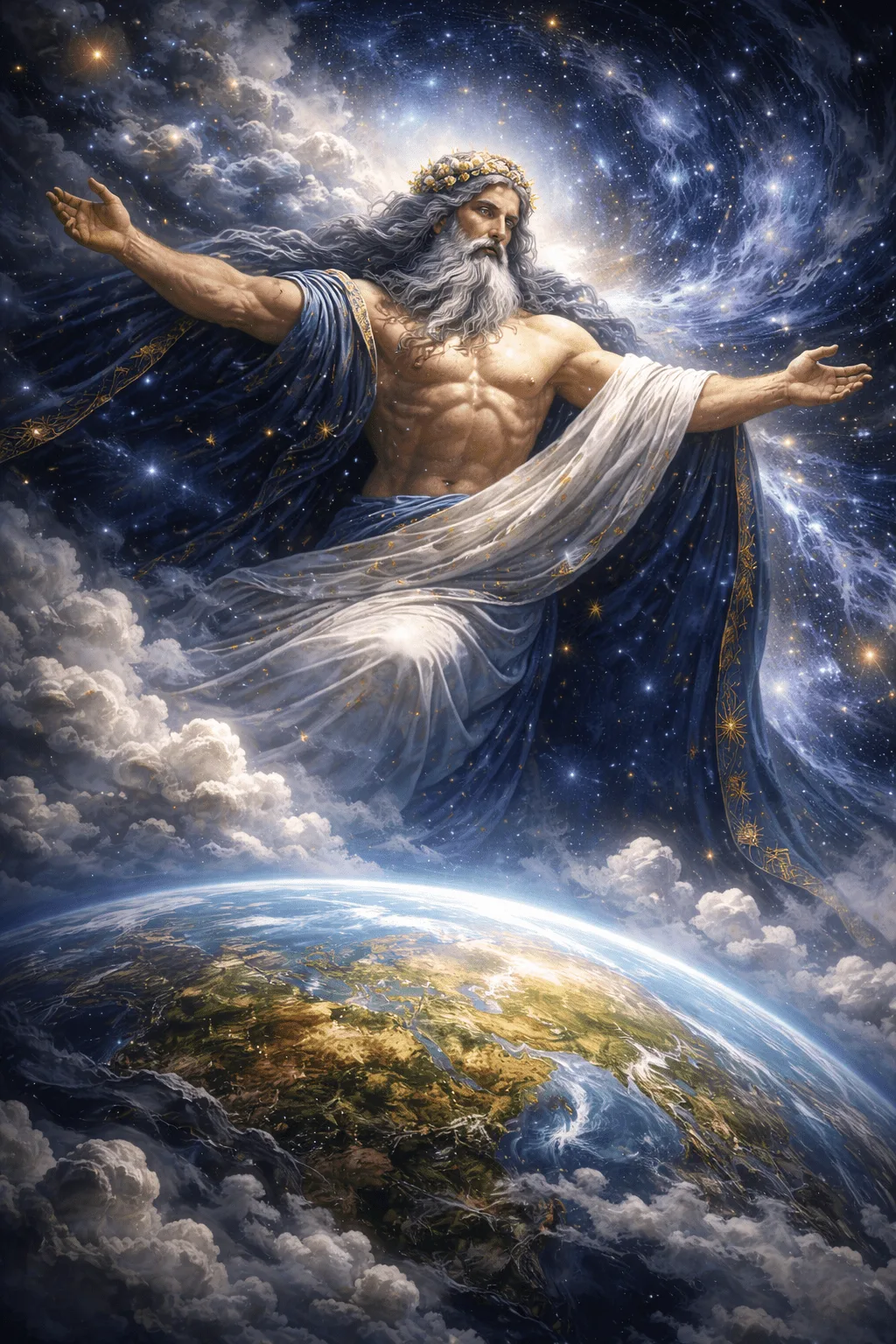
Uranus – The Primordial God of the Sky
- UranusThe personification of Uranus is one of the most ancient and fundamental deities of Greek mythology. It belongs to Primordial gods, the first cosmic powers born at the beginning of creation. He wasn't just a god of heaven.· was himself uranium dome, that embraced and covered the Earth.
As her husband GaiaUranus was the birthplace of the first divine generations and played a decisive role in the formation of the secular order, but also in the first major conflicts of mythology.
The Birth of Uranus and Cosmogonia
According to Hesiod, Heaven was born directly from GaiaNo father. Earth created him to cover her above, as her equal and complementary element. Together they formed the first secular couple: Earth and Heaven, the solid foundation and protective dome of the universe.
In ancient Greek cosmology, Uranus was presented as solid dome, pinned to the ends of the Earth, which held the stars and heavenly phenomena. Under him lay the world of mortals and gods, while deep down was the Tartarus.
Uranus and Gaia – The First Divine Union
The union of Uranus with Gaia has been extremely fertile but also destructive. From this relationship they were born:
The Twelve Titans
The Cyclops, single-eyed giants with enormous power
The Hecatoncheires, terrifying beings with a hundred hands and fifty heads
Although he was their father, Uranus feared their strength and ferocity. So he imprisoned in the depths of Gaia, causing unbearable pain to their mother.
The Fall of Uranus
Gaia, enraged by the tyranny of Uranus, decided to avenge. Build one diamond sickle and asked her sons to rebel. Only the youngest Titan, Cronus, dare.
When Uranus descended to join Gaia again, Cronos he castratedBy overthrowing him from power. From the blood of Uranus that fell on Earth were born:
From his genitals to the sea was born AphroditeThe goddess of love.
After his fall, Uranus withdrew from active cosmic power, but remained an eternal symbol of heaven and the first divine sovereignty.
The Role of Uranus in Mythological Tradition
Uranus was not widely worshiped with temples and sanctuaries, such as the Olympian gods. His presence is secular and symbolicNot man-made. Represents:
The primary authority
The heavenly order
the distance between the divine and the earth
His overthrow by Saturn and later the overthrow of Saturn by Jupiter established a recurring pattern in mythology: the power of the old gods is replaced by younger generations.
The Iconography of Uranus
In ancient art, Uranus is rarely depicted as a full human figure. He is usually depicted:
as Sky dome full of stars
as a male figure spreading over Gaia
in cosmogenic mosaics and vase paintings
In later works, he appears as a mature bearded god, a symbol of eternal heavenly power.
Uranus as a Symbol
Uranus symbolizes the principle of creation, but also the rigidity of absolute power. He's the god who gave birth to everything, but he couldn't control them. Its fall marks the beginning of the mythological history of conflicts, generations and evolution of the world.
Frequently Asked Questions About Uranus
Who was Uranus in Greek Mythology?
Uranus was the personification of the sky and one of the primary gods of Greek mythology. He was the son and husband Gaia and with her she gave birth to the first gods and mythical beings.
Who were the children of Uranus?
Uranus and Gaia had many offspring, including Titans, the Cyclops and Hecatoncheires.
Why did Uranus imprison his children?
According to legend, Uranus feared the power of his children and imprisoned them in the depths of the earth, causing Gaia's anger.
Who overturned Uranus?
Titan Cronus He overturned Heaven with the help of Gaia's mother, cutting off his genitals with a sickle.
What happened after the castration of Uranus?
From the blood of Uranus that fell to earth were born the Erinyes, the Giants and Melies. From the foam of the sea created by its genitals was born Aphrodite.
What does Uranus symbolize in Greek mythology?
Uranus symbolizes the sky and the primal power of the universe, as well as the first generation of divine beings that preceded the Titans and the Olympian gods.
What is Uranus relationship with Gaia?
Gaia was his mother and companion. Together they formed the primary pair of heaven and earth that gave birth to the next generations of gods.
In which ancient texts is Uranus mentioned?
Uranus refers mainly to Theogony of Hesiod, where the birth of the gods and its overthrow by Saturn is described.
JTNDADILM0UlQULQTALQ0UlQElQ0UlQElQ0YlodalQ0UlQkYlQlQlQMlQ0YlodalQ0UlQlQlQlODlM0UlQUzRSUwQsuzQ0UlQlQlQUlQKYLQTBJTBJTBJTBJTBBBGlM0UlMEELQ0ULOTCLQ0YODMlQODRSVIVIVIVIVIVIVIVI JUJUJUJUJUJUJUJUJUJUJUJUJUJUJUJUJUJUJUJUJUJUJUJUJUJUJUJUJUJUYZ2VJTNEJTYMJJTIWJSJTJSGJSG9jJJUJUYRM0UJJTBJJJTJJTJJTJVUJTJMJJJKM UyRdvcmslMkYMCUyMiUyMHRhcmldCUzRCUyMl9ibGFuayUyMiUyMHJlbCUzRCUy Mm5vZm9sbG93JTIwbm9vVuZilMjlM0UlMEFUb3Bvc1RleHQlMEELM0MlMkZhJTNFLiUwQsuzQyUyRmxpJTBJTBJTJTNDbGklM0UlMEElQ0UluluylQ0UlQUlQ0UlQ0UlQQlQlQlQjklQ0UlQklQlQUlQlQYlQYlQLDILMKMlMlMjAlM0NlBRSVRSVSSU5QYVNSVNSVNSVNSVNSVNSVNSVSVRU4NCSVCSVCRSVCRSVSVVCRSVSVSVSVCQYVCQYVCQYVDRIVDRIVDRIVICVRIVIDRIVIDRIVIDRIVIVIVIV