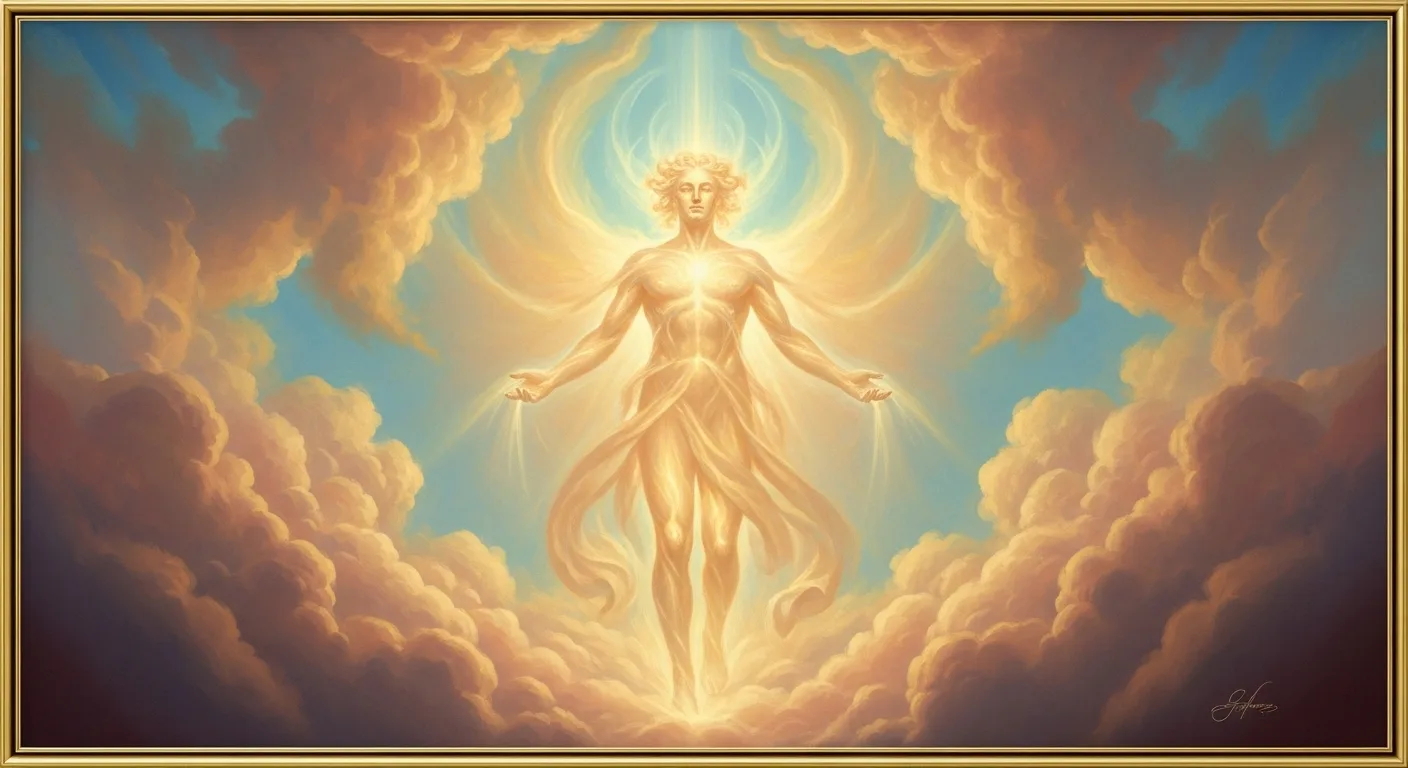
The Origin of Aether
Aether belongs to the first generation of deities, those born directly from the primordial chaos. According to his *Theogony* Hesiod, Ether is his child Erebus (darkness) and Nyx (night).
This origin is particularly significant: light is born out of darkness and night. Aether represents precisely this transition—from chaos and obscurity to clarity and luminosity.
With his sister, Hemera, form a circle: Night retires to give its place to the light of Etherra and Day.
What does Aether represent?
Ether is not a god in human form or personal stories such as Olympians. Instead, it is an abstract but fundamental concept:
- It is the clear, bright air of the upper layers of the sky
- It is the light that surrounds the gods
- It is the divine energy separated from the mortal world
The ancient Greeks believed that humans breathe ordinary air, while the gods breathe "ether"—a purer and more subtle substance.
This separation highlights the difference between divine and human world.
Aether in cosmology
In ancient Greek thought, the world was not merely material but also hierarchical. Aether occupied the highest position in the heavens, above the air and the clouds.
In later philosophical theories, especially in Aristotle, ether was regarded as the “fifth element” (quinta essentia), in addition to:
In this philosophical conception, the aether was the material of which the celestial bodies are composed—indestructible and eternal.
Relations with other deities
Aether is closely associated with other primordial deities that represent fundamental cosmic forces:
- With Chaos, as part of the original creation
- With Gaia, representing the earth
- With Uranus, personifying the sky
In some traditions, Aether is also considered the father of Uranus or other deities, although these accounts vary depending on the source.
The Symbolism of Aether
Aether has a strong symbolic significance that transcends mythology:
1. Purity and divinity
It represents absolute purity, free from the wear of the material world.
2. Light and knowledge
Light from the Aether is associated with knowledge, clarity, and spiritual elevation.
3. Distinction between worlds
It shows the clear line between men and gods.
4. Eternity
Unlike the four elements, ether does not wear out, which makes it a symbol of eternal.
Aether in Modern Thought
Although the mythological concept of the Aether has been abandoned by modern science, the word “aether” survives in various fields:
- In old physics, as a hypothetical means of spreading light
- In philosophy, as a concept of higher substance
- In everyday language, to describe something «uranium» or «intangible»
His influence shows how deeply ancient ideas have taken root in modern thinking.
Conclusion
Aether may not have the dramatic stories of the Olympian gods, but its significance is fundamental. It represents the light born of darkness, the purity that transcends the material world, and the very essence of the heavens themselves.
By understanding the Aether, we gain a better understanding of how the ancient Greeks perceived creation, nature, and humanity’s place in the universe. It serves as a reminder that, before the myths of heroes and gods, there were the very forces that made existence possible.