What is Titanomachy?
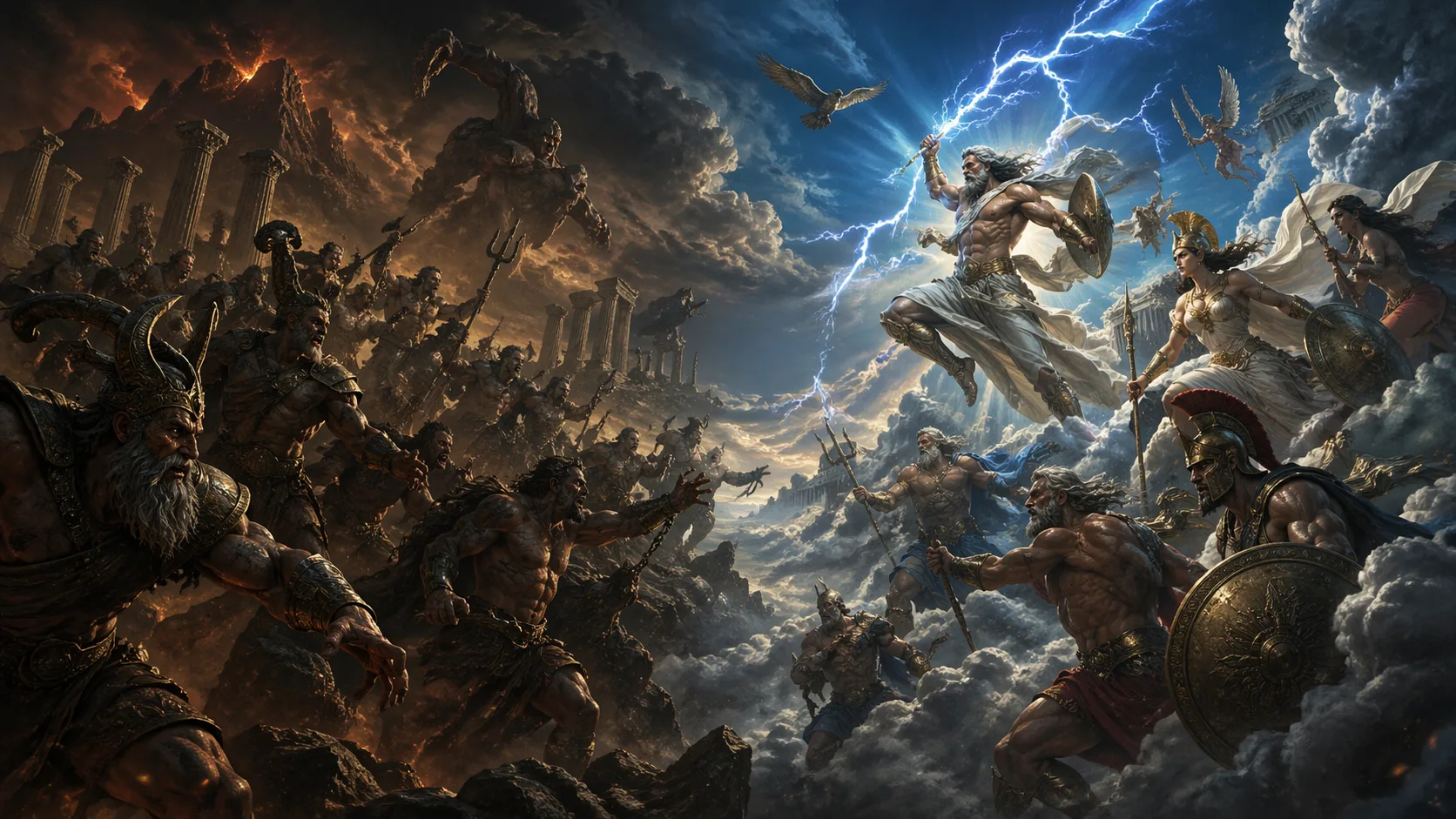
Titan fighting is the great mythical war between Titans, the oldest generation of divine beings, and their Olympian gods, the new power that emerged to take over the domination of the world. This is one of the most decisive moments of Greek mythology, as it marks the transition from the primitive disorder to a new secular balance, where the gods of Olympus dominate.
The Roots of the Cosmic Conflict
The conflict did not arise suddenly, but had deep roots in the first generations of gods. The story of the Titanomachy is closely linked to the cycle of power, overthrow, and fear of losing power.
Uranus, Cronus, and the Cycle of Betrayal
- Uranus, the world's first sovereign was destroyed by his own son, Saturn. THE Cronus, with the help of Gaia, he overturned his father, starting a circle where every generation of gods feared the next.
Cronus, now ruling on his own, tried to avoid Uranus’s fate. However, this action would bring him face to face with an even more inevitable downfall.
The prophecy of overthrow
Cronus learned that one of his children would overthrow him. This prophecy led him to swallow his newborn children in an attempt to maintain his power.
This act, though born of fear, sowed the seeds of his future fall.
The rescue of Zeus and his secret childhood
- Rhea, unable to constantly lose her children, she hid the newborn Zeus in a cave in Crete. There, Zeus grew away from his father, protected from nymphs and Divine forces.
This hidden upbringing gave Zeus time to mature and prepare for the great conflict that would follow.
The Return of Zeus and the Liberation of His Brothers
When the Zeus He grew old, returned to Saturn and forced him to release his oppressed brothers. In this way, the united group of the Olympian gods was created, ready to challenge the sovereignty of Titans.
The Battle Lines: Gods vs. Titans
The world was divided into two camps. On one side were the Olympians, led by Zeus, and on the other were the Titans, led by Cronus. The conflict was not only physical but also cosmic, as it determined the future of all creation.
The Ten Year War
The Titanomachy lasted ten years, with battles that shook the earth, the sky, and the sea. At first, neither side could gain the upper hand, as their forces were almost evenly matched.
The final confrontation
The final phase of the war was judged by the intervention of powerful allies and divine weapons. The balance leaned in favour of the Olympians, leading to the final defeat of the Titans.
The Olympic Coalition
The Olympian gods formed a united alliance led by Zeus. They fought with him Poseidon, Hades, - Hera, - Demeter and Hestia, forming a new divine order with the common purpose of overthrowing the old power.
The Titan Forces
The Titans, under the leadership of Cronus, possessed immense primal power and experience. They represented the primordial order of the world, but lacked the unity and strategic flexibility of the Olympians.
Key allies: Cyclopes and Hecatocheires
A defining role was played by Cyclops and Cyclops 100-Handed, whom Zeus liberated from Tartarus. In return, they gave him powerful weapons and fought alongside the Olympians, greatly strengthening their power.
Zeus's thunderbolts and the divine weapons
The Cyclops They built Jupiter's lightning, Neptune's trident and his invisible helmet Hades. These weapons gave the Olympians a decisive advantage in battle and changed the course of the war.
Tactical Advantages of the Olympians
The Olympians were not only based on power, but also on strategy. Their cooperation, flexibility and use of divine weapons allowed them to overcome the brutal power of the Titans.
The punishment of the defeated Titans
After their defeat, most Titans were imprisoned in Tartarus, a deep and dark abyss of the underworld. There they remained under the supervision of powerful guards, away from the world of living and gods.
The Division of the World
After the victory, the world was divided among the three main Olympians: Zeus took heaven, Poseidon the sea and Hades the underworld. This division determined the new cosmic balance.
The New Divine Order
Titan fighting marked the establishment of a new divine order, with Zeus as supreme sovereign. The Olympians were no longer contenders, but the official rulers of the world.
Titan fighting in ancient texts
The history of Titan fighting refers to important ancient works, such as «Theogony» of Hesiod, describing the birth and evolution of the gods and the great conflict that determined secular order.
Symbolic significance and modern interpretations
Titan fighting is not just a battle myth, but a symbolic account of change and evolution. It represents the transition from chaos to order, from old power to a new form of organization and justice. In modern interpretation, it is often read as a symbolism of historical and social progress, where the new succeeds the old through conflict and renewal.