
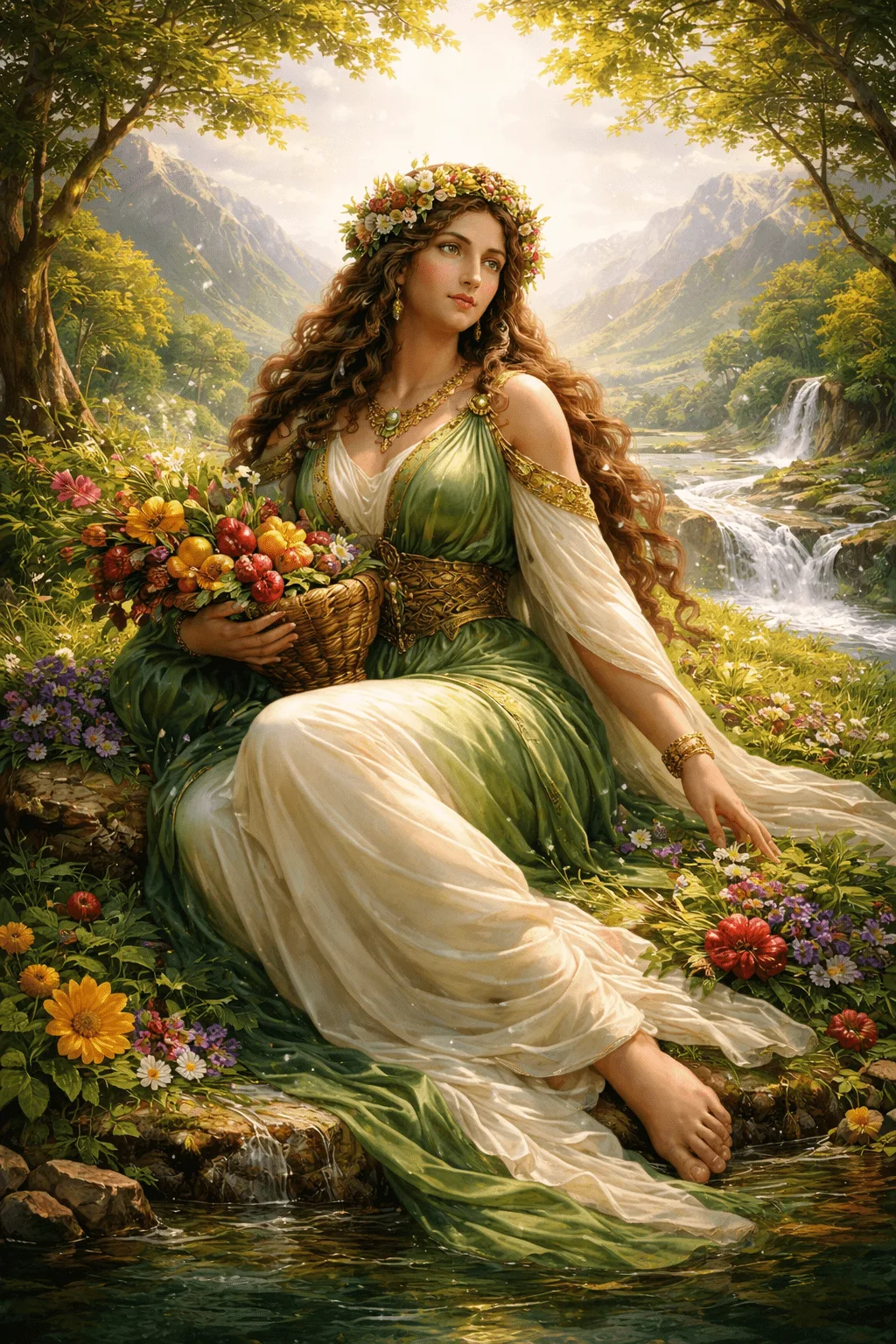
Gaia – The Primary Mother of Creation
- GaiaThe goddess of Earth is one of the most primitive and fundamental forms of Greek mythology. It belongs to Primordial gods (Protogene), the first divine powers that appeared at the dawn of creation, before the world as we know it. She wasn't just a deity.· was the same Earth, the matter from which gods, monsters and mortal creatures were born.
Gaia was worshiped as the Great Mother of all, the source of all life and the basis of secular order. On her body were raised mountains and seas spread, while from her bowels emerged deities and powers that determined the evolution of the universe.
The Birth of Gaia and Cosmogonia
According to the Theogony of Hesiod, Gaia emerged almost immediately after Chaos, without parents, as the second entity of creation. In other traditions, such as Orphic hymns, Gaia came from Water, while Yyygios mentions as her parents Ether and Hemera.
In ancient Greek cosmology, the Earth was perceived as flat disk, surrounded by the river Oceanus, with its solid dome Uranus from above and its terrible barium Tartarus underneath. Gaia supported the seas and mountains, becoming the solid foundation of the world.
Gaia’s Unions and Her Children
Gaia's creative power was expressed through her associations with secular deities:
With Heaven (Uranus – Sky/Uranus) She gave birth to them Titans, Cyclops and HecatoncheiresThe first heavenly gods.
With Ponto, the divine personification of the sea, gave birth to sea gods.
With Tartarus, the cosmic barium brought into their world GiantsGreat chthonian beings.
From her own flesh they were born and mortal creatures, showing that every life form has its roots on Earth.
Gaia as Opponent of the Olympian Gods
Although she was the mother of the gods, Gaia was often found in conflict with its heavenly descendants. At first she rebelled against her husband, UranusBecause she had locked their children in her bowels. She supported her son. Cronus in overthrowing his father, giving him the sickle with which he castrated Heaven.
But when Cronus repeated the same mistakes, imprisoning his brothers, Gaia stood by him. Zeus, helping him lead Titan fighting. However, her relationship with Jupiter did not remain harmonious. When he imprisoned the Titans in Tartarus, Gaia became angry.
From her wrath they were born:
The Giants, in Gigantomachy, and
the terrible monster Typhon, the ultimate threat to his sovereignty Zeus.
Despite her efforts, both revolts failed.
The Iconography of Gaia
In ancient art, Gaia is inextricably depicted bound to the element of the Earth:
In angiogram, appears as a large, maternal woman who surface from the ground.
The mosaics, appears lying on earth, often dressed in green garments, symbol of vegetation.
It is often accompanied by Hours (seasons) and Fruits, personifications of fertility and natural cycle.
The Meaning of Gaia in Mythology
Gaia is not just a goddess· is the beginning and end, the power that gives birth and swallows. It represents fertility, stability, but also wild, unbreakable nature. In Greek mythology, Gaia keeps reminding that even the gods depend on the Earth that gave birth to them.
Gaia — Frequently Asked Questions & Short Answers (Q&A)
1. Who's Gaia?
Gaia is the primal goddess of Earth and the mother of all things in mythology.
2. Where does Gaia come from in mythology?
It emerges first from Chaos as the deity representing the Earth itself.
3. Who are Gaia's main descendants?
He gave birth to Heaven (heaven), Pontus (sea) and the Mountains (mountains).
4. How did he give birth to the Titans?
He was associated with Heaven and together they gave birth to the twelve Titans.
5. What role did he play in divine history?
Through patents and advice he participated in the cosmogenic changes, such as the rebellion against Heaven and the support of Zeus against Saturn.
6. What does the name "Gay" mean?
Means «Land» or «soil», representing Earth itself.
7. Is Gaia deity or mere personification?
In mythology she is also a goddess and the personification of the Earth itself.
8. Who was Gaia's husband?
Heaven (the sky) is considered her husband in the creative union.
9. Gaia had human children?
Titans and other creatures of mythology were considered children or descendants of Gaia.
10. What happened when Heaven imprisoned their children?
Gaia organized the plan with Saturn to weaken Heaven.
11. Is Gaia connected to the gods of Olympus?
Yes — She was Zeus' grandmother and had an important role in his support.
12. What's a Titanic fight?
The great battle between the Titans and the Olympian gods, with the support of Gaia on Zeus.
13. Does Gaia have symbols or worship?
Although less personally dedicated, the Earth was worshiped as a source of life and fertility.
14. What does it represent in the Greek myth?
Fertility, life, creation and dynamics of nature.
15. Are there any monsters related to Gaia?
Yes — Like Typhon who is said to have been born of Gaia to challenge Jupiter's power.
16. How were Cyclops and Centuries created?
From Heaven and Gaia to mythology.
17. Gaia is still important today?
As a primitive symbol of Earth and motherhood, it remains important in the study of mythology.
18. Is she the same as Demeter?
No. No.· Demeter is a lower deity with another role in mythology.
19. Is Gaia the first deity?
It existed immediately after Chaos and before most gods.
20. What does Gaia teach ancient myths?
Respect for nature, life and the root of creation.
Primordial Gods
Chaos | Gaia | Tartarus | Eros | Nyx | Erebus | Aether | Hemera
Ancient sources
Hesiod – Theogenia & Works and Days | Primary Sources
Primary Sources of Greek Mythology | Hesiod, Homer, Orphic Hymns
Primary Sources of Greek Mythology | Ancient Texts
Perseus Digital Library is a reliable academic database with ancient Greek texts and historical sources, particularly useful for the study of Greek mythology and Elefsinian Mysteries.