
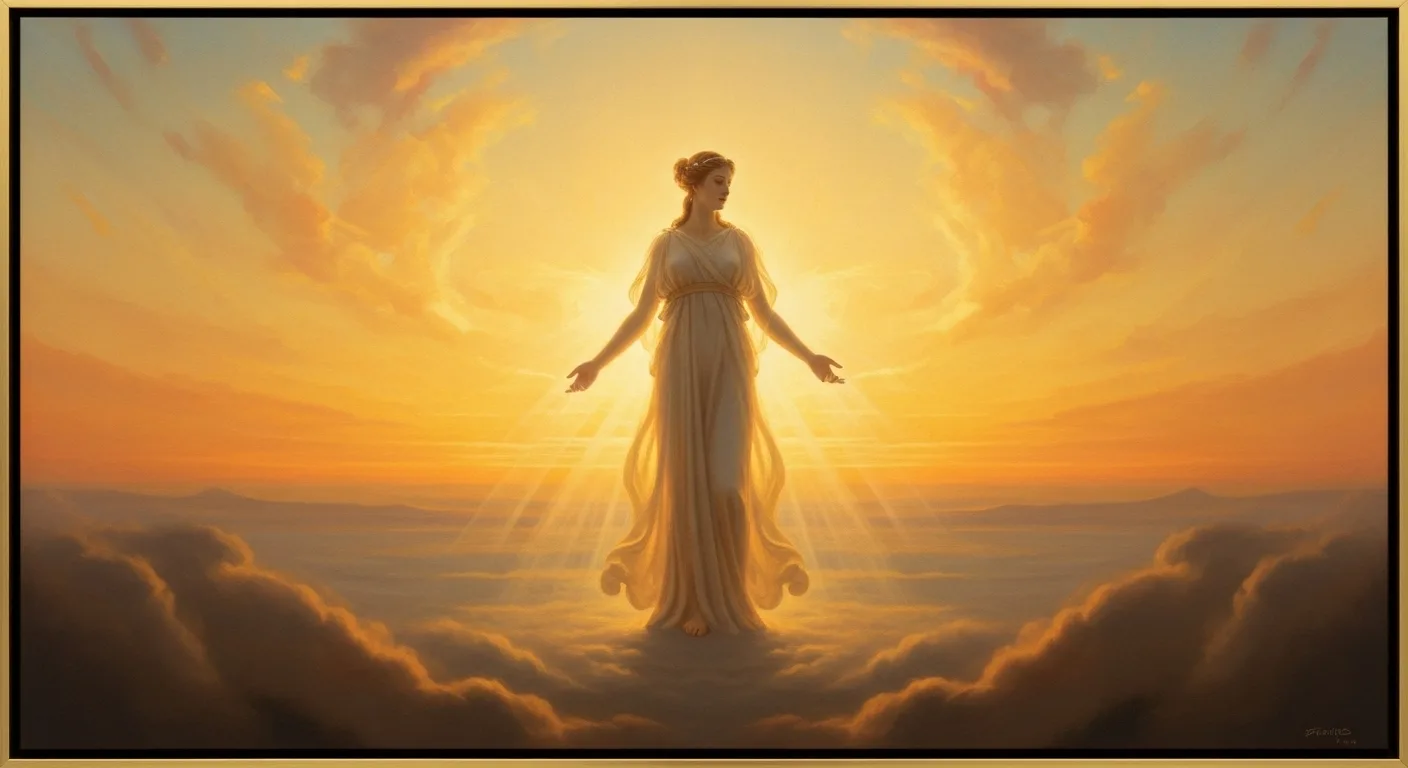
In Greek mythology, before the rule of the Olympian gods, there were the primal forces that defined the function of the world. Among them is the Hemera, the deity that personifies daylight and the succession of time.
Hemera is not just a goddess of light· is the very concept of rotation between darkness and brightness. Through its presence, the ancient Greeks explained the circle of life and the physical order of the world.
The Origins of Hemera
According to the Theogony of Hesiod, Hemera is the daughter of Erebus and Nyx.
This genealogy is especially symbolic: from Night and Darkness is born daylight. With her brother, Aether, form the dipole of light that contradicts at night.
Ancient myths describe a continuous cycle: when Night retires, Day emerges and illuminates the world. When Day goes, Night returns. That explains the physical rotation of day and night.
Her role in the secular class
Day has a fundamental role in organizing the world. He is not involved in adventures or conflicts like the later gods· its significance is more cosmological.
- It brings light to people's world
- It divides time into circles
- It contributes to the stability and order of nature
Its existence shows that ancient Greeks perceived the world as a balance of forces. Day is not working alone, but in constant rotation with Night.
The relationship with Night and the Ether
The relationship between the day and the Nyx is one of the most characteristic in Greek mythology. The two deities do not conflict, but succeed each other in a perpetual cycle.
Night covers the world in darkness, while Day reveals it with light. This rotation is not random, but part of a cosmic harmony.
At the same time, the Day is closely linked to Aether, representing the upper, clear light of heaven. If Day is the light men see, the Ether is the light that belongs to the gods.
The Symbolism of the Day
Day has a profound symbolism that transcends mythology and touches human experience:
1. Renaissance and beginning
Each new day symbolizes a new beginning, an opportunity for change and progress.
2. Light and truth
The light of day reveals everything, linking the Day to knowledge and truth.
3. Order and rhythm
Her recurring appearance brings stability and rhythm to life.
4. Balance
Day exists only in relation to Night, showing that light and darkness are interrelated.
Hemera in Philosophy and Thought
Although the Day as a deity did not heavily concern philosophers, the concept of day and light had an important place in Greek thought.
For example, light was associated with knowledge and logic, especially in his philosophy Plato, where light is a symbol of truth.
Thus, the Day can also be seen as a metaphor for the mental clarity and understanding of the world.
Day in Modern Concept
Although goddess Day is not worshiped today, the meaning it represents remains alive:
- In the language where the «day» linked to the principle and action
- In literature, as a symbol of hope and light
- In everyday life, as a key cycle defining time
Her influence shows how ancient myths continue to influence the way we perceive the world.
Conclusion
Hemera is one of the most fundamental but also most distinctive forms of Greek mythology. She does not stand out for myths full of action, but for her role in the structure of the world.
As a goddess of light and time rotation, it represents stability, renewal and balance. Through its understanding, a world is revealed where even the simplest daily experiences are revealed — Like sunrise — They have a deeper meaning.