
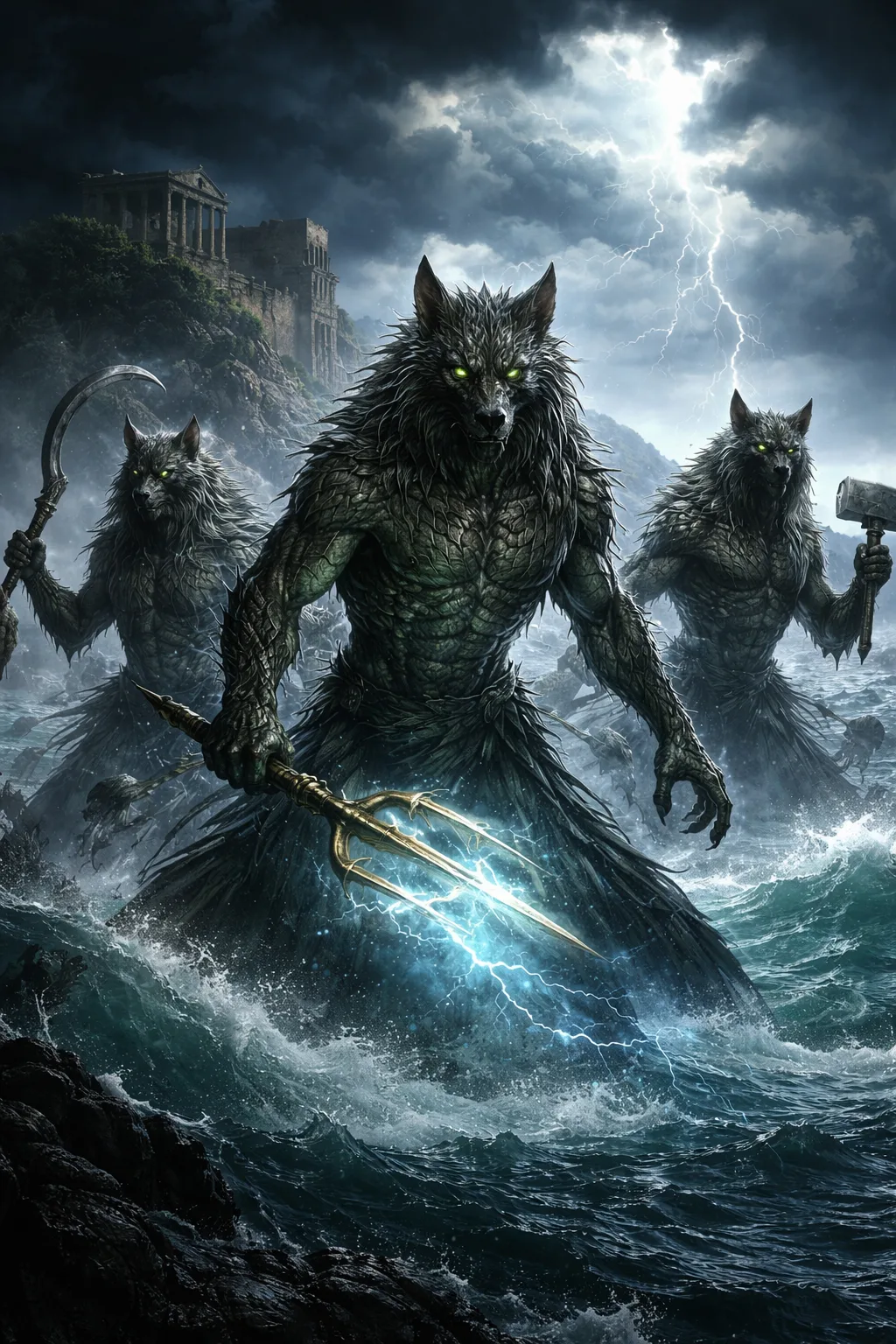
Telhines are one of the most enigmatic and less understandable forms of Greek mythology. Combining elements divine, demonic, and artificially, these forms are closely related to sea, magic, and early metallurgy. Tradition around them differs depending on the source, but a common denominator is their dual nature: creators and destroyers simultaneously.
Origin and nature
Telchines are considered ancient sea demonic entities residing mainly in Rhodes and other Aegean islands. Sources disagree as to their origin:
- According to some traditions, they were children of Pontus and Gaia.
- Others consider them descendants of the Marine element or even attendants of primitive deities.
- In some versions, they are linked to Cronus or Rhea, as it is said to have undertaken his upbringing Poseidon.
Their form is described as hybrid and terrifying:
- human body
- head of a dog or other animal
- fish fins or tails
- in some cases scaly skin
Their external appearance reflects the wild and unstable nature of the sea.
Role in mythology
Telchines appear as beings with excellent knowledge and abilities. It was:
- skilled craftsmen
- magicians and connoisseurs of magic art
- Early metalworkers
They are attributed to the construction of important divine objects:
- His scythe Cronus, by which he castrated him Uranos
- Poseidon's trident
- Probably other sacred and powerful weapons of the gods
Their ability to handle metals and create objects of great power makes them precursors to technology and technical knowledge in the mythological world.
Magic and dark fame
Despite their creative abilities, the Telchinas had a bad reputation. Many ancient writers present them as dangerous and malicious:
- It is said that they could cause storms and disasters
- They used magic to influence the environment
- They could have «poison» land and water
In some traditions, they were accused of dumping destructive substances on earth, causing pestilence and crop destruction.
The destruction of Telchines
Their dark nature eventually led to their extermination. According to different versions:
- - Zeus He destroyed them with thunder.
- - Poseidon caused a flood to wipe them out.
- Apollo killed them because of their malice and arrogance
Their extermination is often interpreted as the prevalence of divine order over chaotic and uncontrolled forces.
Relationship with Rhodes
Telchines are closely associated with Rhodes, which in some traditions was originally called «Telhinis». There it is considered that:
- established first settlements
- developed technical skills
- They taught art to people
However, after their destruction, Rhodes passed to new deities and peoples, marking a new era.
Symbolism and interpretation
Telchines can be symbolically interpreted in many ways:
- Power of nature: Express the uncontrolled side of the sea and natural elements
- Early technology: They represent the transition from natural to artificial, from nature to technique
- Dynasty of creation–destruction: Like fire and metal, they can create and destroy
- Fear of unknown: They reflect the ancient fear of forces that man cannot control
Telhines in the ancient secretariat
References to Telchines are found in several ancient writers:
- Pindar
- Strabo
- Diodoros Siciliotis
- Ovid
Their descriptions differ, which enhances their mysterious character and suggests that it is a very old mythological layer.
Conclusion
Telhines are one of the most special forms of Greek mythology. Combining technical skill with magic power and dark nature, they embodie tension between creation and destruction. Their presence in ancient traditions bears witness to the admiration and fear of people toward the forces of nature and knowledge.
Their history is not just a narrative of strange beings, but a deeper allegory of human relationship with the power, technology, and boundaries of nature.