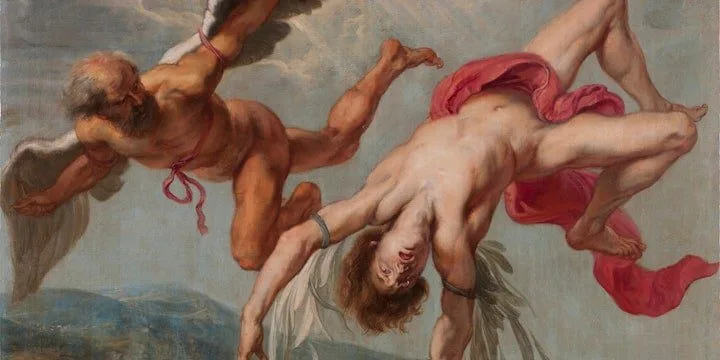
The Myth of Daedalus and Icarus
The myth of Daedalus and Icarus begins long before Icarus' birth. Daedalus, according to tradition, was an unparalleled sculptor. In one of Plato's dialogues, Socrates mentions a legend whereby Daedalus' sculptures had to be tied up, or they would run away. His art was so alive, he ended up gaining life. It is no coincidence that many ancient wooden cult statues in Greek temples were attributed to him. Pausanias, a 2nd century AD traveler, saw several of these statues, which were considered works of the legendary sculptor, and wrote that they rendered an intense sense of uncle.
But Daedalus was more than a skilled artist. He was an inventor. The ancients attributed him a series of inventions, with more important woodworking. In a sense, Daedalus was the mythical equivalent of a Renaissance man.
«For many years, Minos has been fortunate to have in his court the most talented inventor, the most skilled craftsman except for the Olympic blacksmithies of Hephaestus. His name is Daedalus and is capable of making moving objects of metal, bronze, wood, ivory and precious stones. He has conquered the art of wrapping tight steel sheets into strong springs, which control wheels and chains to form complex and marvelous mechanisms that mark the passage of hours with great accuracy and correctness, or control the levels of water currents. There's nothing this wicked man can't invent in his lab. There are moving statues there, men and women who come alive thanks to his ability, boxes that play music and devices that can wake him up in the morning. Even if only half the stories about what Daedalus can achieve are true, then you can be sure that no more cunning and clever inventor, architect and craftsman has ever walked on earth.»
— Stephen Fry, Heroes: Mortals and Monsters, Quests and Adventures
Daedalus in Athens
However, there was also a dark side to Daedalus. The inventor was the greatest of his time, but for a short time he faced serious competition. According to Transformations of Ovidius (VIII.236–259), Daedalus was born in Athens (though other sources want him Cretan) and quickly became a respected citizen thanks to his ability and intelligence. His sister believed that her son, Talos (in other sources of Kalos or Perdix), would benefit greatly if he apprenticed alongside his uncle in Athens. But he didn't know what was coming.
Daedalus took Talo and taught him everything he knew. The boy was young and extremely intelligent. He quickly assimilated knowledge and began applying it to the world around him. Daedalus soon realized that the child was not just intelligent, but smarter than himself. If Talos continued like this, Daedalus would be completely overshadowed. So he threw him off a cliff. Goddess Athena saved Talo by transforming him into a bird, named after his mother, Perdix. Nevertheless, Daedalus was tried for his act and exiled from Athens.
Daedalus in Crete
After his expulsion from Athens, Daedalus found refuge in the court of King Minos, the mythical king of Crete. Minos dominated the seas with a powerful fleet unopposed. With Daedalus in his court, he became almost invincible.
During his stay in Minos' court, Daedalus had the opportunity to start over. There he had a son from a slave named Admiral. The child's name was Icarus. There is hardly any information about Icarus' childhood or his relationship with his father.
Pasiphae, Minotaur and Labyrinth
Daedalus could have lived peacefully in Crete. But one day he was suddenly asked to help Pasiphae, Minos' wife. Pasiphae wanted to commit one of the most appalling acts that one can imagine: to meet with an animal, and even a bull. It all began when Minos asked Poseidon for a sign of divine favor in the form of a beautiful bull. The king promised to sacrifice the animal. God fulfilled his desire and a unique beauty bull emerged from the sea.
Minos was glad Neptune favored him, but he did not want to sacrifice the animal. Instead, he held the bull and sacrificed another in his place. Poseidon had kept the deal, but Minos had not. Punishment was inevitable and came in the form of a divine fury that captured Pasiphae. Minoa's wife was dominated by an uncontrolled desire to meet the bull Poseidon had sent. As he could not carry out the act – the bull had also become insubordinate – he asked for Daedalus' help.
To solve Pasiphae’s problem, Daedalus constructed a hollow wooden cow with wheels. He dressed her with the skin of a real cow and Pasiphae entered the wooden effigy, thus tricking the bull. From the union of man and animal was born Minotaur, half man and half bull.
When Minos saw the terrible creature, he asked Daedalus to build the Labyrinth to hide it there. Later, Minotaur was used by Minotaur to impose a regime of terror in Athens, demanding every so many young and seven young people as a tribute to be devoured by the monster. Finally, Theseus, an Athenian hero, arrived in Crete and killed Minotaur with the help of Ariadne, the daughter of Minos. Some ancient writers even argue that Daedalus helped the couple in his operation.
Daedalus and Icarus in Prison
According to Ovid, at one point Daedalus hated Crete and decided to return home. Minos, however, was determined to keep him close to him and imprisoned him. Other writers say Minos locked him in a cell when he learned of his role in the sin of Pasiphae, in theseus' escape or simply to keep the mysteries of the Labyrinth secret.
Daedalus was imprisoned in a tower overlooking the sea. Life in prison wasn't easy, but at least he wasn't alone.· His beloved son Icarus was with him. Nevertheless, Daedalus was desperate to escape Crete.
«It may prevent our flight from land or sea, but the sky is certainly open: We'll get out of there. Minos rules everything, but he does not rule the heavens.»
— Ovid, VIII,183
So Daedalus did what he knew best: he thought out of the ordinary. The result of his creative outburst was an invention that would haunt the imagination of the Western world for millennia, until man conquered the sky. Daedalus studied bird movements and built a device that imitated them. He placed wings in order, one of the closest to the farther away, and tied them with bee wax and thread. All this time, Icarus played with the wings laughing, without realizing he was touching what would lead to his tragic end.
When Daedalus was finished, he wore the wings. Daedalus and Icarus looked, as the father flew in front of the son. Then he explained how to use the wings and what to avoid:
«I warn you, Icarus, follow the middle road: if you fly too low, the moisture will weigh your wings.· If you fly too high, the sun will burn them. Traveling between the ends. And I command thee not to turn unto Botite, the Boscus, nor to Elicia, the Great Arct, nor to Orion's sword.· Follow the path I'm showing you!»
— Ovid, VIII.183–235
Daedalus' warnings had a dramatic tone. He understood that this was not a game, but a journey that could end badly. Fear of his son's life overwhelmed him. The tears flowed out of his eyes and his hands trembled. Icarus' reactions showed that he did not recognize the dangers of flying. However, there was no other choice. Daedalus approached Icarus and kissed him. Then he flew again, leading the road and teaching him how to use his wings properly.
Ovidus writes that a farmer, a shepherd and a fisherman saw Daedalus and Icarus fly away and passed them for gods — a scene that was beautifully depicted on the painting Landscape With Icarus Fall Peter Brigel of the Elder.
Icarus Flys Very Near the Sun
Daedalus and Icarus flew and left Crete behind. They were no longer out of Minos' range, but not safe. As they approached the island of Samos, Icarus became arrogant. He felt an irresistible impulse to fly toward the sky, as close to the sun as he could. He ignored Daedalus' instructions and rose higher and higher, until the candle holding the wings melted and Icarus fell with momentum. He tried to fly, but his hands were naked now. He fell, and all he had left was to call out his father's name.
«Father!»
«Icarus, Icarus, where are you? Which way do I look to see you?» Daedalus shouted, but Icarus had already drowned in the dark sea, since then named Icarius Sea.
«Icarus!» He shouted again, but he didn't get an answer.
Finally, Daedalus found the dead Icarus floating among wings. Cursed by his inventions, he took the body to the nearest island and buried it there. The island where Icarus was buried was named Ikaria.
Once Daedalus buried his son, a little bird flew beside his head. It was his nephew, Talos. —now Perdix— who had returned to enjoy the pain of the man who almost killed him out of envy. Thus comes the end of the myth of Daedalus and Icarus.