
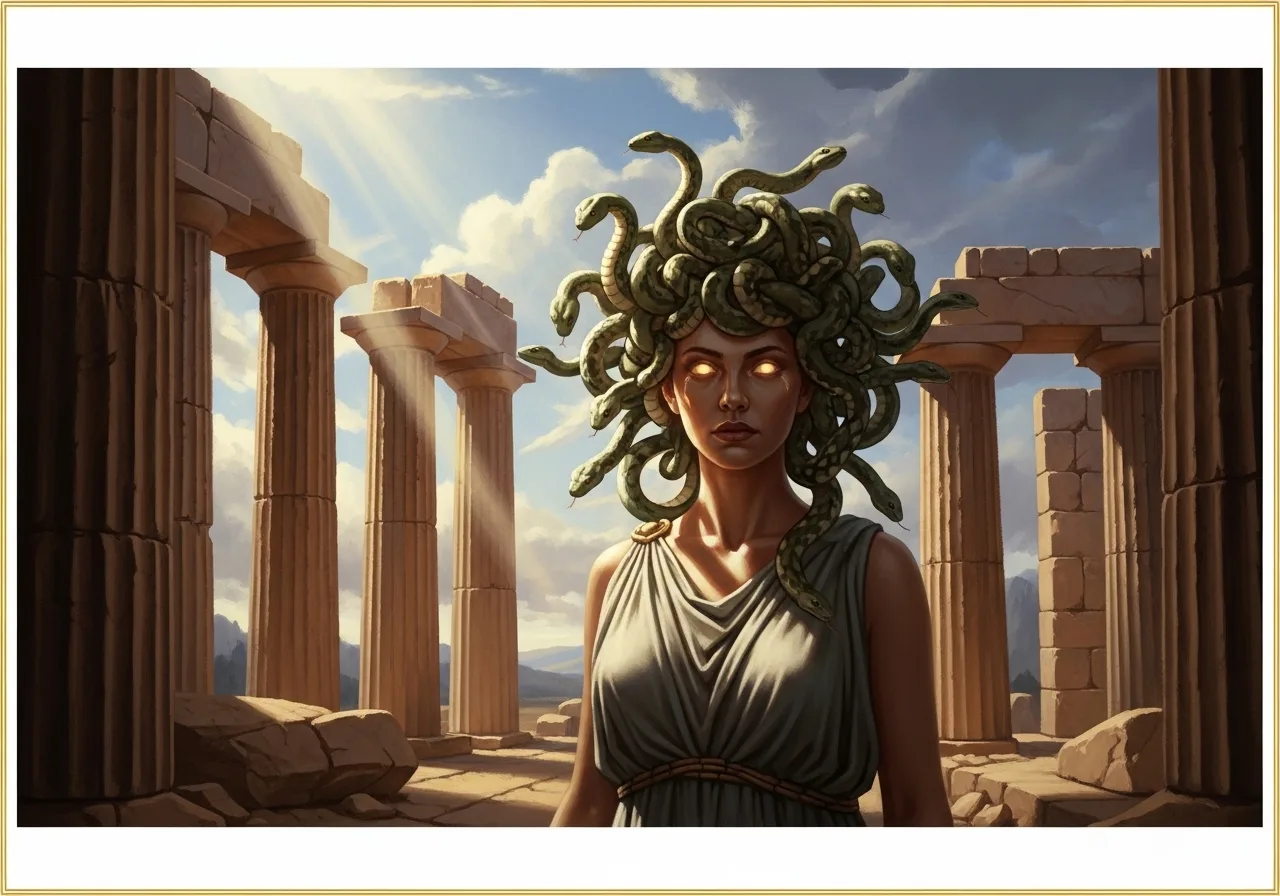
Greek mythology is full of gods, heroes and ghosts stories. But behind these accounts lies something far deeper: an entire world of symbolisms reflecting the thought and experience of ancient Greeks.
Hidden symbolism in Greek mythology reveals that myths were not created merely for entertainment. Rather, they acted as tools for understanding the world, nature, and human behavior.
As we explore what the myths really meant, we find that each story contains multiple levels of interpretation. From the forces of nature to the deepest human emotions, myths speak a timeless language that remains timely to this day.
Ancient Greeks did not understand the myths literally. These stories acted as symbolically «tools» explaining phenomena and situations that could not be interpreted scientifically.
The gods, for example, were not merely supernatural beings. They symbolized forces of nature and human qualities. THE Zeus He expressed authority and order, while Poseidon represented the unstable and unpredictable power of the sea.
Through this prism, hidden symbolism in Greek mythology becomes a «key» That helps us understand stories deeper.
Many myths function as a mirror of human psychology. Heroes are not perfect; they make mistakes, fear, doubt and
only accounts, but also life lessons.
Beyond psychology, many myths explain natural phenomena. Before

the development of science, people used mythology to understand the world around them.
The change of seasons, for example, is associated with the myth of Persephone, while the thunders were attributed to Jupiter. Through such stories, the ancient Greeks gave meaning to what surrounded them.
Hidden symbolism in Greek mythology proves that myths were a way of interpreting reality.

Greek mythology continues to influence modern culture. Legends reappear in books, films, and video games, often with new interpretations.
In literature, the ancient myths inspire modern fantasy accounts. In cinema, stories of gods and heroes are carried on the large screen in an impressive way.
In video games, titles inspired by Greek mythology allow players to experience these worlds interactively.
This influence shows that hidden symbolism in Greek mythology remains alive and continues to inspire new generations.
Conclusion
Greek myths are much more than simple stories.
They are a complex system of symbols that connects man to his nature, society and inner world.
Hidden symbolism in Greek mythology helps us to look at these stories with a new look and discover their timeless value.
❓ FAQ
1. What is hidden symbolism in Greek mythology?
It is the deepest meaning behind myths, involving ideas, emotions and natural phenomena.
2. Did ancient Greeks literally believe in myths?
To a large extent, myths also functioned symbolically, not only as literal accounts.
3. What is the role of gods in myths?
The gods symbolize forces of nature and human characteristics.
4. Why do myths remain timely?
Because they touch timeless subjects like life, fate, and human nature.
5. How can we interpret a myth today?
Through symbolic, psychological and cultural analysis, depending on the context.
Explore the Full Mythology Guide in our collection.
Bibliography
Ancient Sources
- Metamorphosis. Translation in Greek: Cactus or other valid version.
- Library. Athens: Cactus.
- Tour of Greece. Athens: Cactus.
- Fabulae. Harvard University Press (Loeb Classical Library).
Modern Studies
- The Greek Myths. Penguin Books.
- The Complete World of Greek Mythology. Thames & Hudson.
- Greek Religion. Harvard University Press.
- A Companion to Greek Mythology. Wiley-Blackwell.
- The Cambridge Companion to Greek Mythology. Cambridge University Press.