

His myth Apollo and Daphne is one of the most characteristic myths of the transformation of Greek mythology, known mainly through Latin tradition but with roots also found in Greek sources of older times. It is a narrative that combines unfulfilled love, resistance to oppression, the power of nature and the birth of one of the most important symbols of the ancient Greek world: the laurel crown. In this article we will examine in detail the origins of myth, the ancient sources that carry it, its symbolism and its influence on art and literature until today.
Who was Apollo?
Apollo was his son. Zeus and Leto, her twin brother Artemis, and is considered one of the most multidimensional deities of the 12th. According to tradition, she was born on the island of Delos, where Lito fled to avoid her jealousy Hera. Its origin is closely related to light and purity, elements reflected in its names, such as «Phoebus», meaning bright or clean.
Apollo in Greek mythology is not just a god of light. He is also a god of music, as he owns the lyre and is considered a patron of the Muses· god of divination, with the famous Oracle of Delphi to be its main center of worship· god of poetry and arts· and excellent archer, skill that plays a decisive role at the beginning of this particular myth. The complexity of his character makes him one of the most representative deities of the Greek spirit, combining order, harmony, but also a certain arrogance that, as we shall see, is a central element of the narrative.
Who was Daphne?
Daphne, according to the prevailing version, was Nymph, daughter of the river god Pineios, which is connected to the river of Thessaly. Other, less widespread traditions, refer to her as the daughter of Ladon, the river of Arcadia, which shows that the myth did not have a single, consolidated form in antiquity, but varied according to local tradition.
Daphne is described as closely related to ArtemisThe goddess of hunting and chastity. Like this goddess, Daphne was bound by a purity oath, choosing a life dedicated to hunting and nature, away from marriage ties. Her desire for freedom and autonomy is one of the most interesting elements of the myth, as Daphne does not appear as a passive victim, but as an existence of her own will, which consciously refuses to submit to the erotic desire of a god.
The beginning of the myth
The narrative, as preserved primarily by Ovid In his *Metamorphoses*, he begins immediately after Apollo’s victory over the monstrous serpent Python, which had been terrorizing the region of the Delphi. Apollo, having just accomplished this feat, is overcome with pride in his skill with the bow. In this state of arrogant self-confidence, he encounters Eros, the young god with the bow, and mocks him, considering Eros’s weapons insignificant compared to his own, which had just slain a monster.
This insult to the Eros It turns out to be fatal. The little god, offended, decides to avenge Apollo's arrogance, not by force, but by his own, especially, weapons: two arrows with completely opposite qualities.
The two arrows of Eros
According to Ovid, Eros possessed two magical arrows, each with the power to produce a completely opposite effect. The first was a sharp, golden arrow that inspired overwhelming love and irresistible desire in anyone it struck. The second was a blunt arrow tipped with lead, which extinguished affection and filled its target with aversion to love. Together, these two arrows symbolize the unpredictable and often unequal nature of human emotions, where love may be intense for one person yet entirely absent in another.
Determined to punish Apollo for his arrogance, Eros devises a cruel but ingenious form of revenge. He strikes Apollo with the golden arrow, causing the god to fall instantly and hopelessly in love with Daphne. At the same moment, he pierces Daphne with the leaden arrow, leaving her incapable of returning Apollo's feelings or experiencing romantic desire. This contrast lies at the heart of the myth, serving as a powerful allegory for unrequited love—a relationship in which one person's overwhelming passion is met only with rejection, making reconciliation impossible from the very beginning.
The pursuit of Daphne
The moment Apollo sees Daphne, he is overwhelmed by an irresistible passion. He approaches her and tries to win her over, speaking of his divine lineage, his greatness, and the many gifts that set him apart from gods and mortals alike. Daphne, however, remains completely unmoved. As soon as she realizes his intentions, she turns and flees. What follows is one of the most dramatic chase scenes in Greek mythology, as Apollo relentlessly pursues the nymph through the forest while she runs in desperation, calling upon her father for help.
Ovid recounts the scene with remarkable poetic intensity, comparing the chase to an eagle pursuing a hare or a wolf closing in on a frightened deer. These vivid images emphasize the unequal balance of power between an immortal god and a mortal nymph. Daphne's flight is far more than an attempt to escape physically—it is her final act of resistance. Unable to match Apollo's divine power, she fights to preserve her freedom, her identity, and the life she has chosen for herself, even as her chances of escape grow ever smaller.
Daphne's Transformation into the Laurel Tree
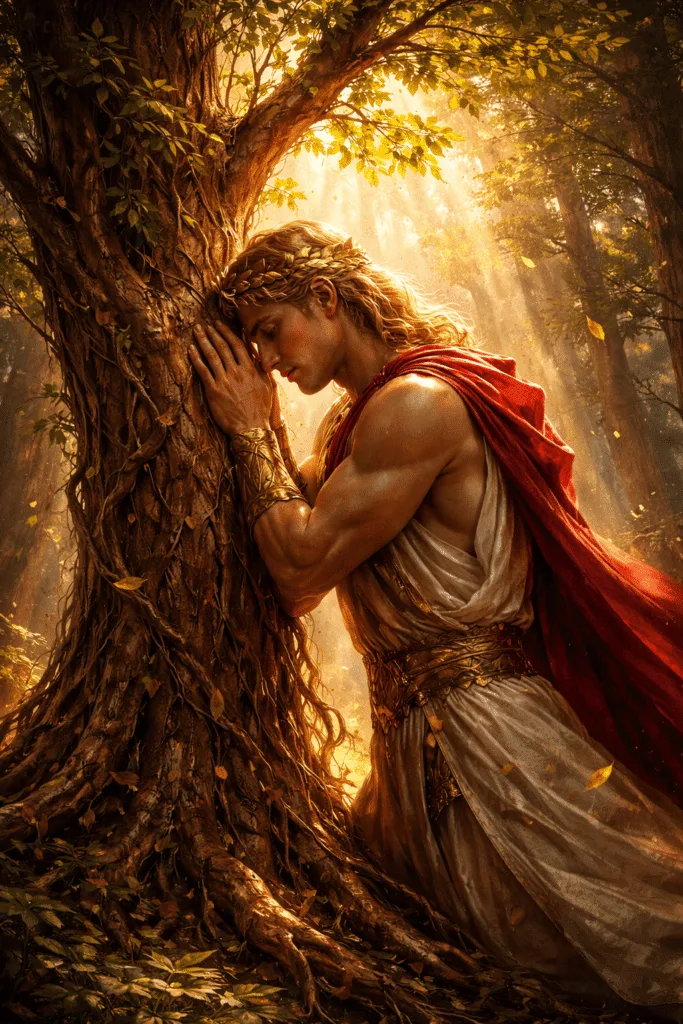
As Apollo draws ever closer and Daphne realizes that escape is no longer possible, she offers a desperate prayer to her father, the river god Peneus, begging him to take away the beauty that has become the cause of her suffering. Moved by her plea, Peneus answers immediately. Daphne's feet take root in the earth, her skin hardens into bark, her arms stretch into branches, and her flowing hair becomes a crown of leaves. Before Apollo's eyes, the nymph is transformed into a laurel tree, retaining, as Ovid beautifully describes, a trace of the grace and beauty that had once defined her human form.
Witnessing the transformation, Apollo embraces the newly formed laurel tree, realizing that Daphne is forever beyond his reach. Though he can no longer possess the woman he loves, he vows that the laurel will remain sacred to him for all time. He declares that its evergreen leaves will adorn his hair, his lyre, and his quiver, ensuring that Daphne's memory will live on forever as a symbol of honor, victory, and eternal glory.
Why the Laurel Became Apollo's Sacred Tree
Apollo's decision to establish laurel as his sacred tree is not merely an emotional gesture, but acts as a causative myth, i.e. as an account explaining the origin of an existing cult practice. In ancient Greece, The laurel was already associated with the worship of Apollo, especially in Delphi, and the myth comes to offer a narrative explanation for this connection.
According to the myth, Apollo swears that the laurel will forever adorn his hair, his lyre, and his quiver. He also declares that its leaves will crown those who achieve greatness in athletic competitions, military victories, and the arts, ensuring that Daphne's memory will be honored for generations to come. In this way, a deeply personal tragedy is transformed into a timeless symbol of glory, achievement, and everlasting remembrance.
Symbolism of the Myth
The myth of Apollo and Daphne is rich in symbolic meanings, which partly explains its enduring appeal throughout the centuries. Above all, it is one of the most characteristic narratives of unfulfilled love in ancient literature, where one person’s desire never receives an answer, leading to a resolution that is neither union nor complete loss, but rather a form of eternal, transformed presence.
Secondly, the myth highlights the themes of freedom and personal choice. Daphne chooses transformation — even the loss of her human form — rather than submission to a relationship she does not desire. This choice, although brought about by a higher power, still preserves the element of her conscious refusal and personal agency.
Thirdly, the myth explores the themes of arrogance and divine power, as the initial cause of the story is Apollo’s prideful attitude toward Eros — an act that is punished in a way that reveals that even the gods are not immune to the passions they themselves awaken in others.Fourthly, transformation itself is a central theme, as the change of form functions both as a means of escape and as a way of achieving permanence. Daphne does not disappear; instead, she is transformed into something that will be remembered forever.Finally, the myth emphasizes the power of nature, which serves both as a refuge and as a means of salvation, while Daphne’s memory is preserved eternally through a natural element: the laurel tree.
The Symbolism of the Laurel
The laurel tree, as a result of this transformation, acquired a wide range of symbolic meanings in ancient Greece. It became primarily associated with victory and glory, as the laurel wreath was awarded to winners of athletic competitions and to distinguished figures. It was also connected with wisdom and intellectual clarity, given its association with Apollo, the god of light and knowledge.
Furthermore, the laurel was considered a symbol of immortality, as it is an evergreen plant that preserves its green color throughout the year — a characteristic that suggested endurance and the preservation of memory beyond death.In religious ceremonies, laurel was also used for purification purposes, particularly within the worship of Apollo at Delphi, where the Pythia is believed to have used laurel leaves as part of the prophetic process.Finally, the laurel became closely associated with poetic inspiration, as poets were crowned with laurel wreaths as a symbol of their connection with Apollo, the patron of the arts of speech and literature.
The laurel in ancient Greece
The practical importance of laurel in ancient Greek religion and society was extremely great. The Pythiums, the games held in Delphi in his honor Apollo, the winners were crowned with a laurel wreath, unlike other nationwide struggles where different plants were used, such as the olive tree in Olympia. This choice was not accidental, but was directly linked to Daphne's myth and her relationship with Apollo.
At Delphi, the laurel held a central position in religious practice, both as a decorative element of the temple and oracle and as a means used in the purification rituals that preceded the delivery of prophecies. Beyond its religious use, the laurel was widely adopted by poets and orators as a symbol of recognition and distinction — a tradition that continued, with modifications, into the Roman era and beyond, eventually giving rise to the modern concept of the “poet laureate.”
Ancient sources
The main and most complete account of the myth comes from Ovid and his work Metamorphoses, written in the 1st century BCE, in which the myth of Apollo and Daphne occupies a prominent place in the first book. It is important to emphasize that Ovid was a Roman poet, and therefore the best-known and most detailed version of the myth comes from a Latin source, although it is based on earlier Greek traditions.
Pausanias, in his Description of Greece, refers to local traditions surrounding Daphne and the worship of the laurel at Delphi, providing valuable information about the connection between the myth and specific sanctuaries and locations. Hyginus, a Roman writer of mythological summaries, also records a brief version of the myth in his Fabulae, which generally follows the main outline of Ovid’s narrative, although with fewer details.
Of particular interest is Parthenius of Nicaea, a Greek poet and scholar of the 1st century BCE, who in his work Erotic Passions (Erotika Pathemata) records various versions of love myths, including narratives involving the pursuit of nymphs by gods. This indicates that the motif was not unique to Daphne, but rather formed part of a broader narrative pattern within Greek mythology.It is important to distinguish between these earlier, fragmentary Greek accounts and Ovid’s later, more systematic Latin version, which enriched the myth with literary elements and details that are not fully documented in earlier Greek sources.
The myth in art
The myth of Apollo and Daphne has inspired countless artists from the Renaissance to the present day, precisely because of the dramatic intensity of the moment of transformation, which provides ideal material for depicting movement, passion, and change.The most famous work of art inspired by the myth is undoubtedly the marble sculpture by Gian Lorenzo Bernini, created in the early 17th century, which portrays with extraordinary skill the exact moment of transformation, as Daphne’s fingers and hair turn into laurel branches and leaves.
Before Bernini, Antonio del Pollaiuolo had already depicted the scene in a 15th-century painting, while Titian, a leading figure of the Venetian Renaissance, also explored mythological themes related to this subject, although his treatment of this particular myth never achieved the fame of Bernini’s masterpiece.The popularity of the theme continued into the Baroque period, when the dramatization of emotional climaxes was a central artistic concern, making the moment of transformation an ideal subject for artists. Even in contemporary art, the myth continues to inspire creators, who reinterpret the theme through the lens of issues such as bodily autonomy and the violence of desire.
The reason why the myth inspired so many artists lies in its unique ability to capture a moment of transition — something between two states, the human and the vegetal form — thus offering endless possibilities for the depiction of movement, texture, and emotion within a single instant.
The influence of the myth in literature
Beyond the visual arts, the myth also exerted a profound influence on literature, beginning with Ovid’s own poetic treatment, which is considered one of the greatest literary achievements of Latin poetry.Poets of the Renaissance and Baroque periods repeatedly referred to the myth, using it as a metaphor for unfulfilled love and romantic disappointment, while the laurel wreath itself evolved into an enduring literary symbol of poetic glory, used metaphorically even in eras when the actual crowning with laurel was no longer a living practice.The word “laureate,” still used today to describe honored and award-winning writers, derives etymologically from this very tradition.
Modern interpretations
Modern scholarly study of the myth approaches the narrative from various perspectives, which should be clearly distinguished from the ancient traditions themselves, as they represent interpretative frameworks of contemporary research rather than elements of the original story.Some scholars examine the myth through the lens of personal freedom, viewing Daphne’s refusal as an expression of autonomy in the face of an imposed desire, regardless of its divine origin.
Other approaches focus on the themes of transformation and identity, examining how the change of form functions as a mechanism of negotiation between human and natural existence — a subject that is central to broader studies of metamorphosis in ancient literature.At the same time, some researchers explore the relationship between the myth and nature, recognizing in Daphne’s transformation an ancient perception of the connection between humanity and the natural world.Finally, the myth is often examined as a narrative concerning divine power and its limitations, since even a god like Apollo ultimately fails to fully impose his will, finding only a symbolic, rather than a substantial, form of fulfillment.
Interesting elements
Less well known is the fact that in Arcadia there existed a parallel local tradition that identified Daphne as the daughter of the river Ladon rather than the Peneus, revealing the existence of local variations of the myth already in antiquity.It is also noteworthy that some later sources connect the worship of the laurel at Delphi with earlier, pre-Greek religious practices, which may have existed before the cult of Apollo became established in the region. However, this issue remains a subject of scholarly debate due to the limited available evidence.
It is also worth noting that the Greek word for laurel, “daphne” (δάφνη), gave its name not only to the plant itself but also to scientific botanical terminology, such as the genus Laurus. Likewise, the words “laureate” and “laureated” in many European languages retain a direct etymological connection with the Latin name of the plant, laurus, which itself is a translation of the Greek term.
FAQ
What was the myth of Apollo and Daphne?
It is a myth in which the god Apollo, struck by Eros’s golden arrow, falls in love with the nymph Daphne, who, struck by the opposing leaden arrow, rejects him and ultimately transforms into a laurel tree in order to escape his pursuit.
What was Daphne's origins in Greek mythology?
The prevailing tradition presents her as the daughter of the Pinius River in Thessaly, while an alternative, local tradition of Arcadia considers her the daughter of the Landona River.
Why did Cupid hit Apollo with an arrow?
Apollo, after his victory against Python, mocked Eros for his weapons, considering them trivial. Love avenged this insult by hitting him with the golden arrow of love.
What did Cupid's two arrows symbolize?
The golden arrow symbolized the irresistible love passion, while the lead arrow symbolized the abhorrence and rejection of love, thus creating an asymmetrical and unbeatable relationship between Apollo and Daphne.
Why did Daphne turn into a tree?
Daphne, unable to escape the pursuit of Apollo by natural means, sought the help of her father, Pinios, who transformed her into a laurel tree in order to save her from unwanted union.
Why did the laurel become a sacred Apollo tree?
After the transformation, Apollo stated that the laurel would henceforth be sacred to him, adorning his hair, lyre and quiretra, while being used to coronate winners, thus continually honoring the memory of Nymph.
Who is the main ancient writer who rescued the myth?
The fullest version comes from Ovid and his work Metamorphosis, although there are other references to authors such as Pausanias, Hyginus and Parthenes.
What is the connection between the laurel tree and the Pythian Games?
At the Pythian Games, which were held at Delphi in honor of Apollo, the winners were crowned with a laurel wreath, a direct reference to the myth and the god’s connection to that particular tree.
What is the difference between the Greek and the Latin version of the myth?
Early Greek accounts are fragmentary and relate mainly to local religious traditions, while the detailed, literary narrative with a complete plot comes primarily from the Roman poet Ovid, who systematized and enriched the myth.
What artist portrayed the myth more famously?
The most famous artwork is the sculpture of Gian Lorenzo Bernini, which depicts in detail the exact moment of Daphne's transformation into a tree.
What is the symbolism of the laurel wreath?
The laurel wreath symbolizes victory, glory, wisdom and poetic inspiration, and also refers to the concept of immortality because of the evergreen character of the plant.
Table of Character
| Character | Property | Role in the Legend |
|---|---|---|
| Apollo | God of light, music, divination, and archery | He falls in love with Daphne after being struck by Eros' golden arrow and pursues her |
| Daphne | Nymphe, daughter of Peneus | She rejects Apollo's love and transforms herself into a laurel tree to escape him |
| Eros | God of love, son of Aphrodite | He avenges the insult to Apollo by striking the two with opposing arrows |
| Pineos | River god of Thessaly | Daphne's father answers her plea and transforms her into a tree |
Timeline of the Myth
- Apollo kills Python and mocks Cupid for his weapons.
- Eros takes his revenge, striking Apollo with a golden arrow and Daphne with a leaden one.
- Apollo falls in love with Daphne and tries to get close to her.
- Daphne rejects him and flees.
- Apollo is chasing her through the woods.
- Daphne, seeing that she has no way out, calls on her father, Peneus, for help.
- Peneios transforms her into a laurel tree.
- Apollo establishes the laurel as his sacred tree and symbol of glory and victory.
Conclusion
The myth of Apollo and Daphne remains, centuries after its first recorded appearance, one of the most timeless narratives of Greek mythology, precisely because it explores universal themes: the imbalance of love, resistance against coercion, the power of personal choice, and transformation as a means of survival and perpetuation. The transformation of Daphne’s tragedy into a symbol of glory, through the laurel wreath, reflects the way ancient Greek thought turned human suffering into a lasting cultural legacy. From Delphi and the Pythian Games to Bernini’s sculptures and the modern literary use of the term “laureate,” the myth continues to inspire the imagination, proving that ancient Greek mythology still retains, even today, the ability to speak about the deepest aspects of the human experience.
Bibliography
Ancient Sources
- Ovidius; Transformations (Metamorphoses), Book I, 438–567
- The most famous and detailed version of the myth of Apollo and Daphne. The Roman poet describes Apollo's love after being struck by Cupid's golden arrow, the pursuit of Daphne and her transformation into laurel.
- Virgin Nicaeus, Love Suffering (Erotika Pathemata), 15 – «Daphne»
- Early Greek fictional source associated with the myth of Daphne.
- Pausanias, Greece Tour, 8.20
- It provides information on local traditions about Daphne and Arcadia.
- Hyginus; Fabulae
- Collection of Roman mythological traditions including references to Apollo and Daphne.
Modern Bibliography
- Barnard, Mary E. (1987). The Myth of Apollo and Daphne from Ovid to Quevedo: Love, Agon, and the Grotesque. Durham: Duke University Press.
- Studying the evolution of myth from Ovid to modern European literature, with emphasis on the themes of love, conflict and transformation.
- Griffiths, Alan H. (2015). "Daphne, nymph of Greek myth." Oxford Classical Dictionary / Oxford Research Encyclopedias.
- Academic presentation of the form of Daphne, ancient sources and her relationship with Apollo.
- Francese, Christopher (2004). "Daphne, Honor, and Aetiological Action in Ovid’s Metamorphoses.” The Classical World, 97(2), 153–157.
- Analysis of the importance of the transformation of Daphne and the connection of myth to the explanatory tradition.
- Nicoll, W. S. M. (1980). "Cupid, Apollo, and Daphne." The Classical Quarterly, 30(1), 174–182.
- Studying the relationship between Love, Apollo and the pattern of love failure.
External Sources
- Theoi Greek Mythology – Daphne
It gathers ancient sources, artistic illustrations and bibliographic references for Daphne. - Oxford Classical Dictionary – Daphne, nymph of Greek myth
Academic source for Daphne's mythological tradition. - Perseus Digital Library – Ovid, Metamorphoses
Digital library of ancient texts with access to the original Latin text and translations. - The Metropolitan Museum of Art – Apollo and Daphne (artistic illustrations)
Useful for section «The myth in art».