
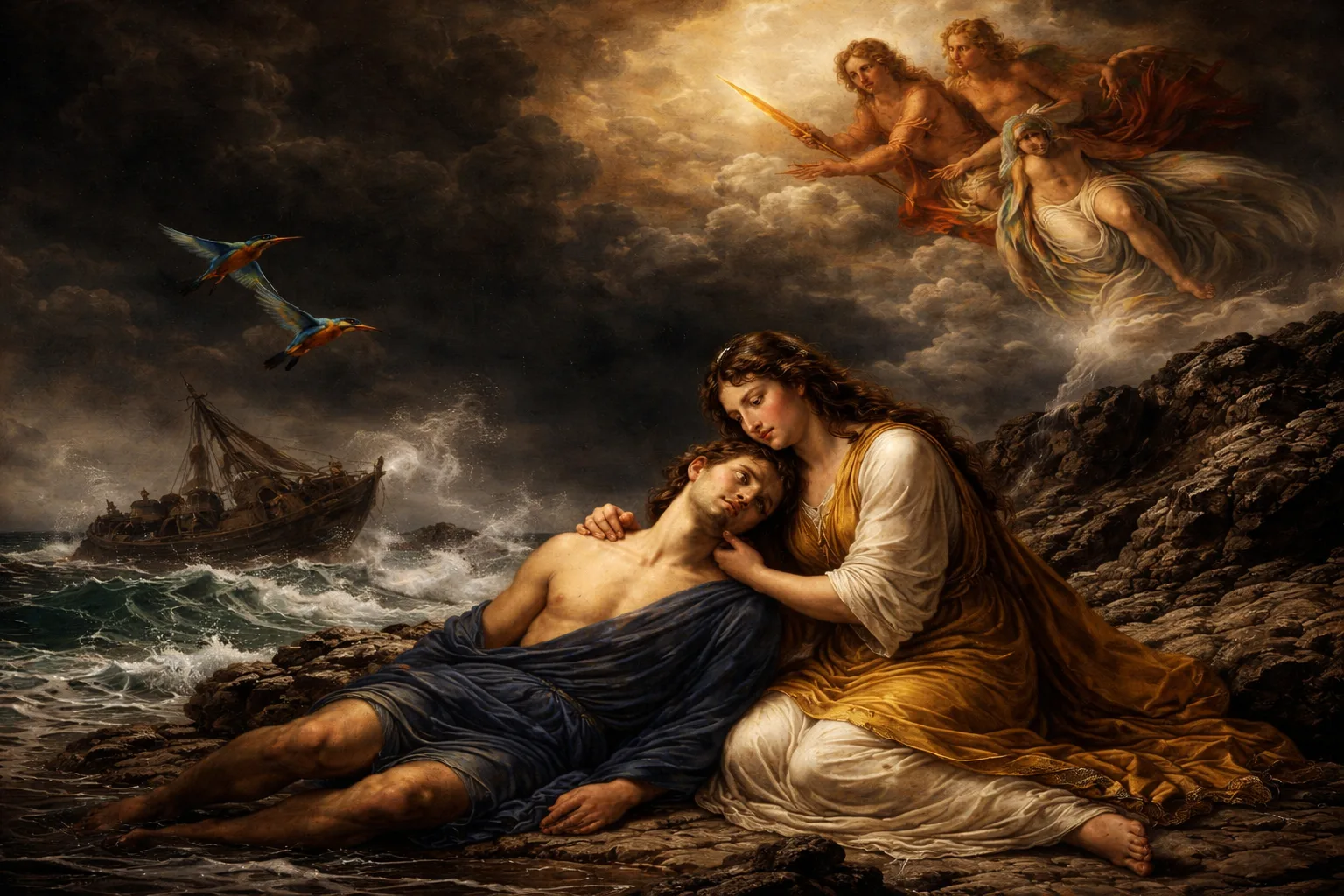
The myth of Alkyone is one of the most touching and influential myths of Greek mythology, combining elements of love, hybris, divine punishment and transformation. It belongs to the wider circle of myths related to the relationship of people and gods, while at the same time explaining natural phenomena through mythological thought. Alcyone's narrative is directly linked to her husband, Keykas, and culminates with their transformation into sea birds, which gave their name to the famous «Halcyon days».
Genealogy and mythological context
Alkyone is considered the daughter of Aeolus, the god of the winds, which incorporates the myth into a context of secular and natural importance. THE AeolusAs a wind regulator, it has a special place in mythology, as it controls forces that directly affect the sea and human life.
Alcyone married him Goat, King of Trachina and his son Lucifer (or Phosphorus), the personification of the morning star. This union symbolizes the connection of heavenly and earthly elements, while their relationship is presented as a model of marital love and devotion.
Hybridity and divine intervention
According to the most famous version of the myth, Alkyone and Keykas were so happy and devoted to each other that they began calling each other by the names of the gods: he called her «Hera» And she called him «Zeus». This act was considered a hybrid, that is, transcending the boundaries that the gods set on mortals.
Hubris is a key motif in ancient Greek thought and is associated with inevitable divine punishment. The gods, and especially Zeus, did not tolerate questioning the order of the world. Therefore, they decided to punish the couple.
The journey of the King and his death
The Keykas, desiring to consult the oracle on a matter (in some traditions to atone for the hybrid), began a sea voyage. Despite Alcyone’s warnings, which he feared for his safety, he insisted.
During the trip, a severe storm broke out. The winds, under the influence of divine will, caused the shipwreck of the ship and the death of the Cyca. This scene highlights the power of nature as the tool of the gods, but also the weakness of man towards destiny.
The dream and the revelation
Alkyone, unsuspecting of her husband's fate, waited for his return. The gods, moved by her devotion, decided to reveal the truth to her.
Sleep sent a dream, through which the figure of the dead Garden appeared. In this dream, the King revealed his death to her and begged her to mourn him. The dream works here as a means of communication between the world of living and the dead, an element often found in the ancient Greek secretariat.
The self-sacrifice of Alcyone
After the revelation, Alkyone headed to the shore, where she found her husband's body floating. Broken by pain, she was thrown into the sea to join him in death.
This act is a culmination of the tragedy of the myth and highlights its absolute devotion and love. Her self-sacrifice is not presented as an act of weakness, but as an expression of deep emotional unity.
Transfiguration and redemption
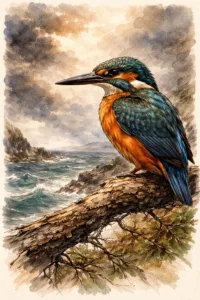
The gods, moved by the couple's love and tragic fate, they decided to transform them into birds — specifically in alkyones (a species of seabird, known today as a fishing bird or kingfisher).
Metamorphosis is a form of redemption: the couple acquires a new form and continues to exist together, beyond the limits of human life. In Greek mythology, such transformations often function as a symbolic restoration of balance.
The Halcyon days
According to tradition, during the winter period where Alkyone lays her eggs, her father, Aeolus, retains the winds, so that the sea remains calm. These days are known as «Halcyon days» and characterized by unusual summer in winter.
This phenomenon, although having natural explanations in meteorology, was attributed mythologically to the care of the gods to Alcyone. Thus, myth acts as an interpretive tool for natural phenomena.
Symbolism and interpretation
The myth of Alcyone can be analyzed at multiple levels:
- Hybris and nemesis: The couple is punished for exceeding the limits of the human measure.
- The power of love: Alkyone's devotion is presented as a force that transcends death.
- The transformation as redemption: Divine intervention restores balance and offers eternal union.
- Nature and myth: Halcyon days show how ancient Greeks associated natural phenomena with mythological accounts.
The myth in literature and tradition
The most famous literary version of the myth comes from «Transformations» of Ovid, where it is presented with strong dramatic and poetic elements. Through its narrative, the myth acquires a timeless dimension and affects western literature.
At the same time, the concept of «Halcyon days» remains alive in the Modern Greek language, used metaphorically to declare periods of calm in difficult situations.
Alcyone as a symbol of love, transformation and hope
The myth of Alkyone is among the most lyrical and touching accounts of Greek mythology. Beyond the history of her devotion to her husband Keukas, this tradition explores deeper issues, such as human hybrids, divine justice, the power of love and rebirth through sorrow. The transformation of the couple into seabirds is not just a punishment or divine intervention, but symbolizes the continuity of love even after death.
According to legend, Alkyone and Keukas loved each other so much, they called each other «Hera» and «Jupiter»This behavior was considered an insult to the gods, as mortals were not allowed to be equated with divine forms. This hybris provoked Zeus’ anger, who decided to remind the boundaries between humans and immortals. History thus acts as a typical example of the ancient Greek notion that arrogance towards the gods inevitably leads to nemesis.
At the same time, the myth highlights the close relationship between man and the sea. The journey of Keukas, the sea riot and the wreck reflect the uncertainty that characterized the lives of ancient sailors. The sea was a source of wealth and communication, but at the same time it was a place full of dangers, where the fate of man depended on the dispositions of gods and natural forces.
Alcyone is presented as a model of a devoted wife. Her despair when she learns the death of her loved one and her decision to follow the same fate reveal the intensity of her emotions. However, the gods do not let history end exclusively in tragedy. Moved by her devotion, they transform both into alkylones, giving them a new existence near the sea that determined their destiny.
Metamorphosis is one of the most important patterns of ancient mythology. In many Greek myths, gods transform people as either punishment or reward or as a means of salvation. In the case of Alcyone, the transformation combines all these elements. Human life ends, but love continues in a new form, rendering history a highly optimistic symbolism.
The Alkyonid days in ancient tradition
Of particular importance the myth gained through its connection to the famous Alkyonid days. According to tradition, when Alkyone laid her eggs on the sea during winter, Zeus ordered the winds to stop and the waves to calm down, to protect her nest. Thus were created a few days of peace and sunshine within the coldest month of the year.
This tradition was particularly dear to ancient Greeks, as it combined mythology with the observation of nature. Even today, the expression «Alcyonide days» is used to describe the sunny and mild days usually occurring in the middle of winter. Although the phenomenon now explains weather, its name keeps its connection to ancient myth alive.
Alcyone in literature and art
Alcyone's story was widely spread thanks to Transformations of Ovid, where it is presented with special lyrality and emphasis on human emotion. This work deeply influenced medieval and Renaissance literature, as well as the painting of Europe. Many artists portrayed the moment Alkyone discovers the body of Keukas or the divine transformation of the couple into birds.
Its form also appears in poems, plays and musical compositions, where it symbolizes loyalty, faith and hope that love can defeat even death. The timelessness of the myth proves that the human feelings it expresses remain topical regardless of the time.
Modern interpretations of myth
Modern scholars approach the myth of Alcyone from different perspectives. Some consider him an allegory for the cycle of nature and the alternation of bad weather with peace. Others argue that it reflects the anguish of ancient societies toward the dangers of navigation and the need for divine protection.
At the same time, the myth highlights the role of women as a body of faith and stability within the family. Alkyone does not stand out for war actions or superhuman power, but for her devotion, patience and sincere love. These virtues make it one of the most human and beloved forms of Greek mythology.
The myth of Alcyone continues to thrill because it combines grief with hope. History begins with loss and pain, but ends with a form of redemption that transcends death. Through the transformation of the couple and the birth of the Alkyonid days, Greek mythology recalls that even in the most difficult times there can be a period of peace, light and new beginning.
Conclusion
The myth of Alkyone is a complex and deeply symbolic account of Greek mythology. Through its history, fundamental concepts of ancient Greek thought emerge, such as hybris, divine justice, the power of love and harmony of the natural world.
His timeless value lies not only in his literary beauty, but also in his ability to offer interpretations about human experience and human-nature relationship. The myth of Alkyone, thus, remains one of the most touching and essential examples of the Greek mythological tradition.
Bibliography
Ancient Sources
- Metamorphosis. Translation in Greek: Cactus or other valid version.
- Library. Athens: Cactus.
- Tour of Greece. Athens: Cactus.
- Fabulae. Harvard University Press (Loeb Classical Library).
Modern Studies
- The Greek Myths. Penguin Books.
- The Complete World of Greek Mythology. Thames & Hudson.
- Greek Religion. Harvard University Press.
- A Companion to Greek Mythology. Wiley-Blackwell.
- The Cambridge Companion to Greek Mythology. Cambridge University Press.