
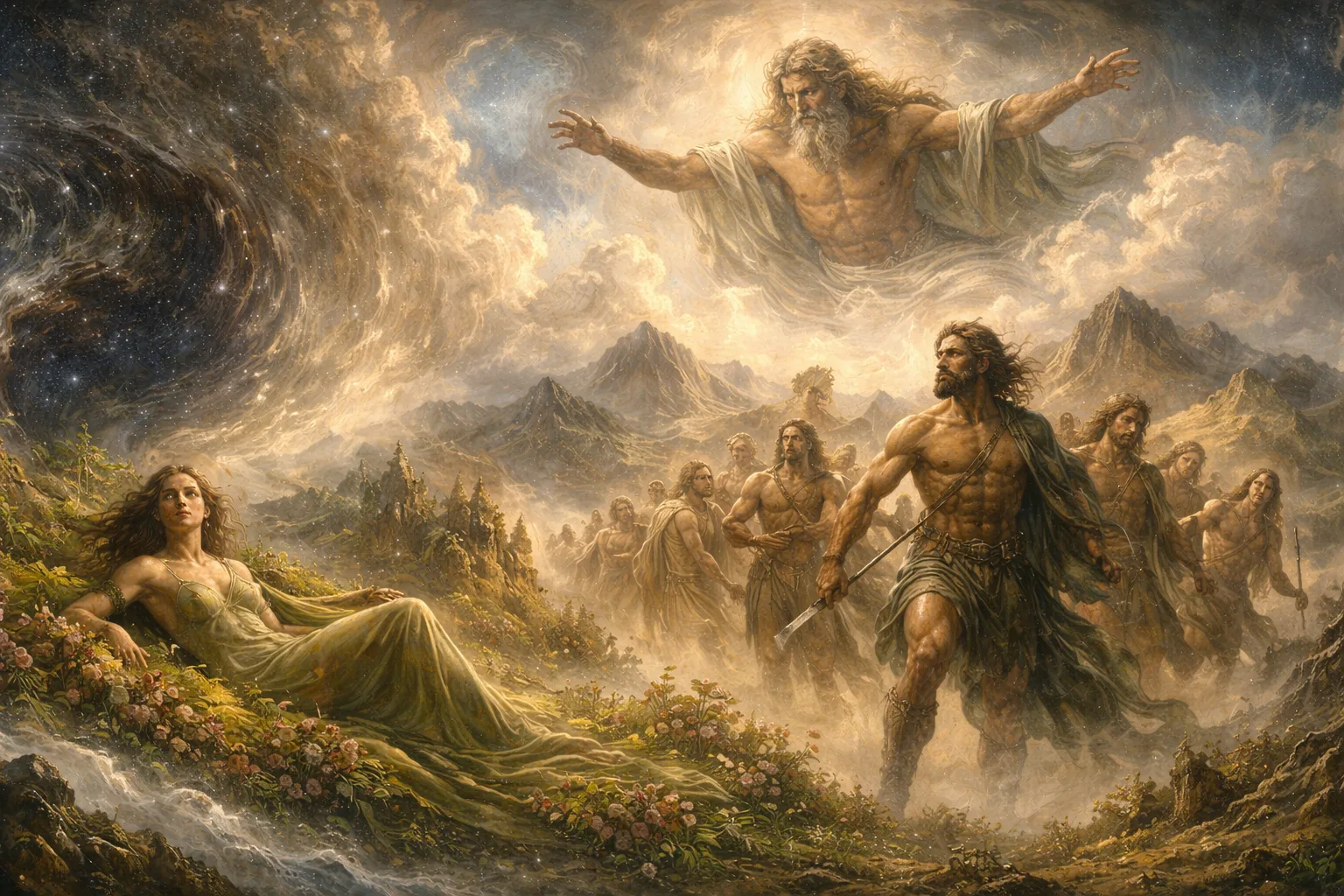
The Full World of Greek Mythology
According to Hesiod and his work Theogony, the first deity from which the rest came was Chaos. From Chaos came Erebus (darkness), Ether (light), Nyx (night), Hemera (day), Tartarus (the underworld) and Eros (reproduction). Primitive deities were usually depicted as places or kingdoms, as shown by the above. The Gaia (Mother Nature or earth) was also his daughter House, together with the Uranos (heaven) and Pontos (sea).
Greek cosmogony is not just a narrative of the creation of the world. It is a deep, poetic and often violent vision of how order was born through chaos, light through darkness, and divine power through eternal conflict.
At the heart of this tradition lies the Theogony of Hesiod, one of the oldest and most important texts of the Greek secretariat. But cosmogenicity is not limited to that. It draws elements from orphic traditions, archaic hymns and local myths that compose an impressively complex picture of the genesis of the universe.
That's the full story.
1. Chaos – The Beginning of All
At first there was no heaven, no earth, no gods. There was only the Chaos.
Chaos was no disorder in the modern sense· was the opening, the infinite void, the shapeless possibility. From this emerged the first secular entities:
Gaia (the Earth)
Tartarus (the deep depth)
Eros (the power of attraction and creation)
The Nyx
Erebus
Being begins not with matter, but with principles. Attraction precedes form.
2. The Birth of Heaven and the First Deities
- Gaia It gives birth to Heaven, Pontus and the Mountains on its own. Heaven becomes her companion. Together they bring the world a new generation of beings:
The Titans
The Cyclops
The Hundred Hands
But creation is accompanied by fear. Heaven, frightened by the power of his children, imprisons them in the bowels of the Earth. The first act of power in secular history is oppression.
The cosmogony of Greek mythology does not idealize the birth of the world. It shows it as a conflict.
3. The Fall of Heaven – Saturn’s Rise
Gaia, hurt and angry, draws up a revenge plan. The youngest Titan, the Cronus, he accepts to turn against his father.
With a sickle of adamant, Saturn castrates Heaven. From the blood falling on Earth new forms are born: Furies, Giants, and Honeys. From the sea foam emerges Aphrodite.
Violence is being created again.
Saturn takes power. But the circle repeats itself. He learns that one of his children will overthrow him. And so, like his father before him, he begins swallowing his own children.
4. The Birth of Zeus and Titanic Fight
Rea saves her younger child, Zeus, hiding him in Crete. Zeus grows away from his father, but not away from destiny.
When he comes of age, he forces Saturn to throw up his brothers. The ensuing collision — The Titanic — lasts ten years. It's not just a battle for power. It is a conflict of generations, secular principles, old and new world.
With the help of Cyclops and Centurions, Zeus wins. Titans throw themselves at Tartarus. The world is changing.
5. The Establishment of the World Order
Zeus is not just king of the gods. He's the world's organizer. He shares powers:
In Neptune the waters
In Hades the underworld
In the sky itself
The world is gaining structure. Olympus becomes the center of the divine order. The gods are no longer primary powers· persons with a character, will and plans.
The cosmogony passes from elemental to anthropomorphic.
6. Orphic Traditions – The Cosmic Egg
In parallel with Hesiod, Orphic tradition offers a different perspective.
In Orphic cosmogony, at first there is Time and Need. The Cosmic Egg is born of them. From the Egg emerges Fanny — a bright, primary deity that brings in the seeds of all things.
Here creation does not begin with violence, but with display of light. The emphasis shifts from conflict to revelation.
The two traditions do not negate each other. They complement the cosmic vision of the Greeks.
7. Humanity – The Position of Man
After the establishment of divine order, the question arises: where is man?
The myth of Prometheus shows that man is not a passive creation. He's a being who claims knowledge. The fire stolen by the gods is not just technology — It's a conscience.
Greek cosmogony does not place man in the center of the universe. But it puts him in a dramatic relationship with the uncle.
8. The Deepest Meaning of Greek Cosmogonia
The creation of the world, as the Greeks tell it, is not a momentary act. It's a process of successive twists.
Chaos → Primary Forces → Titans → Olympians → Man.
Each stage contains a collision. Every new order is born through the overthrow of the former.
The cosmogony thus becomes philosophy:
Power is fragile.
Creation is painful.
Order is not given — It is conquered.
Conclusion
The full cosmogony of Greek mythology is one of the most complex creation narratives in the ancient world. It does not merely offer answers to «how the world was created»But it raises deeper questions about the power, fate and nature of existence.
From the darkness of chaos to the lightning of Zeus, the story of the birth of the world is a history of transition — from the shapeless possibility to organized reality.
Genealogical Table of Greek Deities
CHAOS
│
├── GAIA (Earth)
│ │
│ ├── Uranus (Uranus)
│ │ │
│ │ ├── TITANS
│ │ │ ├── OCEANUS
│ │ │ ├── COEUS
│ │ │ ├── CRIUS
│ │ │ ├── Hyperion
│ │ │ ├── IAPETOS
│ │ │ ├── Cronus ── RHEA
│ │ │ │ │
│ │ │ │ ├── ZONES
│ │ │ │ ├── HERA
│ │ │ │ ├── POSEIDON
│ │ │ │ ├── DEMETER
│ │ │ │ ├── HESTIA
│ │ │ │ └── HADES
│ │ │ ├── THEMIS
│ │ │ ├── Mnemosyne
│ │ │ ├── PHOEBE
│ │ │ └── Tethys
│ │ │
│ │ └── CIRCLES / Hecatoncheires
│ │
│ └── ΠΟΝΤΟΣ (Θάλασσα)
│
├── Tartarus in Greek Mythology (Abyss)
│
├── EROS (Creative power)
│
├── Erebus ── ΝΥΞ (Νύχτα)
│ │
│ ├── AETHER
│ ├── HEMERE
Death
Sleep
│ ├── NEW
│ └── ΜΟΡΟΣ
OLYMPIAN GODS
│
├── ZONES
With HERA
│ │ ├── ARES
│ │ ├── HBO
│ │ └── ΕΙΛΕΙΘΥΙΑ
│ │
│ ├── με ΜΗΤΙΔΑ
│ │ └── ATHENA
│ │
With LATE
│ │ ├── APOLLO
│ │ └── ARTEMIS
│ │
│ ├── με ΜΑΙΑ
│ │ └── HERMES
│ │
│ ├── με ΣΕΜΕΛΗ
│ │ └── DIONYSUS
│ │
With DEMETER
│ └── PERSEFONE
│
├── POSEIDON
│ ├── Third
│ └── POLYPHY
│
├── HADES
ZAGRYS (hormic tradition)
│
├── APHRODITE
│ ├── ΕΡΩΣ
FEAR
INDICATION
│
├── ARES
FEAR
INDICATION
│
├── HEPHAESTUS
│ └── (τεχνουργήματα – όχι θεϊκά τέκνα)
│
├── DEMETER
│ └── ΠΕΡΣΕΦΟΝΗ
│
├── ATHENA
│ └── (γεννήθηκε άνευ μητέρας)
│
├── APOLLO
│ └── ASKLEPIOS
│
└── ARTEMIS
└── (παρθένος θεά)
Frequently Asked Questions About Cosmology
What is cosmogony?
Cosmogony is the sum of myths and narratives that explain how the world, gods, nature and universe were created according to ancient tradition.
What is the cosmogenicity of Greek mythology?
In Greek mythology, it all starts in Chaos. From this were born the first deities such as Gaia, Tartarus, Eros, Night and Erebus, which formed the basis of the creation of the world.
Who created the world in Greek mythology?
There is no single creator. The world is gradually created through the birth and conflict of primary deities such as Gaia and Heaven.
What was Chaos?
Chaos was the first state in the universe — a vast, shapeless and dark void from which the first forces of creation came.
What was the first deity?
According to Hesiod, after Chaos Gaia appeared, the personification of the Earth and the mother of many gods and creatures.
What was Gaia's role?
Gaia is considered the mother of life and gods. He gave birth to Heaven, the Mountains and the Sea and later the Titans, the Cyclops and other mythical beings.
What is the relationship between cosmogony and theogeny?
Cosmogony explains the creation of the world, while theogeny focuses on the birth and genealogy of the gods. In Greek mythology the two concepts are closely linked.
Who wrote about Greek cosmogony?
The most important source is the Theogenia of Hesiod, where the creation of the world and the origin of the gods is described.
What are primary deities?
The primary deities are the first secular powers to appear at the beginning of creation, such as Gaia, Heaven, Night and Pontus.
How is cosmogony connected to the Titans?
Titans were children of Gaia and Heaven and form the second generation of gods before the rule of the Olympian gods.
Are there different versions of cosmogony?
Yeah. In addition to hesiodia tradition, there were orphic and local versions that otherwise described the creation of the world and the gods.
What is Orphic Cosmogonia?
Orphic Cosmogonia is a mystical version of the creation of the world, where the Cosmic Egg and the god Fanny have an important role.
Why was cosmogony important to ancient Greeks?
Cosmogony helped people understand the nature, position of the gods and the origins of the world around them.
What is the difference between myth and science for the creation of the world?
Mythological cosmogony is based on symbolic narratives and deities, while the scientific approach is based on observations and theories such as the Big Bang Theory.
What does cosmogony symbolize today?
Today cosmogony is considered an important part of the mythology, philosophy and cultural heritage of ancient Greece.