
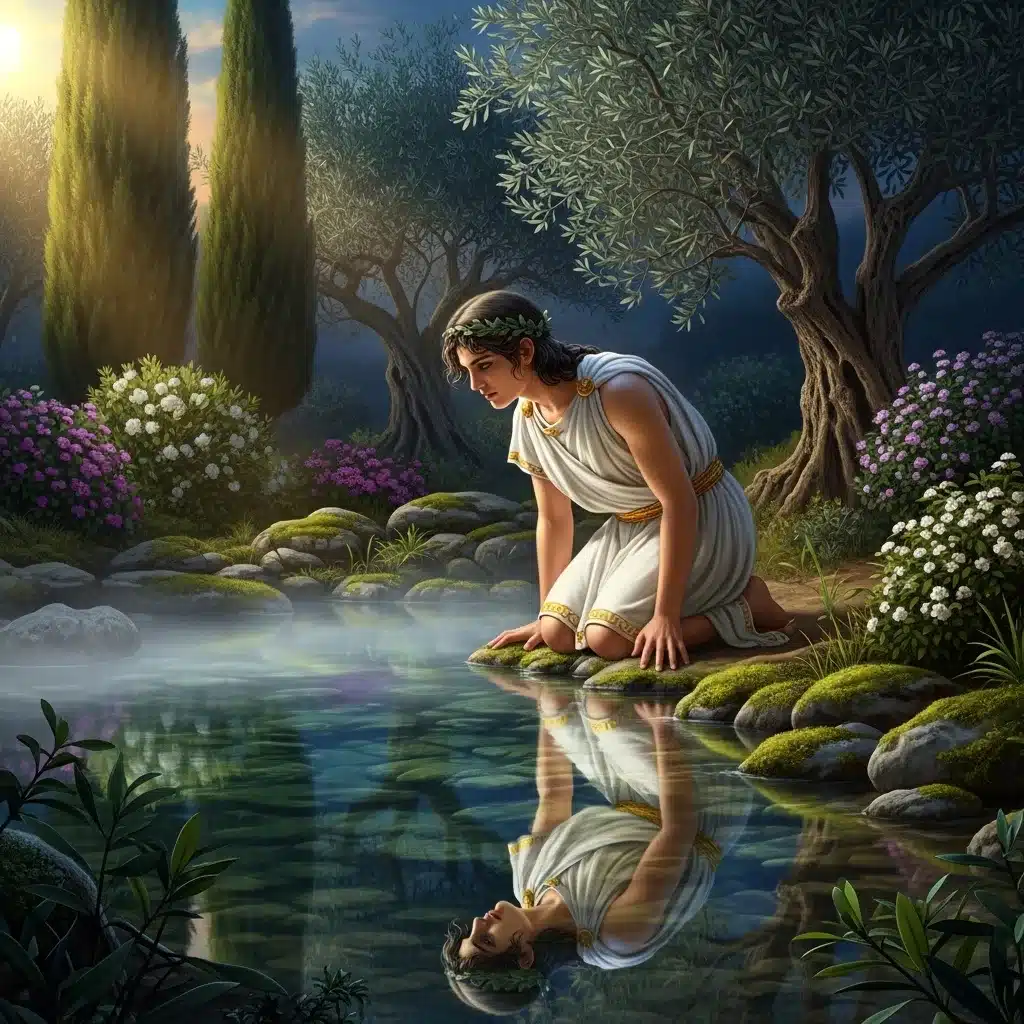
Narcissus’ Myth – The Young One Who Loved His Own Reflection
The myth of Narcissus is one of the most timeless and deeply symbolic stories of Greek mythology. It's not just a beautiful young man who fell in love with himself. It is an account of the hubris, rejection, weakness of self-awareness and ultimately tragic self-destruct.
His story is inextricably linked to the bride Echo and ends in the young man's transformation into a flower, explaining the origin of the narcissism. The most famous version of the myth is preserved in the work «Transformations» of Ovid, although its roots are found in ancient Greek tradition.
Birth and Prophecy
Narcissus was the son of the river Knife and the nymph Northern Ireland. From his birth he stood out for his incomparable beauty.
His mother, worried about her child's future, asked the seer for oracles. TeiresiasThe answer was enigmatic:
Narcissus will live many years as long as he never knows himself.
This prophecy is the core of the myth. The «knowledge of self» This is not philosophical, but literal and tragic.
The Rejection of Love
As he grew older, Narcissus became more and more beautiful. Brides and youths fell in love with him, but he remained cold and indifferent. His heart was closed, not out of spite, but of an arrogant self-sufficiency.
Among those who fell in love with him was the bride EchoThe echo had already been punished by the goddess Hera, because with her words she delayed the goddess while the Zeus He met other nymphs. As punishment, Hera deprived her of the ability to speak first. Echo could only repeat the last words he heard.
When he faced Narciso, he fell deeply in love with him. He followed him silently into the woods, waiting for a chance to talk to him. When he screamed «Hello?», Echo responded by repeating «Here.». But when he tried to hug him, Narcissus pushed her hard.
This rejection was disastrous for the nymph. Echo withered by unfulfilled love, until her body left only her voice, still echoing in the mountains.
Divine Punishment
Narcissus' cruelty did not go unpunished. According to one version, one of his rejected lovers prayed for revenge. The Goddess Nemesis Listen to the request.
One day, while Narciss was hunting in the woods, he bent over to drink water in a clean source. On the surface of the water he saw his idol. Not knowing it was a reflection, he believed he was facing a beautiful creature.
For the first time in his life he felt love.
Love for Reflection
Narcissus tried to touch the face he saw, but every time the image was dissolved. The more he looked, the more he was trapped. He couldn't leave, couldn't touch, couldn't stop looking.
He gradually realized the tragic truth: the object of his desire was himself. His love was impossible, because there was no «other».
Unable to move away from his image, he withered beside the source. Other traditions say he fell into the water and drowned. When the nymphs sought his body, they found a white and yellow flower in place: the narcissus.
The Symbolism of the Myth
The myth of Narcissus works on many levels.
1. Self - worship and Hybridity
Excessive love of self leads to isolation and eventually self - destruction.
2. The Unable to Self - Knowledge
Tyresia’s prophecy is fulfilled when Narcissus «knows» himself — Not with wisdom, but through image.
3. The Reward
Nemesis embodies the idea that exaggeration and cruelty return to the perpetrator.
4. Echo as a Counterpoint
Echo represents the loss of voice and identity through unfulfilled love.
Narcissus and Psychology
The term «narcissism» comes directly from the myth. In modern psychology, he describes excessive self-interest, the need for admiration and the lack of empathy.
The mythological narrative offers an archetype: when love does not turn to others, but is trapped in the mirror, it becomes destructive.
Variations of Myth
In some ancient Greek versions, Narcissus does not fall in love with his idol, but is punished for rejecting a young man who committed suicide for love. The later Roman tradition, as attributed by Ovid, strengthened the element of reflection and psychological dimension.
The Legacy of the Myth
The myth of Narcissus has influenced:
Literature and poetry
Psychoanalysis
The Art of Renaissance
Modern sociological criticism of image culture
The image of the young man bending over water remains one of the strongest symbols of human self-referentiality.
Conclusion
Narcissus' myth is not just a story about beauty. It is a warning of the isolation that excessive self-sufficiency gives birth. His inability to love others led him to love a ghost.
And finally, all that was left was a flower that leans down towards the water. — Like he's still looking for his idol.
JTNDcCUZRSUwQSVDRSU5MSVDRSVDRSVCQSVDRSVCQSVDRSVCQiVDRiU4RCVDRIU4OCVDRIU4NCVDRSVCNSU4MCVDRSVCNSVDRIU4MSVDRSVCOSVDRIU4MyVDRiU4MyVDRiU4QyVDRIU4NCVDRSVCNSVDRIU4MSVDRSVCNSVDRIU4MiUyMCUzQ2ElMjBocmVmJTNEJTTEYJTJTJTJGA XN0b3JpZXMtbXl0aG9sb2dpYXMmlKYlM0UlQ0UlQjklQ0YlodMlQlQlQlQlQlQlQlQUlQUlQUlQUlQUlQUlQUlQUlQUlQUlQUlQUlQUlQUlQlQlQl0UlQlKYlQlQlQUlQUlQlQlQlQlQlQUlQlQlQUlQlQlQUlQUlQUlQUlQUlQUlQUlQUlQUlQUlQUlQUlQUlQULQULQULQULQULQULQULQULQULQULQULQULQULQULQULQULQULQULQULQULQULQ