
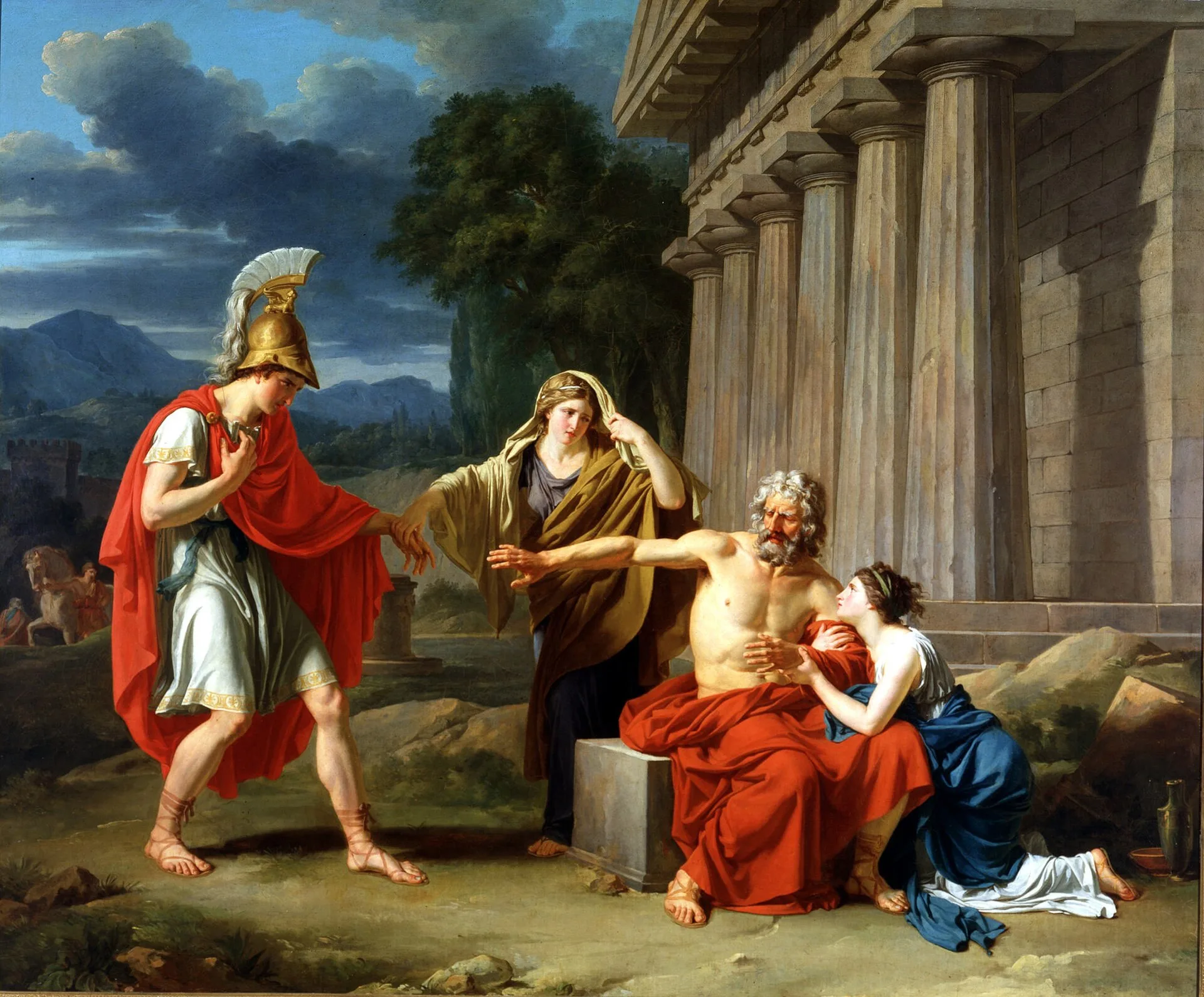
Oedipus is one of the most compelling and much-discussed figures in Greek mythology. His story is not merely a myth filled with drama and twists; it is a deeply human narrative about fate, free will, and the search for truth. Through his life, timeless questions emerge: Can a person escape their destiny? Or do their actions ultimately lead them exactly where they are trying to avoid?
«You are young, and your kingdom is new, and you think the tower in which you live is free from sorrow: did I not see from him two tyrants fall? The third, now king, I will still live to see him fall from the three most suddenly the most disgraced.»
— Aid
The tragedy of Oedipus inspired the great poets of antiquity and continues to influence literature and thought to this day.
Oedipus was the son of Laius, king of Thebes, and Queen Jocasta. Even before he was born, a terrible prophecy foretold that the child would kill his father and marry his mother.
Terrified, Laius decided to prevent the prophecy from coming true. He ordered that the newborn child be abandoned on the mountain, after first binding his feet—hence the name “Oedipus,” which means “swollen feet.”
However, the child did not die. A shepherd found him and handed him over to the king of Corinth, who raised him as his own son.
When Oedipus grew up, he learned of an oracle concerning him: that he would kill his father and marry his mother. Believing that his adoptive parents were his biological parents, he decided to leave Corinth to protect those he loved.
This decision, though seemingly the right one, brought him closer to his fate.
On the road to ThebesOedipus meets an unknown man at an intersection. After intense controversy, he kills him. — without knowing he was his real father, Lius.
Thus, the first part of the prophecy had already come true, without him even realizing it.
The Sphinx and Rise to the Throne
Upon reaching Thebes, Oedipus finds the city in despair. The Sphinx, a terrifying mythical creature, sets a riddle to those who pass and kills anyone who cannot solve it.
Oedipus manages to give the correct answer: man. In this way, he liberates the city and is proclaimed king.
As a reward, she marries her queen Thebes — Jocaste, his mother — without knowing the truth.
Years later, a great calamity strikes Thebes. In search of a solution, Oedipus sets out to investigate and discover the cause.
Little by little, through testimonies and revelations, the truth is coming to light. He is both Laius’s murderer and his mother’s husband.
This revelation is devastating. Jocasta cannot bear the truth and takes her own life, while Oedipus, in an act of profound guilt and self-punishment, blinds himself.
Fall and Exile
Following the tragic revelation, Oedipus abdicates the throne and goes into exile. Blind and alone, he wanders, accompanied only by his daughter, Antigone.
His life as a king turns into a journey of humiliation and inner reflection. In the end, he meets a peaceful death, having finally accepted his fate.
The myth of Oedipus is not merely a tragic story. It embodies deeper meanings:
- The power of fate: No matter how much one tries to avoid it, fate seems to be fulfilled.
- The search for truth: Oedipus does not stop until he knows the truth, even when it destroys him.
- Human weakness: Despite his intelligence and power, he cannot escape his mistakes.
- Responsibility and punishment: His self - punishment shows man’s need for justice, even at the expense of himself.
«DANCE:
You who live in the homeland of my ancestors, Thebes, behold Oedipus, who knew the famous riddles and was a man of outstanding skill· There was no citizen who wasn't jealous of his fate.· See him now and see how the waves of misfortune swallow him!
Always keep an eye on that last day. Do not consider any mortal happy if he has not passed the final limit of his life free from pain.»
— Sophocles, The Complete Greek Songs
Conclusion
The story of Oedipus remains one of the most powerful narratives in Greek mythology. It combines drama, philosophy, and human tragedy in a way that resonates across the ages.
Through his life, we see how knowledge can be both liberating and destructive, and how people often find themselves caught between choice and fate.
Oedipus is not merely a mythical king—he is a symbol of human fate and the eternal quest for truth.