
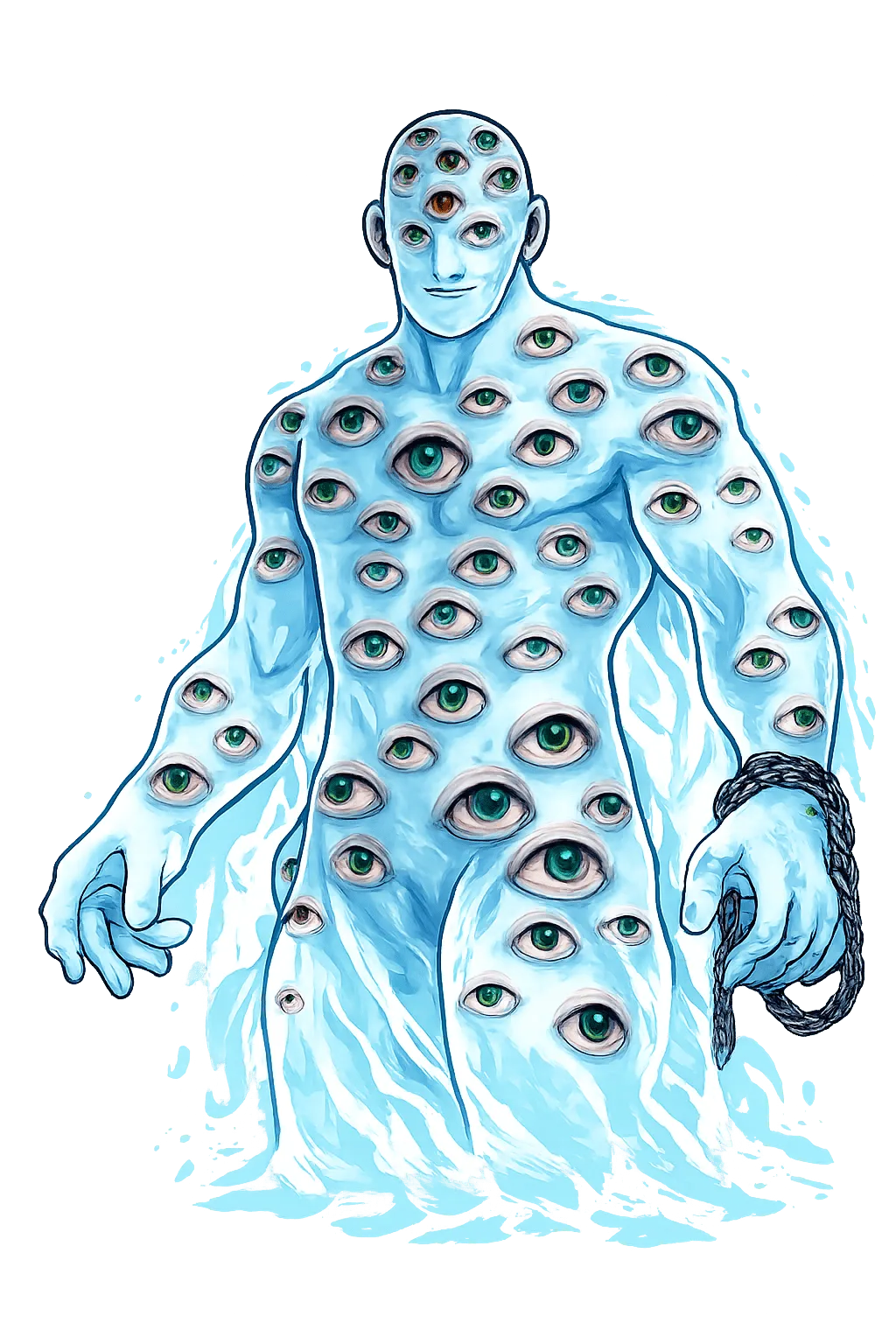
Argos Panoptes
The giant with a hundred eyes in Greek mythology
- Argos Panoptes is one of the most iconic forms of ancient Greek mythology. Known as the giant with 100 eyes, Argos personifies absolute alertness, uninterrupted surveillance and ubiquitous present knowledge. His name, Panoptis (he who sees everything), it is not merely descriptive; it is the core of his mythical identity.
His myth is closely related to Hera, Zeus, the Page and Hermes, forming one of the most famous accounts of deception and divine conflict in Greek mythology.
Origin and nature of Argos
Ancient sources do not entirely agree on the origin of the Argo Panoptis. In some traditions he is presented as her son Gaia, in others as a descendant of InahuThe river god of Argos. The fact that it is directly linked to the region of Argos it is not accidental; there he was worshiped as a primal guard and local hero.
Argos is not just a monster. Unlike other mythical creatures, it is often presented as servant of the divine order, an executor of divine orders, mostly Hera's. His natural peculiarity – the hundred eyes throughout his body – made him an alert guard, as even in his sleep some eyes remained open.
His feats and achievements
Before the myth of Virus, the Slow Panoptis appears as hero-guard that eliminates threats to humans and gods. According to certain traditions:
Kill one. Ethnic snake terrorizing Argolida
Exterminate one wild bull
He punished satyrs and lawless figures that offended divine order
His exploits make him an intermediate type between hero and monster — a form that acts on the boundary of the civilized and primitive world.
The myth of Ios and the command of Hera
The most famous story of Argo Convulsion is directly linked to the Page, priestess of Hera and lover of Zeus. To hide her from his jealous wife, Zeus transformed her into white cow. Hera, however, realized the deception and asked for the cow as a gift.
To ensure that Zeus would not approach her again, Hera commissioned Slow Panoptis to guard her. The giant tied Io to a tree and watched her uninterruptedly, making every escape impossible.
Argos here works as absolute obstacle in Jupiter's desire; it is the embodiment of supervision that neither divine omnipotence can override directly.
The death of Argos by Mercury
Zeus, unable to free Io by force, assigned the mission to HermesThe god of cunning, music and messengers. In disguise as a shepherd, Mercury approached Argos and began telling him stories, playing alongside syringe.
One by one, Argo's eyes are closed. When the last fell asleep, Mercury fell asleep decapitated, releasing Jo.
Hera, crushed but also honorable toward her faithful servant, took Argos' eyes and placed them in his tail powder, which has since become her sacred animal.
Symbolization of the Argos Panoptes
Slow Panoptis is intense symbolic character:
The hundred eyes symbolize the omnipotence and Monitoring
His weakness toward music and speech shows her strength art and intelligence
His death underlines that even absolute surveillance can be defeated by Tricky intelligence
In philosophical thought, Argos is often interpreted as a symbol of the rigid order that cannot be adapted.
Argos in art and secretariat
The myth of Argos answers to:
Ovid (Transformations)
Apollodorus (Library)
AustriaPrickets, indirect references)
In ancient art, he is often depicted as a giant with eyes all over his body or as a guard next to a cow. During the Renaissance, his myth returns as her allegory State surveillance.
The Argos Panoptes today
The term panopt survives to this day, both in language and philosophy and political theory (e.g. «Panoptikon»). Argos remains its timeless symbol Monitoring, Power and its boundaries.
Conclusion
- Argos Panoptes It's not just a mythical creature with a strange look. It's a multidimensional form that combines the guard, the servant, the hero and the victim. His myth reveals deep truths about power, knowledge and human—but also divine—weakness.