
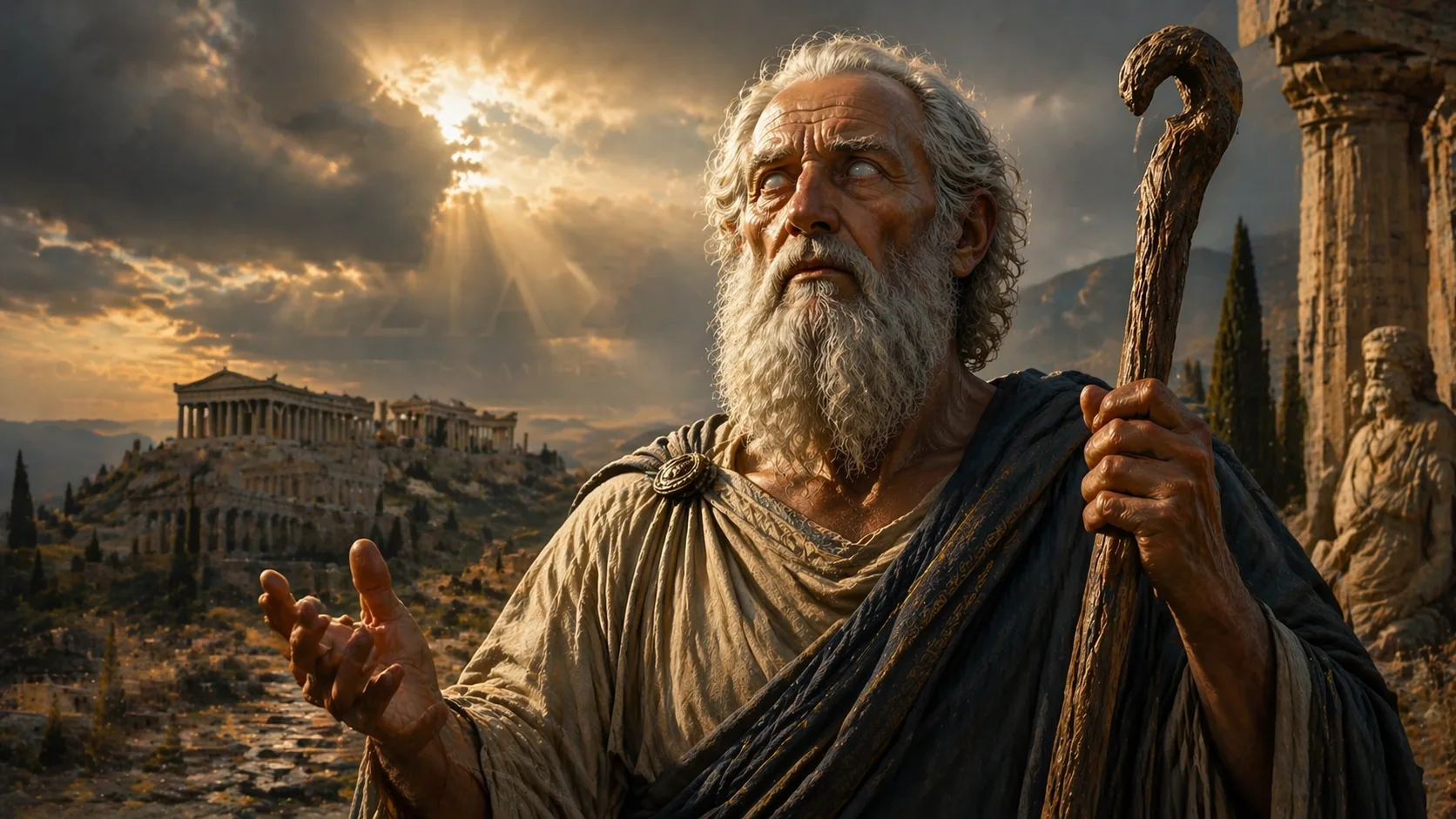
- Teiresias He is one of the most fascinating and complex figures in Greek mythology. He was not merely a seer; he was a man who experienced things beyond the limits of human understanding, who knew both male and female nature, and who was both punished and blessed by the gods themselves. His figure appears in numerous myths and tragedies, always as a bearer of truth—even when it is difficult or unwelcome.
«TERIES:
Alas, how awesome wisdom is when
It brings no benefit to the wise!
I knew that well, but I forgot,
Otherwise I wouldn't have come here.»
— Sophocles, The complete Greek tragedies
In this article, we will explore the life, myths, and significance of Tiresias, shedding light on why he remains such an important figure to this day.
Tyresia is closely connected to the city of Thebes, where he lived and worked as its most important seer. He was the son of Eueris and Chariklo, and tradition holds that he had a special relationship with the goddess Athena.
His reputation spread throughout the Greek world, as kings and heroes sought his counsel at critical moments. Although he was blind, his insight surpassed any physical sight.
Tiresias' blindness is one of the best-known elements of his myth, but the accounts vary.
According to one of the most widespread traditions, Tiresias accidentally saw goddess Athena to bathe. To protect her divine nature, the goddess blinded him. However, at his mother’s request, she granted him the gift of prophecy and the ability to understand the language of birds.
In another version, blindness is associated with the dispute between Zeus and Hera. When Tiresias was asked to decide which gender enjoyed love more, he replied that it was women. Hera, enraged, blinded him, while Zeus rewarded him with the gift of prophecy and a long life.
Blindness, then, is not presented as a mere punishment, but as an exchange: the loss of physical sight in exchange for deeper knowledge.
One of the most unique aspects of the myth of Tiresias is that he lived as both a man and a woman. According to tradition, he once came upon two snakes mating and struck them. As a result, he was transformed into a woman.
He lived like that for seven years, experiencing life from a completely different perspective. When he encountered the same pair of snakes again and repeated the act, he returned to his human form.
This experience made him a unique witness to human nature, which explains why the gods deemed him capable of answering questions that went beyond ordinary experience.
The figure of Tiresias occupies an important place in ancient Greek tragedy, particularly in plays related to Oedipus.
In the project «Oedipus Tyrannus», Tiresias is called upon to reveal the truth about the curse that strikes the Thebes. Despite his initial denial, he eventually reveals that Oedipus himself is the cause of the tragedy. This scene is telling: the blind seer sees the truth, while the sighted king is unable to accept it.
He also appears in *Antigone*, where he warns Creon of the consequences of his actions. In any case, Tiresias serves as the voice of divine justice and inevitable fate.