
Introduction
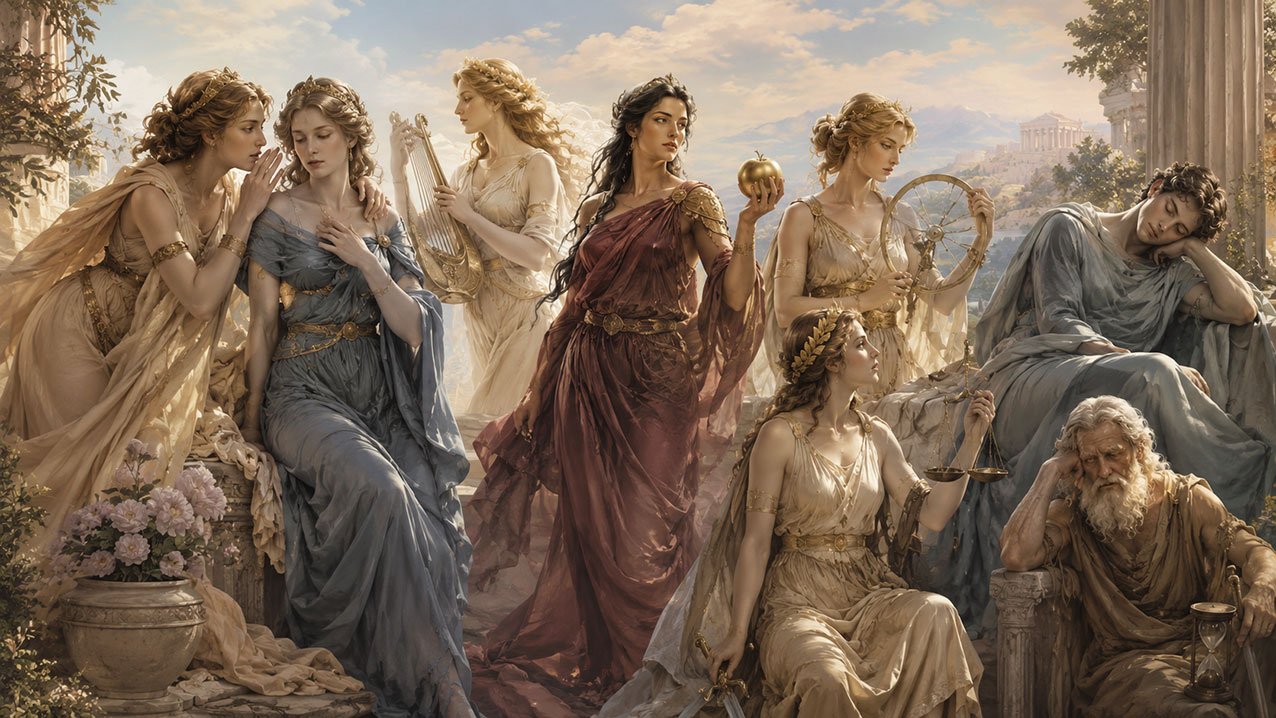
Greek mythology is full of figures that have captured the imagination for centuries: Zeus With lightning, the Athena with the aegis, Apollo In the case of lyre, the Artemis with the bow, Aphrodite With the power of love. But next to the great Olympians and his heroic circles Hercules, Theseus or Odysseus...there is a whole world that is less well-known but extremely revealing of how the ancient Greeks understood life, society, and the divine. These are the personifications: deities of Greek mythology that embody abstract concepts, psychological forces, social situations, natural experiences, or moral principles.
- Peitho, - Harmonia, - Eris, - Tyche, - Nemesis, Hypnos and Giras They are not merely poetic allegories. In ancient sources, they appear as active figures, with genealogies, cults, iconography, and a symbolic presence. Sometimes they stand on the margins of the great myths, and at other times they reveal fundamental aspects of ancient Greek religion. A study of them shows that Greek mythology was not merely a collection of narratives about ancient Greek gods, but also a way to give form to forces that influenced human existence on a daily basis: persuasion in public discourse, conflict in politics, fate in history, justice in human actions, and sleep and decay as the inevitable limits of life.
The forgotten personifications of Greek mythology invite us to view the ancient world with greater sensitivity. These are not minor or “decorative” deities. On the contrary, they reveal how people in a polytheistic society could perceive every force of life as a potential divine presence. In this article, we will examine the most significant of these, based on the Hesiod, Homer, the tragic poets, Pausanias, Pindar, and later writers, as well as with the help of modern studies on ancient Greek religion.
What are personifications in Greek mythology
In Greek mythology, personifications are called the divine or semi-theistic forms that embodie abstract concepts, situations or powers. They are not just symbols in the modern narrow sense. For ancient Greeks, Diki, - Nike, - Herene, - Eris, - Peitho, - Nemesis or Tyche They could be honored, portrayed, challenged and integrated into genealogical systems. Personalization was not just a literary trick· It was often a religious reality.
The difference between the personifications and the Olympian gods is not always absolute, but essential. Olympians, such as Zeus, Hera, Athena or Poseidon, have rich mythological circles, strong nationwide cults, complex personality and a wide field of action. Instead, many personifications are more closely linked to a basic concept or function. The Peitho expresses the power of speech and love or political charm. The Nemesis expresses the restoration of balance when the measure is breached. Old Age embodies aging, not as a simple biological process, but as an existential fate.
However, personalities should not be considered inferior or insignificant deities. The Theogony of Hesiod, many of them appear as primitive or secular forces, children of Nyx, Eris, Oceanus or other primary deities. Their presence within genealogies shows that abstract concepts had a place in the structure of the world. Divine order involved not only anthropomorphic rulers of heaven, sea, and earth, but also forces regulating social life, moral experience, and the human soul.
The role of abstract concepts in the world of ancient Greeks
Ancient Greeks lived in a world where religion, politics, poetry and everyday life were not completely separated. Abstract concepts did not belong only to philosophical thought· They could acquire altars, statues, and ritualism. The Herene worshiped in Athens, - Tyche It has become of enormous importance in the Hellenistic era, Nemesis was particularly honoured to Ramnuda of Attica, while Peitho had a place in her worship Aphrodite and the political self-consciousness of cities.
The personification of a concept allowed people to chat with the invisible. The fate of a war, the success of a marriage, the power of a orator, the birth of controversy, or the punishment of the hubris could be understood through divine forms. This does not mean that ancient Greeks «They believed naively» that every abstract concept was a person of simple human form. Greek religious thought was more flexible. A deity could be at the same time a person, power, poetic image and an object of worship.
In archaic poetry, personifications help organize the world. Hesiod, especially in Theogenia, records relationships that are not random: Nyx gives birth to Sleep, Thanatos, the Giras, Nemesin, the Apati, Friendship and Eris, among other forms. Discord in turn gives birth to him Pain, Lithi, Limbo, Battles, Murder and MalignanciesThese genealogies show a deep perception of the relevance of experiences: night is associated with sleep and death, controversy breeds social decay, excess of measure causes retribution.
In classical times, personifications acquire new meaning within the city. The Dimokratia, - Vouli, Dimos, - Herene, - Evnomia and Diki appear in vases, reliefs and public monuments. The religion of the city uses the personified concepts to express political values. Thus, personifications link Greek mythology to the history of institutions and social thought.
Peitho: the goddess of persuasion and charm
Peitho is one of the most fascinating personifications in Greek mythology, as she embodies love, speech, rhetoric, and social consensus. In Hesiod’s Theogony, she is mentioned as one of the Oceanids, daughter of Oceanus and Tethys. Her inclusion among the Oceanids is no accident: the daughters of Oceanus often represent forces that flow through the world, forces that are beneficial or formative for human life.
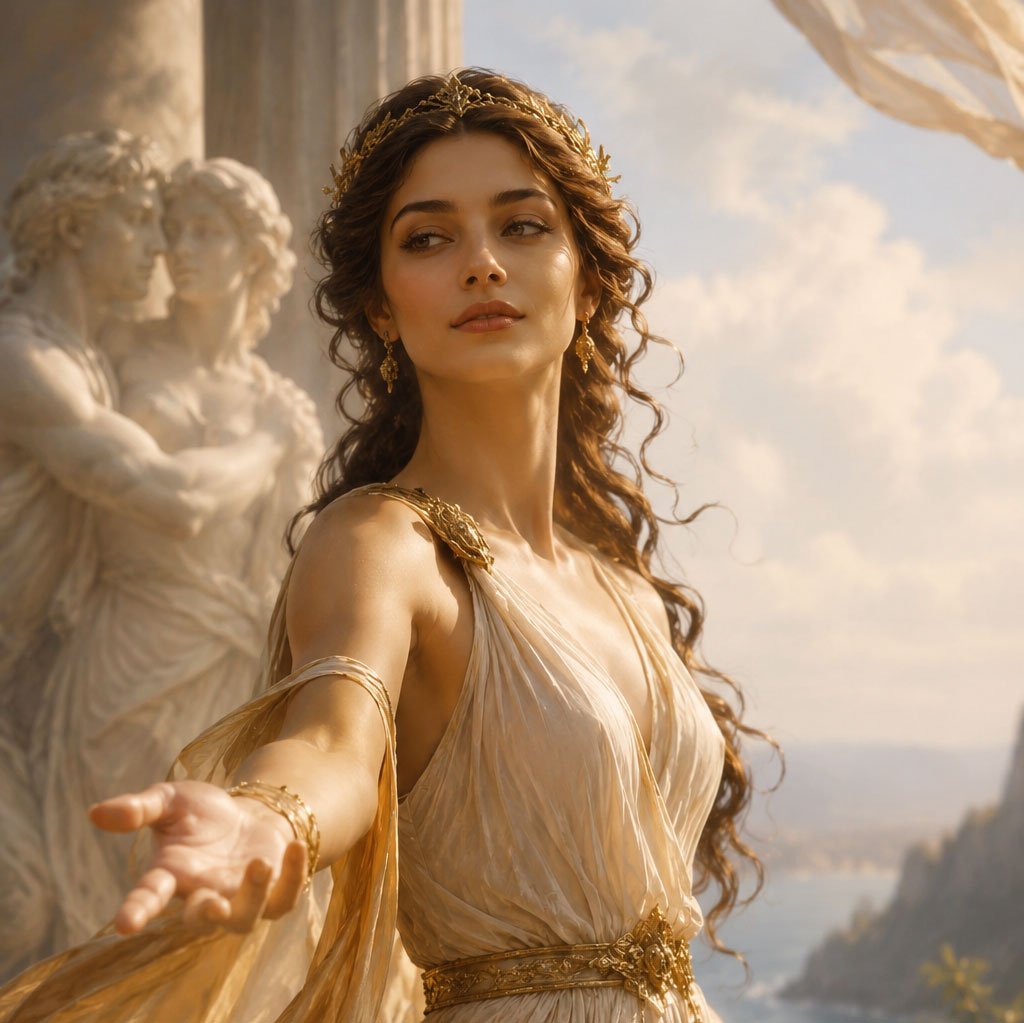
The persuasion is closely linked to the Aphrodite. In poetry and art, he often appears as a follower or companion of the goddess of love. This reveals a subtle understanding of the phenomenon of love: love is not merely physical desire, but also a force of speech, charm, promise, and mutual consent. In the world of the ancient Greeks, Peitho could have both a positive and an ambiguous side. Persuasion is necessary for marriage, reconciliation, and political life, but it can also become a tool of deception.
In AthensPeitho had religious significance. Pausanias mentions that there was a cult of Peitho associated with Aphrodite Pandemos on the Acropolis or near it, in a tradition linked to Theseus and the unification of the Attic municipalities. This connection is extremely important: Peitho concerns not only romantic relationships, but also political unification. The city is held together not only by force or law, but also by the power of speech to persuade citizens.
In tragedy, Peitho often appears as a force of moral ambiguity. In Aeschylus, for example, Peitho can be associated with justice and order, but also with seduction. In Euripides, speech often has the power to turn situations around, yet the effectiveness of persuasion does not always coincide with the truth. Peitho, as a deity, embodies precisely this ambiguity: she is the goddess who makes speech effective, not necessarily just.
Her symbols are not as consistent as those of other deities, but in iconography she appears as a young female figure, often alongside Aphrodite, the Graces, or in wedding scenes. Her presence in wedding scenes signifies the transition from desire to a socially recognized union. Peitho is, therefore, a deity of bonds: between lovers, between families, and between citizens.
Armonia: the embodiment of balance and reconciliation
- Harmonia is a figure with a dual nature: on the one hand, the personification of harmony, balance, and order; on the other, the mythical queen of Thebes, his wife Cadmus. According to the most widely known tradition, she is daughter of Ares and Aphrodite. This genealogy is deeply symbolic: the union of war and love is born Harmonia, i.e. the possibility of reconciliation of the opposite. In other traditions, mainly Samothracic, Harmony is associated with Zeus and Electra, which shows the variety of local mythological systems.

The most important myth of Harmony is her marriage to Cadmus, founder of Thebes. This marriage was one of the most famous of Greek mythology, because, according to tradition, the gods attended and offered gifts. Among the gifts stands out the notorious necklace of Harmony, the work of Hephaestus by many versions, but it brought a curse on her descendants. The necklace was associated with the tragic fate of the house of Labdakides, with figures such as the Semeli, - Jocaste, Oedipus, - Antigone.
Here lies the tragic irony of Harmony. The goddess or heroine who embodies balance becomes the starting point of a genealogy marked by ruptures, sins, ignorance and destruction. This does not invalidate its symbolism· Instead, it deepens him. The Harmonia It is not a simplistic peace without tensions, but the delicate and fragile balance that can be disturbed. In Greek thought, harmony is often the result of conflict and measure, not the absence of opposition.
In philosophy, the term «harmony» gained enormous importance, especially in Pythagoreans, who connected the secular class with numerical relationships and musical proportions. Although the mythical Harmony is not identified with the abstract philosophical concept, the relevance is evident. Personalization prepares a way of thinking where the universe can be understood as a class opposite.
In art, Harmony is mainly depicted in scenes of her marriage to Cadmos. Her symbols relate to marriage, jewelry, and royal dignity. The necklace, however, remains the most powerful symbol: an object of beauty that hides destruction, as often happens in the myths of Greek mythology.
Eris: the goddess of strife and conflict
- Eris is one of the darkest and most meaningful personifications of Greek mythology. In Hesiod's Theogenia she is her daughter Nyx and mother of a series of sufferings: Pain, Oblivion, Limou, Algae, Fighting, Murder, Androktaion, Youth, False, Dyspnoea, Page and Oath. This genealogy presents the conflict as a principle of social and moral decay.
However, Hesiod in Works and Days distinguishes two forms Eris. One is destructive, leading to war and violence. The other is beneficial because it gives birth to competition that pushes people to work and to progress. The farmer is jealous of the neighbor who prospers and works most· the technician competes with the technician· the poet the poet. This distinction is one of the most interesting points of self - control thinking, for it shows that conflict is not only a disaster, but also a driving force.
In Homer, Eris appears as a fearsome goddess of war. In the Iliad Linked to Ares and the battle, growing as it moves among the warriors and wreaking havoc. The Homeric Eris is not merely a psychological state; she is a force that spreads across the battlefield. War is not explained solely by human decisions, but also by divine actions that transcend individuals.
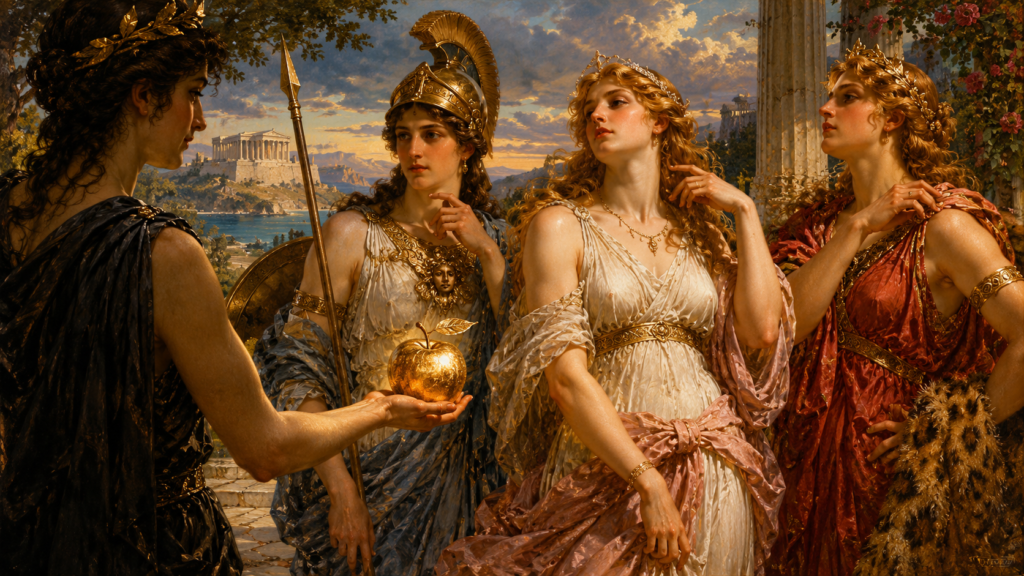
The best-known later myth involving Eris is that of the “Apple of Eris,” which is linked to the Judgment of Paris and the outbreak of the Trojan War. According to post-Homeric tradition, because she was not invited to the wedding of Peleus and Thetis, Eris threw a golden apple inscribed with the words “to the fairest,” sparking a dispute between Hera, Athena, and Aphrodite. Although this story does not appear in this form in the Iliad, it is known from the epic cycle and later sources, such as the Library attributed to Apollodorus and mythographic traditions.
The symbols of Eris are conflict, the apple, war, and competition. Her cultural significance is highly relevant today: every society needs to distinguish between creative competition and destructive discord. Eris is one of the deities of Greek mythology who demonstrates just how deeply the ancient Greeks had contemplated the ambivalent forces of human coexistence.
Tyche: the personification of fate and good or bad luck
- Tyche is a personification that gained particular importance mainly from classical and, even more, the Hellenistic era. The Theogony of Hesiod is referred to as Oceandaughter of Oceanus and Tethys. In other traditions it is linked to Zeus, while Pindar appears as a powerful force affecting the course of people and cities. The variety of her genealogy reflects and the difficulty of joining luck into a stable theological system.
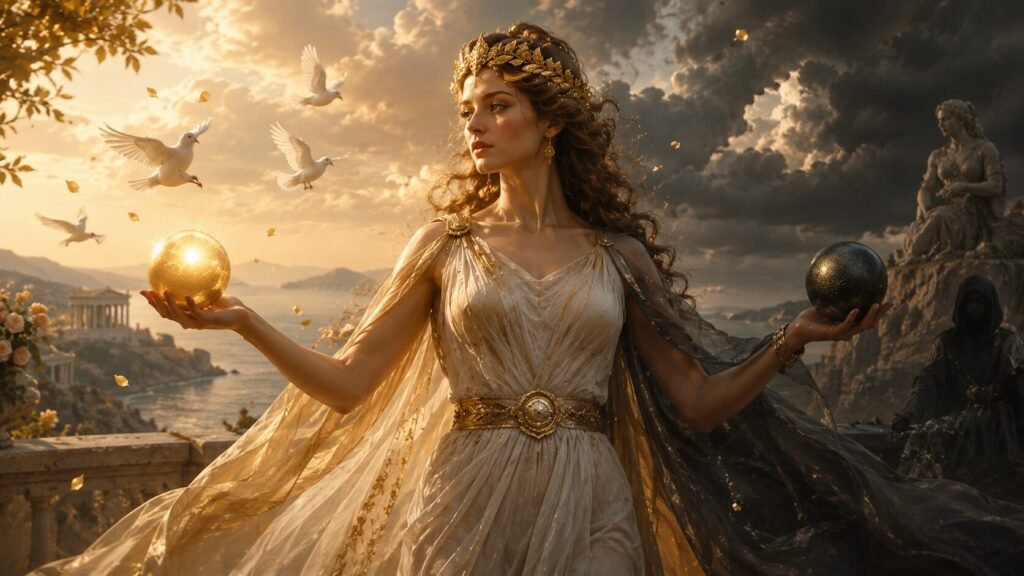
Fortune isn't exactly the same as fate. The The Moirai (Fates), Clotho, Lachesis and Atropos, are related to the destiny and fate of life, while Fortune expresses the unpredictable, favorable or adverse turn of events. In everyday experience, people often could not explain why a city prospers or is destroyed, why a man succeeds or fails, because a battle is judged by an accidental incident. Fortune gave form to this uncertainty.
In the Hellenistic era, after his conquests Alexander and the creation of great kingdoms, Tyche became particularly popular. Traditional city-states lost part of their autonomy, people found themselves within huge political structures and historical changes seemed unpredictable. The Fortune of cities, the Fortune of Antioch, Alexandria, or other major centers, was depicted as a women's form with a turret crown, horn of abundance, rudder or wheel. The rudder states that it directs the course of things· the wheel that everything changes· the horn of abundance that can give wealth.
Fortune is one of the personifications that most bridge ancient religion with popular piety. It concerns not only myths, but also daily wishes, fears and expectations. In inscriptions, coins and statues, her presence shows how important the idea that human life depends on factors beyond the control of reason and virtue became. In modern language, the word «Luck» She remains alive, but behind her lies a long religious and mythological history.
Nemesis: the goddess of divine justice and retribution
- Nemesis is the personification of divine retribution, the restoration of measure and punishment of hubris. In Hesiod's Theogenia she is referred to as her daughter Nyx. This ancestry connects it to the dark, relentless aspects of the secular order. It is not just a goddess of vengeance, as is often called simplistic, but a power that restores balance when people exceed their limits.
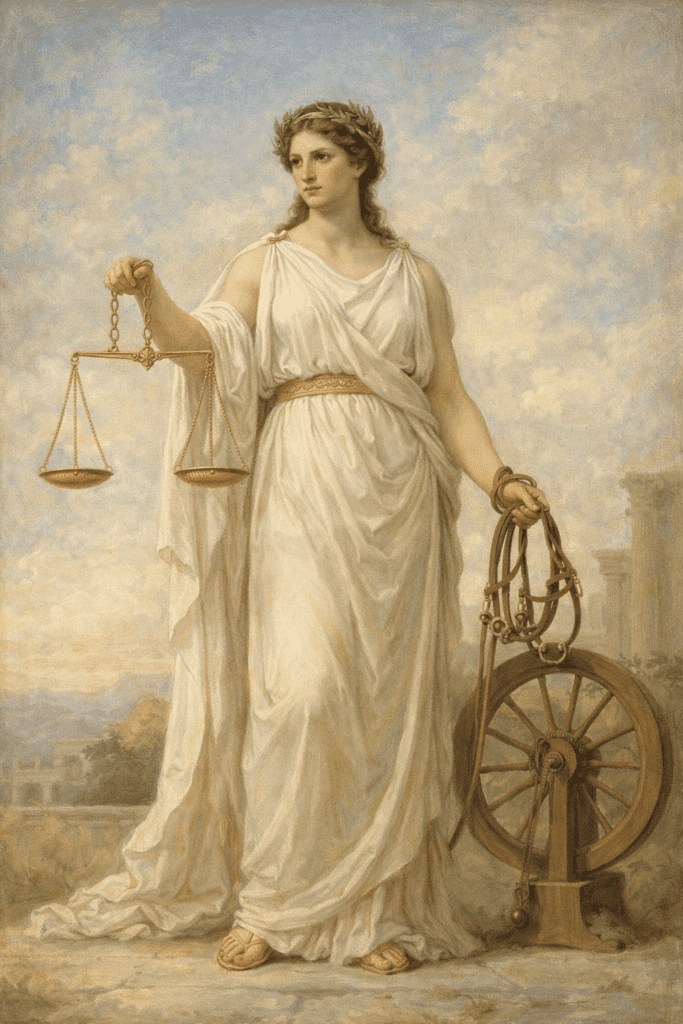
The word «nemesis» It is etymologically linked to distribution, award, sharing of what is due. In archaic and classical moral thought, excessive happiness, arrogance, or hubris could cause divine reaction. The Nemesis It does not punish because it hates, but because the order of the world does not tolerate amenity.
Her most important worship was in Ramnuda, Attica. Pausanias describes the famous statue of Nemesis, a work associated with the sculptor Agoracritus, a disciple of Phidias, although traditions for his construction vary. Ramnuda’s Nemesis was of particular importance after the Persian Wars, as the Athenians could interpret the defeat of the Persians as punishment for the great king’s hubris. Thus, the Nemesis It also takes political meaning: it is the divine response to the arrogance of power.
In some traditions, the Nemesis It is linked to the birth of Helen. In the Cypriot Epis, as later summaries and comments testify, Zeus pursues Nemesis, she transforms to avoid him, and eventually gives birth to an egg from which Helen comes. This tradition is less known than the version where her mother Helen is the Leda, but it is very interesting: the beauty that will cause him Trojan War is linked to the Nemesis, i.e. with a force of retaliation and cosmic overthrow.
Nemesis symbols often include the wheel, scales, meter, rein or sword, depending on the time and pictorial tradition. The rein declares the restriction of exaggeration. The Nemesis is related as meaning to the DikiBut he doesn't identify with her. The Diki expresses justice as order and law, while the Nemesis is the reaction when this class is violated.
Hypnos: the god of sleep and his place in the world of the gods
- Hypnos is one of the most poetic personifications of Greek mythology. In Hesiod's Theogenia he is her child Nyx and his brother Thanatos. The two brothers dwell on the dark limits of the world and express the close relationship between sleep and death. Sleep is a temporary departure from consciousness, while death is final. Greek mythology captures this affinity with remarkable poetic accuracy.
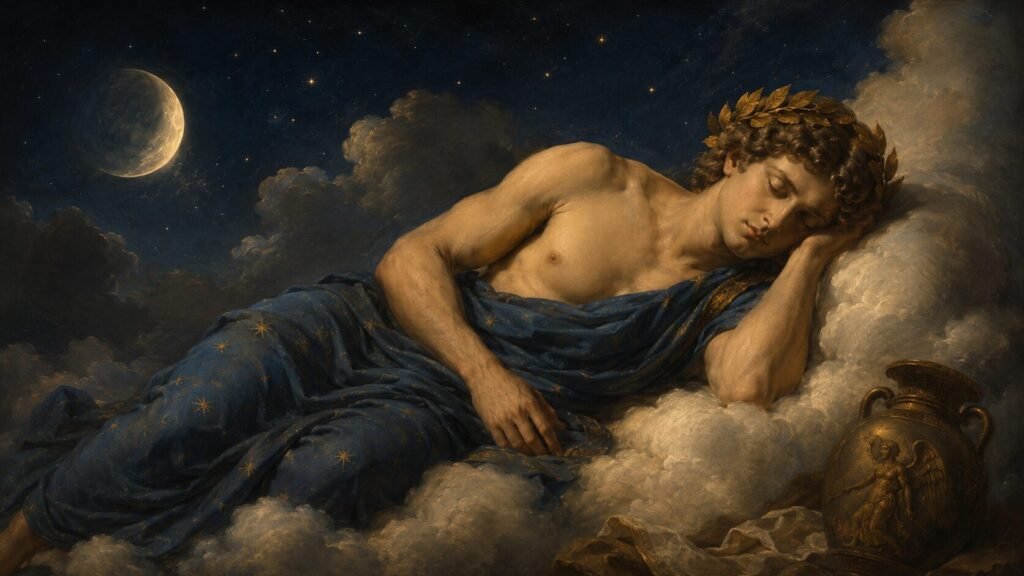
In Iliad, Hypnos plays an active role in one of the epic's most charming episodes. In rhypsodia X, the Hera asks the Sleep sleep him ZeusSo he can help the Achaeans without his intervention. Sleep was initially afraid, because in the past it had caused Zeus' anger, when he had helped Hera against him Hercules. He finally accepts, since Hera promises him as a wife one of her Graces, the Pasithea. The episode shows that Sleep has power even upon the highest god, although it must act with caution.
The relationship of Sleep with Death also appears in the famous scene of Sarpina's body transfer to Iliad. THE Apollo handed over the body to the twin brothers, Sleep and Thanatos, to carry it to LyciaThis image, also reflected in the Attic angiography, especially in the vase of Euphronios, is one of the most powerful performances of ancient art. The dead hero is not carried by terror demons, but by two calm, almost ceremonial figures.
The symbols of Sleep belong to the wings, the poppy, the horn from which sleep is poured, and later the night calm. In Roman and later literature, as in the Transfigurations of Ovid, the palace of Sleep is described as a place of silence, darkness and stillness. Although this description is Roman, it is based on Greek perceptions of sleep as a metalytic state.
Sleep did not have as extensive worship as other ancient Greek gods, but it mattered in therapeutic and dreamy contexts. In Asclepia, sleep and dreams were a key means of healing communication with the uncle. So Sleep is indirectly associated with healing, prophecy, and inner experience.
Geras: the personification of aging and human decay
The Giras is one of the simplest but shocking personifications of Greek mythology. In Hesiod's Theogenia she appears as her child Nyx, along with other dark and inevitable forces. He has no rich myths such as Tyche or NemesisBut his importance is deep. The Giras Incarnates body damage, loss of youth, weakness and human perfection.
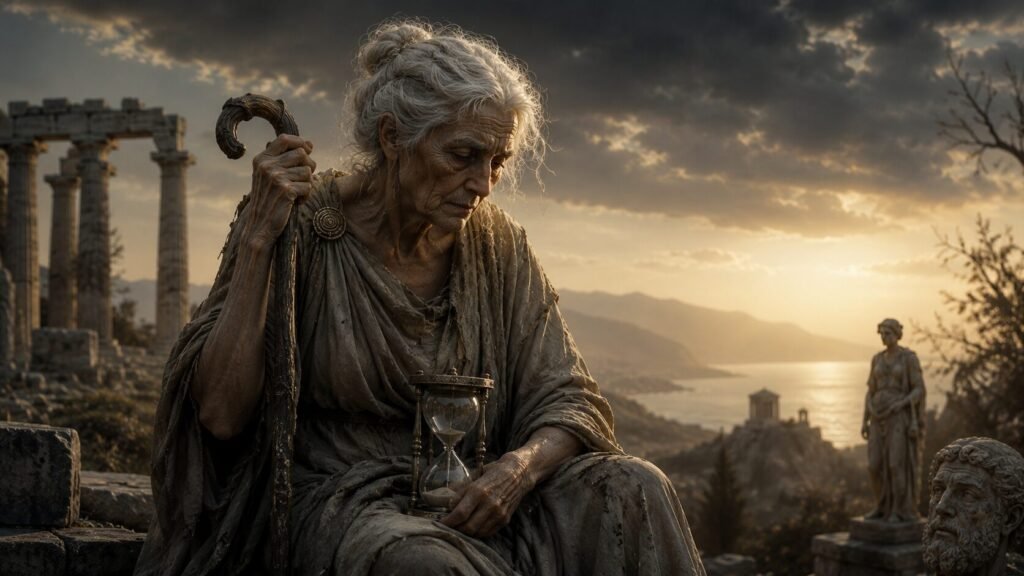
Ancient Greeks had a complicated attitude toward old age. On the one hand, age could be associated with wisdom, prestige and experience. The elders had a place in councils, family and political memory. On the other hand, poetry often presents old age as a burden. In Homer, Priamos is respected but tragic in his weakness. In lyrical poetry, as in Mimnermo, old age appears as a dark fate that removes the enjoyment of life.
The most famous iconographic presence of the Elder is in vases where the Hercules fights with the Giras. The scene is paradoxical and deeply symbolic. The hero who defeats monsters, lions, giants and divine trials faces the very inevitable deterioration. He can fight the GirasBut this struggle has an ironic dimension: no mortal really defeats time. Hercules, of course, is a special case, because in the end he is stored. This makes its conflict with Old Age even more interesting: the hero stands at the boundary between human decay and divine transcendence.
The Old Man has no bright symbols. His own form, usually as weak, wrinkled, small or frightened old man, is his symbol. Culturally, this personification reminds me that Greek mythology does not only idealize power and beauty. It also recognizes the dark truths of existence. If Hypnos is his gentle brother Thanatos, the Giras is the slow attendant of man toward the end.
Other lesser-known figures from Greek mythology
Beyond Persuasion, Harmony, Discord, Fortune, Nemesis, Sleep, and Old Age, Greek mythology has many other personalities. Many of these appear in Hesiod, others in tragedy, worship, angiography, or philosophical language.
- Good. is the personification of shame, respect and moral suspension. It is not a mere contraction, but an internal force that holds man back from the improper act. The Works and Days of Hesiod, Good. and Nemesis They abandon people at the end of moral degeneration, a sign that society has lost its foundations.
- Dikidaughter of Zeus and Themes according to Hesiod, it is the personification of justice. With the Evnomia and Herene is owned by Hours, which are not only times of the year but also deities of social order. The Diki reports to Zeus people's injustices, showing that justice has a cosmic dimension.
- Herene, also one of the Hours, gained considerable public worship in Athens, especially after periods of war. The statue of Peace that holds Pluto, the work of Cephisodotus, expressed the idea that peace breeds prosperity. Here we see clearly how personifications functioned as political and social messages.
- Nike is better known than others, but it is often forgotten that it is also personification. In Theogonia she is her daughter Pendant and Pallanda, his sister State, Violence and ZeluThe Nike was closely associated with the Zeus and Athena, while her iconography as a winged form deeply influenced Greek and Roman art.
- State and Violence, appearing particularly in Prometheus Bond of Aeschylus, embodie power and violent enforcement. It is no coincidence that they accompany Hephaestus in his commitment PrometheusZeus' divine sovereignty is presented not only as law, but also as a force of coercion.
- Apati, Momos, - Balances, Fat and Lithi are children of Nyx or connected dark powers in the ethos world. Fraud personifies deception, the Momos charge and impeachment; Balances the misery and suffering, Fat The Commission's proposal for a Directive on the approximation of the laws, regulations and administrative provisions of the Member States relating to restrictions on the marketing and use of certain dangerous substances Lithi Forgetfulness. These forms may not have had great cults, but form a map of human suffering.
- Phobos and Deimos, sons of Ares and Aphrodite In many traditions, they accompany the war. Fear is terror, Deimos panic or awe of battle. Their presence shows that the war in Greek mythology is not only strategic and bravery, but also psychological disintegration.
- Rumor or Ossa personifies the spread of news and fame. In Homer the Ossa may act as a divine voice that transmits information. In the city world, where public opinion was of great importance, such forms gained particular weight.
How personifications affected ancient religion, philosophy, and art
Personalizations deeply influenced ancient Greek religion, for they allowed worship not only of natural powers or of great gods, but also of social values. The city could honor Peace, Democracy, Fortune, Trial or Persuasion, thus expressing collective expectations. At this point personifications differ from most Olympians: they often function as a condensation of a value the community wants to project.
In philosophy, the transition from mythical personification to abstract concept is one of the most important developments in Greek thought. Terms such as trial, harmony, need, luck, nature, speech, love, friendship and youth acquire philosophical use in the Prosocrates, Plato and Aristotle. Empedocles, for example, uses Friendship and Neoscos as secular forces of union and division. Although not just traditional deities, the language of personification remains strong.
In art, personifications enabled artists to attribute abstract concepts in human form. The Victory of Samothraki, Peace with Pluto, the performances of Fortune with a towering crown, Nemesis with symbols of measure and retribution, Persuasion beside Venus, all of this shows how art turned ideas into bodies. Anthropomorphy was not just an aesthetic choice· It was a way of understanding.
In tragedy and poetry, personifications offered dramatic intensity. Discord can explain the birth of the conflict, Nemesis the fall of the arrogant, Fortune the unpredictable change, Persuasion the power of speech. Thus, the deities of Greek mythology are not limited to external interventions, but also function as forms of internal or social forces.
Personalizations in modern literature and pop culture
In modern times, the personifications of Greek mythology often survive without being directly recognized. Nemesis has become an international word for the relentless opponent or inevitable punishment. Fortune is still depicted with a wheel in literary and visual traditions. The Discord appears in modern reproductions of the myth of the Trojan War, while the «Eridus apple» remains a daily expression for the cause of a controversy.
In fantasy literature, comic books, video games, and television series, ancient Greek gods are often presented as characters with supernatural powers. Although the Olympians dominate, forms such as Nemesis, Victory, Sleep or Fortune appear more and more, because they offer more complex narrative themes. A hero facing Nemesis not only fights an enemy, but the consequences of his actions. A world governed by Fortune raises questions about freedom, responsibility and chaos.
Modern psychology and literary criticism also use personifying shapes, even metaphorically. We talk about fear, memory, oblivion, desire, guilt as if they were forces that dwell within us. This language is not so far from ancient mythological fiction. The difference is that today we tend to interpret these powers psychologically, while the ancients could incorporate them into a religious and secular context.
Greek mythology remains alive precisely because its personifications speak of experiences that have not ceased to concern us. Media persuasion, strife in politics, fortune in the economy, nemesis of arrogance, sleep as a refuge, old age as the body’s anguish: all these are modern matters, even though they have ancient names.
Conclusion
The forgotten personifications of Greek mythology reveal a world much more complex than the simple image of a pantheon with twelve Olympians. Persuasion, Harmony, Discord, Fortune, Nemesis, Sleep and Oldness show that ancient Greeks gave form to the invisible forces that determine human life. Others were beneficial, others threatening, many ambivalent. But all had a place in a mythological and religious thought that recognized the complexity of existence.
Unlike the great Olympians, these personifications do not always dominate extensive narratives. Their importance is often found in condensation. Within a name, a genealogy, a statue or a brief poetic reference, they encompass whole conceptions of society, morality, body, time and fate. Discord teaches us that conflict can be destructive but also creative. Nemesis recalls the limit of human arrogance. Fortune expresses the unforeseenness of history. Persuasion highlights the power and danger of speech. Harmony shows the fragile balance of the opposite. Sleep and Oldness bring to the fore the limits of body and life.
Their study is not just a complement to our knowledge of Greek mythology. It is key to understanding how ancient Greeks thought of man within the world: as being exposed to forces greater than he, but also capable of naming them, honoring them, fearing them and interpreting them.
FAQ
What does it mean? «personification» in Greek mythology?
Personalization is the rendering of human or divine form in an abstract concept, state or power. In Greek mythology, concepts such as Victory, Trial, Discord, Persuasion, Fortune and Nemesis are not just words, but can appear as deities with genealogy, worship, and iconography. This shows that ancient Greeks understood many aspects of life as active forces within the world.
What is the basic difference between the personifications and the Olympian gods?
The Olympian gods have a wide scope of action, rich myths and powerful national cults. Personalizations are usually more directly associated with a concept or function, such as persuasion, chance, conflict or justice. However, the difference is not always absolute. Venus, for example, is an Olympian goddess but also the power of love, while Persuasion is a more specialized deity expressing the charm and effectiveness of speech.
Were the personifications objects of true worship?
Yes, several personifications had a real cult presence. Nemesis was worshiped in Ramnuda, Fortune in many cities, Peace in Athens, Persuasion in connection with Venus. Other forms were more literary or poetic, without strong public worship. The Greek religion was polymorphic and allowed a concept to function simultaneously as a poetic image, divine power and adoring person.
Why is Hesiod so important to the study of personalities?
Hesiod, especially in Theogonia, offers one of the oldest and most systematic genealogical frameworks for the deities of Greek mythology. There appear many personifications as children of Night, Discord, Ocean, or other primates. Through these genealogies we see how ancient Greeks associated concepts with each other: Night gives birth to Sleep and Old Age, Discord gives birth to Battle and Dysnomy, Themis gives birth to Trial and Peace.
Is Luck the same as Fates?
Nope. Fortune mainly expresses the unpredictable turn of events, the good or bad timing, the instability of human life. The Fates are more related to destiny, duration and inevitable limit of life. In practice concepts may overlap, but they do not identify. Fortune became particularly important in the Hellenistic era, when historical changes made people feel more strongly about uncertainty.
Why should Nemesis not simply be viewed as a goddess of vengeance?
Nemesis is more a goddess of retribution and restoration of the measure. Its action is linked to the hybrid, i.e. the arrogant transcendence of boundaries. It does not punish by personal hatred, but because secular and moral order must be restored. That is why Nemesis has a deep connection with the ancient Greek conception of measure, justice and human responsibility.
What is the role of Discipline in political life?
Persuasion is not only about love or charm. In Athens it was associated with political organization and the power of public discourse. In a society where assembly, courts and rhetoric were of enormous importance, persuasion was a fundamental force of the city. The goddess Persuasion expresses both the creative aspect of speech, which unites and convinces, and the danger of manipulation.
Why is Sleep considered the brother of Death?
In Theogonia of Hesiod, Sleep and Death are children of the Night. This affinity is based on the empirical similarity of sleep and death: both entail departure from active consciousness and stillness. The difference is that sleep is temporary and refreshing, while death is definitive. Greek mythology expresses this relationship in a poetic and anthropomorphic way.
Why is Old Man personified if he doesn't have many myths?
Old Age is personified because it is one of the most universal and inevitable human experiences. Even without rich mythological action, his presence in Theogonia and art shows that ancient Greeks considered it almost divine, in the sense that no one can avoid it. The personification of the Elder allows the myth to speak of the deterioration, loss of youth and limits of heroic power.
How did personalities affect modern culture?
Many personalities survive in language, literature, and pop culture. Words like «nemesis», «Luck», «herd», «harmony» and «persuasion» are still used with intense symbolic load. In novels, comic books, games and films, the deities of Greek mythology reappear as characters or archetypes. Their timelessness is due to expressing experiences that remain alive: conflict, justice, charm, wear, sleep, luck and human boundaries.
Sources and Bibliography
Hesiod, Theogenia. A key ancient source for the genealogies of the gods and the personified forces, such as Night, Discord, Sleep, Age and Nemesis.
Hesiod, Works and Days. Particularly important work to distinguish the two forms of Discord and the moral concepts of Trial, Aidus and Nemesis.
Homer, Iliad. Critical source for Sleep, his relationship with Zeus and Hera, as well as for the presence of Discord and other war powers.
Homer, Odyssey. Useful for understanding the Homeric religious imagination and the function of divine forces in human fate.
Hostage Hymns. Valuables for the religious environment and divine functions associated with large and smaller deities.
Pindar, Odes. Important for the presence of Fortune, Victory and other personified concepts in aristocratic and nationwide poetry.
Achylus, Suppliers, Orestea. Useful for understanding the State, Violence, Trial, Discipline and divine justice.
Sophocles, tragedies. Valuable to the concept of fate, divine order, hubris and human responsibility.
Euripides, tragedies. Important for the dramatic use of Discipline, Fortune and instability of human things.
Pausanias, Greece Tour. Needed source for cults, statues and local traditions, especially for the Nemesis of Ramnuda and cults of personified deities.
Apollodorus, Library. Useful fictional collection for later systems of myths, such as the crisis of Paris and genealogies.
Ovid, Metamorphosis. Roman but important source for the later recruitment of Greek personalities, such as Sleep.
Burkert, Walter, Greek Religion. Harvard University Press, 1985. Classical contemporary study of ancient Greek religion and the religious framework of deities.
Parker, Robert, Athenian Religion: A History. Oxford University Press, 1996. Fundamental work on Athenian worship and the relationship between religion and city.
Stafford, Emma, Warshipping Virtues: Personalization and the Divine in Ancient Greece. Classical Press of Wales, 2000. Specialized study on the personifications and worship of abstract concepts in ancient Greece.
Shapiro, H. A., Personalizations in Greek Art: The Representation of Abstract Concepts 600–400 B.C. Akanthus, 1993. Basic work on iconography of portraits in archaic and classical art.
Hard, Robin, The Routledge Handbook of Greek Mythology. Routledge, 2004. Modern and reliable composition of Greek myths, based on ancient sources.
Gantz, Timothy, Early Greek Myth: A Guide to Literary and Artistic Sources. Johns Hopkins University Press, 1993. Detailed reference work on the early sources of Greek mythology.
Ogden, Daniel, A Companion to Greek Religion. Wiley-Blackwell, 2007. Collective volume for Greek religion, cults and interpretive approaches.
Graf, Fritz, Greek Mythology: An Introduction. Johns Hopkins University Press, 1993. An introductory but substantial study on the structure and operation of Greek myths.
Vernant, Jean-Pierre, Myth and Thought Among the Greeks. Zone Books, 2006. Classical anthropological and historical approach to Greek mythological thought.
Loraux, Nicole, The Children of Athena. Princeton University Press, 1993. Useful for the relationship between myth, city and political symbolism in Athens.
LIMC, Lexicon Iconographicum Mythologiae Classicae. Basic encyclopedic work on the iconography of gods, heroes and personalities of antiquity.