
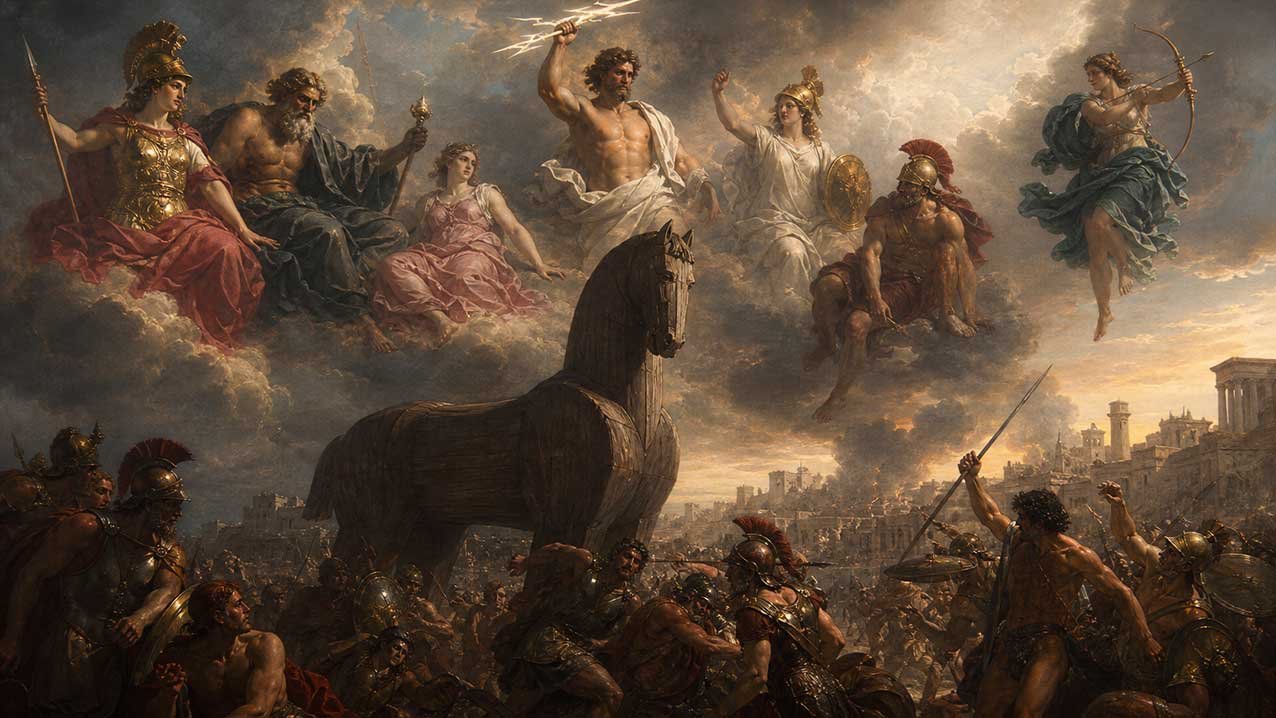
Mythological context of the gods in the Trojan War
- Trojan War It is not only a conflict of heroes, but also one of the most complex divine dramas of Greek mythology. In the Homeric tradition, the Gods in the Trojan War do not just follow the events from Olympus: they intervene, they meditate, they favor, they punish, and sometimes they clash with each other, as if they reflect on a supernatural scale human tensions themselves.
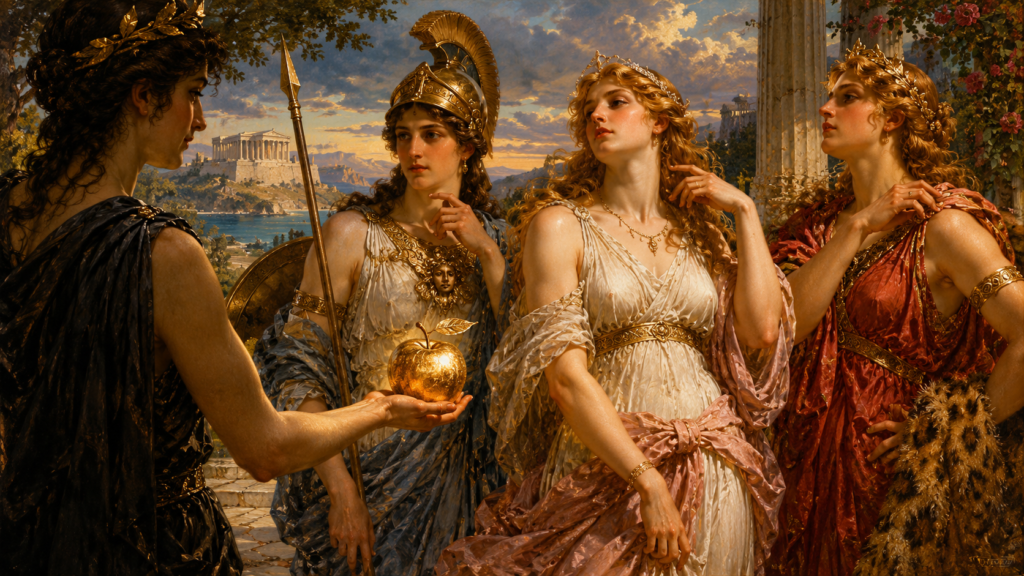
The Apple of Discord: How Eris Sparked a Decade of War
The beginning of divine confrontation is at the wedding of Pelea and Thetis, when the Eris threw away the famous apple «The best» and Hera, Athena and Aphrodite They claimed the title of the prettiest. Paris was invited to judge, and his decision in favor of Venus changed the course of the myth: in exchange he received Helen's promise.
From there on, the conflict is not only about the honor of Helen or the revenge of the Achaeans. At its core is the divine insult, retribution and constant battle between different forms of power: strategy, love, royal power, war momentum, marine element and divine order.
The gods as a reflection of human values
In Homer, the gods function as persons with will, passions, and alliances. They are not abstract concepts· They embody values that were familiar to the ancient Greek public: honor, foreignness, oath, strategy, rage, desire and fate. That is why the Trojan War in myth resembles a conflict not only between Achaeans and Trojans, but also among secular authorities.
The gods who supported the Achaeans
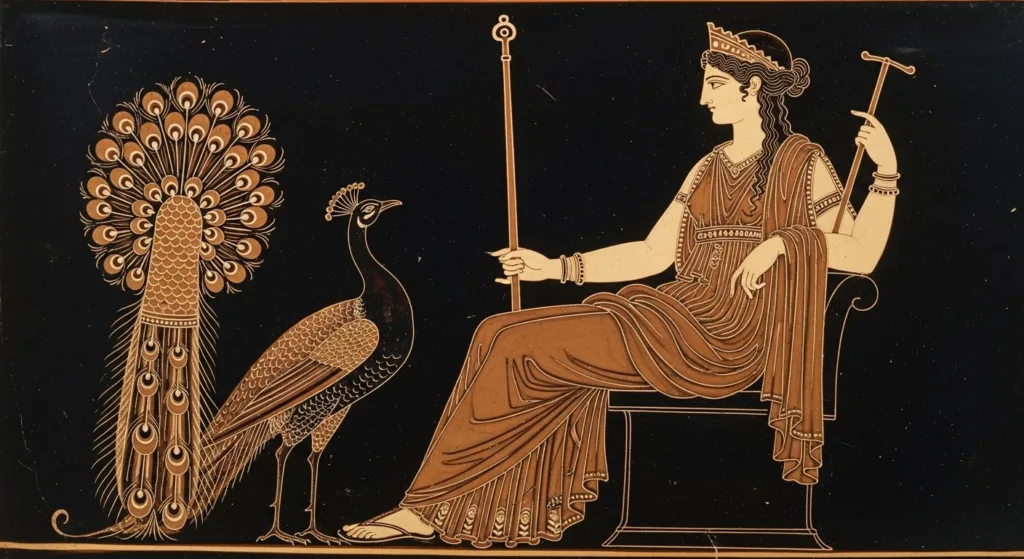
Hera: the Queen of Olympus and the memory of the insult
- Hera are one of the most stable supporters of the Achaeans. Her hostility to Troy is directly linked to «A pity of Paris», after being insulted when not chosen as the most beautiful. As a goddess of royal power and marriage, Hera embodies the order and hierarchy that Troy, in her eyes, defied.
In Iliad, Hera does not hesitate to plot, convince, and mislead in order to strengthen the Achaeans. Her attitude shows that in Homeric religion the gods are not ethical «neutral»· have memory, insults, and personal motives.
Athena: the goddess of strategy and intellect
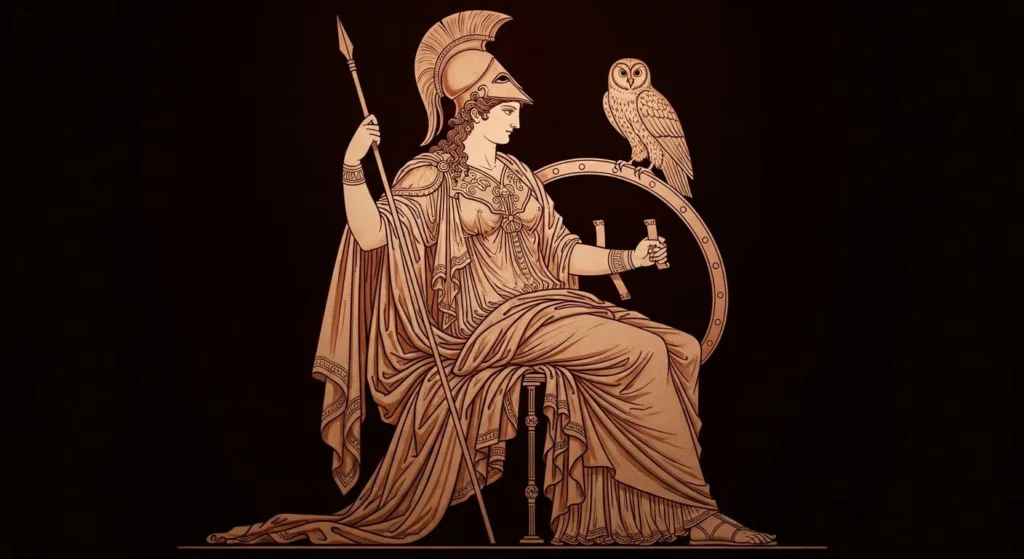
Athena is perhaps the most emblematic goddess of the Achaean camp. She symbolizes strategic thinking, self-restraint, skill, and victory through intelligence, not mere impetus. In the mythology of the Trojan War, she particularly supports the Odysseus, Diomede and, more generally, the aspect associated with *mētin*, intelligent action.
Athena embodies a different ideal of war than Ares: not lawless violence, but organized superiority. That is why her presence in war carries deep symbolism: victory is achieved not only through courage, but also through reason.
Poseidon: the god of the sea and old injustices
- Poseidon He often supports the Achaeans, although his attitude is not always entirely stable. His hostility to Troy is associated with an earlier myth: along with him Apollo He had built the city walls for Laomedon, but the king did not give them the reward he had promised. This default explains, within the mythological universe, why the god of the sea turns against Troy.
Poseidon is not just a god of the sea· It's also seismic power, unpredictable, primary. His support for Achaeans adds to their campaign an element of secular power.
Thetis: Achilles' divine mother
Thetis doesn't exactly belong to «camp» Like Hera or Athena, however, it has a decisive role. As his mother Achilles, begs Zeus to honor her son and highlight the importance of his archaic rage. Her intervention shows that in Trojan War divine relations are intertwined with family faith and the vindication of virtue.
The gods who stood by the Trojans
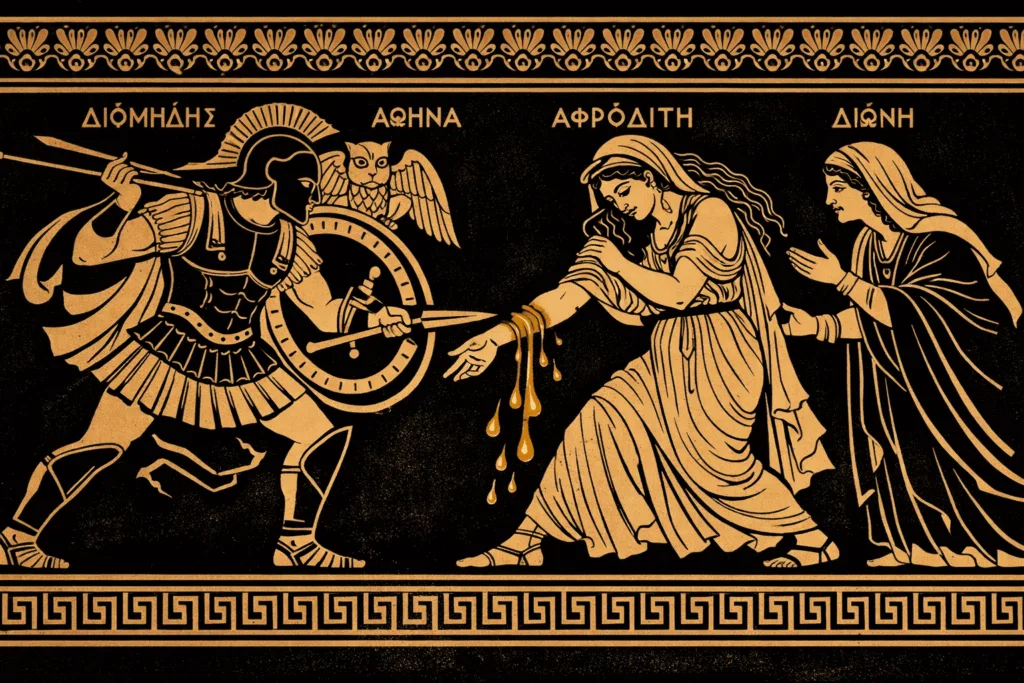
Aphrodite: Love as a power that dissolves order
- Aphrodite is the goddess most directly associated with the beginning of the conflict, after promising Paris Helen. In war, she protects Paris, supports Troy and is particularly interested in Aeneas, her son. Her presence is not just romantic· represents the power of desire that can transcend political and moral balance.
Symbolically, Aphrodite is contrasted with Athena: love versus strategy, attraction versus reason, charm versus discipline. The myth thus takes on an almost philosophical dimension.
Apollo: the god of prophecy, purification, and the well-aimed blow
- Apollo He is one of the Trojans’ strongest allies. In the *Iliad*, he brings a plague upon the Achaean camp when Agamemnon insults the priest Chryses. As the god of prophecy, order, and archery, Apollo often acts as the protector of Troy and, in particular, of Hector.
His proper bow shot reflects his own principle: power does not always need to be noisy to be decisive. Apollo punishes the hubris and restores balance in a cold and relentless manner.
Artemis: Apollo's sister and the fragile balance of mortals
- Artemis It is also associated with the Trojan side in several traditions. As a goddess of nature, boundaries and youth, it showcases a different form of power than purely warlike. Her presence in Trojan War Stresses that the conflict touches not only warriors, but also the wider grid of life, family and generation.
Ares: the unstable face of war
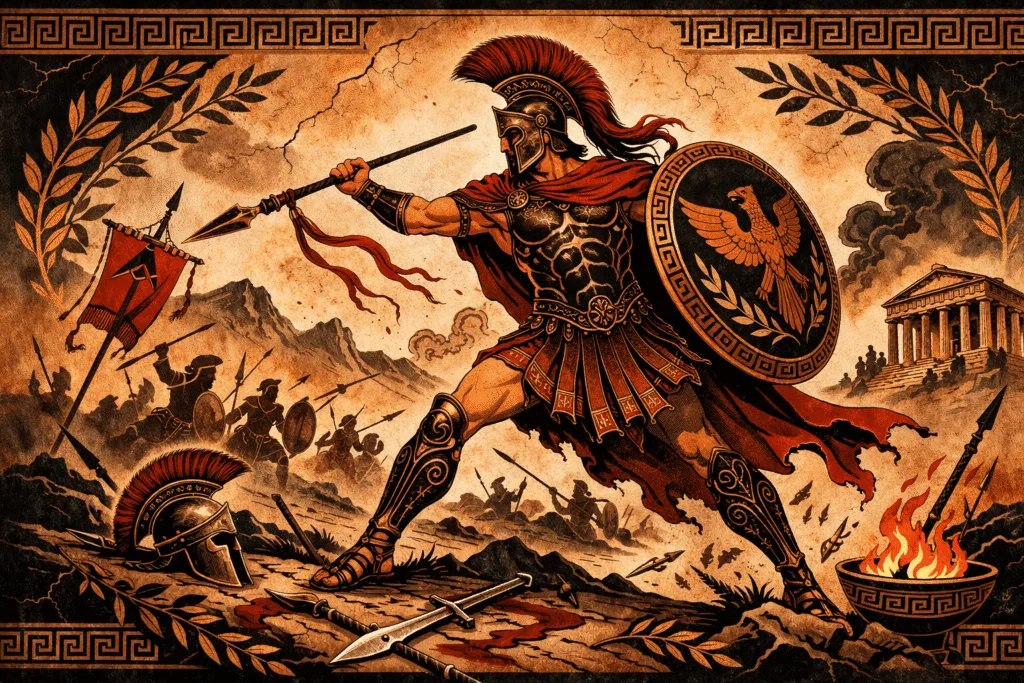
- Ares, god of raw war mania, is often near the Trojans, but his behavior is never completely predictable. In Iliad it acts more as a personification of uncontrolled combat than as an ally with a stable moral identity. His defeat by Diomedes, with Athena's help, symbolically shows that disorderly anger yields before the strategy and favor of the gods of understanding.
The Skamandros River: when even nature reacts
In one of the most impressive scenes of the Iliad, the river Skamandros, divine power of the landscape of Troy, reacts to the massacre caused by Achilles. Conflict is no longer just human or Olympic· becomes ecological, if the modern term is allowed. Earth, water, and the battlefield are presented as active forces resisting the exaggeration of violence.
The Role of Personifications: Phobos, Deimos, and Eris on the Battlefield
In Iliad, war is not presented merely as a conflict between humans and gods. Homer also brings abstract concepts to life; these take on a divine nature and move among the warriors. Fear, panic, and discord are not merely emotions; they are divine forces that directly influence the outcome of the battle.
Phobos (Fear)
- Phobos is the son of Ares and Aphrodite and the brother of Deimos. He always follows his father into battle, striking terror into the hearts of the warriors.
When Ares charges into battle on the side of the Trojans, Fear is right by his side. Even the bravest heroes feel their knees buckling, while even the most seasoned warriors hesitate to face the god of war.
Phobos symbolizes that moment when a person loses their composure and reason gives way to the terror of battle.
Deimos (Deimos)
- Deimos, also the son of Ares and Aphrodite, personifies the panic and utter horror that overtake an army when the battle is lost.
Unlike Phobos, which functions more as an internal anxiety, Deimos represents the moment of uncontrolled flight and the collapse of the formation. Its presence transforms an organized retreat into a chaotic flight.
That is why Homer depicts Deimos as constantly accompanying Ares, since war is won not only by weapons but also by the warriors’ morale.
Eris.
- Eris., the goddess of strife and discord, is one of the most important figures associated with the Trojan War.
She was, in fact, the primary cause of the conflict. At the wedding of Peleus and Thetis, because she had not been invited to the celebration, she threw the famous golden apple with the inscription:
«Τῇ καλλίστῃ» («Στην ομορφότερη»).
The dispute over the apple between Hera, Athena, and Aphrodite led to the Judgment of Paris, the abduction of Helen, and ultimately the outbreak of war.
However, her action does not stop there.
In Iliad, Eris hovers over the armies, fueling the confusion, anger, and frenzy of battle. The longer the conflict lasts, the greater her power becomes. Homer describes her as starting out small and gradually rising until she reaches the sky—a striking image that illustrates how a minor disagreement can escalate into a war that engulfs entire peoples.
The gods of the psychology of war
These personifications reveal a profound understanding of war on the part of the ancient Greeks. Victory depends not only on physical strength or the favor of the Olympian gods, but also on the mental state of the warriors.
- - Phobos paralyzes the courage.
- - Deimos It turns retreat into panic.
- - Eris. breeds discord, feeds violence and prolongs conflict.
Thus, Homer portrays war as a clash not only of bodies and weapons, but also of emotions, in which invisible divine forces can prove to be just as powerful as the heroes themselves.
Interesting element
On Ares' shield and chariot, the following are often depicted: Phobos and Deimos, showing that the god of war brings not only violence but also its mental consequences. The Eris., on the other hand, often precedes the battle itself, suggesting that every war begins with discord before escalating into bloodshed.
The gods who mediate between the factions
Zeus: the highest regulator and gravity of fate
- Zeus It's not just «With the Trojans» or «With the Achaeans». In Iliad acts primarily as guarantor of the order of the world and fate. He may temporarily lean toward one side or the other, but he does not act as a party ally. The weighing of the fates of heroes, the observance of vows and the postponement or acceleration of Troy's fall pass through his own will.
This is crucial for understanding the epic: the gods are powerful, but they do not abolish fate. Ancient Greek thought insists that even the highest god moves within a context of necessity.
Hermes: The Mediator and Guide
- Hermes It does not fight primarily on the side of a party, but its role is essential. In the most human perhaps divine moment of the epic, he leads the old Priam to his tent AchillesSo that the Trojan king may ask for Hector's body. This scene highlights the power of reconciliation and begging, two pillars of ancient Greek morality.
Hephaestus: art in the service of the hero
- Hephaestus Helps him Achilles building his legendary shield. His contribution is invaluable, because this shield is not just a weapon.· It's a miniature of the world. Divine art here meets human fate, and the result is one of the most famous symbols of the Iliad.
What Role Did the Gods Play in the Trojan War?
A war of honor, foreign and hubris
The Trojan War reveals basic values of ancient Greece: honor, glory, hospitality, retribution and measure. When they are violated, the gods intervene as carriers of justice or vengeance. The insult of Christ, the breach of Laomedon, the judgment of Paris and the arrogance of heroes are not simple details· are the moral turning points of the myth.
Gods as cultural symbols
Every god carries a cultural meaning:
- Athena represents wisdom and strategy.
- Hera's legitimacy and royal dignity.
- Venus represents desire and erotic power.
- Apollo's purity, measure and proper punishment.
- Ares the raw war instinct.
- Poseidon the elemental force and the unstable power.
- Zeus the supreme order, but also the weight of fate.
This wealth of symbolism explains why the Trojan War remains so alive: it is not only a battle narrative, but a fundamental map of values.
Historical and cultural shades
The myth and possible memory of the Late Bronze Age
Historical research cannot prove the Trojan War as told by Homer. However, excavations on the hill of Hissarlik, by Schliemann and later archaeologists, showed that Troy was a real settlement with many successive phases of habitation and destruction. This does not prove the Homeric epic, but shows that the myth may retain memories of conflicts of the Late Bronze Age in the Aegean and western Anatolia.
Homeric poetry and religious perception of the Greeks
In the Homeric era, the gods are presented with anthropomorphic characteristics, but remain superior to mortals in power and knowledge. This reflects a world where religion, politics, and morality are not separate spheres. Poet doesn't write historography· compose a grand universe where human act always has a divine impact.
Frequently Asked Questions About Gods in the Trojan War
What gods were with the Achaeans?
Mostly Hera, Athena and often Poseidon. Also, Thetis supports Achilles, while Hephaestus helps him with his shield.
What gods supported the Trojans?
Venus, Apollo, Artemis, and in some scenes Mars. Important is also the presence of divine forces associated with Troy itself, such as the Skamandros River.
Zeus was on the Trojan side?
Not in a simple and permanent way. Zeus acts more as a supreme regulator of fate and divine balance. At some times he favours the Trojans, but he does not completely identify with them.
Why did Apollo support Troy?
In the mythological tradition, the Trojans are associated with respect for Apollo, while the insult of the priest Chrysis by the Achaeans strengthens his hostility towards the achaean camp. Moreover, an older myth with Laomedon explains his displeasure.
The Trojan War was a real historical event?
Probably the myth retains memories of true conflict of the Late Bronze Age, but the Homeric narrative cannot be read as an accurate historical chronicle. It is literary and religious work that uses historical hints.
Conclusion
The gods in the Trojan War are not decorative faces of the myth. They are the real catalysts of conflict, the carriers of memory, honor, desire and fate. Through Hera, Athena, Venus, Apollo, Neptune, Mars, Mercury, Hephaestus and Zeus, Homer transforms a war into a global drama about how divine and human forces shape history.
That’s why «Gods in the Trojan War» remains so exciting: not only does it explain who fought with whom, but also why the ancient world saw conflict as something far deeper than a simple battle between two armies.
Bibliography
Ancient sources
- Hesiod. TheogonyTranslation and comments: Ioannis Th. Kakrides or other valid Greek edition.
- Hesiod. Heracleus shield.
- Homer. IliadTranslation: D. N. Maronite or I. Kakridis.
- Apollodorus. Library.
- Pausanias. Greece Tour.
Modern bibliography
Burkert, Walter. Greek ReligionHarvard University Press, 1985.
Grimal, Pierre. The Dictionary of Classical MythologyBlackwell.
Kirk, G. S. The Iliad: A CommentaryCambridge University Press.
Morford, Mark & Lenardon, Robert. Classical MythologyOxford University Press.
Strauss Clay, Jenny. Hesiod’s CosmosCambridge University Press.
Schein, Seth L. The Mortal Hero: An Introduction to Homer’s IliadUniversity of California Press.
Indicative footnotes
For Fear and Deimo
Homer, Iliad XIII 298–302· III 119–121· Hesiod, Theogony 933–937.
For Discord
Homer, Iliad IV 440–445.
For the Crisis of Paris
Apollodorus, Library 3.12.5.
Sources
- Homer. Iliad. Met. D. N. Maronite. Athens: Agra.
- Hesiod. Theogony. Met. I. T. Kakrides.
- Hesiod. Heracleus shield.
- Apollodorus. Library.
- Burkert, W. Greek ReligionHarvard University Press.
- Grimal, P. The Dictionary of Classical Mythology.
- Morford, M. & Lenardon, R. Classical MythologyOxford University Press.
- Kirk, G. S. The Iliad: A CommentaryCambridge University Press.