
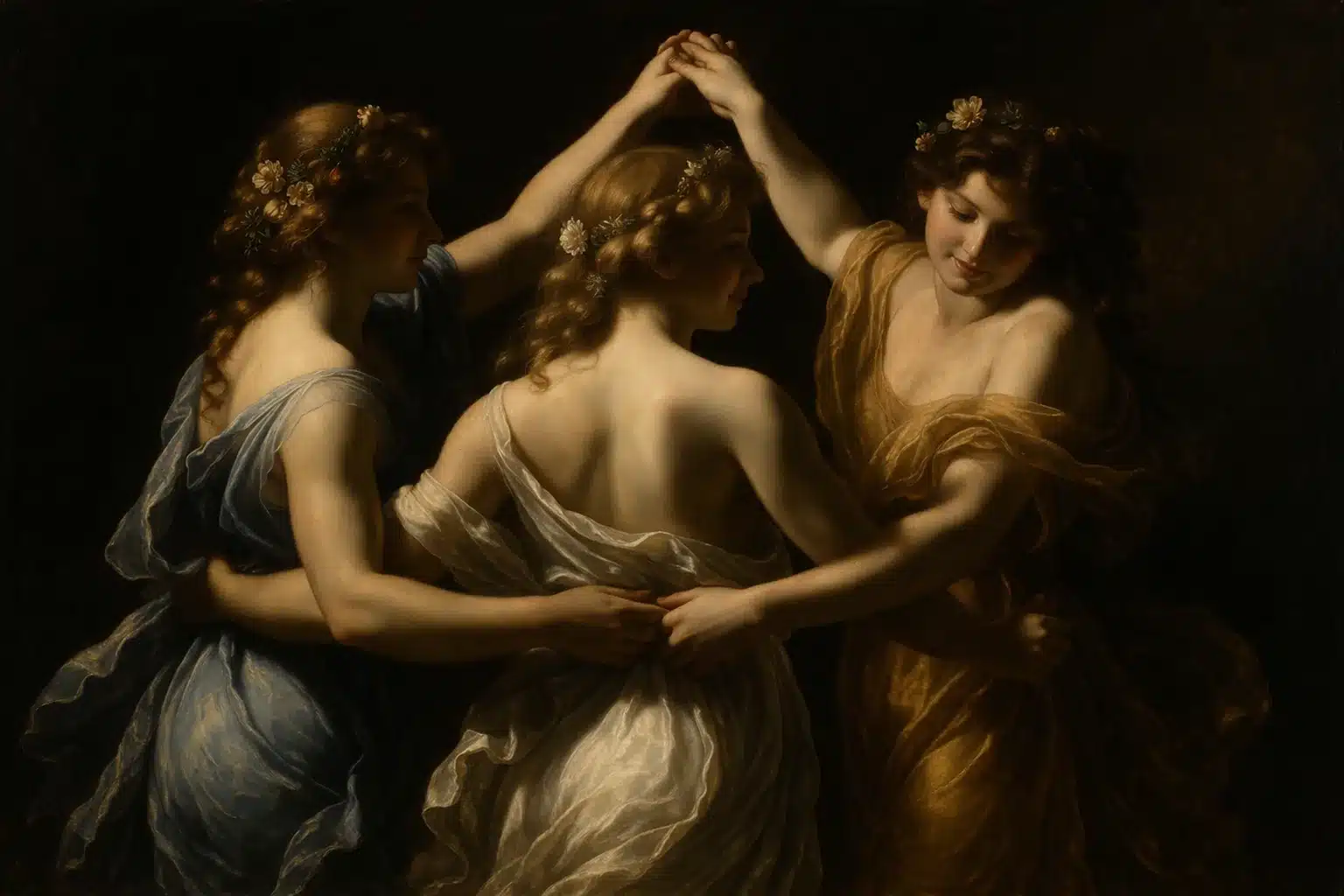
In the bright world of ancient Greek mythology, where gods and deities embodied concepts and forces of nature and human experience, the Charites held a special and charming position. They were not war deities or strict forms of power; instead, they symbolized the beauty, grace, joy of life, and delicate balance of social harmony. Their presence was associated with everything pleasant and artistic: dance, music, celebration and the kindness of human relations.
The Graces did not only inspire mortals, but also the gods themselves, giving shine and elegance even to Olympus. They were symbols of beauty and abundance, and their effect spread to both nature and human culture.
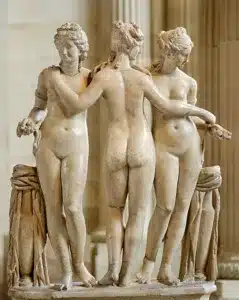
The Charites, also known as the Graces or Charites in ancient Greek, were usually three in the number. Their names were:
- Aglaia (The Brilliant)
- Euphrosyne (the Joy)
- Thalia (The Flowering or Prosperity)
According to the prevailing tradition, they were his daughters Zeus and the Eurynome Oceanide. However, different genealogies are also mentioned in some local traditions, suggesting their deep and multidimensional worship in the Greek world.
Each of the Harites represented a different aspect of beauty and human happiness. Aglaia was associated with the glamour and glory, Euphoria with joy and joy, while Thalia with the flourishing and prosperity of life.
In art, they were often portrayed as young women dancing in a circle, gripped hand-in-hand, symbolizing the unity and continuous flow of grace and beauty. The simplicity of their form was accompanied by a discreet aesthetic that emphasized the inner harmony.
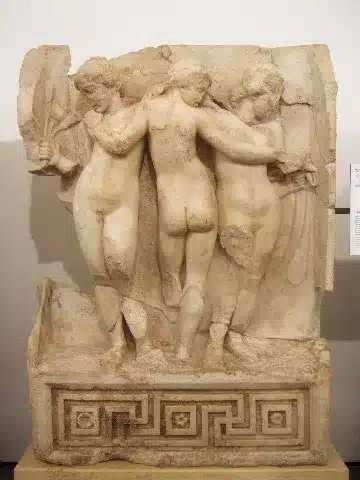
In ancient Greek society, the Charites were not merely mythological forms, but living symbols of cultural values. They were closely associated with her worship Aphrodite, the goddess of beauty and love, and with Muses, which inspired arts and letters.
The Charites represented the concept of «grace» Not only as aesthetic quality, but also as a social virtue. Kindness, hospitality, and generosity were considered manifestations of their influence. A man who had «grace» was someone who could create harmony around him, inspire and connect others.
Their worship was widespread in many areas of Greece, with important centres in Boeotia and Sparta. There were celebrations in their honor, where dancing, music, and ritual offerings dominated.
In literature and poetry, the Harites often appear as attendants of the gods or as patrons of creativity. Poets invoked their favor to give beauty and harmony to their works. At the same time, in angiography and sculpture, their forms were a favorite subject, reflecting the ideal of female elegance.
Discover more Greek deities in our collection.