
The Iliad
The Epic of the Trojan War and Human Hybrid
Introduction
- Iliad It is one of the leading works of the ancient Greek secretariat and the foundation of European literary tradition. It is attributed to the poet Homer and tells facts by tenth and final year of the Trojan War.
The epic does not focus on Troy itself, but on Achillea's conflict with Agamemnon and the dramatic consequences of anger, honor and human hubris.
«And Zeus said, "Hera, you can choose another time to visit the Ocean — For now, let us dedicate ourselves to love and the pleasure of each other. I have never so far been possessed by passion, nor for goddess nor mortal woman, as at this moment for you. — Not even when I was in love with Ixion's wife, who gave birth to Pirithus, the peer of the gods in counsel, nor with Danae, the daughter of Acrosius on thin feet, who gave birth to me the famous hero Perseus. Then there was Phoenix' daughter, who gave birth to Minos and Radamandhi. It was Semmel and Alcmene in Thebes, of which I gave birth to my lion-hearted son Hercules, while Semmel became the mother of Bacchus, the comforter of humanity. She was Queen Demeter again, and beautiful Leto, and you — But with none of them I was never as much in love as I am now with you.»
— Homer, The Iliad
Historical and cultural context
1. Introduction
- Iliad of Homer is one of the most important works of the ancient Greek secretariat and foundation of European literary tradition. Composed in a digital hexameter and divided into 24 stitchings, it dates conventionally to the 8th century BC and deals with a limited time but extremely dense episode of the Trojan War.
Although the epic unfolds in a war context, its importance transcends military narrative. The Iliad works as a philosophical and anthropological text, exploring fundamental concepts such as honor, rage, fate, loss and human mortality.
2. Object and narrative range of Iliad
In contrast to the common impression, Iliad It does not narrate the entire Trojan War, nor does it involve the melting of Troy. Its narrative range is limited to about fifty days from the last year of the ten-year conflict.
This choice allows the poet to focus not on the external events of war, but on the internal conflicts of heroes and the moral consequences of their actions.
3. Achilles's main theme axis
The opening verse of the epic («She saw, goddess, Clayideus.») makes it clear that the narrative is organized around Achilles' anger. His confrontation with Agamemnon, due to the removal of Brisida, is an insult to his heroic honor (value).
The withdrawal of Achilles from battle is not just a personal reaction, but an act with collective and destructive consequences. In this context, the Iliad highlights the fragile balance between individual Cleos and the common interest.
4. Gods, fate and human responsibility
Her gods Iliad They actively interfere with the evolution of events, sometimes supporting Achaeans and sometimes Trojans. However, divine action does not negate the sovereignty of Squadron. Even Zeus appears limited by a supreme, impersonal secular design.
The relationship of gods and men does not lift human responsibility; on the contrary, it strengthens the tragicity of the choices of heroes, who act freely but know their inevitable end.
5. Patroclus and the displacement of the epic
Patrocle's death is a turning point of the narrative. His entry into battle with Achilles' armor symbolizes the illusion of replacing the hero, while his fall from Hector's hand (with divine assistance) turns the epic from a conflict of honor into a drama of mourning and vengeance.
Patrocle's form highlights the importance of friendship and emotional connection in a world dominated by war values.
6. Achilles as a tragic hero
Achilles embodies the ideal but also deeply tragic hero. His choice between a long life without glory and an early death with eternal Cleos is a central philosophical dilemma of Iliad.
His vengeance against Hector and the abuse of the dead body reveal the limits of heroic morality and touch the concept of hubris, preparing the need for cleansing.
7. Hector and the human heroism pattern
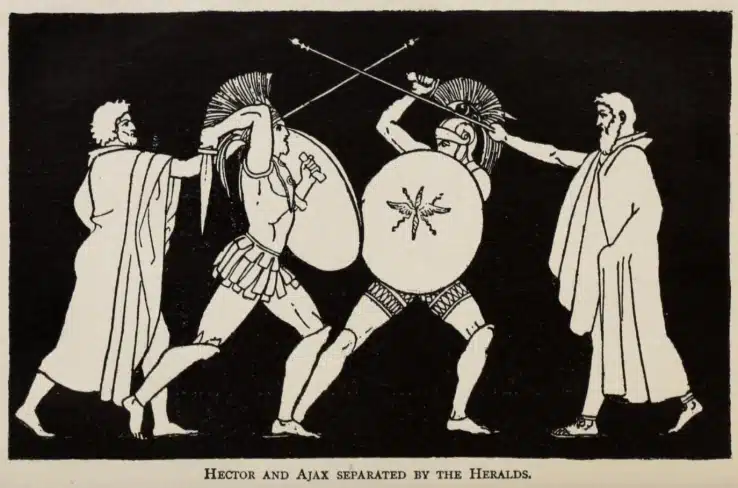
Hector is shown as the epic's foremost human hero. Defender of Troy, husband and father, knows the inevitable of his fate, but chooses to face it with dignity.
The stage of farewell with Andromache is a leading moment of humanism and gives Iliad intense emotional and moral dimension.
8. The end of Iliad and the concept of cleansing
- Iliad is completed with the meeting of Primia and Achilles. The begging of the old king and the thrill of Achilles lead to temporary reconciliation and restoration of human dignity.
The epic closes with Hector's burial, stressing that the final word is not of violence, but of memory, pain and common human fate.
9. Conclusion
- Iliad remains a timeless work, because it combines heroic narrative, tragic philosophy and deep humanism. Her power lies in her ability to present war not as a means of glory, but as a field where the boundaries and values of human existence are revealed.
FAQ – Iliad
1. What's Iliad?
Iliad is one of two major Homeric epics and tells events from the Trojan War, focusing mainly on Achilles' conflict with Agamemnon.
2. Who wrote the Iliad?
Iliad is traditionally attributed to Homer, although its historical existence remains the subject of discussion.
3. How many books does Iliad have?
The Iliad consists of 24 stitches.
4. What's the main theme of the Iliad?
The main theme is his month (orgy) Achilles And its consequences in the Trojan War.
5. What does the word mean? «month» Iliad?
It means divine, deep rage that leads to tragic events.
6. Who was Agamemnon?
- Agamemnon He was leader of the Achaeans in the campaign against Troy.
7. Who was Achilles?
- Achilles was the most important warrior of the Achaeans and central hero of the epic.
8. What's the Iliad case?
It tells a few weeks from the last year of the Trojan War.
9. Who's Troy in the Iliad?
- Troy It was the city that the Achaeans besieged.
10. Who's fighting in the Iliad?
The Achaeans (Greeks) against the Trojans.
11. Who was Hector?
- Hector He was the greatest hero of the Trojans.
12. What goddess helped Achilles?
- Thetida He was protecting him.
13. What gods appear in the Iliad?
Many gods of Olympus appear who interfere with the war.
14. Why did Achilles stop fighting?
Because Agamemnon removed his captive Brise.
15. Who killed Hector?
Achilles in a duel outside the walls of Troy.
16. What is Achilles' shield?
It was a masterpiece work of art detailed in the epic.
17. How does Iliad end?
It ends with Hector's burial by the Trojans.
18. Is Iliad a historical book?
It combines myth, epic poem and possible historical references.
19. What is the meaning of the Iliad?
It is a foundation of ancient Greek literature and education.
20. When was the Iliad written?
Probably the 8th century B.C.E.
21. Why is Iliad important today?
It deeply influenced world literature and understanding heroic narrative.
Bibliographic Epilogue
- Homer, Ilia, critical publications and translations (Allen, West).
- Kirk, G. S., The Iliad: A Commentary, Cambridge University Press.
- Griffin, J., Homer on Life and Death, Oxford University Press.
- Snell, B., The Discovery of the Mind, Harvard University Press.
- Finley, M. I., The World of Odysseus, Penguin Classics.
- Nagy, G., The Best of the Achaeans, Johns Hopkins University Press.
Read more
Achilles’ vulnerability – Achilles heel