
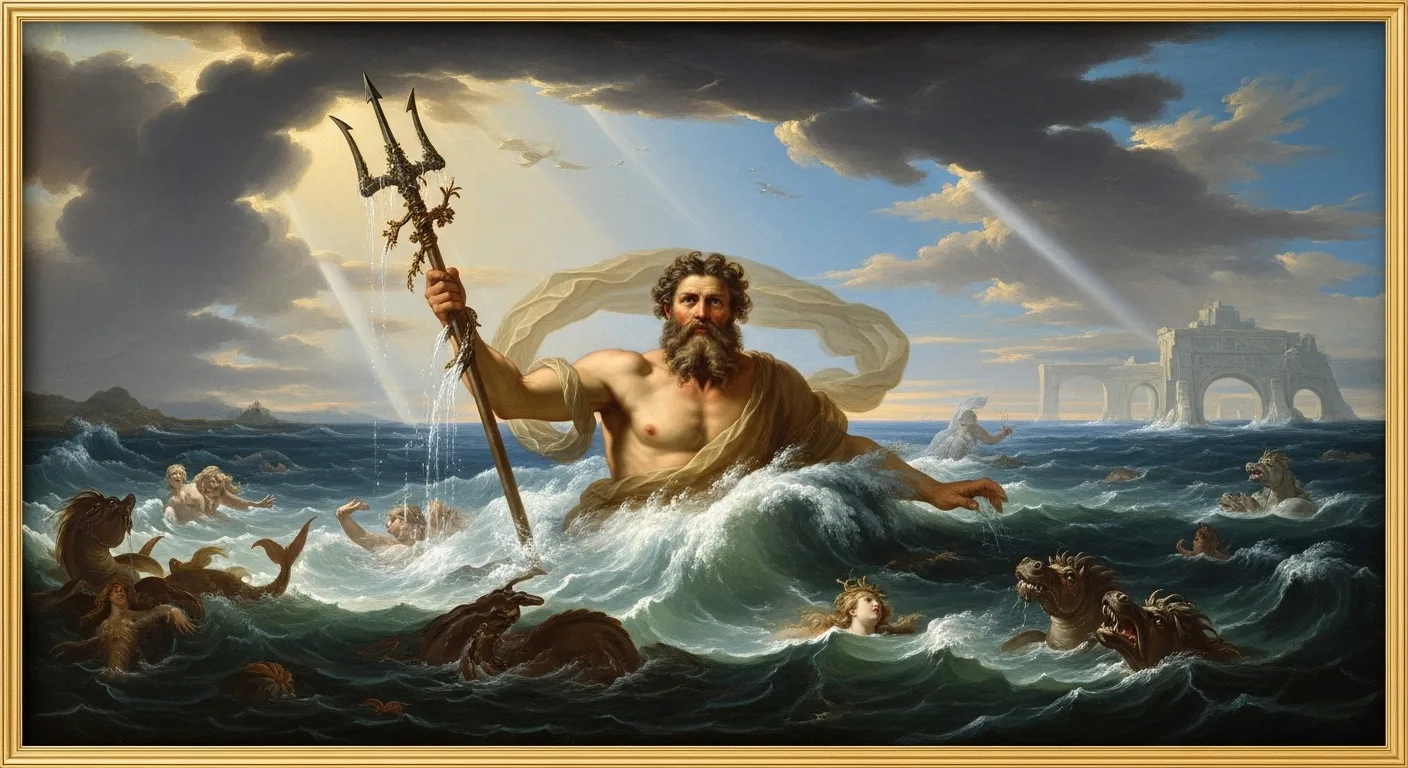
Oceanus – The Titan of the Cosmic River

The Ocean is one of the oldest and most magnificent forms of Greek mythology. It belongs to the Titan generation and is considered the personification of the vast cosmic river surrounding the entire Earth. Unlike today's term «ocean», which refers to the vast sea areas of the planet, the mythological Ocean was a divine entity, a powerful primary force encompassing the known world and was a source of every river, lake, source and water element.

In ancient Greek cosmology, even before the pantheon of Olympia was fully formed, the Ocean held a prominent position as one of the fundamental forces of nature. Ancient Greeks understood him not only as a water god, but also as a symbol of the perpetual flow of life, birth, renewal and connection of all things into the universe.

The Origins of the Ocean

The Ocean was his son Uranus and Gaia, Heaven and Earth respectively, the two primary deities who gave birth to the Titans. It belonged to the generation that preceded the Olympian gods and was considered one of the strongest and oldest Titans.

Unlike his brother Saturn, who sought the sovereignty of the world, the Ocean is not presented as ambitious or warlike. Instead, ancient sources describe him as a calm and stable secular force, devoted to maintaining natural order.

His wife was Titanida Tethys, also the daughter of Heaven and Gaia. Together they were the divine couple from which almost all the sweet waters in the world came.

The cosmic river surrounding the Earth

In the ancient Greek conception of the world, Earth was presented as a record surrounded by an endless circular river. This river was the ocean itself.

The Greeks believed that from its waters were born all rivers, springs, lakes and seas. The Ocean was considered the primordial source of all forms of water and therefore of life itself.

This idea is reflected in the works of Homer, where the Ocean is characterized as «father of the gods» and as the primary source from which many divine and natural forces came.

His cosmic dimension made him more than just a god of the sea. It did not only govern certain waters but the water element itself that surrounded and maintained the world.

Tethy and the descendants of the Ocean

The Ocean and Tethys had countless offspring. According to Hesiod’s Theogenia, they gave birth to three thousand Rivers and three thousand Oceans.

The Rivers were deities who personified the great rivers of the Earth. Among them were Acheloos, Skamandros, Alpheus, and many other water deities worshiped in various areas of the Greek world.

Oceanides were nymphs of water and nature. Many of them played an important role in mythology. Among them are Styx, Dioni, Eurynome, Pleion and Mitis.

This huge generation shows how central the role of the Ocean was to the secular structure of Greek mythology. Through his descendants he was associated with countless myths and deities.

The Ocean and Titanic Battle

A special feature of the Ocean is its attitude during Titanic combat, the great war between Titans and the Olympian gods.

Unlike Saturn and many others Titans, the Ocean did not actively participate in the conflict. Ancient sources suggest that he chose to remain neutral and not engage in the war for power.

This neutrality probably reflects his secular character. As a force representing the eternal flow of nature, the Ocean was beyond the political and dynastic disputes of the gods.

Thanks to this attitude, he was not punished after the Olympian victory and continued to hold an important position in the divine hierarchy.

The depiction of Ocean in ancient art

The artists of ancient times portrayed the Ocean as an imposing bearded god with features referring to water. It often appeared with bull horns or body combining human and marine elements.

In vessels, reliefs and mosaics it is presented to emerge from the waves or travel on a chariot that was dragged by sea creatures.

Οι παραστάσεις αυτές υπογράμμιζαν τον κοσμικό του χαρακτήρα και τη στενή του σχέση με τις δυνάμεις της φύσης.

The Symbolism of the Ocean

Ο Ωκεανός συμβολίζει την αέναη ροή της ζωής και τη σύνδεση όλων των πραγμάτων μέσα στο σύμπαν. Τα νερά του δεν έχουν αρχή και τέλος, όπως ακριβώς ο κύκλος της φύσης και της δημιουργίας.

Παράλληλα, αντιπροσωπεύει τη σταθερότητα που κρύβεται πίσω από τη συνεχή αλλαγή. Ενώ τα ποτάμια, οι βροχές και οι θάλασσες μεταβάλλονται διαρκώς, η πρωταρχική πηγή τους παραμένει αμετάβλητη.

Για τους αρχαίους Έλληνες, ο Ωκεανός ήταν η ζωντανή απόδειξη ότι ο κόσμος λειτουργεί μέσα από κύκλους ανανέωσης και ισορροπίας. Ως πατέρας ποταμών, γεννήτορας νυμφών και κοσμικός περιβάλλων του κόσμου, ενσάρκωνε τη δύναμη της φύσης που τροφοδοτεί κάθε μορφή ζωής.

Η μορφή του παραμένει μία από τις πιο αρχέγονες και φιλοσοφικά σημαντικές της ελληνικής μυθολογίας. Αν και δεν πρωταγωνιστεί σε πολλές δραματικές αφηγήσεις, η παρουσία του βρίσκεται στο υπόβαθρο ολόκληρης της μυθολογικής κοσμογονίας, ως η αιώνια πηγή από την οποία αναβλύζει η ζωή και η τάξη του κόσμου.


- Oceanus is one of the oldest and most secular Titans of Greek mythology. It represents the raw water that surrounds and sustains the world, the uninterrupted cycle of life and physical balance. Unlike other Titans, the Ocean is characterized by calm and stability, elements that make him a symbol of peace and harmony.

In mythoi.org, the Ocean is presented as a fundamental deity of nature, with intense cultural and educational value.


Key Data

  • Name: Oceanos (Oceanus)

  • Domain: Titan of the waters and rivers

  • Type: Titans

  • Parents: Uranus and Gaia

  • Wife: Tethys

  • Children: Potamoi and Oceanides

  • Symbols: Waves, snake, horns, rivers


The Role of the Ocean in Mythology

The Ocean:

  • encloses the world as cosmic river

  • is a source of all water

  • sustains life on earth

In ancient cosmology:

  • The world is surrounded by the Oceanos

  • beyond him extends the unknown


The Concept of the World River

The Oceanos is not just a sea:

  • is life flow

  • It's a border of the world

  • is a source of wisdom and memory

This concept shows:

  • how ancient Greeks understood geography

  • the relationship between man and nature


⚔️ Oceanus and Titanic Battle

Unlike other Titans:

  • the Oceanos did not fight

  • remained neutral

  • represents the Peaceful power of nature

This makes him:

  • balance symbol

  • contrary to conflict


Powers & Skills

  • Control of all waters

  • Maintaining physical balance

  • Creation and protection of rivers

  • Eternal flow and renewal of life


Symbolism & Cultural Meaning

The Oceanos symbolizes:

  • The beginning of life

  • the continuity and eternity

  • natural wisdom

In philosophy:

  • water as a primary element

  • nature as balance and harmony

Ancient sources

Hesiod – Theogenia & Works and Days | Primary Sources

Primary Sources of Greek Mythology | Hesiod, Homer, Orphic Hymns

Primary Sources of Greek Mythology | Ancient Texts

Apollodorus

Perseus Digital Library is a reliable academic database with ancient Greek texts and historical sources, particularly useful for the study of Greek mythology and Elefsinian Mysteries.

Leave a comment