
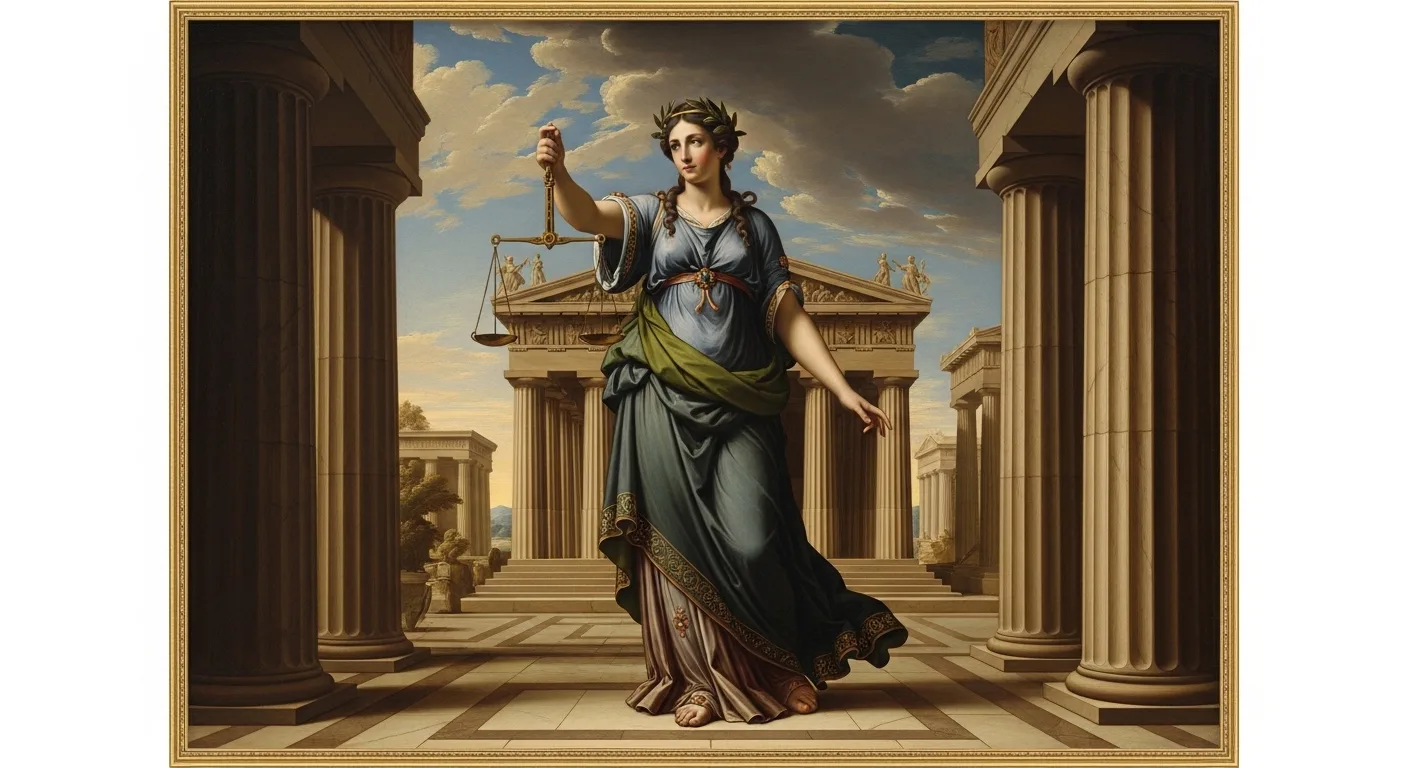
Themis – Titaness of Justice and Order

Spread the love

Themis is one of the most important and most respected deities of ancient Greek mythology. It belongs to the Titanid generation and is considered the personification of divine justice, natural order and unwritten laws governing the universe. Unlike many other deities associated with wars, passions or natural phenomena, Themis represents an abstract but fundamental power: the harmony that allows the world to function according to rules and principles.

In ancient Greek thought, justice was not limited to human societies. There was a higher secular order that regulated relations between gods, people and nature. Themis was the deity that embodied this world balance. For this reason he held a particularly high position among the gods and was considered counseling both the Titans and the Olympian gods.

Origin and place in cosmogony

Themis was her daughter. Gaia and Uranus. As one of the twelve Titanides and Titans, belonged to the second generation of divine existences born after the primary secular powers.

Her name comes from the word «themis», which in ancient Greek meant the established law, the righteous custom and the right order of things. This concept was much wider than the modern term «Law», as it included every divinely defined principle that ensured the proper functioning of the world.

Themis was considered one of the wisest Titanides and often appears as a deity who knows the past, present and future.

Her relationship with Jupiter

After the Olympic gods prevailed in Titanic combat, Themis was not punished as many other Titans. Instead, she was recognized for her wisdom and justice and gained a prominent place in Olympus.

According to mythology, he became one of his wives ZeusTheir union symbolized the connection of power to justice. Zeus was the supreme ruler of the gods, while Themis represented the principles that even the king of Olympus had to observe.

This relationship stressed that true authority cannot exist without justice and order. For the ancient Greeks, Themidus’ presence next to Zeus was a guarantee that divine rule was based on righteous principles.

Mother of Hours and Squadrons

From the union of Themides with Zeus were born important deities related to the functioning of the world.

Her most famous daughters were the Hours:

  • The Eunice, goddess of good governance and legitimacy.
  • The Trial, goddess of justice.
  • Peace, goddess of peace and social harmony.

These three deities were considered necessary for the welfare of human societies. Their presence ensured the stability of cities and the well-being of citizens.

In some traditions, Themis is also considered the mother of the Fatities, the three deities that determined the destiny of every man and god. This connection strengthens her role as goddess of the secular order, as even fate was subject to the divine laws she represented.

Themis as a goddess of oracles

Even before the god Apollo gained control of the Oracle of Delphi, Themis was closely associated with prophetic knowledge. According to some myths, she succeeded Gaia's mother as patron of the sacred Oracle.

Her relationship with oracles was not accidental. Themis knew the divine laws governing the universe and could predict the consequences of the acts of gods and men. Her prophetic power was based on the deep understanding of the secular order rather than on magic or deception.

The ancients believed that her wisdom surpassed even that of many Olympian gods, which explains the respect she was given.

Symbolism of Themid

Themis is a timeless symbol of justice and balance. It represents:

  • Divine and human justice.
  • The moral order of the world.
  • The observance of laws and customs.
  • The wisdom that guides decisions.
  • The balance between power and law.

Unlike the Trial, which is most concerned with granting justice to human affairs, Themis represents the eternal rules governing the entire universe.

Pictures in art

Themis was usually portrayed as a serious and imposing woman with a royal attitude. In ancient times he often held a sceptre or horn of abundance, symbols of power and prosperity derived from justice.

During the Roman era and later in European art, its form evolved into the well-known allegory of Justice. The image of the woman with the scale, and in later times with blindfolded eyes, has its roots in the ancient conceptions associated with Themida.

Even today, statues of Justice found outside courts throughout the world are an indirect continuation of this ancient deity.

Theme’s legacy

Themis is one of the most timeless forms of Greek mythology. Unlike many deities associated with certain myths or natural phenomena, it symbolizes values that remain important in every era: justice, legality, wisdom and harmony.

As the Titan of divine order, she recalls that power without justice leads to chaos, while true stability is based on respect for rules and moral balance. Her presence in Greek mythology reveals how important the concept of justice was to ancient Greeks, not only as a social principle but also as a fundamental force of the universe itself.


Key Data

  • Name: Themis

  • Domain: Titaness of justice and order

  • Type: Titanesses,

  • Parents: Uranus and Gaia

  • Wife: Zeus (in certain traditions)

  • Children: Hours, Fates (in one version)

  • Symbols: Balances, scepter, peace, law


⚖️ The Role of Themis in Mythology

Themis

  • It regulates the Justice of the gods

  • keeps the secular class

  • protect them. oaths and institutions

It is:

  • Adviser to Zeus

  • voice of moral balance


Mother of Hours and Fatals

According to some traditions, Themis gave birth to:

  • The Hours → Nobility, Trial, Peace

  • The Moirai → Clotho, Lahesis, Atropos

These deities:

  • regulate time, justice and fate

  • ensure the stability of the world


Powers & Skills

  • Absolute knowledge of divine laws

  • Maintaining secular balance

  • Protection of social institutions

  • Prophetic insight


Symbolism & Cultural Meaning

Themis symbolizes:

  • natural justice

  • the relationship between law and morality

  • social harmony

In culture:

  • was based on ancient law

  • influenced philosophy and democracy


⚔️ Themis and the Titanomachy

Themis

  • did not fight the Olympians

  • spoke out in favor of order

  • She maintained her role after Zeus' victory

Ancient sources

Hesiod – Theogenia & Works and Days | Primary Sources

Primary Sources of Greek Mythology | Hesiod, Homer, Orphic Hymns

Primary Sources of Greek Mythology | Ancient Texts

Apollodorus

Perseus Digital Library is a reliable academic database with ancient Greek texts and historical sources, particularly useful for the study of Greek mythology and Elefsinian Mysteries.

Leave a comment

Privacy Overview
MYTHOI. ORG Explore Greek mythology and folklore through gods, heroes, myths and traditions. Educational content for students, educators and friends of mythology.

This website uses cookies to provide you with the best user experience possible. Cookies information is stored on your browser and perform functions such as your identification when you return to our website and helping our team understand which parts of our site you consider more interesting and useful.

Absolutely necessary cookies

The strictly necessary cookie should be enabled at any time so that we can save your cookie settings preferences.

Statistics

This website uses Google Analytics to collect anonymous information, such as the number of visitors on the website and the most popular pages.

Maintaining this cookie allows us to improve our website.