
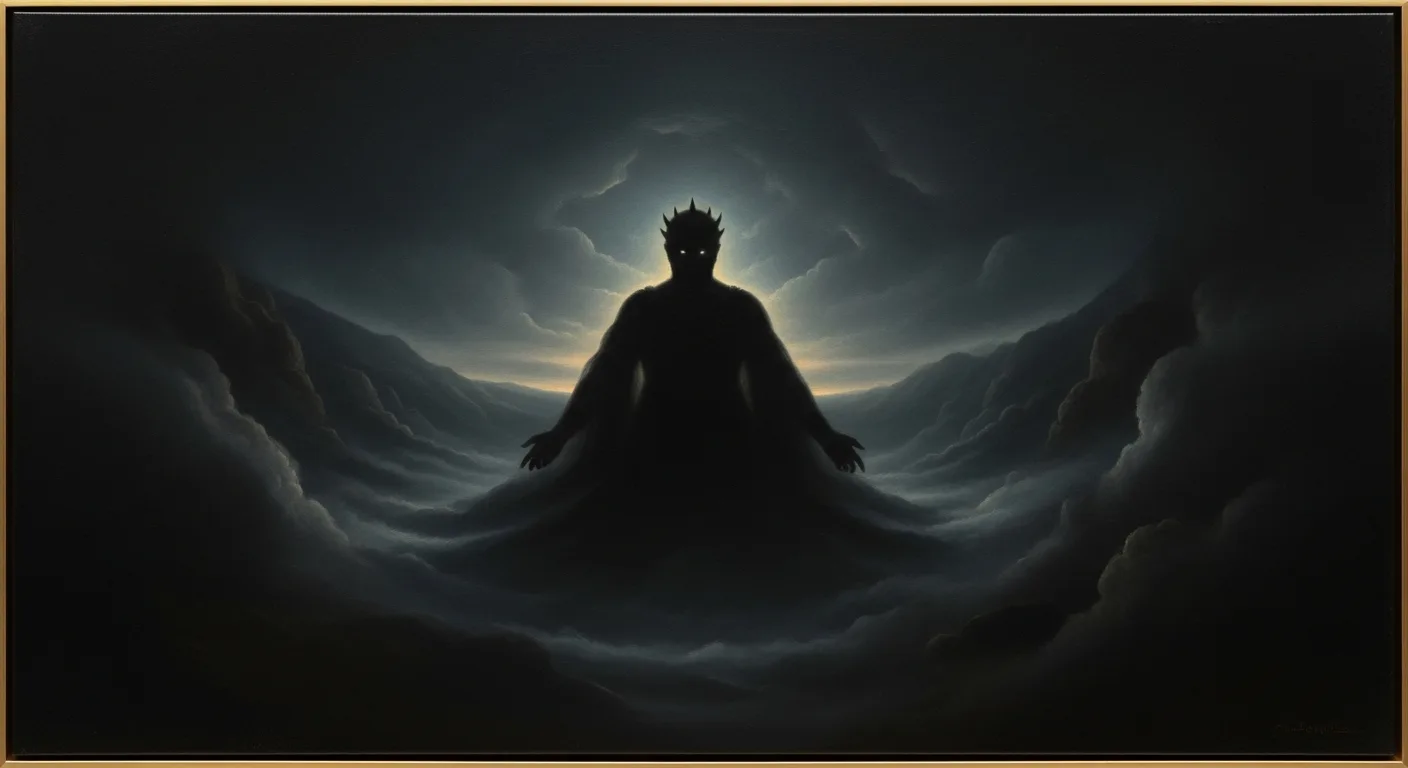
Who was Erebus?
- Erebus is one of the primary deities of Greek mythology and personifies Total darkness and the deep shadow that presupposed the creation of the world.
It is not a god with human characteristics or myths of action, but a god with human characteristics or myths of action. cosmic power, necessary for the birth of the universe.
In the thought of the ancient Greek, Erebos expresses darkness between life and deathThe transition between Chaos and class.
Origin and place in cosmogony
According to Hesiod (Theogony):
- Erebus was born directly from Chaos
It belongs to the same primary generation as:
Erebus has no father or mother in the conventional sense· is manifestation of the first existence.
Erebus and Nyx
Erebos is closely associated with Night, with which:
forms one cosmogenic pair
gives birth to:
Ether – the clear, bright light of the sky
Hemera – the light of the world
This contrast of darkness and light is a basic pattern of Greek cosmogeny:
From the darkness the light is born.
Erebus as a place
In addition to deity, Erebus is also referred to as:
region of the Underworld
Dark zone between Earth and Hades
space where souls wander before reaching their final destination
In this form, Erebos acts as border between worlds.
Symbolization of Erebus
Erebus symbolizes:
The primordial darkness
The unknown
The transition
the shadow of existence before knowledge and light
It does not identify with evil, but with prerequisite for creation.
Erebus in philosophy and culture
In ancient thought, darkness is not an enemy of light but the before
Erebus is often used as a meaning:
in philosophy
correspondent in literature
in poetic language as a symbol of ignorance or silence
Educational value
Erebos is a key element in:
understanding of Greek cosmogony
study of abstract concepts in mythology
comparison with other cosmogenic traditions (darkness → light)
Erebus — Frequently Asked Questions & Short Answers (Q&A)
What is Erebus?
Erebos is in mythology personification of darkness and deep dark existence.
Where did Erebus come from?
According to the «Theogenia» of Hesiod, Erebos was born first of Chaos.
What's his role in mythology?
Erebos symbolizes the primary darkness before light and represents the abyss of the underworld.
What is his relationship with Night (Nyx)?
Erebos is closely associated with the Night — is usually night attendant or companion the creation of the universe.
What kids did he have with Night?
His relationship with Night were born the Ethiopian (the glow of light) and the Day.
Is Erebus a god or a place?
It's Erebos. and mythical person (god/personalization) and name for the deep darkness or space between life and Hades.
Does Erebus have worship or cult myths?
No cult stories or temples are saved for Erevo — Its role is more poetic and symbolic rather than religious.
What does the word mean? «Erebus»?
The word means dark, grey depth, grimness.
Where does he appear in Hesiod's poetry?
Erebus refers to the beginning of cosmogony, when Chaos dominated and the first deities were born.
Is Erebus related to Hades?
Yes — in the case of some ancient authors, «Erebos» refers to dark space of the Underworld or its entry.
Is Erebus one of the Olympian gods?
No. No. — is owned by First generations of the worldBefore the Olympian gods.
What does Erebus symbolize mythologically?
Symbol the primordial dark matter and the depth from which all life and light were born.
Are there any heroes stories about Erebus?
No — there is no traditional "adventure" or myth starring Erebus like there is for other gods.
How is it connected to the existence of light?
From the darkness of Erebus and Night light was born (Either and Day).
Does Erebus have a Roman equivalent?
The Roman equivalent of Night and Darkness is Nox, but this particular «God Erebus» has no clear Roman worship or name.