
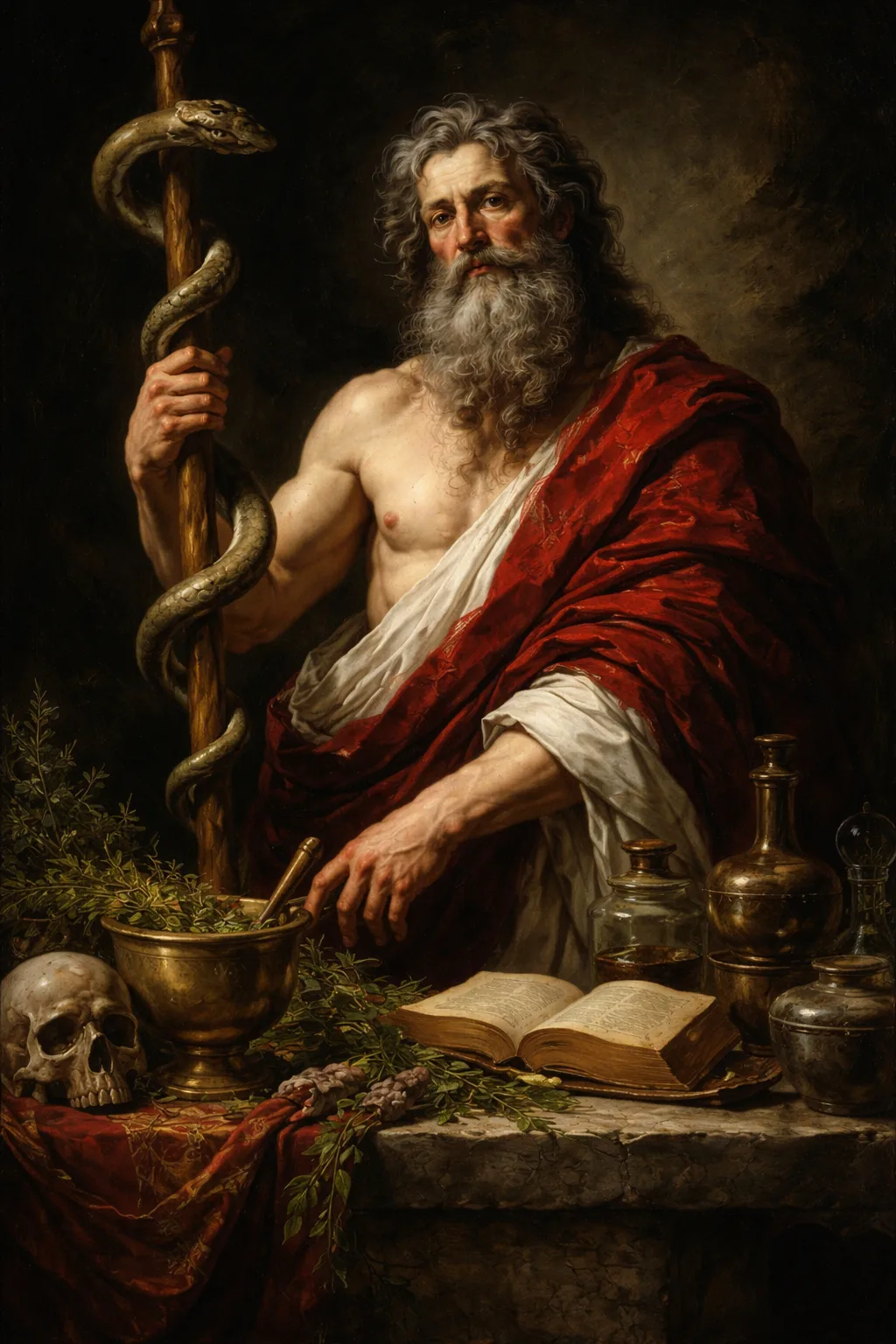
- Asclepius (Aesculapius) is one of the most important and dear forms of Greek mythology, connected inextricably with the medicine, treatment and regeneration of life. His worship spread throughout the ancient Greek world and deeply influenced the evolution of medical science.
- Asclepius (Aesculapius) He was the son of God. Apollo and the mortal princess Crown, daughter of the king Flax.
- According to legend, Koronida was unfaithful to Apollo.
- God, learning betrayal, fatally punished her (or through her) Artemis).
- Before she burned her body in the fire, Apollo saved the unborn child, removing it from her belly.
Thus Asclepius was born, a form that has already since his birth been associated with the victory of life upon death.
Apollo delivered the little Asclepius to the wise centaur Chiron, known for his knowledge and wisdom.
- Chiron taught him:
- The art of medicine
- The use of herbs
- Surgery
- Treatment of injuries and diseases
Over time, Asclepius became so capable that:
- He cured every disease
- He raised up dead (according to certain traditions)
Asclepius' ability to restore dead to life was considered dangerous to natural order.
- - Hades He protested that people stopped dying.
- - ZeusFearing to overthrow the cosmic balance, he punished him.
Zeus struck him with lightning and killed him.
However:
- Apollo was furious and avenged by killing the Cyclops.
- Eventually, Asclepius was deified and became a god of medicine.
Asclepius is connected to a whole «medical family»:
- Spouse:
- Epione – goddess of softness of pain
- Children:
- Hygieia – god of health
- Panacea – goddess of universal therapy
- Iaso – goddess of recovery
- Aceso – goddess of the healing process
- Aglaia (in some versions)
- Mahaon and Podalirius – doctors in Trojan War
The worship of Asclepius was among the most widespread in ancient Greece.
The Asclepians
They were sacred healing centers where patients sought healing.
Important asclipia existed in:
- Epidaurus (the most famous)
- Kos
- Pergamon
Therapeutic practices
- Annotation (holy sleep in the temple)
- The interpretation of dreams by priests
- Use of herbs and natural treatments
- Cleaning and sacrifice
Patients believed that Asclepius appeared in their dreams and indicated the treatment.
His most famous symbol is:
- The snake rod
Characteristics:
- The snake symbolizes:
- Renaissance (due to skin elimination)
- Sofia
- Treatment
???? This symbol is used to date as a global emblem of medicine.
Asclepius worship is closely linked to the development of scientific medicine.
- In Kos The Hippocrates.
- Asclipia were:
- Hospital precursors
- Medical Events Registration Centres
What was Asclepius?
Asclepius was a god of medicine in Greek mythology, known for his healing abilities and association with asclepians.
What is the symbol of Asclepius?
The snake rod, a symbol of healing and regeneration.
Where was Asclepius worshipped?
In sacred healing centers such as Epidaurus and Kos.
Why did Zeus kill him?
Because he could raise the dead, disrupting the natural order.
Discover more Greek deities in our collection.