
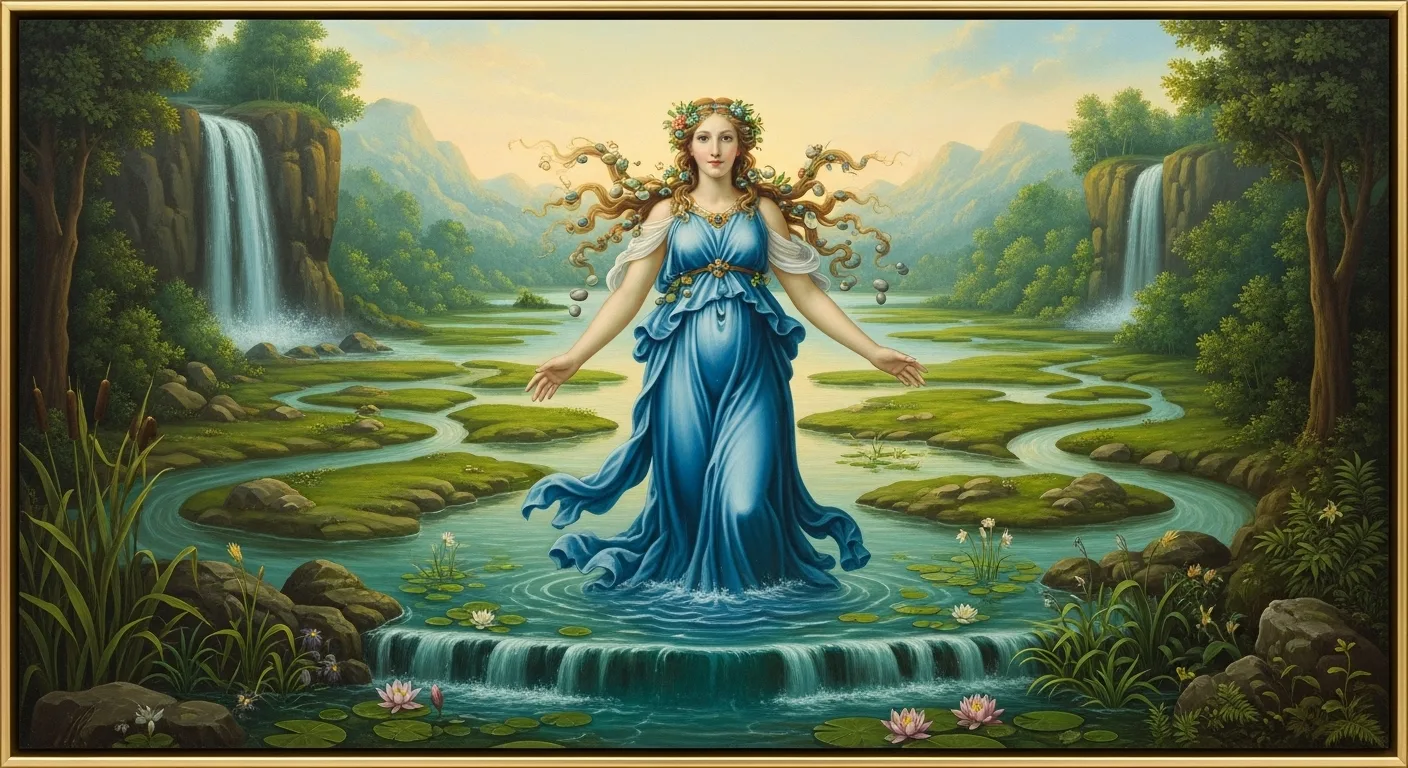
- Tethys It is one of the oldest and most serene figures in Greek mythology. As Titan of water and fertility, she personifies the feminine aspect of water, nourishment, and the preservation of life. Together with Oceanus, is the birth power of all the water elements of the world.
She belongs to the generation of the Titans, the all-powerful divine beings who preceded the Olympian gods, and is directly associated with the waters of the Earth—the seas, rivers, and springs. As the wife of Oceanus and the mother of thousands of river deities and nymphs, Tethys was considered the primordial mother of the waters, a deity who symbolized fertility, life, and the constant renewal of nature.
Origin and place in cosmogony
According to the «Theogenia» The HesiodTethys was her daughter. Gaia and Uranus, two of the first secular entities to appear after Chaos. She was one of the twelve original Titans and Titans, brothers who formed the second generation of divine existences.
Tethys was united with her brother Oceanus, the Titan who personified the vast cosmic river that surrounded the world. Their union was regarded by the ancient Greeks as the source of all earthly waters. Unlike other Titans who engaged in wars and conflicts over power, Tethys and Oceanus were primarily associated with the creation and preservation of life.
The mother of rivers and oceans
The most important quality of Tethys was its role as mother of the river gods and the Oceanids. According to mythology, she gave birth to three thousand Rivers And three thousand oceans, a figure that symbolizes the countless multitude of water powers that exist in nature.
The Rivers were deities who personified the great rivers of the world. Among them are: Acheloos, Alphae, Skamandros And many others. Each river had its own divine personality and worship, as ancient Greeks felt that the waters had divine power.
The OceanidsOn the other hand, they were nymphs of sources, lakes, rivers and marine waters. Among them we find important forms such as Styx, - Dione, - Metis and Clymene,Many of them were later associated with other divine generations and played an important role in Greek myths.
Tethys as the Nurturer of the Gods
In some traditions Tethys appears as a deity with maternal characteristics that exceed the limits of her family. One of the most famous stories reports that he hosted and raised Hera when she was still a child.
During the conflict between the Titans and the Olympian gods, known as Titanomachy, Rhea entrusted Hera to Tethys and Oceanus to protect her. Thus, Tethys became the foster mother of the future queen of Olympus.
This tradition highlights the figure of Tethys as a protector and nurturer, a deity who offers safety and care. This aspect reinforces her symbolism as the maternal force of nature.
Symbolism and significance
Tethys was not merely a sea goddess. She embodied the very concept of water as the source of life. In ancient Greek thought, all living beings depended on water, whether it came from rivers, springs, or the seas.
The goddess symbolized:
- The fertility of nature.
- Mother's protection.
- Renewal and life cycle.
- The connection of all the water elements in the world.
- Plenty and prosperity.
The ancients observed that water nourishes the earth, enables plants to grow, and sustains life. For this reason, Tethys was regarded as one of the great creative forces of the universe.
Pictures in ancient art
Tethys appears relatively rarely in Greek art compared to deities such as Athena or Aphrodite. When depicted, she is usually presented as a mature and imposing woman with a royal appearance, suggesting her ancient and primary nature.
In Hellenistic and Roman mosaics it is often accompanied by sea creatures, dolphins or mythical water beings. Sometimes it bears small wings on the forehead or symbols that refer to the fertility of water.
The artists sought to emphasize not only her relationship with the sea but also her role as the mother of countless divine descendants.
Tethys in Roman tradition
The Romans adopted many Greek deities and myths, largely preserving the form of Tethys. In Roman art it occurs more frequently, especially in decorative mosaics and sarcophagus, where it is associated with the beneficial power of water.
Her presence in the Roman period proves that her symbolism as the mother of the waters remained strong even centuries after the formation of the first Greek myths.
The Legacy of Tethys
Although not starring in heroic adventures or dramatic conflicts, Tethys holds a fundamental position in Greek mythology. Without it there would be no rivers, sources and nymphs that fill the mythological world with life and movement.
Its form recalls that ancient Greeks understood water as a sacred element and recognized its vital importance to the existence of the world. As the mother of the waters and protector of natural fertility, Tethy represents the creative power of nature and the continuous regeneration of life. Through this symbolic dimension, it remains one of the most important Titanics of Greek cosmogony and a form that reveals the deep relationship of ancient Greeks with the natural environment and mysteries of water.
Key Data
Name: Tethys
Domain: Titan of Fresh Waters and Fertility
Type: Titans
Parents: Uranus and Gaia
Spouse: Oceanus
Children: Potamoi and Oceanids
Symbols: Water, rivers, waves, vessels
The Role of Tethys in Mythology
Tethys:
gives birth to all freshwater
nourishes the earth and life
acts as a maternal deity of nature
Completes the Oceanus:
He encloses the world
she bring him to live
Mother of Rivers and Oceans
According to tradition:
obtained 3,000 rivers
and 3,000 Oceanids
These represent:
the dissemination of life
the importance of water in culture
⚔️ Tethys and Titanic fighting
Tethys:
did not participate in the war
held a peace stand
took on a protective role
In some versions:
Host the Hera When Titanic broke out
Powers & Skills
Create and protect freshwater
Fertility of the earth
Divine motherhood
Balance of nature
Symbolism & Cultural Meaning
Tethy symbolizes:
The mother face of water
food and life
peace and continuity
Connected:
with nature
with ecology
with sustainability
Ancient sources
Hesiod – Theogenia & Works and Days | Primary Sources
Primary Sources of Greek Mythology | Hesiod, Homer, Orphic Hymns
Primary Sources of Greek Mythology | Ancient Texts
Perseus Digital Library is a reliable academic database with ancient Greek texts and historical sources, particularly useful for the study of Greek mythology and Elefsinian Mysteries.