
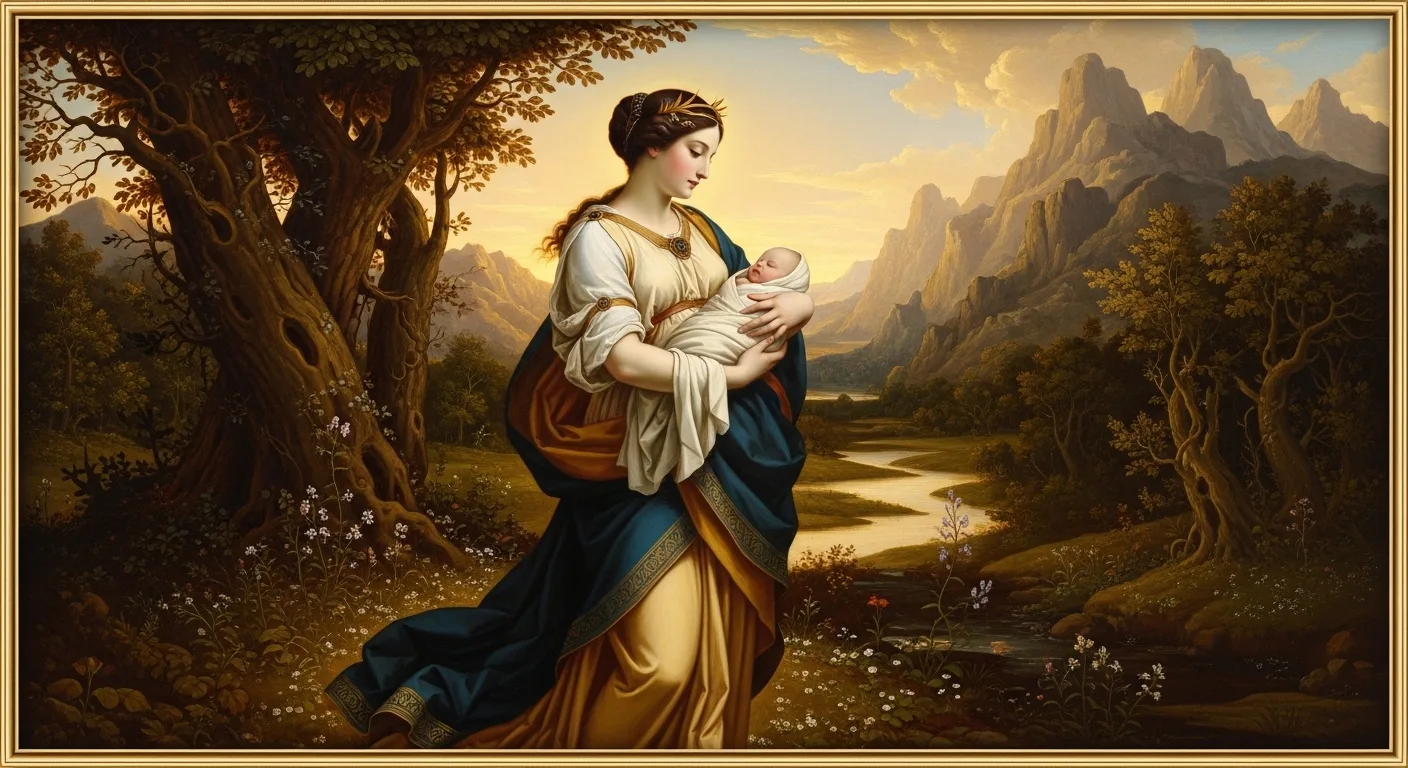
Goddess Rhea Mother of the Gods of Greek Mythology
Rhea is one of the most important deities of primitive Greek mythology and holds a central place in the transition of power from Titans to Olympian gods. As the daughter of Uranus and Gaia, she belonged to the generation of the Titans and was regarded as the great mother who gave birth to the most powerful gods of the Greek pantheon. Her figure is associated with fertility, motherhood, childbirth, the protection of children, and the continuity of life.
Rea's importance is not limited to her role as his mother. Zeus. In fact, its presence is a determining factor in the evolution of secular order. Without its intervention, the Cronus would have been able to eliminate all his descendants and the Olympian gods would never have taken over the world's power.
Its origin and place among the Titans
Rhea was one of the twelve primordial Titanesses and Titans, children of Gaia, the personification of the Earth, and Uranus, the god of the sky. Together with her siblings, she belonged to the second generation of divine beings that appeared after the primordial cosmic forces.
Her husband became her brother Saturn, who overturned their father Uranos and assumed dominion over the universe. However, Cronus received a prophecy similar to the one that had doomed Uranus: one of his descendants would dethrone him in the future.
Fearing that the prophecy would come true, Cronus decided to swallow every child Rhea gave birth to immediately after their birth. Thus, he swallowed Demeter, Hera, Hestia, Hades, and Poseidon.
The salvation of Zeus
The best-known mythological story associated with Rhea concerns the birth and rescue of Zeus. When she was about to give birth to her sixth child, Rhea could no longer bear to see her children being swallowed by Cronus. So she asked her parents, Gaia and Uranus, for help.
Following their advice, she traveled secretly to Crete, where she gave birth to Zeus in a cave—according to various traditions, either in the Idaean Cave or the Dictyean Cave. To deceive Cronus, she wrapped a large stone in swaddling clothes and presented it to him as a newborn child. Cronus, unaware of the deception, swallowed the stone.
Meanwhile, the young Zeus grew up under the protection of nymphs and mythical creatures. According to the myth, the Curetes clanged their shields and weapons to drown out the infant’s cries so that Cronus would not hear him.
This act by Rhea was not merely a mother’s attempt to save her child. It was the first step toward overthrowing Cronus’s tyrannical rule and establishing a new divine order.
Her contribution to Titanic combat
When Zeus came of age, he followed the plan that his mother had essentially set in motion. With the help of Metis, he forced Cronus to regurgitate the children he had swallowed. Thus, his siblings were freed and joined him in the great war against the Titans, known as the Titanomachy.
Although Rhea is not portrayed as a warrior in most accounts, she is considered one of the key forces behind the Olympians’ victory. Her wisdom, foresight, and maternal resolve laid the foundation for Zeus’s ultimate triumph.
After the victory of the Olympians, Rhea continued to be honored as the revered mother of the gods and was not treated as an enemy by the new generation, unlike many other Titans.
Rhea as a deity of fertility
Beyond her role in the creation of the world, Rhea was closely associated with the fertility of nature and the renewal of life. The ancient Greeks regarded her as the protector of mothers, pregnant women, and newborn children.
Her cult bears similarities to earlier mother goddesses of the Eastern Mediterranean and Asia Minor. In some regions, her characteristics were merged with those of Cybele, the Great Mother of the Gods.
In art, she was often depicted seated on a throne, wearing a crown with towers and accompanied by lions. The lions symbolized the goddess’s strength, royal authority, and protective nature.
The symbolism of Rhea
Rhea represents the archetype of the mother who protects her children even in the face of seemingly invincible forces. Her figure embodies the creative power of life, the fertility of nature, and the ability of a mother’s love to change the course of history.
At the same time, her story symbolizes the succession of generations and the inevitable shift in power. Just as Uranus was dethroned by Cronus and Cronus by Zeus, so too is Rhea at the center of a mythological cycle that highlights the continuous renewal of the world.
For the ancient Greeks, Rhea was not only the mother of the gods but also a cosmic force that ensured the continuity of life and the preservation of the natural and divine order. Her contribution to Greek mythology remains fundamental, for without her intervention, the world of the Olympian gods as we know it from the great myths of antiquity would not exist.
- Goddess Rhea She is one of those figures in Greek mythology who doesn’t make a fuss, but holds the whole world together. She doesn’t wield a thunderbolt like Zeus, nor does she wear armor like Athena. And yet, without Rhea, the world of the gods—and perhaps the entire cosmic order—would never have existed.
In Greek mythology, Rhea is the mother of Olympian gods, the great Titaness who stood up to fear, tyranny, and fate—not with violence, but with intelligence, resilience, and maternal instinct. She is the goddess who saved Zeus, and with him, the future of gods and mortals.
Orphic Hymn 13: Towards Rhea
Daughter of great Protogonus, divine, illustrious Rhea, to my prayer incline,
Who drives your holy car with speed along, drawn by fierce lions, terrible and strong.
Mother of Zeus, whose mighty arm can wield the avenging bolt, and shake the dreadful shield.
Drum-beating, frantic, of a splendid mien, brass-sounding, honored, Kronos’ blessed queen.
You rejoice in mountains and tumultuous fight, and in humanity’s horrid howlings, you delight.
War’s parent, mighty, of majestic frame, deceitful saviour, liberating dame.
Mother of Gods and humanity, from whom Gaia and lofty Ouranos derive their glorious birth;
The ætherial gales, the deeply spreading sea goddess ærial formed, proceed from you.
Come, pleased with wanderings, blessed and divine, with peace attended on our labors shine;
Bring rich abundance, and wherever found drive dire disease, to earth’s remotest bound.
The Origin of Rhea
Rhea belongs to the generation of Titans. She was daughter. of Uranus and Gaia, that is, he was born at a time when the world did not yet have established laws, but was taking shape through conflicts and upheavals
Sister and wife of Cronus, Rhea became queen of the Titans and embodied her role early on Great Mother: the deity that gives birth, protects and preserves life.
Cronus and the Fear of Overthrow
- CronusLike his father before him, he feared fate. An oracle warned him that one of his children would overthrow him. So every time Rea gave birth, Cronus Swallow the child.
Rea saw her children lost one by one:
Hera, Poseidon, Hades, Demeter, Hestia.
Not from natural death, but from their own father.
Here the Goddess Rea is not only presented as a mother, but as a form tragic resistance. He can handle pain, but he doesn't quit.
The Salvation of Zeus – The Great Deed of Rhea
When the time came for the birth of Zeus, Rhea decided that this circle had to be broken.
He secretly gave birth to Crete, in a cave of Mount Dikti or Ides, and gave Cronus a stone wrapped in sprouts. Cronus He swallowed it without realizing the fraud.
Little Zeus grew up protected:
breast-feeding Amalthea
and Courites They were hitting their shields to cover his crying.
This act of Rhea is one of the most decisive in all Greek mythology. It is not just maternal love; it is conscious revolution against tyranny.
Rhea as Mother of the Olympian gods
Goddess Rhea is the mother of the six great Olympians:
Zeus
Hera
Poseidon
Hades
Demeter
Hestia
Through them, Rea becomes womb of the secular class. The gods that rule heaven, earth, sea, the underworld, family and fire all come from it.
Symbols and Character of the Goddess Rhea
Rea is not a goddess of war or power. She's a goddess:
The maternity
The fertility
The Nature
The continuity of life
Its symbols include:
The lion, symbol of strength and protection
The drum, associated with ceremonies and ecstasy
The mountains and nature, where he was worshipped away from cities
Rhea is a power quiet but unbearable. Like nature: it can wait, but it always returns.
Worship and the Shrines of Rhea
The worship of the goddess Rhea was most widespread in mountainous and archaic regions. She did not have magnificent temples like those of the Olympian gods, but:
Sanctuaries in Crete
Worship in Phrygia (where he was identified with the Mother of the Gods)
Music, drums and dance ceremonies
Rhea was worshipped as Mother of Gods, protector of the fertility and vital power of the world.
Rhea in Symbolic and Modern Thought
Today, Rhea is interpreted as:
archetype of Great Mother
symbol of resistance to power
expression of of female wisdom which does not conflict directly, but changes the flow of history
Without Rea, there is no Zeus. And without Zeus, there is no Olympus.
Educational Summary
- Goddess Rhea Greek mythology is not just the mother of gods. It is the form that shows that real power is not always in violence or power, but in patience, insight and care of life.
She is the goddess who stood between chaos and order. — and chose the future.
Frequently Asked Questions About Goddess Rhea
What is Rhea in Greek mythology?
- Rhea She was one of the Titanides of Greek mythology and is considered the goddess of motherhood, fertility, and the protection of life. She was the wife of Cronus and the mother of important Olympian gods.
Who were Rhea's children?
Rhea was his mother Zeus, Hera, Poseidon, Hades and Demeter.
Why is Rhea important?
Rhea played a crucial role in mythology, as she helped preserve the life of Zeus, who later overthrew Cronus and became the king of the gods.
How did Rhea save Zeus?
When Cronus feared he would lose his power, he swallowed his children. Rhea tricked Cronus by giving him a stone wrapped in swaddling clothes instead of the newborn Zeus, thus saving him.
What is the symbol of the goddess Rea?
Rhea is often portrayed with a wreath that resembles city walls, sitting on a throne or accompanied by lions, symbols of power and maternal protection.
What is the worship of Rhea in ancient Greece?
The worship of Rhea was associated with nature and fertility. In many regions of ancient Greece, there were sanctuaries dedicated to her, where people honored her maternal nature.
Bibliography for Rhea
Ancient sources
Hesiod – Theogenia & Works and Days | Primary Sources
Primary Sources of Greek Mythology | Hesiod, Homer, Orphic Hymns
Primary Sources of Greek Mythology | Ancient Texts
Perseus Digital Library is a reliable academic database with ancient Greek texts and historical sources, particularly useful for the study of Greek mythology and Elefsinian Mysteries.
Modern Bibliography
- The Greek Myths. London: Penguin Books.
- Extensive analysis of the myths of Rea and Saturn.
- Theogony and Works and Days. Oxford University Press.
- Classical academic publication and commentary of Hesiod's Theogeny.
- Early Greek Myth. Johns Hopkins University Press.
- Detailed examination of ancient sources for Rhea and Titans.
- Greek Religion. Harvard University Press.
- Study of the worship of Rea and maternal deities in the Greek world.
- The Routledge Handbook of Greek Mythology. Routledge.
- Contemporary and documented presentation of Greek mythology.
- The Gods of the Greeks. Thames & Hudson.
- Rea's interpretive approach as a Great Mother.
- Dictionary of Greek and Roman Biography and Mythology. London.
- Useful reference work for Rhea and the mythological traditions accompanying it.