
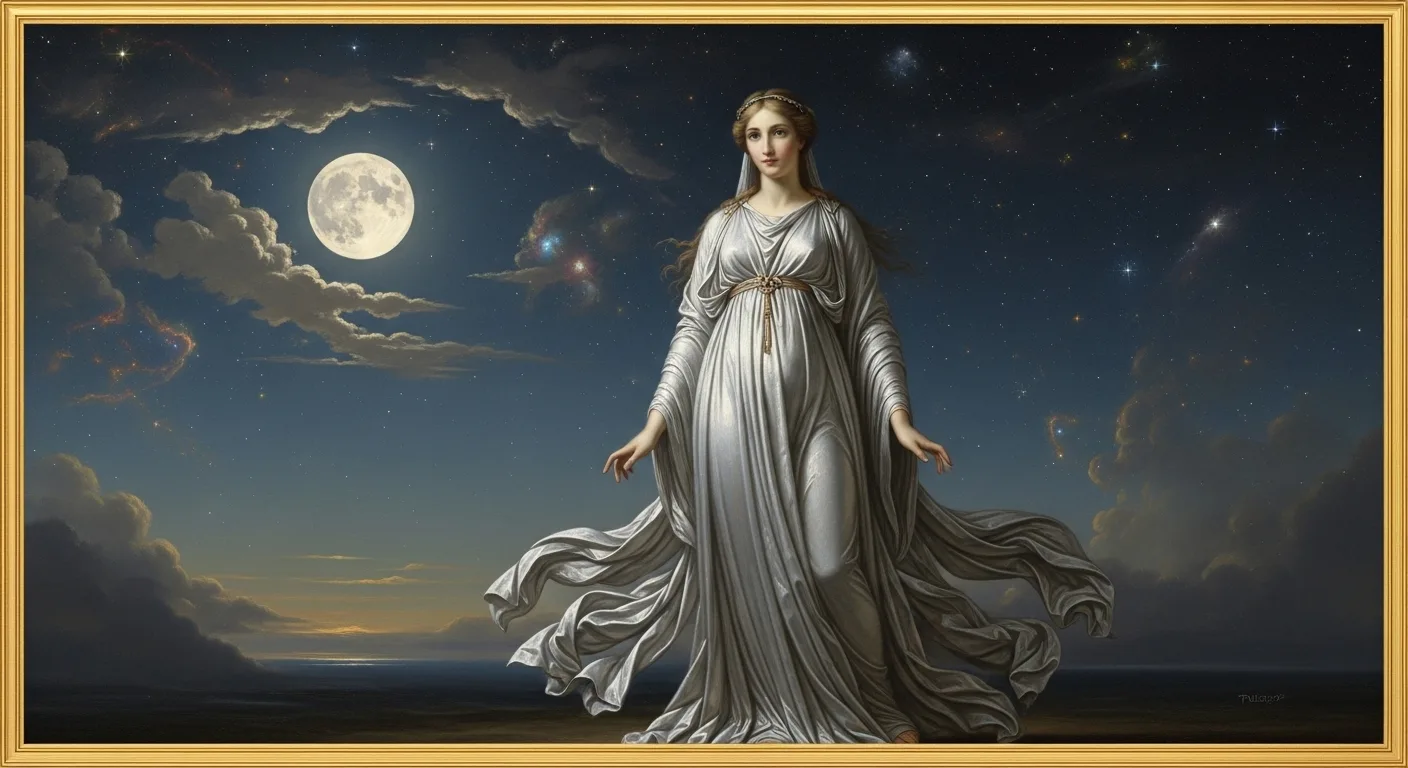
Phoebe, the Titaness of Prophecy

Spread the love

Phoebe in Greek mythology She's Titanic, his daughter. Uranus and GaiaShe was the wife of Koios and the mother of Letos and Asteria, and is considered his grandmother Apollo and Artemis. It is associated with divination and the Oracle of DelphiWhich he delivered to Apollo.


Phoebe – The Titan of Prophecy and Divine Light

Phoebe is one of the least known but extremely important forms of Greek mythology. It belongs to the generation of Titans, the powerful divine beings that preceded the Olympian gods, and is closely associated with wisdom, divination art, the light of knowledge and prophetic powers. Although it does not often appear in popular myths, its influence has been decisive for the evolution of divine order and especially for the tradition of the Oracle of Delphi.

Phoebe represents the divine wisdom passed from generation to generation. Her name comes from the word «palm», meaning bright, bright or pure, suggesting its connection to light not as a natural phenomenon, but as a symbol of knowledge, insight and truth. Through her descendants, her power continued to affect the world of gods and men.

Phoebe’s Origin

Phoebe was the daughter of Heaven and Gaia, the primary deities who gave birth to the Titans. It therefore belonged to the second generation of divine beings that shaped the universe after the creation of the world.

As Titanidas, she was a sister of important figures such as Saturn, Rea, Themida, Tethys, Monument and Ocean. This generation held power before the rise of the Olympian gods and were considered the founders of the secular order.

Her husband was Titan Coius, who was also associated with knowledge and mental power. The union of these two deities is considered symbolic, as it represents the connection of wisdom to prophetic insight.

Phoebe’s descendants

Phoebe and Kos had two important daughters: Leto And Asteria.

Leto later became the mother of Apollo and Artemis, two of the most brilliant deities of Olympus. Through Letus, Phoebe became the grandmother of Apollo, the god of light, music, divination and healing.

Asteria, on the other hand, was associated with stars, night prophecies, and heavenly phenomena. From her generation also came deities associated with magic and divination knowledge.

This lineage shows that Phoebe was at the core of an entire family of deities associated with light, wisdom, stars, and prophecy.

Her relationship with Delphi Oracle

The most important myth associated with Phoebe concerns the famous Delphi Oracle. According to ancient traditions, Delphi' divination power did not belong to Apollo in the first place.

The original sovereign of the holy place was Gaia. Power then passed to Themida and later Phoebe. Finally, Phoebe voluntarily handed the oracle over to the grandson of Apollo, who became the best known divine god of Greek mythology.

This tradition presents Phoebe as a link between the primal deities of Earth and the new generation of Olympians. Through this transfer of divination power, the continuity of divine wisdom and knowledge is preserved.

Some ancient writers felt that Apollo himself had the nickname «Phoebus» because of his relationship with Phoebe's grandmother, inheriting her splendor and prophetic power.

Phoebe and the symbolism of wisdom

Unlike other Titanics associated mainly with physical elements, Phoebe represented abstract but fundamental concepts. Wisdom, foresight, clarity of thought and the revelation of truth were traits attributed to its deity.

Ancient Greeks considered that true knowledge came not only from reason but also from divine inspiration. Phoebe symbolized precisely this deeper form of knowledge, the one that allows understanding of the future and hidden laws of the world.

Its connection to light should not be interpreted solely as a solar symbol. It mainly represents the spiritual light that dissolves the darkness of ignorance and reveals the truth.

Her post after Titanic combat

When the Olympian gods defeated the Titans in Titanic combat, many Titans were imprisoned in Tartara. However, Phoebe does not appear in the sources as an enemy form against the Olympians.

As with other wise Titans, such as Themida and Monument, Phoebe retained the respect of later gods. Her wisdom was considered valuable in maintaining secular balance and divine order.

This attitude reflects a basic idea of Greek mythology: the new divine powers do not completely destroy the older, but often inherit and incorporate their properties.

Phoebe’s legacy

Although Phoebe does not have the wealth of myths that characterizes other deities, its importance in Greek mythology is deep and timeless. It is one of the most important sources of divination knowledge and divine wisdom, and through its descendants it influenced the religion and mythological tradition of ancient Greeks.

Its form symbolizes the transmission of knowledge from generation to generation, the power of prophecy and the light of truth that guides gods and people. As the grandmother of Apollo and guardian of the ancient magic spirit, Phoebe remains one of the most substantial but often overlooked forms of the Greek mythological world.

- Phoebe is one of the most mysterious Titanics of Greek mythology and is associated with lunar glow, psychic ability and divine knowledge. It represents light that is not blinding but revealing – the light of night, intuition and prediction.


Key Data

  • Name: Phoebe (Phoebe)

  • Domain: Titanic of the moon and prophecy

  • Type: Titanesses,

  • Parents: Uranus and Gaia

  • Wife: Coeus

  • Children: Letto, Starea

  • Eggs: Apollo, Artemis

  • Symbols: Moon, light of night, oracle


Phoebe’s Role in Mythology

Phoebe:

  • Incarnates lunar wisdom

  • protect the magic art

  • represents the knowledge that is gradually revealed

According to tradition:

  • originally held the Oracle of Delphi

  • handed it to Apollo through Letus


Powers & Skills

  • Magical insight

  • Lunar energy

  • Divine wisdom

  • Protection of sacred sites


Symbolism & Cultural Meaning

Phoebe symbolizes:

  • the light of intuition

  • the knowledge of the unknown

  • the connection of night and wisdom

In culture:

  • linked to philosophy

  • influenced the concept of divine revelation


⚔️ Phoebe and the Titanomachy

Phoebe:

  • does not appear in war conflicts

  • remains spiritual power

  • conveys knowledge to the Olympians


Frequently Asked Questions About Phoebe

Who was Phoebe in Greek mythology?

- Phoebe She was one of the Titanics, his daughter. Uranus and Gaia. It belonged to the second generation of deities and was associated mainly with divination and light.

Who was Phoebe's husband?

Phoebe married Titan. Coeus. Together they had two important deities of Greek mythology.

Who were Phoebe's kids?

Phoebe's children were Leto and Starship.

What's Phoebe's relationship with Apollo?

Phoebe is considered God's grandmother ApolloAfter Lito's daughter was his mother. According to legend, Phoebe delivered their oracle Delphi THE Apollo.

What does Phoebe have to do with mythology?

Phoebe is associated with divination, wisdom, and pure light. Her name means «Shining» or «light».

What's the meaning of the name Phoebe?

Name «Phoebe» comes from the word «Favos», meaning bright or clean. From the same root comes the adjective of the god Apollo «Phoebus».

Is Phoebe mentioned in ancient texts?

Yes, Phoebe refers to Theogony of Hesiod, where the genealogy of Titans and gods is described.

  • Pandora’s Box: Inspiring by Greek mythology is our exclusive Nemesis Now design, Pandora’s Box
  • Box For Storing Small Accessories: This exquisite box beckons you to reveal the terrifying tinkets that lie within
  • Gold Detailing with Red Velour Interior: Gold detailing surrounds the box as well as blue gemstones, then within the box...

Ancient sources

Hesiod – Theogenia & Works and Days | Primary Sources

Primary Sources of Greek Mythology | Hesiod, Homer, Orphic Hymns

Primary Sources of Greek Mythology | Ancient Texts

Apollodorus

Perseus Digital Library is a reliable academic database with ancient Greek texts and historical sources, particularly useful for the study of Greek mythology and Elefsinian Mysteries.

Leave a comment

Privacy Overview
MYTHOI. ORG Explore Greek mythology and folklore through gods, heroes, myths and traditions. Educational content for students, educators and friends of mythology.

This website uses cookies to provide you with the best user experience possible. Cookies information is stored on your browser and perform functions such as your identification when you return to our website and helping our team understand which parts of our site you consider more interesting and useful.

Absolutely necessary cookies

The strictly necessary cookie should be enabled at any time so that we can save your cookie settings preferences.

Statistics

This website uses Google Analytics to collect anonymous information, such as the number of visitors on the website and the most popular pages.

Maintaining this cookie allows us to improve our website.