
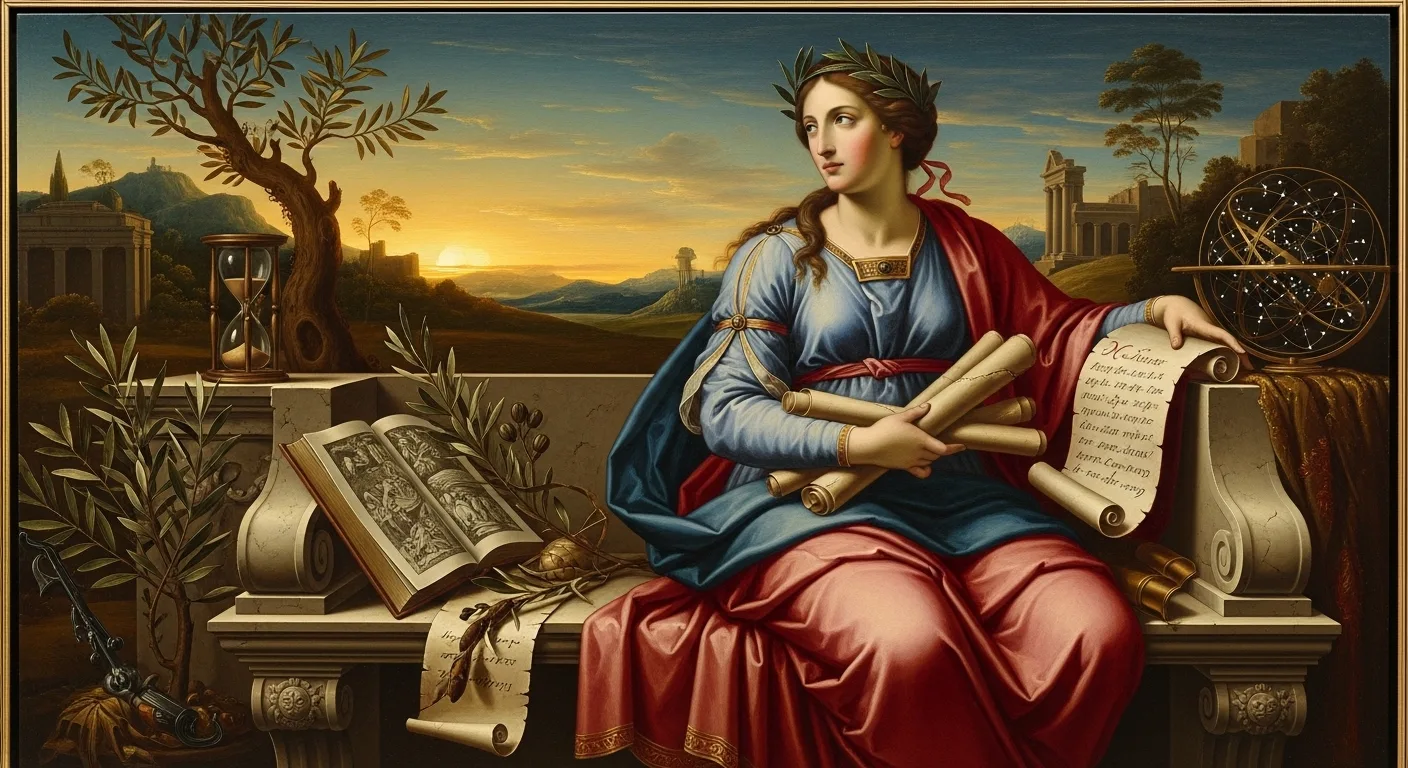
Mnemosyne is one of the most important and symbolic figures in Greek mythology. She belongs to the generation of the Titanides and personifies memory, one of the fundamental forces of human thought and civilization. For the ancient Greeks, memory was not merely the ability to recall past events; it was the source of knowledge, wisdom, history, and art. Without memory, people would be unable to preserve their traditions, pass on knowledge to future generations, or create a civilization.
Mnemosyne holds a special place in Greek cosmogony, as her union with Zeus gave birth to the nine Muses, the deities who presided over the arts, poetry, music, history, and science. As the mother of the Muses, Mnemosyne was considered the source of all intellectual creation and inspiration.
Origin and place in cosmogony
According to the «Theogenia» The Hesiod, Mnemosyne was the daughter of Gaia and Uranus and one of the twelve Titanesses and Titans. She belonged to the second generation of divine beings that appeared after the primordial cosmic forces.
Her name derives from the word “memory,” immediately revealing her role and nature. The ancient Greeks believed that memory was essential to the existence of knowledge. Anything that could not be retained in memory was lost forever. For this reason, Mnemosyne was considered one of the most important deities of intellectual life.
At a time when writing was not widespread, memory was the main means of preserving history, legends, and religious traditions. The deification of memory reflects the great importance of ancient Greeks.
The union with Zeus
After the Olympian gods had triumphed, Zeus united with Mnemosyne in one of the most symbolic unions in Greek mythology.
According to tradition, Zeus spent nine consecutive nights with her. From this union were born the nine Muses, the deities that inspired poets, musicians, historians and artists.
This story has profound symbolism. The ancients believed that every form of art and knowledge stems from memory. The poet needs to remember the traditions of his people, the historian the events of the past and the musician the songs and melodies he inherited.
Thus, Mnemosyne is presented as the mother of all arts and sciences.
The Nine Muses
The daughters of Mnemosyne were:
- Calliope, patron of epic poetry.
- Cleo, patron of history.
- Euterpe, patron of music.
- Thalia, protector of comedy.
- Melpomeni, protector of tragedy.
- Terpsichore, patron of the dance.
- Erato, patron of lyric poetry.
- Polymnia, patron of hymns.
- Urania, patron of astronomy.
Through these deities, Mnemosyne’s influence extended to every form of intellectual activity. Ancient poets used to invoke the Muses before beginning their works, thereby indirectly acknowledging the power of Mnemosyne that lay behind inspiration.
Memory as a Divine Power
In modern times memory is considered mainly psychological function. But in ancient Greece it was treated as a divine force that connected the past with the present.
Mnemosyne represented:
- The preservation of knowledge.
- The transmission of tradition.
- The collective memory of a people.
- Spiritual creation.
- The historical consciousness.
The ancients believed that oblivion was dangerous, as it led to the loss of identity and wisdom. Memory, on the contrary, kept the past generation experience alive.
For this reason the Mnemosyne was not just a deity of the past but a force that ensured the continuity of civilization.
The relationship with Oblivion
In Greek mythology Mnemosyne is often contrasted with Oblivion, the personification of oblivion.
In the world of the dead there was the River Oblivion, from which souls drank water to forget their past lives. Rather, certain orphic traditions also refer to the source of Memorialism, from which souls could drink to maintain their knowledge and consciousness.
This contrast between memory and oblivion symbolized the constant struggle between knowledge and ignorance, truth and loss of identity.
Mnemosyne in Ancient Worship
Although it did not have large national shrines such as Zeus or Athena, Mnemosyne was honored in various areas of Greece, especially in places connected with Muses and intellectual cultivation.
Poets, tailors, and historians felt that the power of memory was necessary for their work. Before the development of written literature, the memorization of huge poems such as «Iliad» and «Odyssey» It was an impressive achievement that was partly attributed to the divine favor of Mnemosyne.
Pictures in art
Mnemosyne is usually depicted as a serious and dignified female form. The artists presented it with a calm expression, symbolizing the wisdom and knowledge derived from experience.
In later works of art she often appears along with the Muses, highlighting her role as a mother and source of artistic creation.
The Legacy of Mnemosyne
Mnemosyne is one of the most profound symbolic deities of Greek mythology. It represents the power that allows people to remember, learn and create. Without memory there would be no history, culture, art or knowledge.
As the mother of the Muses, it is at the beginning of every spiritual creation and is the foundation of human thought. Her form reminds that wisdom is not born of the void but is built upon the experiences and knowledge of the past.
For the ancient Greeks, Mnemosyne was much more than a deity. It was the very power that keeps human heritage alive and allows culture to pass from generation to generation. This is why it remains one of the most important and timeless forms of Greek mythology.
Key Data
Name: Μνημοσύνη (Mnemosyne)
Domain: Titaness of memory, knowledge, and storytelling
Type: Titanesses,
Parents: Uranus and Gaia
Spouse: Zeus
Children: The Muses
Symbols: Books, circle, memory, inspiration
The Role of Memory in Mythology
Mnemosyne:
Incarnates memory and preservation of knowledge
It protects the oral and written delivery
connect the divine knowledge with human creation
According to legend:
she joined Zeus for nine consecutive nights
From this divine union were born the Muses, patrons of art and science
Powers & Skills
Keep the memory of all events
Transmission of knowledge to Muses
Inspiration and guidance of creators
Protection of historical and mythological knowledge
Symbolism & Cultural Meaning
Mnemosyne symbolizes:
the importance of memory for culture
ensuring knowledge and history
the divine source of inspiration and art
In culture:
Mnemosyne is associated with the preservation of myths
guides people's spiritual and artistic evolution
⚔️ Mnemosyne and Titanic Battle
Mnemosyne:
did not fight actively in Titanic combat
focuses on maintaining knowledge
its influence continues through the Muses
Ancient sources
Hesiod – Theogenia & Works and Days | Primary Sources
Primary Sources of Greek Mythology | Hesiod, Homer, Orphic Hymns
Primary Sources of Greek Mythology | Ancient Texts
Perseus Digital Library is a reliable academic database with ancient Greek texts and historical sources, particularly useful for the study of Greek mythology and Elefsinian Mysteries.