
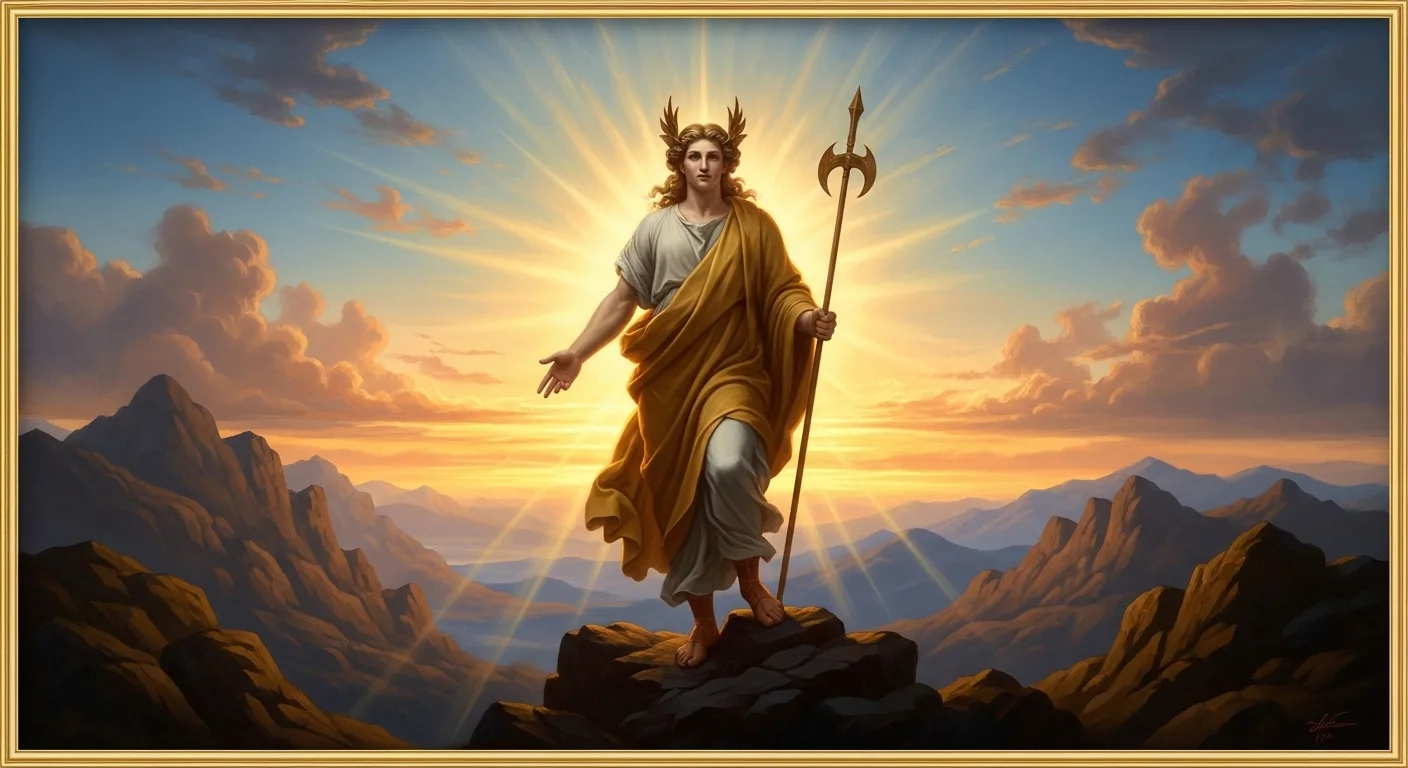
The Hyperion In Greek mythology, he is a Titan, the son of Uranus and Gaia, and the husband of Theia. Father of Helios, Selene and Io, connected to light and sky. His name means «the high» and symbolizes the divine brilliance and power of light.
Although it does not appear as often in known myths as the Cronus or Oceanus, holds a prominent place in the cosmogony of ancient Greeks as personification of heavenly light and observation of heavenly bodies. His name means «The one who's high» or «He who walks above all», revealing his close relationship with the sky, the sun and the brightness of the world.
As the father of the Sun, the Moon, and Eos, Hyperion is considered the ancestor of the most important celestial deities that govern the cycle of day and night. Through his descendants, his influence extends throughout the entire universe and is associated with light, time, and the cosmic order.
Origin and position among Titans
According to the «Theogenia» The Hesiod, Hyperion was the son of Gaia and Uranus, belonging to the second generation of divine beings who shaped the world. He was one of the twelve Titans, along with Cronus, Oceanus, Coeus, Crius, Iapetus, and their Titan sisters.
Titans represented fundamental forces of nature and the universe. Hyperion was associated with the heavenly light and observation of the movements of the stars, at a time when ancient Greeks were trying to explain the function of the world through mythology.
Marriage to Auntie
Hyperion joined his sister, the goddess Theia, a Titaness associated with radiance, sight, and precious metals. The union of these two divine figures was considered particularly symbolic, as it combined the light of the heavens with the radiance perceived by the eyes of mortals and gods alike.
Three of the most important celestial deities of Greek mythology were born of this divine union:
- Helios, the personification of the sun.
- Selene, the moon goddess.
- Eos, the goddess of dawn.
The children of Hyperion were not merely deities but the very forces that determined the succession of day and night, ensuring the harmony of the world.
Father of heavenly bodies
Hyperion’s most important role is that of the father of the luminous bodies of the sky. The Sun drove his brilliant chariot across the sky every day, illuminating the Earth. The Moon followed her nightly course, while Eos heralded each new day with her rosy light.
Through these descendants, Hyperion was regarded as the source of all celestial radiance. The ancient Greeks saw in him the primordial force that gave birth to light and set the rhythm of time.
His relationship with the sun was so strong that in later periods the name «Hyperion» It was often used as a poetic nickname of the Sun itself.
Hyperion and Titanic Fight
Like the other Titans, Hyperion found himself at the center of the great conflict between the Titans and the Olympian gods. The Titanomachy, which lasted ten years, determined who would rule the universe.
Hyperion fought alongside his brothers under the leadership of Saturn. However, the Olympian gods led by Zeus eventually prevailed. After the defeat of the Titans, many of them were imprisoned in the depths of Tartarus.
Ancient sources do not extensively mention the fate of Hyperion after the war, but are thought to have shared the fate of most Titans, losing its primary authority as the new generation of gods took over the rule of the world.
Symbolization of light and knowledge
Hyperion was not merely a god of light. He symbolized the power of observation and understanding of the heavens. The ancient Greeks associated him with the ability to see from above, to observe the stars, and to comprehend the cosmic cycles.
The light he represented was not only physical but also spiritual. Just as light reveals objects to the eyes, so knowledge reveals truth to the mind. For this reason, Hyperion can be considered a forerunner of the concept of wisdom and cosmic awareness.
Hyperion in ancient art and literature
Depictions of Hyperion are relatively rare in Greek art, as artists’ interest was more often directed toward the Olympian gods. Nevertheless, in literary sources he is presented as a majestic and radiant Titan, associated with celestial radiance.
In later Hellenistic and Roman works he appears as a bearded god with halo or rays around his head, features indicating his relationship with the sun and the heavenly light.
The Legacy of Hyperion
Although it does not play an active role in most Greek myths, Hyperion is a fundamental form of cosmogony. As the father of the Sun, Moon, and Hous, it is directly associated with the basic forces that regulate time and life on Earth.
Its shape reflects the ancient Greeks’ efforts to understand celestial phenomena and explain the origin of light. It symbolizes the eternal radiance that illuminates the world, the order of the universe, and the knowledge that arises from observing nature. For this reason, Hyperion remains one of the most important and symbolic Titans of Greek mythology, representing the power of light that conquers darkness and reveals the mysteries of the world.
- Hyperion is one of the oldest Titans of Greek mythology and personifies heavenly light, the world's observation and rhythmic movement of celestial bodies. It does not identify with the Sun itself, but with the source and spread of light, which allows knowledge, time and order.
Key Data
Name: Hyperion
Domain: Titan of light and heavenly order
Type: Titans
Spouse: Theia
Children: Sun, Moon, Io
Symbols: Light, sun, sky, observation
The Role of Hyperion in Mythology
The Hyperion:
represents the cosmic vision
supervise the movement of celestial bodies
symbolizes knowledge through light
It is the divine link between:
in chaos
And in the order of the universe
☀️ Father of the Bright Gods
Hyperion is a father:
of Helios (sunlight, time)
The Selene (cycles, night)
The Io (egg, start of the day)
This trinity:
determines the flow of time
It regulates life on Earth
⚔️ Hyperion and the Battle of the Titans
Sources:
do not report active participation
they present him as detached.
This enhances:
his role as an observer
Not as a warrior.
Powers & Skills
Transmission and dissemination of light
Configure Heavenly Circles
Spiritual clarity and knowledge
Cosmic awareness
Symbolism & Cultural Meaning
Hyperion symbolizes:
the light of knowledge
the mathematical and astronomical class
the observation of nature
In culture:
associated with scientific thought
understanding time
Frequently Asked Questions About Hyperion (FAQ)
Who was Hyperion in Greek mythology?
Hyperion was one of the twelve Titans of Greek mythology. He was the son of Uranus and Gaia and is associated with the light of the sky and the observation of celestial bodies.
What does the name Hyperion mean?
The name Hyperion comes from the words “hyper” and “ion” and means “he who is high” or “he who moves above all things,” suggesting his connection to the sky and light.
Who was Hyperion's wife?
Hyperion's wife was the Titaness Theia (or Theia). Together they had three important children associated with the light of the sky.
Who were Hyperion's children?
The children of Hyperion and Theia were Helios (Sun), Selene (Moon), and Eos (goddess of the dawn).
What was the role of Hyperion in Greek mythology?
Hyperion is considered a Titan of heavenly light and the observation of celestial bodies. In some traditions he is considered the first to observe the movement of the sun, moon, and stars.
Was Hyperion involved in the Titanic Battle?
Yes, like the rest of Titans, Hyperion fought against the Olympian gods in Titan fighting, the great war between Titans and gods.
What happened to Hyperion after Titan fighting?
After the victory of Zeus and the Olympian gods, many Titans, including Hyperion according to certain traditions, were imprisoned in Tartarus.
What ancient texts does Hyperion refer to?
Hyperion refers mainly to Theogony of Hesiod, where he is presented as one of the ancient Titans coming from Heaven and Gaia.
What is the symbolic meaning of Hyperion?
Hyperion symbolizes the primary heavenly light and birth of the great bright bodies of heaven, such as the sun, moon, and dawn.
Ancient sources
Hesiod – Theogenia & Works and Days | Primary Sources
Primary Sources of Greek Mythology | Hesiod, Homer, Orphic Hymns
Primary Sources of Greek Mythology | Ancient Texts
Perseus Digital Library is a reliable academic database with ancient Greek texts and historical sources, particularly useful for the study of Greek mythology and Elefsinian Mysteries.