
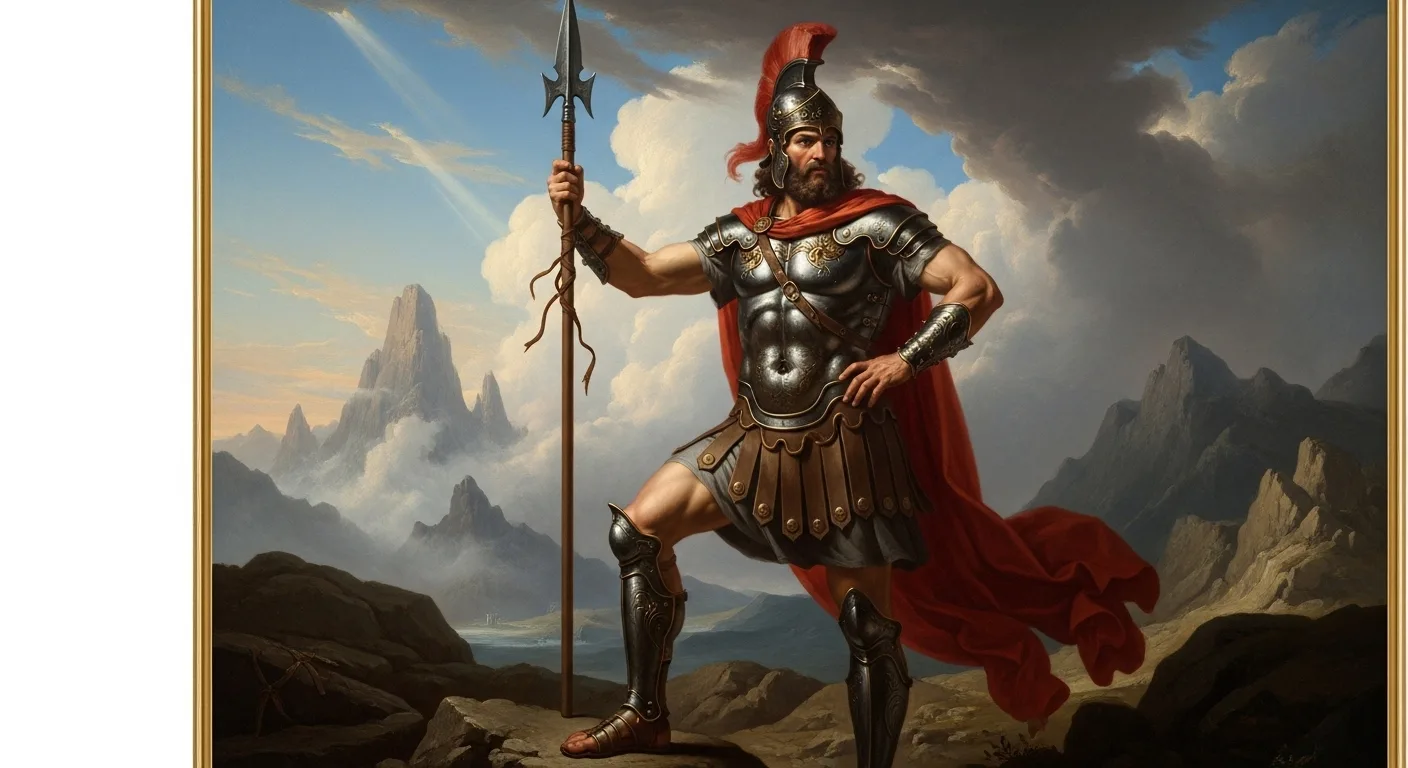
- Iapetus is one of the most decisive Titans of Greek mythology, as it is directly linked to creation and fate of mankind. It does not represent the power of light or heaven, but the limit, mortality and responsibility that accompanies knowledge.
Iapetus is one of the most important figures in Greek mythology and one of the twelve original Titans, the all-powerful beings born of Gaia and Uranus before the Olympian gods came to rule. Although he is not as well known to the general public as Cronus or Oceanus, his role in Greek cosmogony is particularly significant, as he is considered the ancestor of many figures who shaped the fate of humanity.
Iapetus is closely associated with mortal nature, labor, intelligence, endurance, and the hardships faced by humans. Through his famous sons— Prometheus, Epimetheus, Atlas, and Menoetius—represent different aspects of human existence and human character. For this reason, many scholars consider him the Titan who is closest to the human condition of any ancient deity.
Origin and place in cosmogony
According to the «Theogenia» The Hesiod, Iapetus was the son of Gaia and Uranus and one of the twelve Titans who made up the second generation of divine beings.
The Titans represented fundamental cosmic forces and helped shape the world before the rise of the Olympian gods. Iapetus stood out because his generation was directly linked to the creation and evolution of the human race.
In some ancient traditions, his wife is referred to as the Oceanid Clymene or Asia, with whom he fathered his famous sons.
The sons of Iapetus
The greatest importance of Iapetus comes from his descendants, who hold a prominent position in Greek mythology.
Prometheus
His best known son was PrometheusPrometheus became famous for stealing fire from the gods and offering it to humans, allowing them to develop culture, arts and technology.
Prometheus symbolizes knowledge, prediction, and human progress. Through him, Japanese is associated with the creative and spiritual aspect of mankind.
Epimetheus
His second son was Epimetheus. Unlike his brother, Epimetheus represented the recklessness and thought that comes after the act.
He became known for accepting Pandora, the first woman created by the gods. When she opened Pandora's famous jar, all suffering spread to the world.
Epimetheus symbolizes the mistakes and weaknesses that are part of human experience.
Atlas
His third son was Atlas. After Titan fighting he was punished by Zeus to keep the sky forever on its shoulders.
The form of Atlas symbolizes the endurance, responsibility, and weight that people are often called upon to lift in their lives.
Menitius
The fourth son was Menoitius, a Titan who represented arrogance and violent power. According to mythology, he was punished by Zeus for his excessive pride and was thrown down into Tartarus.
His story acts as a warning of the consequences of arrogance and abuse of power.
Iapetus and the Titanomachy
Like most Titans, Japanese participated in TitanomachyThe great war between the Titans and the Olympian gods.
Iapetus fought alongside Cronus against Zeus and his allies. After ten years of conflict, the Olympians prevailed, and most of the Titans were defeated.
According to tradition, Iapetus was imprisoned in Tartarus along with many other Titans. However, his influence continued through his children, who remained active in the mythological world.
The Symbolism of Iapetus
Iapetus is one of the most symbolic figures in Greek mythology. His four sons represent fundamental characteristics of human nature:
- Prometheus symbolizes knowledge and progress.
- The Epithea is recklessness and mistakes.
- Atlas of endurance and responsibility.
- Menoitius arrogance and exaggeration.
Thus, Iapetus himself can be considered the progenitor of all human traits, both positive and negative.
Many modern scholars describe him as the Titan who embodies mortality and the challenges of human life. Through his descendants, the potential as well as the weaknesses of the human race are revealed.
Iapetus in Ancient Literature
Although he does not often appear as the protagonist of myths, Iapetus occupies a prominent place in the works of Hesiod and other ancient authors. His significance stems not from heroic deeds but from his genealogical and symbolic status.
Ancient Greeks were particularly interested in the origins of gods and people. Within this context, Japan was considered one of the key links that connected the Titan world to the history of mankind.
The Legacy of Iapetus
The figure of Iapetus transcends the boundaries of a mere divine genealogy. Through his descendants, the most significant aspects of human existence are expressed: intelligence, labor, responsibility, ambition, weakness, and mortality.
As the father of Prometheus, Epimetheus, Atlas, and Menoetius, Iapetus is at the center of many of the most important myths in Greek tradition. His legacy reflects the way the ancient Greeks viewed humanity: a being capable of great achievements but also vulnerable to mistakes, excesses, and trials.
For this reason, Iapetus remains one of the most significant figures in Greek mythology—a Titan who bridges the world of the gods with human destiny and reveals the deepest dimensions of human nature.
Key Data
Name: Iapetus (Iapetos)
Domain: Titan of humanity and destiny
Type: Titans
Parents: Uranus and Gaia
Spouse: Climeni or Asia (by tradition)
Children: Prometheus, Epimetheus, Atlas, Menuitius
Symbols: Fire, chains, limit, human fate
The Role of Iapetus in Mythology
The Iapetus
represents the boundary between gods and people
is associated with the mortal nature
is responsible for human evolution
Through his children:
humanity acquires knowledge
and punishment
Father of the Protagonists of Human Destiny
Prometheus
Fire donor
Protector of people
Epimetheus
It symbolizes carelessness
Atlas
He brings the sky to his shoulders
Menotios
Incarnates the hybrid
⚔️ Iapetus and the Battle of the Titans
The Iapetus
Allied with the Titans
Defeated by Zeus
He was imprisoned in Tartara
His defeat:
marks the end of the Titanic era
Powers & Skills
Cosmic Power
Control of Destiny
Creative and destructive dynamics
Spiritual influence through offspring
Symbolism & Cultural Meaning
Iapetus symbolizes:
human responsibility
the price of knowledge
the dividing line between divine and human
In ancient thought:
Man is not immortal
But he has a divine spark.
Ancient sources
Hesiod – Theogenia & Works and Days | Primary Sources
Primary Sources of Greek Mythology | Hesiod, Homer, Orphic Hymns
Primary Sources of Greek Mythology | Ancient Texts
Perseus Digital Library is a reliable academic database with ancient Greek texts and historical sources, particularly useful for the study of Greek mythology and Elefsinian Mysteries.