
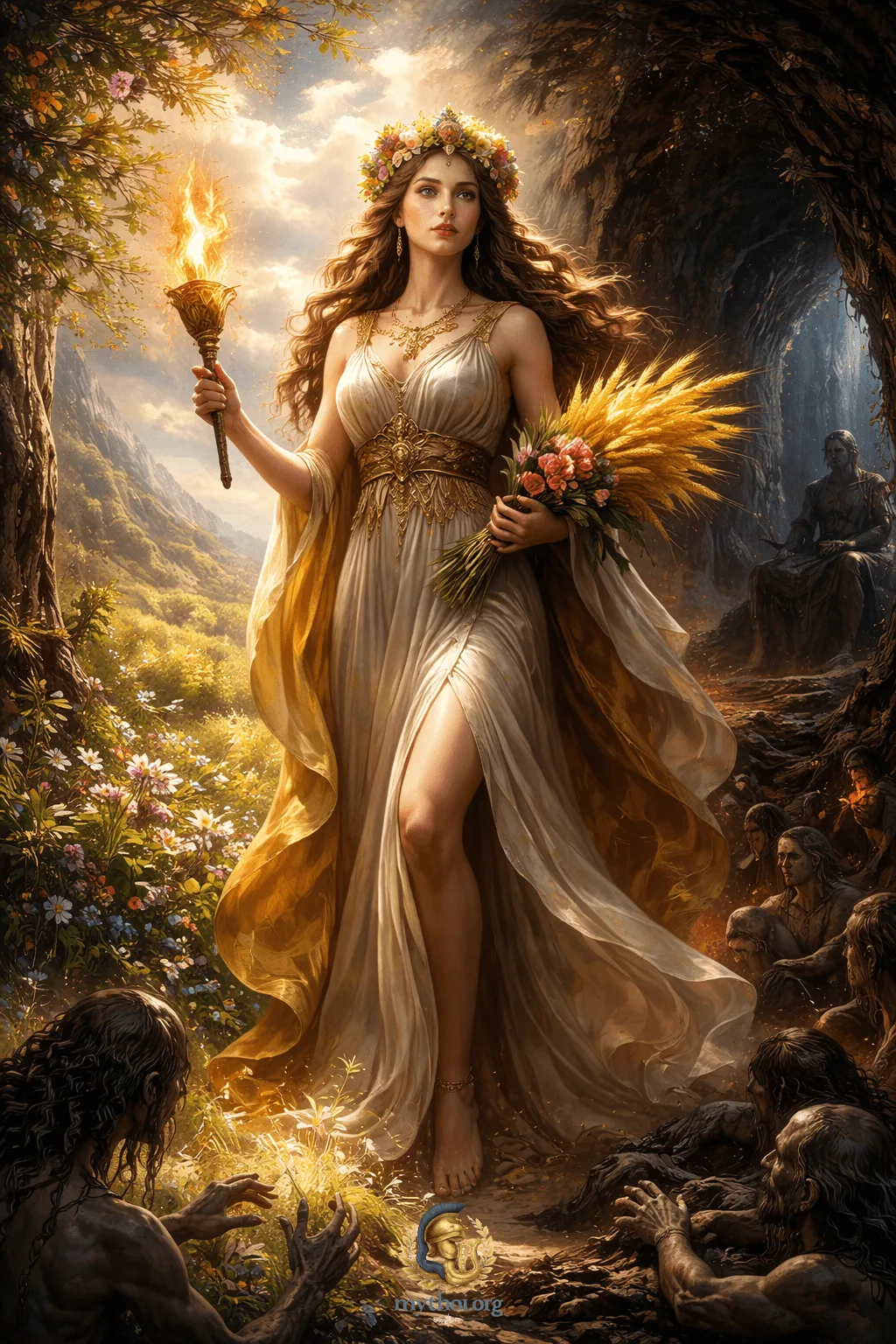
Persephone: Goddess of Spring and Queen of the Underworld
The myth of Persephone
Persephone is one of the most complex and symbolic figures in Greek mythology. She is both the goddess of spring and renewal and the Queen of the Underworld, wife of Hades. This dual role makes her a powerful symbol of the eternal cycle of life, death, and rebirth.
Daughter of Zeus and Demeter, Persephone was originally known simply as Koremeaning “the Maiden.” In this form, she represented youth, purity, and the vitality of spring vegetation. She was closely associated with her mother in Eleusinia Mysteries, one of the most important religious cults of ancient Greece, which promised initiates a blessed afterlife.
According to the most well-known version of the myth, Persephone was abducted by Hades while gathering flowers in a meadow with nymphs. With Zeus’s consent, Hades took her to the Underworld to make her his wife. Demeter, devastated by her daughter’s disappearance, wandered the earth in search of her, accompanied by the goddess Hecate. When she learned the truth, her grief turned to anger, and she refused to let the earth bear fruit, bringing famine and devastation upon humanity.
This crisis forced Zeus to intervene. It was decided that Persephone would return to the world above. However, because she had eaten pomegranate seeds in the Underworld, she was bound to return there for part of each year. As a result, Persephone spends spring and summer on earth, bringing growth and abundance, and returns to the Underworld in autumn and winter, when nature fades.
In other mythological traditions, Persephone appears not as a passive form, but as a strong and righteous queen of the Underworld. She accepts in her kingdom heroes such as Hercules and Orpheus and is often presented as a strict but wise deity, who participates in the decisions on the souls of the dead.
In art, Persephone is typically shown as a young woman holding sheaves of grain or flaming torches—symbols of agriculture, life, and transition. She may appear alongside Demeter and Triptolemus, the mythical teacher of agriculture, or seated beside Hades as Queen of the Underworld.
The myth of Persephone not only explains the changing seasons but also expresses deeper themes such as loss, transformation, the passage from childhood to adulthood, and the balance between life and death.
JTNDcCUZRSUwQSVDRSU5MSVDRSVDRSVCQSVDRSVCQSVDRSVCQiVDRiU4RCVDRIU4OCVDRIU4NCVDRSVCNSU4MCVDRSVCNSVDRIU4MSVDRSVCOSVDRIU4MyVDRiU4MyVDRiU4QyVDRIU4NCVDRSVCNSVDRIU4MSVDRSVCNSVDRIU4MiUyMCUzQ2ElMjBocmVmJTNEJTTEYJTJTJTJGA XN0b3JpZXMtbXl0aG9sb2dpYXMmlKYlM0UlQ0UlQjklQ0YlodMlQlQlQlQlQlQlQlQUlQUlQUlQUlQUlQUlQUlQUlQUlQUlQUlQUlQUlQUlQlQlQl0UlQlKYlQlQlQUlQUlQlQlQlQlQlQUlQlQlQUlQlQlQUlQUlQUlQUlQUlQUlQUlQUlQUlQUlQUlQUlQUlQULQULQULQULQULQULQULQULQULQULQULQULQULQULQULQULQULQULQULQULQULQ