
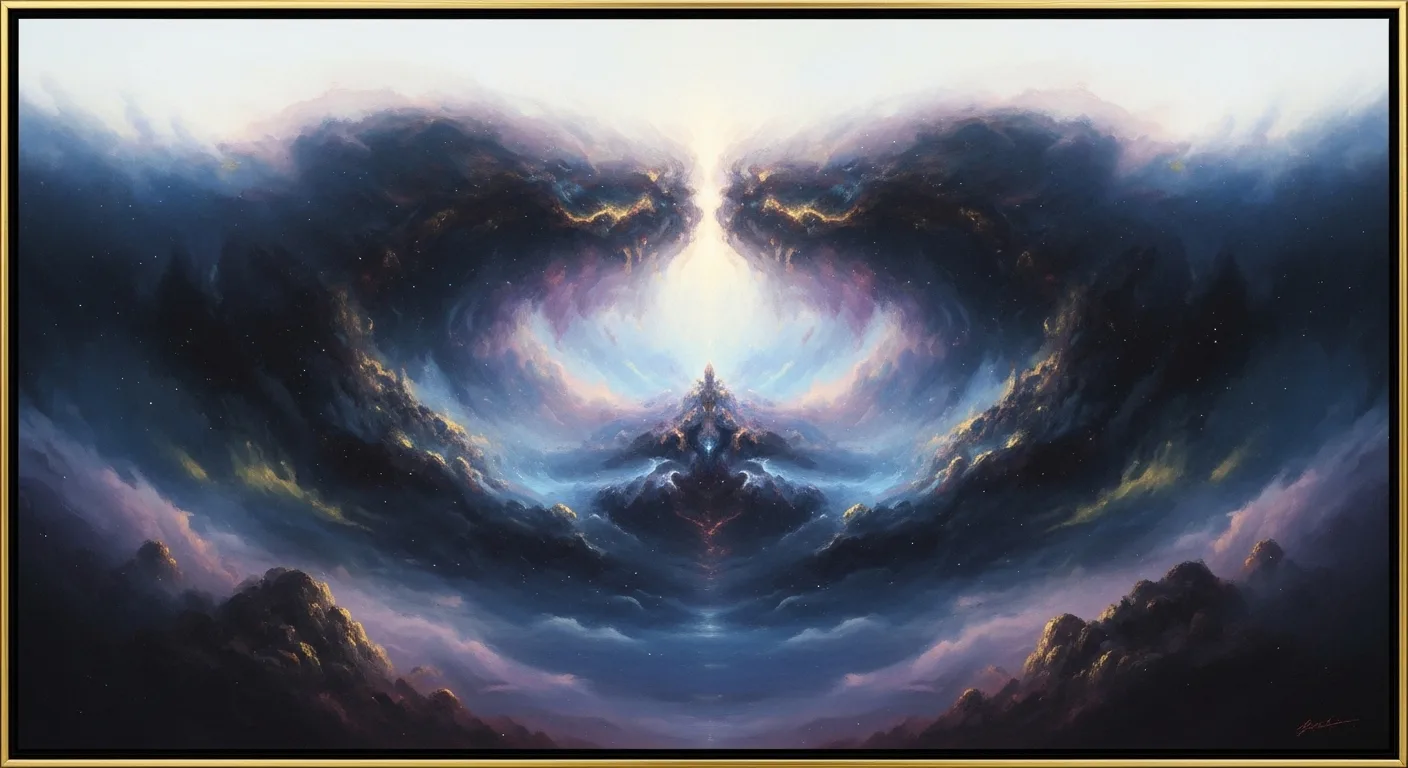
The Chaos It holds one of the most fundamental positions in Greek mythology, because it is associated with the very beginning of the world. It is not about the «confusion» or «ataxia» in the modern sense of the word, but for a primary state, an opening, a chasm, a vast empty space from which the secular order emerged. In Greek cosmogenic thought, Chaos is not the end of the class· is the pre-existing background before the world's formation.
This concept is especially important, because it helps us to understand how ancient Greeks understood the birth of the universe: not as creation from scratch in the newest theological sense, but as a gradual transition from amorphity and openness to discrimination, form and life.
Chaos in Greek Cosmogonia
The first cosmic situation before the world's formation
In ancient Greek thought, the beginning of everything is associated with a primary, uneducated situation. Chaos is this very earlier treaty: the space where the elements of the world have not yet been separated, where there are no fixed boundaries between earth, heaven, the underworld and life.
The meaning of chaos is not merely philosophical. She's also poetic. It shows the need of ancient Greeks to explain how the secular structure emerged from the absence of organization. The birth of the world, in the mythological language, arises through successive births, divisions and conflicts.
Chaos in Hesiod
The most known and influential wording is in «Theogenia» of Hesiod. Hesiod presents Chaos as the first of the primary beings:
The wording of Hesiod is decisive, for he does not describe Chaos as a god with an anthropomorphic personality, but as a primary entity or state of existence. From this initial opening emerge forces and forms that will form the universe.
After the theogenic account, the Gaia It gives birth to Uranos, the Mountains and the Sea, while the cooperation or relationship of the first divine forces emerges the next generations of gods, Titans and worldly forces. Thus, Chaos acts as the starting point of a chain creation.
What does it really mean? «Chaos»
The ancient word chaos Etymologically connected to the verb I dive., meaning «open the mouth», «yam», «create opening». This is why in its earlier meaning it states: gap, the opening, the empty. This importance is extremely important for understanding cosmogony.
It is not, that is, a universe in disorder in today's sense, but an unformed space, a primary «metaichm» before distinguishing the data. The later use of the word «chaos» As a synonym of disorder it is evolution that acquires wider dissemination in the modern language and thought, but not in its ancient cosmogenic origin.
Mythological Chaos Framework
Chaos as a starting point of birth
Greek cosmogony does not describe a single pattern of creation. There are various traditions, but Hesiodia narrative has been the most influential. Within this context, Chaos has a triple meaning:
- Time: is the first stage.
- Cosmic: is the pre-existing state of the world.
- Symbolic: is the point from which the birth of the class begins.
The fact that Chaos precedes even Gaia and Heaven shows that ancient Greeks imagined the world not as a given, but as a result of gradual formation.
Chaus' relationship with Gaia, Tartarus and Love
In Hesiod, the first primary elements are particularly revealing:
- Gaia symbolizes earth, stability, home.
- Tartarus It is connected to the deep, dark depth, an extreme lower space.
- Eros It is not here merely the god of erotic feeling, but the power of attraction, union and fertility.
In this shape, Chaos is the first opening, while Eros acts as a driving force of union and reproduction. Cosmic order is not born of stagnation, but of energy, relationship and configuration.
Chaos in later traditions
Subsequent texts and cosmogenic versions of the Greek world, such as certain orphic traditions, offer different shapes for the beginning of everything. However, Chaos remains a key point of reference in the wider Greek cosmological imagination.
In Orphic thought, the principle may be associated with other primary forms, such as Time or Cosmic Egg, but the idea of a primary non-formulative state does not cease to be a central pattern. Chaos, thus, is not an isolated concept, but part of a wider consideration of the origin of order.
Symbolism and Interpretations of Chaos
Chaos as an opening rather than a disaster
In modern use, the word «chaos» refers often to confusion, disorder or social disorganization. In ancient Greek cosmogony, however, Chaos has a deeper and more neutral character. It's the opening from which the distinction may arise.
This differentiation is essential because it prevents a simplistic reading of mythology. The ancients did not see Chaos as «Bad», but as a necessary stage before secular formation. Without the primary chasm, there would be no room for the birth of beings.
The cosmic passage from amorphity to form
The transition from Chaos to class reflects a basic concept of Greek thought: that the world acquires meaning through distinction, boundaries and relationships. Earth, heaven, sea, the underworld, gods and mortals acquire a place within a structured universe.
Chaos acts as the non-shaped before the shape, as the background from which the form world emerges. This idea affected not only mythology, but also later philosophical thought.
Philosophy readings
Prosocratic philosophers do not always adopt the mythological language, but inherit the question it asks: how does the formative one come from? How is order born from the indeterminate?
Greek philosophy will seek natural principles, such as water, infinity or elements, but the cosmogenic beginning of Chaos remains culturally decisive. It shows that Greek tradition was never limited to simple narratives· developed a deep meditation on the beginning of the world.
The Chaos and Evolution of the Universe
From the primary void to divine order
Greek cosmogony is primarily a story of birth through successive stages. Chaos is not a final point, but a start. From this follows the emergence of fundamental forces, the births of the gods, the conflicts of generations and eventually the consolidation of a new order.
This development is clearly seen in the mythological cycle:
- primary amorphy,
- birth of the first secular forces,
- appearance of theogeneic generations,
- prevalence of Jupiter and the Olympic order.
Within this route, Chaos is the point zero of secular history.
The operation of Chaos as a foundation of cosmological narrative
The interesting thing about Chaos is that, while it seems like a lack of form, it actually acts as the foundation of the narrative. Without it, there would be no dramatic transition to Gaia, Heaven and the gods. So Chaos isn't just «something before everything.»· is the point from which mythology organizes the very potential of the world.
This symbolic function explains why Chaos remained so powerful in European spiritual tradition. It is not only a myth about the past, but also a figure of thought for every principle born through uncertainty.
Historical Reports and Ancient Sources
Hesiod as a key source
The main written source for Chaos in ancient Greek mythology is «Theogenia» of Hesiod. This work, usually placed in the 8th or 7th centuries BC, is a foundation of the Greek cosmogenic tradition. There Chaos acquires its classical form as a first beginning.
The importance of Hesiod is historically decisive, because it brings together older oral traditions and transforms them into a single poetic and theological narrative. Through this composition, Chaos passes through oral tradition into the literary and spiritual history of the Greek world.
Other ancient testimonies and subsequent returns
The subject of Chaos comes back to other ancient secretarial traditions, directly or indirectly. In Roman literature, for example, Ovid uses Chaos in a way that recalls an inmorphous and unformed pre-cosmic situation. Although it is a Roman recast, it shows the long influence of the Greek cosmogenic idea.
In Greek antiquity, too, the word retains the importance of opening, vacuum or gap in various contexts. This confirms that the concept of Chaos was not just a poetic finding, but an active part of linguistic and mental tradition.
Chaos and the ancient Greek history of ideas
Historically, Chaos allows us to see something wider: the Greeks sought not only gods and heroic genealogies, but also a coherent model for the origin of the world. Cosmogonia is part of the history of the ideas of ancient Greece, associated with language, poetry, religion and, ultimately, philosophy.
Cultural Meaning of Chaos
The effect on western thought and language
The concept of chaos had a huge impact on western cultural history. From the Greek language he passed into Latin and younger European languages, but with semantic displacement. In modern times, chaos became synonymous with disorganization. Nevertheless, his Greek origin still reminds that at first he had a very different, cosmogenic character.
This effect appears to be:
- in literature,
- in philosophy,
- theological thought,
- Even in modern representations of creation and uncertainty.
Chaos as a timeless symbol
Today, Chaos remains a powerful symbol because it expresses a universal experience: before each class there is often uncertainty, fluidity and amorphity. Greek mythology recognized this in a poetic way, turning the unknown into a cosmogenic principle.
So Chaos is not just a term of ancient tradition. It is a symbol that still speaks of human struggles around the beginning, creation and meaning.
FAQ
What is Chaos in Greek mythology?
Chaos is the primary state from which the creation of the world begins in Greek cosmogony. In Hesiod it does not mean disorder in the modern sense, but an opening, a gap or a void before the formation of the universe.
Is Chaos the god of Greek mythology?
Not in the classical sense of the anthropomorphic god. Chaos in Hesiod acts more as a primary entity or state of existence, from which the first cosmic elements arise.
What's the first report in Chaos?
The most famous and decisive reference is to «Theogenia» of Hesiod, where Chaos appears first in the beginning of creation.
What's House's relationship with Gaia?
Chaos precedes Gaia in Hesiodia cosmogonia. Gaia is the Earth, the stable and fertile base of the world, while Chaos is the primary open state before it.
Why today the word «chaos» Does that mean disorder?
The significance shifted over time. In ancient times the word mainly stated opening, gap or void. In modern use, it evolved to mean disorder, confusion or disorganization.
Was there a worship of Chaos in ancient Greece?
We have no evidence of organized worship of Chaos as in other deities. Chaos has mainly a cosmogenic and symbolic role in mythology and the thought of the Greeks.
Conclusion
The Chaos in Greek mythology is much more than an image of disorder. It is the first secular state, the opening from which the world is born, the beginning of order, form and divine genealogy. In Hesiod and the later Greek tradition, Chaos reveals the way ancient Greeks thought of the origin of the universe: not as a momentary event, but as a gradual emergence from the unformed to the shaped.
The timeless power of the concept is due precisely to this: Chaos is not just a beginning of mythology, but a deep cultural idea of how from the vacuum, the unknown, and the virtue may arise the world as we know it.
The World of Chaos
According to Greek mythology:
Initial gap: Chaos means vacuum or abyss – the first stage before creation.
Birth of primary deities
Gaia – Earth, foundation of life
Tartarus – the underground kingdom, place of doom
Eros – the power of attraction that unites the elements of the world
Nyx and Erebus – Night and Darkness
From Chaos began configuration of the universe, the creation of elements, gods and mortals.
Chaos — Frequently Asked Questions & Short Answers (Q&A)
❓What was Chaos in mythology?
It was Chaos. the primordial void or abyss that existed before the creation of the worldIt was the first one in cosmogony.
❓What was Chaos' role in creating the world?
In Theogony of Hesiod, Chaos appears before the existence of the world and the godsAnd that's where the world's first entities start.
❓What did Chaos give birth to?
According to the most famous tradition, from Chaos came Night (Nyx) and Erebus, which in turn brought in other deities and secular powers.
❓Was Chaos a god?
Chaos is considered primary entity (primary element) in cosmogonyBut not a god in human form like Zeus or Gaia.
❓What does the word mean? «Chaos» in ancient Greek?
The word Chaos originally meant opening, gap or fault, not confusion or disorder as in modern use.
❓How is Chaos connected to the rest of the gods?
It's Chaos. the beginning from which other cosmogenic elements and deities begin, like Gaia (Earth), Love, Light and Day, depending on tradition.
❓What was there before Chaos?
In the most known versions, Nothing else existed before Chaos — was the first gap or the beginning of all.