
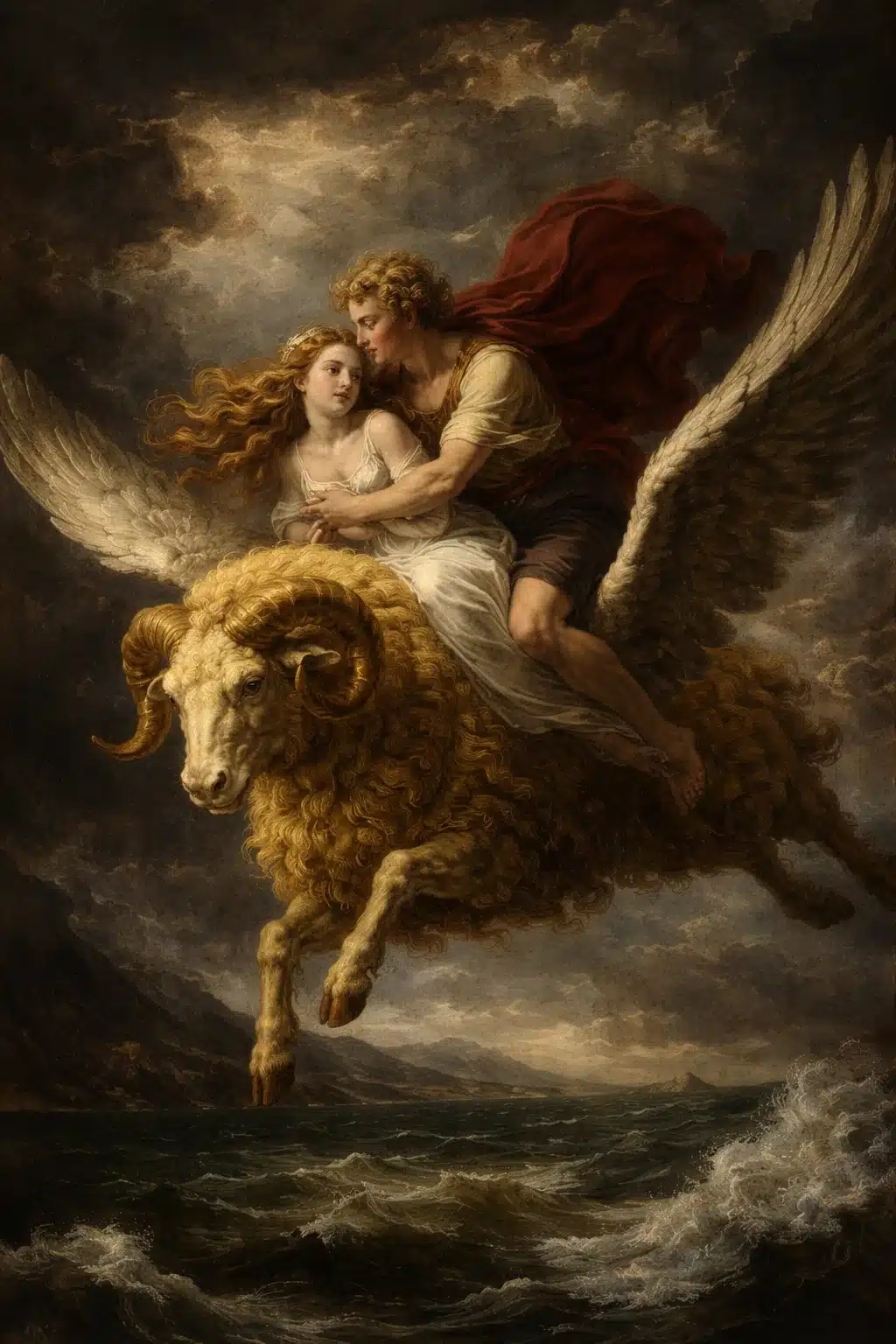
The myth of Phrixus and Helle is one of the most characteristic tales of ancient Greek mythology, intertwining the themes of divine intervention with human tragedy, salvation, and memory. The story of the two siblings, who escape death atop a golden-fleeced ram, culminates in a dramatic separation, leaving an indelible mark on both geography and mythological tradition.
Frixos and Ellie were children of Athamada, king of Orchomenus, and of Nefele, a deity who personified the cloud. After the couple separated, Athamas married Ino, who, according to tradition, treated Nephele’s children with hostility.
Ino, seeking to destroy Phrixus and Helle, devised a plan that involved causing a famine through the deliberate destruction of the harvest and the falsification of an oracle, so that Phrixus’s sacrifice would be demanded to restore the earth’s fertility. The motif of the stepmother plotting against the children of her husband’s previous marriage is a recurring theme in Greek mythology.
Crucial to the development of the myth is her intervention Nefele, who, in order to save her children, sent a marvelous ram with a golden fleece. This animal, endowed with wings and divine powers, carried Phrixus and Helle across the sky, away from certain death.
This flight is not merely a narrative element, but carries a strong symbolic significance, as it conveys the concept of divine salvation and the transition from danger to safety. The Golden Fleece thus becomes an object of sacred significance, destined to play a central role in later mythological narratives.
During the flight, Helle, unable to hold on, fell into the sea and drowned. The spot where she fell was named the Hellespont, making the myth a tool for explaining the naming of an important geographical strait.
The loss of Helle serves as the narrative’s dramatic climax, underscoring the fragile nature of salvation and the delicate balance between life and death. At the same time, it fits into the broader mythological tradition that connects human events with the natural landscape.
Frixos managed to reach ColchisWhere he was accepted by King Aetis. In showing gratitude to Zeus, he sacrificed the ram and dedicated the golden fleece, which was hung in a sacred grove and guarded by a dragon.
The skin thus becomes a symbol of power, blessing, and divine favor, while its placement in a sacred space signifies the transition from a mythical object to a sacred relic. This narrative serves as a prelude to the cycle of ArgonautsWhere the skin will be the main concern.
The myth of Phrixus and Helle has been the subject of numerous interpretations. On a symbolic level, the story reflects:
- The conflict between legal and illegal power within the family.
- Divine protection as a counterweight to human injustice.
- The concept of travel as a test and transition.
- The transformation of mourning into collective memory through geography.
Furthermore, the Golden Fleece has been interpreted as a symbol of wealth, royal legitimacy, or even as an allegory for technological or natural processes, without, however, negating its primary mythological significance.
Conclusion
The story of Frixos and Helle combines drama, divine intervention, and geographical interpretation, forming a fundamental part of the Greek mythological tradition. Through the journey of the two children, fundamental themes such as survival, loss, and the sanctification of experience are highlighted—elements that make the myth timeless and multi-layered.
JTNDcCUZRSUwQSVDRSU5MSVDRSVDRSVCQSVDRSVCQSVDRSVCQiVDRiU4RCVDRIU4OCVDRIU4NCVDRSVCNSU4MCVDRSVCNSVDRIU4MSVDRSVCOSVDRIU4MyVDRiU4MyVDRiU4QyVDRIU4NCVDRSVCNSVDRIU4MSVDRSVCNSVDRIU4MiUyMCUzQ2ElMjBocmVmJTNEJTTEYJTJTJTJGA XN0b3JpZXMtbXl0aG9sb2dpYXMmlKYlM0UlQ0UlQjklQ0YlodMlQlQlQlQlQlQlQlQUlQUlQUlQUlQUlQUlQUlQUlQUlQUlQUlQUlQUlQUlQlQlQl0UlQlKYlQlQlQUlQUlQlQlQlQlQlQUlQlQlQUlQlQlQUlQUlQUlQUlQUlQUlQUlQUlQUlQUlQUlQUlQUlQULQULQULQULQULQULQULQULQULQULQULQULQULQULQULQULQULQULQULQULQULQ