
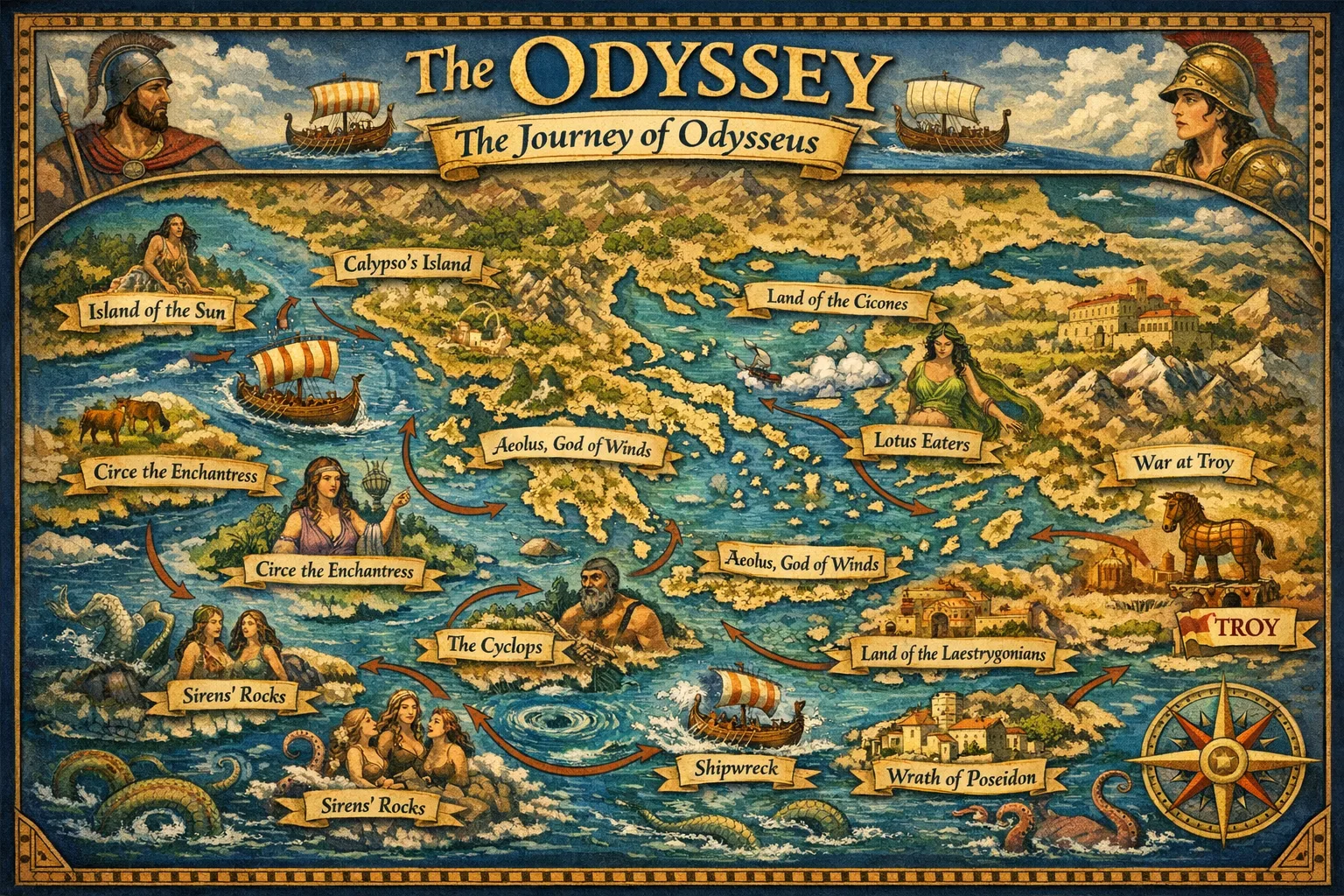
His journey Odysseus presents the main attitudes of his return from Troy in Ithaca, from the Kicones and the Lotaphagus to the Cyclops, Circe, Calypso The Sirens and Dogs with Harybd. Each episode shows trials, losses and decisions that delay the hero.
The narrative is completed with his arrival in Phaeaks and the return to Ithaca, where with the help of Telemachus and Athena He beats the suitors and reunites with Penelope. The text highlights wisdom, perseverance and desire for a homeland.
The epic journey of Odysseus, as told in The Odyssey, is one of the most fascinating adventure stories in world literature. After the fall of Troy, Odysseus begins his long and perilous voyage back to Ithaca, facing mythical creatures, divine interventions, and countless challenges along the way.
The Journey of Odysseus – A Detailed Guide Through Each Stop
The epic journey of Odysseus, as told in Odyssey, is one of the most important narratives in world literature. After the fall of Troy, Odysseus sets out on his journey home to Ithaca, facing gods, monsters, and countless trials.
1. The Land of the Cicones (Ismarus)
After leaving Troy, Odysseus and his men arrive at Ismarus, the land of the Cicones. They attack the city and initially succeed, but their greed delays their departure. The Cicones regroup and counterattack, killing many of Odysseus’ men. This marks the first lesson of the journey: lack of discipline leads to loss.
Rhapsody (9.39–61)
2. The Land of the Lotus-Eaters
Next, they reach the land of the Lotus-Eaters. Here, some of Odysseus’ crew consume the lotus plant, which causes them to forget their desire to return home. Odysseus forcibly brings them back to the ship, showing his leadership and determination to continue the journey.
Rhapsody i (9.82–104)
3. The Cyclops (Polyphemus)
One of the most famous stops is the island of the Cyclopes. Odysseus encounters Polyphemus, a giant one-eyed monster. After being trapped in the cave, Odysseus devises a clever plan: he blinds the Cyclops and escapes by hiding under sheep. However, revealing his name afterward brings the wrath of Poseidon upon him.
Rhapsody (9,105–566)
4. Aeolus, God of Winds
Odysseus then visits Aeolus, who gives him a bag containing all the winds except the one that will guide him home. Just as Ithaca is in sight, his crew opens the bag out of curiosity, releasing the winds and blowing them far off course again.
| Rhapsody (101–79) |
5. The Laestrygonians
The next stop is the land of the Laestrygonians, a race of giant cannibals. They destroy most of Odysseus’ fleet by hurling massive rocks at the ships. Only Odysseus’ own ship survives, marking a devastating loss.
Rhapsody K (10.80–132)
6. Circe the Enchantress
On the island of Aeaea, the sorceress Circe transforms some of Odysseus’ men into pigs. With the help of the god Hermes, Odysseus resists her magic and forces her to restore his crew. They remain on the island for a year before continuing their journey.
Rhapsody (10,133–574)
7. The Underworld (Hades)
Odysseus travels to the Underworld to seek guidance from the prophet Tiresias. There, he encounters the spirits of the dead, including his mother and fallen comrades. Tiresias warns him of the dangers ahead, especially the cattle of Helios.
Rhapsody L (11.1–640)
8. The Sirens
The Sirens lure sailors to their doom with enchanting songs. Odysseus orders his men to plug their ears with wax while he is tied to the mast so he can hear the song without danger. This moment highlights both curiosity and self-control.
Rhapsody m (12.39–54, 158–200)
9. Scylla and Charybdis
Odysseus must navigate between two deadly threats: Scylla, a six-headed monster, and Charybdis, a massive whirlpool. He chooses to pass closer to Scylla, sacrificing a few men to save the ship—a painful but strategic decision.
Rhapsody m (12.73–126, 201–259)
10. The Island of the Sun God (Helios)
Despite warnings, Odysseus’ crew slaughters the sacred cattle of Helios while he sleeps. As punishment, Zeus destroys their ship with a thunderbolt. Odysseus is the sole survivor.
Rhapsody m (12.260–453)
11. Calypso Island (Ogygia)
Odysseus washes ashore on the island of the nymph Calypso, who keeps him there for seven years, offering immortality if he stays. He refuses, longing for home. Eventually, the gods intervene, and he is allowed to leave.
Rhapsody e (5.1–281)
12. The Phaeacians
Odysseus reaches the land of the Phaeacians, where he is welcomed and tells the story of his journey. They help him return safely to Ithaca, providing him with a ship and gifts.
Rhapsodies z–n (6–13)
13. The Return to Ithaca
Finally, Odysseus arrives home in disguise. With the help of his son Telemachus and the goddess Athena, he defeats the suitors who have taken over his palace and reunites with his wife, Penelope.
Rhapsodies n–o (13–24)
Conclusion
The journey of Odysseus is not just a physical voyage but a symbolic one—filled with lessons about leadership, patience, intelligence, and the human desire to return home. Each stop represents a different challenge, shaping Odysseus into the legendary hero remembered through the ages.
Read more
Odysseus: His Story, Adventures, and the Lessons of the Odyssey
The Nymph Calypso and Odysseus
Calypso, the nymph in the *Odyssey*: Her story in Greek mythology
Scylla and Charybdis, Odysseus's deadly trap
Cyclops and Polyphemus: The One-eyed Giants of the Gods and Odyssey
Ancient Sources
- Homer. Odyssey. (mostly Rhapsods a–n)
- Apollodorus. Library (Bibliotheca).
- Pausanias. Greece Tour.
- Strabo. Geographical.
- Hyginus. Fabulae.
- Ovid. Transformations. (for later mythological traditions)
Modern Bibliography
- Burkert, Walter. Greek ReligionHarvard University Press.
- Burkert, Walter. Greek Mythology and Ritual.
- Graf, Fritz. Greek Mythology: An IntroductionJohns Hopkins University Press.
- Grimal, Pierre. The Dictionary of Classical MythologyBlackwell.
- Hamilton, Edith. MythologyLittle, Brown and Company.
- Hard, Robin. The Routledge Handbook of Greek MythologyRoutledge.
- Kearns, Emily. The Heroes of AtticaInstitute of Classical Studies.
- Kirk, G. S. The Nature of Greek MythsPenguin.
- Malkin, Irad. The Returns of OdysseusUniversity of California Press.
- Nagy, Gregory. The Ancient Greek Hero in 24 HoursHarvard University.
- Stanford, W. B. The Odyssey of HomerMacmillan.
- West, M. L. The Making of the OdysseyOxford University Press.
Reliable external links
Perseus Digital Library
The fullest base of ancient Greek texts.
Theoi Greek Mythology
Very reliable website with ancient sources, excerpts and genealogies.
Loeb Classical Library (Harvard)
Scientific publications of Greek and Latin texts.
ToposText
Ancient Greek texts associated with geographical locations.
Oxford Reference
Encyclopedic information on Greek mythology.
https://www.oxfordreference.com
Encyclopedia Britannica
Relics on Ulysses, Odyssey and mythological persons.
World History Encyclopedia
Scientificly edited articles.
Homer Multitext Project
Harvard Center research program for Hellenic Studies for Homeric epics.
https://www.homermultitext.org
Center for Hellenic Studies (Harvard)
Metropolitan Museum of Art – Heilbrunn Timeline
Pictures and articles about ancient Greek art and Odyssey.
https://www.metmuseum.org/toah