
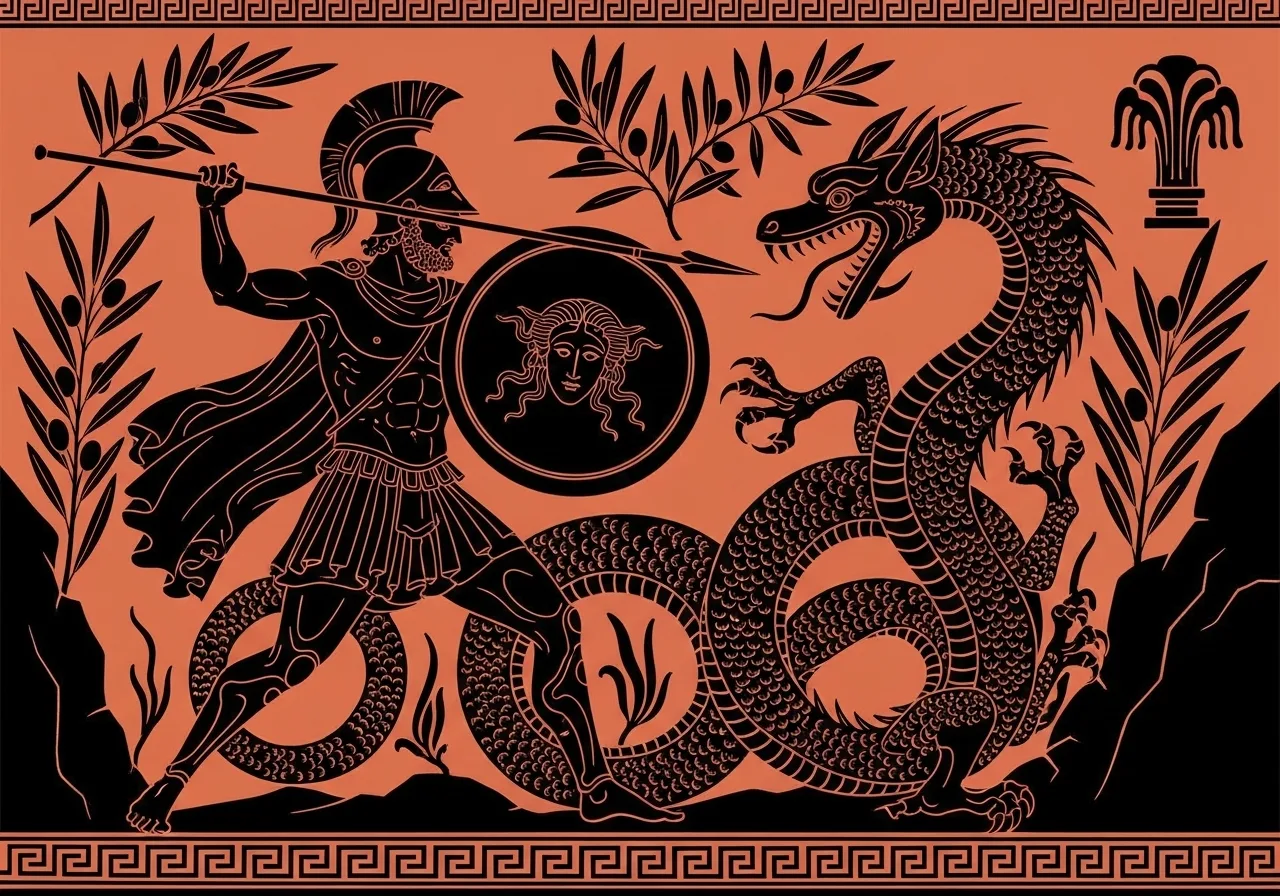
- Cadmus is one of the most important forms of Greek mythology, known as its founder and first king Thebes. Son of the King of Phoenicia Agnes and Telephone, linked to a great search adventure of his sister Europe, which eventually led him to Boeotia, where he founded the famous city of Thebes and, according to tradition, introduced the alphabet and writing to the Greeks.
| Name | Cadmus |
|---|---|
| Parents | Agnore and Telephasia |
| Residence | Tyrus, Thebes (founder of Thebes) |
| Roles and Responsibilities | Founder of Thebes, hero-resident, carrier of Phoenician writing in Greece |
| Other Names | Cadmus the Tibetan |
| Husbands | Harmonia |
| Children | Polydorus, Ino, Semmel, Self, Agay |
| Symbols | Dragon, Thebes foundation stones, letters (alphabet) |
| Roman Name | Cadmus |
Who was Cadmus?
Cadmus was a Phoenix prince, the son of King Agenora and Telefassa, and her brother Europe. His story begins with the desperate search for his sister, which had been seized by Zeus transformed into a bull. This mission, commissioned by his father, did not allow him to return without Europe, which led him on a long journey across the ancient world.
During his wandering, Cadmus consulted the Delphi Oracle, which gave him a new order: to stop searching and follow a cow until she fell exhausted, at the point where she should establish a new city. So she arrived in Boeotia, where she followed the mark of the god and laid the foundations of Thebes.
However, the founding of the city was not peaceful. Cadmus had to face a terrible dragon guarding Mars' source. After his victory, with Athena's help, he killed the monster and, following divine guidance, sowed the dragon's teeth on earth. From these came the Spartans, the first warriors of Thebes, who helped him establish his authority.
Thus, Cadmos is not only the founder of Thebes, but also a form associated with the dissemination of culture, as his tradition also attributes the introduction of the Phoenician alphabet into the Greek world, which makes him a symbol of the transition from myth to history. It is not only distinguished for war feats, but mainly for:
The establishment of Thebes
The Transfer of the writing
the formulation of culture and law
It is a symbol culture and transition from chaos to order.
Origin and family
Father: Ageonor, King of Phoenicia
Mother: Telephone
Siblings:: Europe, Phoenix, Killix
Its origins highlight the Eastern cultural axis of Greek mythology.
Europe's grab and Cadmus mission
When the Zeus He kidnapped her. Europa, Agynor:
He sent Cadmus to find her.
Forbade him to return without her.
Search failed, but gave birth new destiny.
The Delphi Oracle and the sign of the cow
Cadmus consulted the Oracle of Delphi:
follow a cow
set up a town where he'll lie
The cow led to Boeotia.
The dragon of Ares
In the area:
There was a dragon sacred to him Ares
He was saving a water source.
Cadmus:
Kill the dragon
He committed a sacred murder.
This caused divine consequences.
The Spartans – the «Sown warriors»
By order of the Athena:
Sown the dragon's teeth
There have been armed men. Seeds
Killed each other, except five:
ancestors of the nobles of Thebes
Establishment of Thebes (Cademia)
Cadmus:
established the Cadmea
created an organized city
set laws and order
Thebes became one of the most important mythical centers in Greece.
Punishment and atonement
For the murder of the dragon:
served Mars for eight years
purified
His marriage to her Harmonia Seal the restoration.
Marriage to Harmony
Harmony was a daughter:
of Ares
of Venus
Their marriage:
All the gods attended
Divine gifts were given (coin, veil)
represents the conflict and order union
Cadmus' children – tragic legacy
Children:
Semeli (mother of Dionysus)
Ino
Agane
Aftonoe
Polydorus
The family shall be associated with:
Divine punishments
mania
tragedy
The transformation into a snake
At the end:
Cadmus and Harmony transformed into snakes
They left for the Elysian Fields
The snake symbolizes:
knowledge
regeneration
primal wisdom
Cultural significance of Cadmus
Cadmus shall be considered as:
Importer of writing (Cademy writing)
city founder
law and culture body
It belongs to Cultural heroesNot just warmen.
Cadmos is one of the most symbolic forms of Greek mythology, as it unites the concept of hero with that of the cultural founder. His course from Phoenicia to Boeotia is not just a geographical wandering, but a narrative of transition from chaos to order, from search to foundation and personal loss to the creation of an entire cultural centre, Thebes. Through his trials – the search for Europe, the advice of the Oracle of Delphi, the battle with the dragon and the birth of the Spartans – Cadmos emerges as a model of man who works with the divine, but at the same time acts with determination and boldness.
The most important element of his legacy is his connection to the writing and introduction of the alphabet, which makes him a symbol of cultural evolution and knowledge. Thus, Cadmus does not remain just a mythical king, but turns into an archetype founder of cities and cultural bodies, whose history reflects the deeper Greek perception of progress as a result of a combination of divine guidance and human action.