
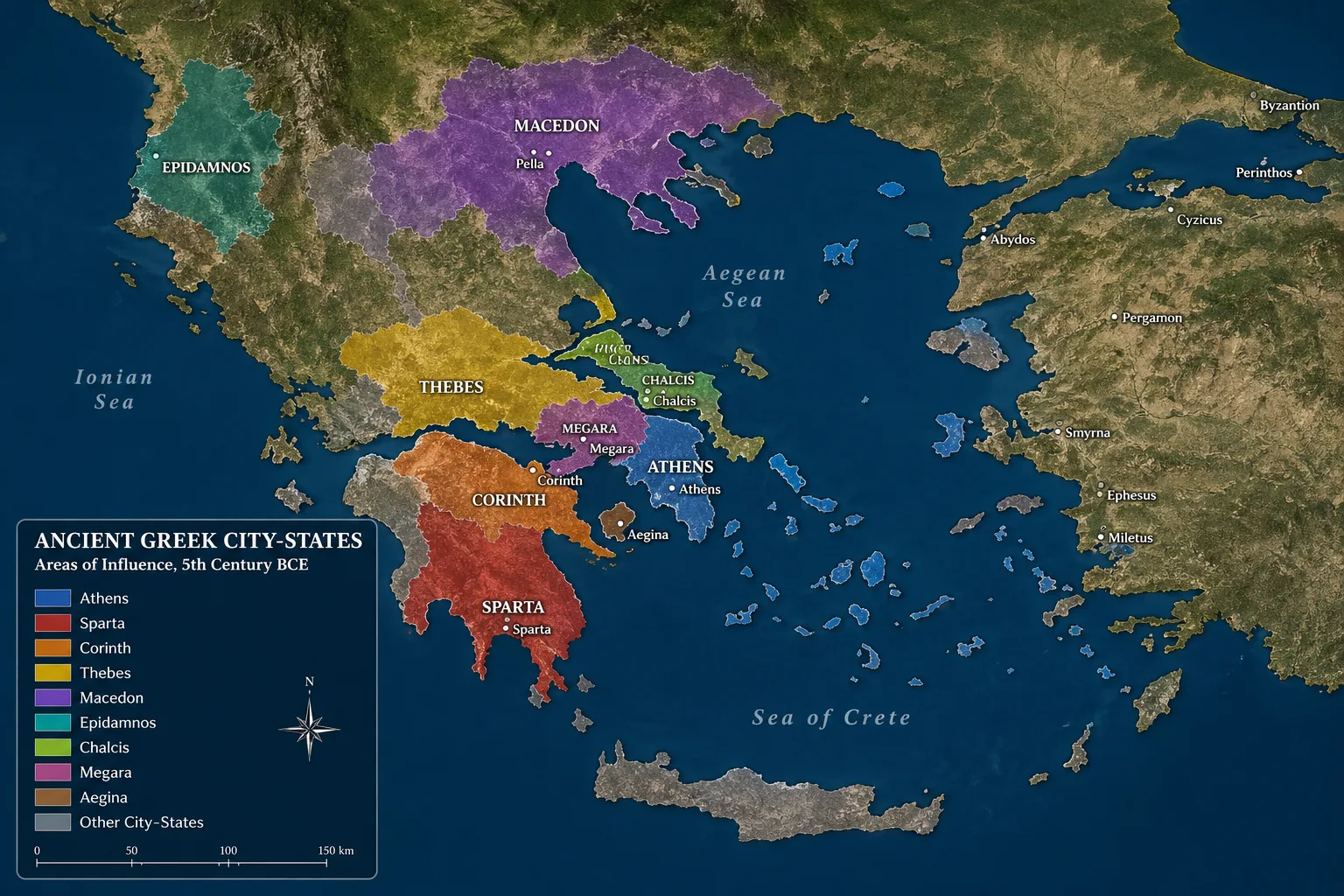
The cities-States of Ancient Greece are one of the most characteristic and decisive elements of ancient Greek culture. Unlike the large, single states of other ancient cultures, such as Egypt or Mesopotamia, Greeks developed a world fragmented into independent political entities. Each state city (or «city») had its own government, laws, army and identity.
This special system of organization not only shaped the political life of ancient Greeks, but also deeply influenced their philosophy, mythology, art and social evolution.
What was the city state?
The city-state was not just a town with inhabitants. It was a complete and self-sufficient community. Includes:
- The urban center (asty)
- Country
- Citizens with civil rights
- Religious institutions and shrines
At the heart of each city was the citadel, a fortified spot that often hosted temples and was a symbol of power and protection.
The concept of «city» It was closely linked to the concept of citizen. It was not just a place of residence, but a community of participation, responsibility and identity.
The main characteristics of city-states
Despite their differences, most city-states had some common features:
Political autonomy
Every city-state was independent. There was no single Greek government. This led to frequent alliances and conflicts.
Different cultures
The city-states developed a variety of political systems, such as:
- Dimokratia
- Oligarchy
- Tyrannia
Intense local identity
The citizens felt first members of their city and then «Greek». Local pride was strong and influenced their attitude toward others.
Religious life
The worship of the gods was common throughout the Greek world, but each city had its own patron gods and special cults.
Athens
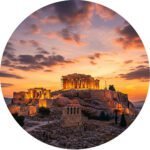
- Athens has been one of the most influential city-states. It is known for its democracy, a pioneering system where citizens actively participated in decision-making.
At the same time, Athens became a center of philosophy, theatre and arts. It is associated with rich mythology such as Theseus The Athena and Poseidon.
Sparta
- Sparta He followed a completely different path. It was a strictly organized military society.
Citizens were trained from an early age for war, while discipline and collectivity were at the heart of life. Its culture was a mixture of oligarchy and monarchy. It is associated with rich mythology such as Trojan War The Zeus .
Corinth
- Corinth She stood out for her commercial and naval power. Its geographical position made it an important hub of trade between East and West.
Her economic power made her one of the richest cities in ancient Greece. It is associated with rich mythology such as Sisyphus and Bellerophon.
Thebes
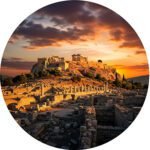
- Thebes played an important role in political and military history. Although often obscured by Athens and Sparta, he experienced periods of great power, especially in the 4th century BC.
At the same time, the city has a strong presence in mythology as a home of heroes such as Oedipus and Hercules.
Allies and conflicts
The independence of city-states often led to competition. Two of the most typical examples are:
- The Persian Wars, where Greek cities united against a common enemy
- The Peloponnesian War, a long and destructive conflict between Athens and Sparta
These conflicts highlighted both the power and weaknesses of the city-state system.
The importance of city-states in Greek culture
The city-states were the environment in which ancient Greek culture flourished. Within them they developed:
- Philosophy
- Democracy
- The theatre
- The Historiography
The variety and competition between cities boosted creativity and evolution.
Conclusion
Member cities were not just political units· were living communities that shaped the thinking and life of ancient Greeks. Through their diversity ideas and institutions were born that affect the modern world to date.
Understanding cities-states helps us to see how a fragmented world can produce one of the most single influential cultures in history.
The city-states of ancient Greece were not only political entities, but also living centers of mythology and worship. Each city had its own gods-protects, local myths and heroes who shaped its identity.
For a more comprehensive picture of the mythological world in which the city-states belong, you can see our analytical guide on Greek mythology:
????
This presents the overall framework of the gods, heroes and basic myths that directly influenced the political and cultural life of cities such as Athens, Sparta and Thebes.