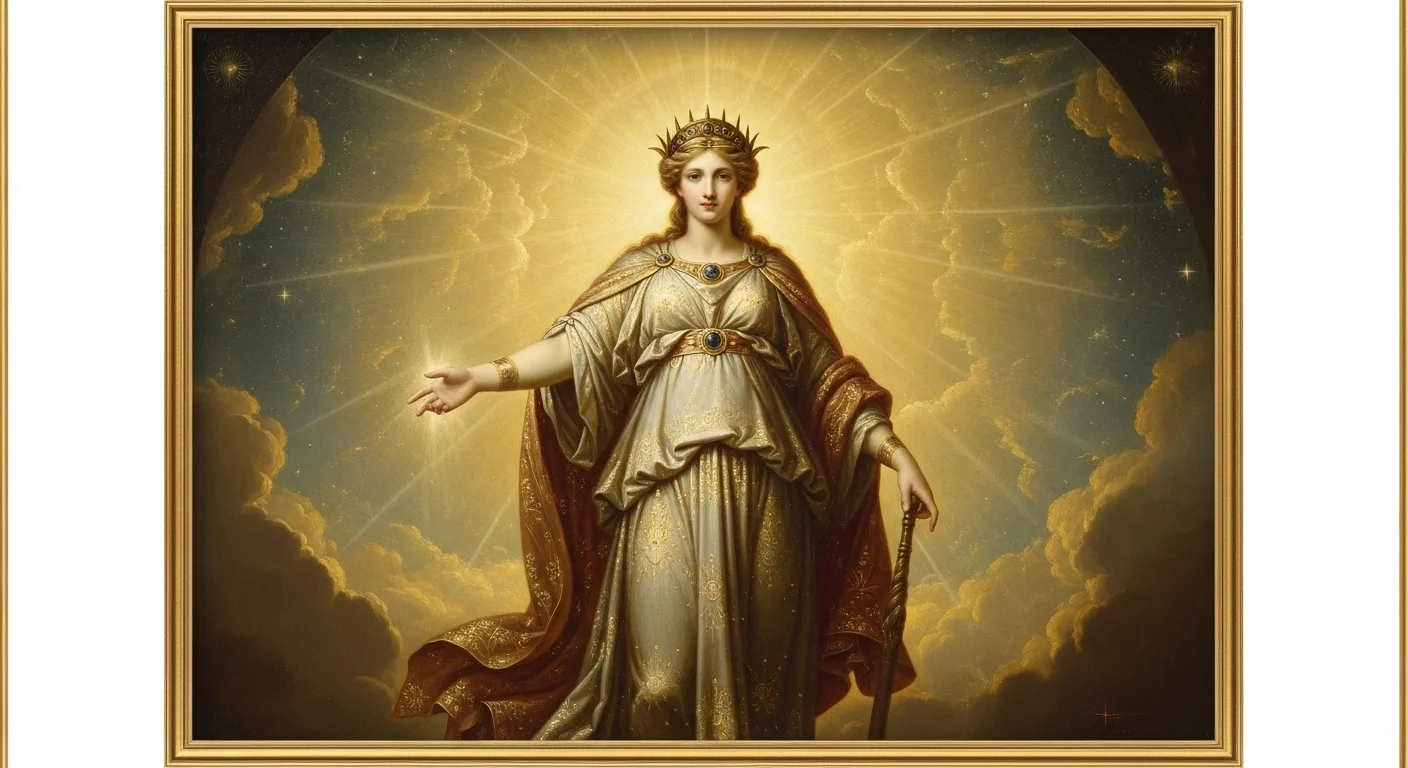
The Divine is one of the oldest and most important deities of Greek mythology, belonging to the generation of Titans who preceded Olympian gods. Although it does not often appear in known myths and heroic narratives, its presence is fundamental to understanding ancient Greek cosmogony. The Divine is associated with the glow of heaven, the ability of vision and the brightness of precious metals and stones. Through her children, the Sun, the Moon and Eo, she became the mother of heavenly lights that determine the rhythm of the world.
Although in some newer interpretations it is presented as a deity of wisdom or justice, ancient sources mainly link it to the brilliance, perception and power of light. Its form expresses the primal power that allows beings to see and perceive the world around them.
Origin and place in cosmogony
According to the «Theogenia» The Hesiod, Aunt was her daughter Gaia and Uranus. It belonged to the twelve great Titanides and Titans born from the union of Earth and Heaven and became the second generation of divine existences.
As Titanida, Aunt represented one of nature's primary forces. Ancient Greeks believed that every element of the world had its own divine personification. Aunt was the power that gave light and visibility to things, making the experience of light possible.
Her name probably comes from the word «goddess» or roots related to sighting and divine radiation. For the ancients, Divine was the source of the brilliance that characterizes both the heavenly bodies and the precious objects of the earth.
Marriage to Hyperion
Aunt joined her brother, Titan Hyperion, who was associated with heavenly light and the observation of heavenly phenomena. This union was considered especially important, as the three deities that govern the cycles of day and night were born of it:
- The Sun, personification of the sun.
- The Moon, goddess of the moon.
- The goddess of dawn.
The children of the Divine represented the basic sources of light that became visible in the sky. Thus, she was considered the mother of every heavenly glow and brightness.
The Divine and the Power of Vision
One of the most important symbols of the Divine is her relationship to vision. Ancient Greeks believed that the ability to see was not just a physical function but a divine force that allowed the perception of reality.
The Divine was considered the deity that gave value to light and allowed the eyes to recognize the beauty and order of the world. Without the light she and her descendants represented, creation would remain immersed in darkness.
This connection to vision led many later writers to consider it a protector of clarity, perception and understanding. Although she was not a goddess of wisdom in the narrow sense later acquired by Athena, she embodied the power that allows knowledge through observation.
Protector of precious metals and stones
Aunt was also associated with the glow of precious metals and precious stones. Gold, silver, and bright gems were considered manifestations of its divine power on earth.
Ancients observed that precious metals reflect light and maintain their brilliance for long periods of time. For this reason they connected them to divine qualities, rendering to the Divine the source of this radiation.
Its connection to wealth was not related to the economic concept of wealth but to the value and shine that make an object special. Thus, Auntie represented the divine quality that makes things stand out and inspire admiration.
The Aunt in Titanic
Like the rest of the Titans, Auntie was at the heart of the great conflict between the Titans and the Olympian gods. Titan fighting was the cosmohistoric event that determined the new order of the world.
Sources do not describe particular acts of the divine, which reflects its peaceful and cosmogenic character. However, as a member of the Titan generation, he is considered to have shared their defeat after the victory of Zeus and his allies.
Unlike other deities disappearing from the mythological tradition after Titanic warfare, the influence of the Divine continued to exist through her children, who continued to illuminate the sky.
Pictures and worship
The Divine is rarely depicted in ancient Greek art. When she appears, she is presented as an imposing and majestic woman with features that highlight her relationship with light. In some performances it is surrounded by rays or bears brilliant garments symbolizing its divine nature.
Her limited presence in art does not diminish her importance. On the contrary, Auntie acts as one of the great secular forces acting in the background of mythology, affecting the functioning of the entire universe.
The legacy of the Divine
The Divine is one of the most important Titanics of Greek mythology, as it is associated with the very phenomenon of light and perception. As the mother of the Sun, Moon, and Hous, she became the generator of celestial bodies that illuminate and organize the world.
Its form symbolizes the glow that reveals reality, the power of vision that allows knowledge and radiation that gives value to the precious elements of nature. Through these symbols, the Divine remains a deity that expresses the beauty, clarity and bright side of creation, holding a separate place in the Greek cosmogony and tradition of Titans.