
Myths About Poseidon – Love Stories, Monsters, and Legends of Greek Mythology
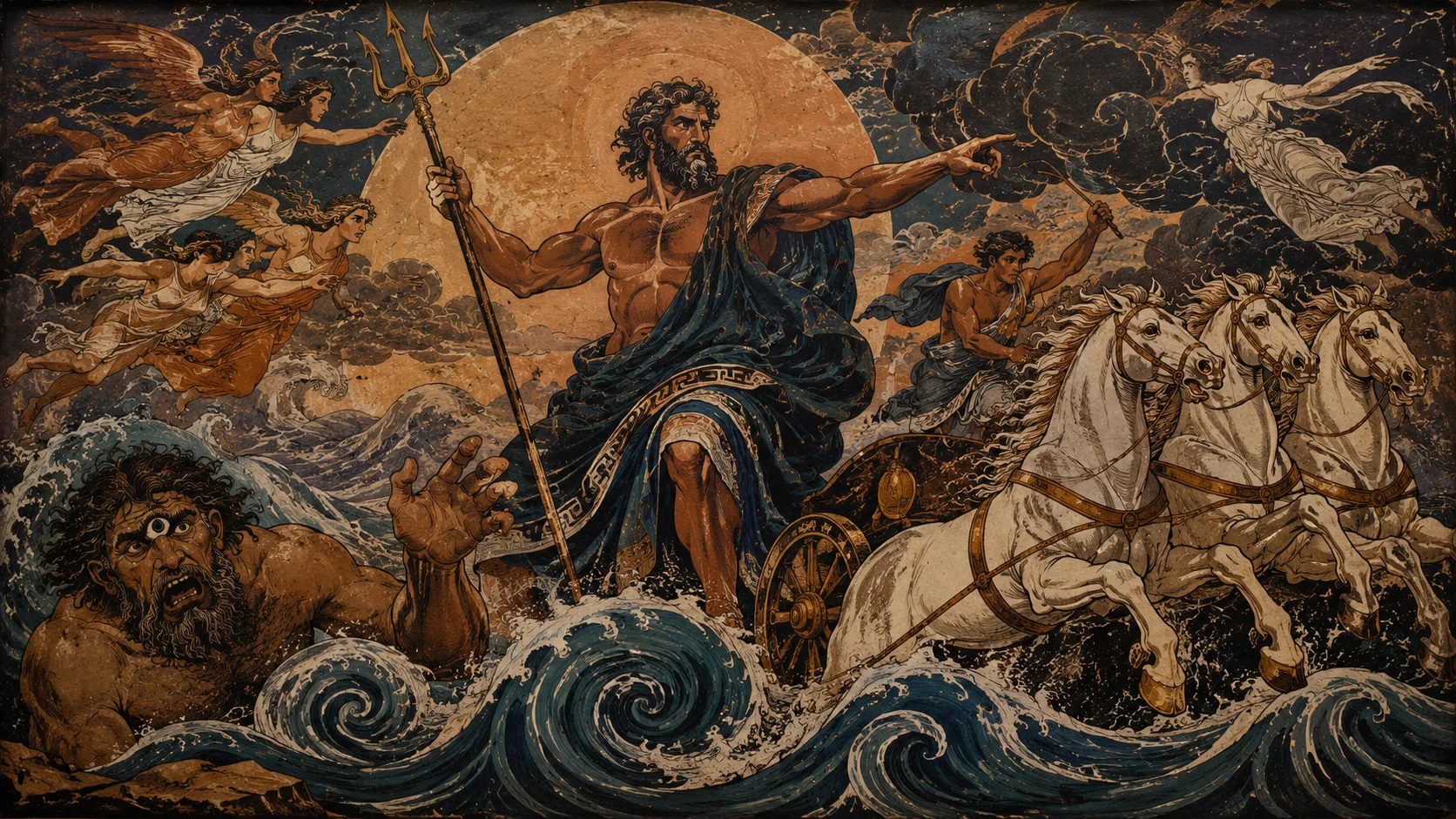
Poseidon was one of the most powerful and imposing deities in Greek mythology. Ruler of the seas, earthquakes, and horses, he appears in countless myths, sometimes as a protector and other times as a fearsome avenger. His personality is characterized by intense anger, passion, and vindictiveness, but also by grandeur—traits that made him one of the most feared gods of Olympus.
The ancient Greeks, a people closely connected to the sea, attributed every storm, earthquake, or maritime disaster to Poseidon. At the same time, however, they believed he could grant safe voyages, fertile lands, and strong descendants. The myths surrounding him are full of conflicts, romances, monsters, and heroes, revealing a deity deeply connected to the uncontrollable forces of nature.
Poseidon and Athena
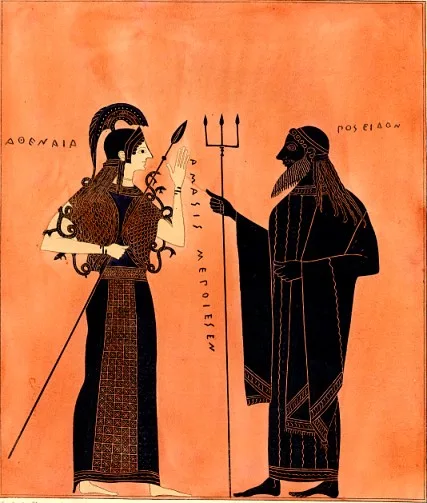
One of the best-known myths concerns the conflict between Poseidon and Athena to protect the city Athens. The two gods vied for control of the new city, and it was decided that the winner would be the one who offered the most useful gift to the inhabitants.
- Poseidon He struck the rock of the Acropolis with his trident and created a spring. In some versions, the water was seawater, symbolizing naval power and dominion over the seas. Athena, on the other hand, bestowed the olive tree, a symbol of peace, wisdom, and prosperity.
The residents chose Athena’s gift, and the city was named after her. Poseidon was enraged and, according to the myth, caused floods and destruction in Attica. This story symbolizes the conflict between the forces of nature and the wisdom of civilization.
Poseidon’s Marriage to Amphitrite
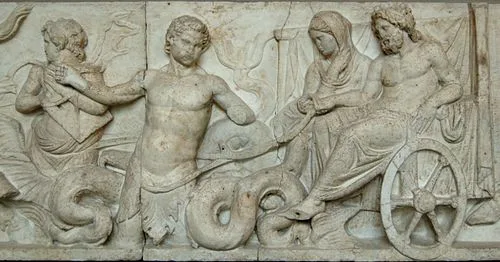
Amphitrite was one of the Nereids, daughters of Nereus and Doris. Poseidon fell deeply in love with her, but she feared his power and hid herself in the depths of the Ocean.
God sent dolphins to find her, and one of them managed to convince her to return. As a reward, Poseidon placed the dolphin among the stars, creating the constellation Delphinus.
Their wedding took place in Poseidon’s golden palace at the bottom of the sea. Although Amphitrite is considered his official wife, myths depict the god as having countless romantic affairs with goddesses, nymphs, and mortal women.
Poseidon’s Love Adventures and Demeter
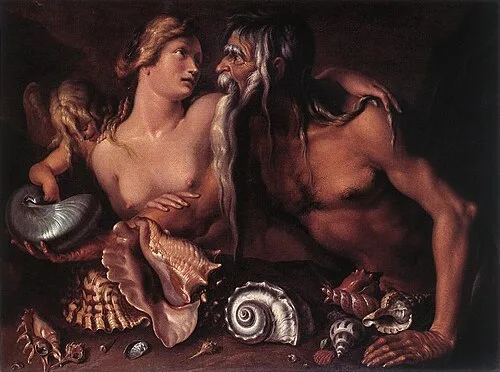
Poseidon is associated with many love myths, but his story with Demeter. According to legend, God fell in love with the goddess of agriculture and pursued her persistently.
Dimitra, trying to escape, transformed herself into a mare and hid among herds of horses. But Poseidon saw through the trick and transformed himself into a stallion as well. From their union was born the divine horse Arion and, in some traditions, a mysterious deity who was secretly worshipped in Arcadia.
This myth illustrates Poseidon's close connection with horses, as he was considered their creator and protector.
Poseidon and Medusa
Before turning into a monster, Medusa She was a beautiful girl and priestess of Athena. Poseidon desired her and joined her in the temple of the goddess.
Athena, enraged by the desecration of her sacred space, punished Medusa by transforming her into a hideous creature with snakes instead of hair. Anyone who looked into her eyes was turned to stone.
When Perseus later beheaded Medusa, two children of Poseidon were born from her blood: the winged Pegasus And the giant Chrysaor.
This myth remains one of the darkest and tragic of Greek mythology.
Poseidon and Gaia – Antaeus
Antaeus was the son of Poseidon and Gaia. He was a giant of immense strength, which he drew from his mother, the Earth. Every time he touched the ground, he grew stronger.
Antaeus challenged all travelers to struggle and killed them, until he met Hercules. The hero understood the secret of his power and lifted him up into the air, depriving him of contact with Earth. So he managed to beat him.
The history of Adaeus symbolizes the power of nature and the connection of life to the earth.
Poseidon as Father of Monsters
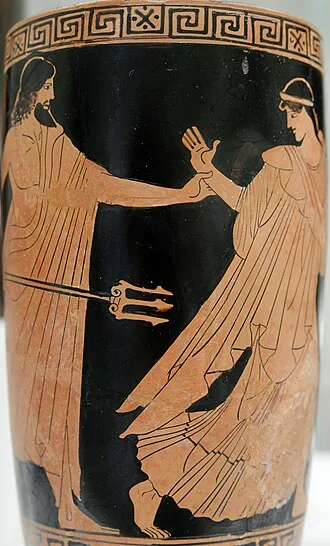
In many myths Neptune appears as the father of monsters and wild creatures. The wilderness of the sea is reflected in its descendants, who often cause fear and chaos.
Among his best known children are:
- Cyclops Polyphemus
- the giant Antaeus
- The bandit Procrust
- the boxer Amycus
- Erux
- Vushiris
- the giant Orion
- the Aloes
These forms are often associated with violence, arrogance and hubris toward the gods and people.
Vousiris
Vushiris was king of Egypt and son of Poseidon. According to legend, he sacrificed foreign travelers to the gods to protect his country from famines.
When Hercules passed through Egypt, he was arrested to be sacrificed. But the hero broke his bonds and killed Vushiri and his priests.
The myth presents Vushiri as an example of barbarity and disrespect towards hospitality, one of the most important values of ancient Greeks.
Amykos
Amycus was his son Poseidon And king of the Bebrys in Asia Minor He was a famous boxer and caused every stranger who arrived in his country in a boxing match to death.
When the Argonauts arrived there, Amykos challenged Polydecukes, one of the best boxers of Greek mythology. Polythek managed to defeat him and kill him.
The myth highlights the punishment of arrogance and violent behavior.
Procrustes and Eryx
Procrust was a notorious bandit of Attica and was considered the son of Poseidon. He hosted travelers at his home and forced them to lie down in an iron bed. If they were shorter, he would force them to stretch.· If they were taller, he would cut their legs off.
He was eventually killed by Theseus, who punished him in exactly the same way.
Erux, also the son of Poseidon, was a mighty boxer and king in Sicily. He challenged all passersby to race until he was defeated by Hercules.
Polyphemous
Polyphemos was the most famous Cyclops of Greek mythology and the son of Poseidon and the nymph Thosa.
In «Odyssey» of Homer, Ulysses and his companions are trapped in his cave. Cyclops devours several men, but Ulysses drunk and blinds him.
When Ulysses reveals his name by leaving, Polyphemus asks his father for revenge. Poseidon hears his prayer and makes Ulysses' journey extremely difficult.
This hatred is a key issue of «Odyssey».
Cygnus
Swan was the son of Poseidon and was famous for his almost undefeated nature. According to some traditions, no weapon could injure him.
During the Trojan War he faced Achilles. The great hero, unable to hurt him with his spear, drowned him with his own hands.
Legend shows that even the most powerful warriors cannot escape their fate.
Orion
Orion was a giant hunter and, according to many traditions, the son of Poseidon. God gave him the ability to walk on the waves of the sea.
Orion became famous for his hunting skills, but also for his arrogance. In some myths he claimed he could kill all the wild animals on Earth. Gaia, enraged, sent a scorpion who eventually killed him.
After his death, Orion was converted into a constellation.
The Aloadae – Otos and Ephialtes
Aloes, Ear and Nightmare, were giants and sons of Poseidon. They were huge in size and incredibly strong.
According to legend, they tried to conquer Olympus by stacking mountains upon one another. They also captured the god Mars and kept him prisoner for months.
Eventually the gods managed to exterminate them using an Artemis trick.
The myth expresses the danger of excessive arrogance toward the gods.
The Victims of Poseidon
Although Poseidon was worshiped as a great god, many myths present him as cruel and vindictive. Those who offended him or resisted his will often suffered terrible consequences.
Ulysses wandered the sea for years because of his rage. Cassiope and Ethiopiaans were punished by a sea monster. King Laomedon of Troy suffered when he refused to pay God for the construction of the city walls.
These stories reflect the fear of ancient people against the sea and natural disasters.
Amymone
Amymone was one of the Danes. When he was in danger from a satyr, Poseidon appeared and helped her.
He then joined her and gave the area water sources by beating with his trident the land. From their union Nafplio was born.
The myth connects Poseidon not only to the sea but also to the underground waters and springs.
Poseidon and Aithra
Aethra was the daughter of King Pitthea and mother of Theseus. According to one of the most famous Athenian myths, he joined on the same night both King Aegeas and Poseidon.
So Theseus was considered the son of both. This dual ancestry gave the hero divine power but also royal legitimacy.
Theseus' connection to Poseidon often occurs in later myths and cults.
Poseidon and Astypalea
Astypalea was a beautiful woman who attracted Poseidon's interest. Ankaeus and other heroes associated with island traditions of the Aegean were born from their union.
Her name was associated with the island of Astypalea, which according to tradition was named in her honor.
The myth demonstrates Poseidon's close relationship with the islands and the Aegean sea world.
FAQ
Who was Poseidon?
Poseidon was the god of the sea, earthquakes and horses in Greek mythology and one of the twelve gods of Olympus.
Who was Poseidon's wife?
His official wife was Amphitriti, one of the Nireides.
Why did Poseidon hate Odysseus?
Because Ulysses blinded his son, Cyclops Polyphemus.
What were Poseidon symbols?
His basic symbols were trident, horses, dolphins, and waves.
What children of Poseidon were the most famous?
Polyphemus, Theseus, Pegasus, Antaeus, Orion and Aloeas.
Why is Poseidon connected to earthquakes?
Ancient Greeks believed it caused earthquakes by striking the earth with its trident. That's why it was called and «Enosigaus»That's the one that shakes the earth.
Sources
- Homer, «Odyssey»
- Hesiod, «Theogenia»
- Apollodorus, «Library»
- Pausanias, «Greece Tour»
- Pindar, «Olympians»
- Young man, «Muscle»