
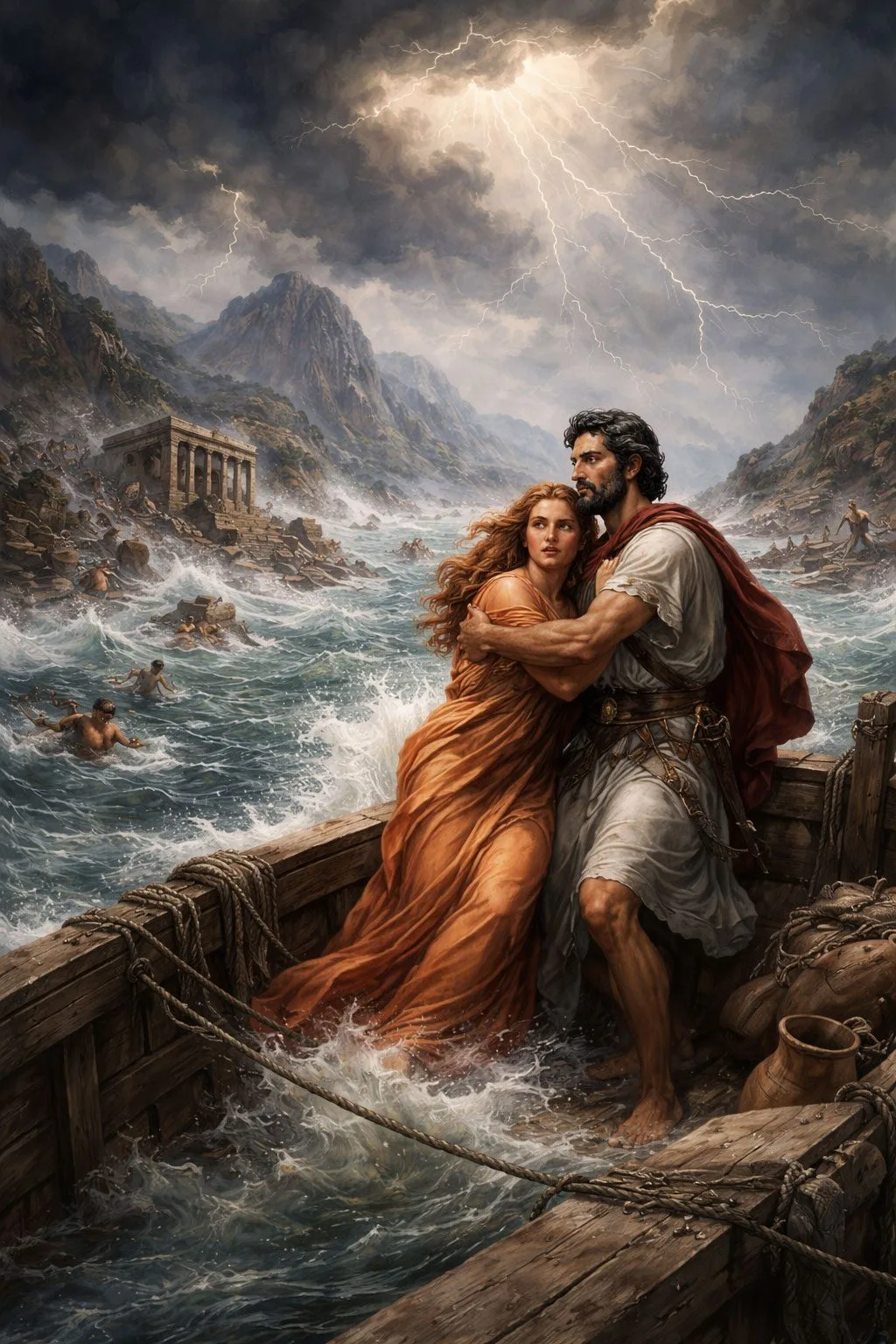
The flood of Deucalion is one of the most shocking myths of ancient Greek tradition, an account of the punishment, destruction, and the rebirth of mankind.
«Zeus threw abundant rain from heaven to flood most of Greece, resulting in the destruction of all people, except those few who found refuge in the high mountains of the region.»
— Apollodoros, The Library of Greek Mythology
In old times, when people had forgotten justice and respect for the gods, the earth was filled with hubris, violence, and injustice. The laws had been broken, the vows were not kept and the weak were oppressed without mercy. Zeus, the father of gods and men, observed from Olympus the corruption of mortals and his wrath grew. It was not the first time he was disappointed by mankind, but this time he believed that there was no hope of correction.
So he decided to clean the earth with water, put out evil and give the world a chance for a fresh start. He ordered the clouds to rust, the winds to break down, and the rivers to overflow. Rain fell constantly, heavy and frozen, day and night. The plains were converted into lakes, the cities sank, the mountains were lost in the waters. People and animals were swept away by the rushing currents, while cries of terror echoed before they were lost in silence.
Only two souls were judged worthy of salvation: Deucalion, the son of Prometheus, and his wife Pyrra, the daughter of Epimetheus and Pandora. They were righteous, devout, and humble. Prometheus, as always, had warned his son of the coming destruction and advised him to build a large wooden ark. So when the waters began to rise, Deucalion and Pyrra entered and surrendered to their fate.
For nine days and nine nights the ark wandered over endless water. There was no land, only heaven and sea united in an unbroken horizon. When the rain finally stopped and the waters began to retreat, the ark staggered on the slopes of Parnassos. The world was unrecognizable: desert, silent, clean but empty of life.
The two survivors came down with awe and sorrow. They prayed to the gods and especially to Themida, goddess of righteousness, seeking guidance. How would mankind be reborn? Themida responded with oracle enigmatic:
«Get away from the temple, cover your heads and put the bones of the great mother behind you.».
Initially they were frightened; the thought of desecration seemed sacrilege. But Deucalion, wise and thoughtful, understood the meaning: a great mother was the Earth, and her bones were the stones. So they started throwing stones behind them. From the stones cast by Deucalion were born men, and from those of Pyrra women. People of hardnecks, born of the earth, able to withstand difficulties and rebuild the world.
So, after the flood, humanity was reborn — more mature, stronger, with the memory of divine punishment engraved deep in her soul. The myth of Deucalion speaks not only of destruction, but of hope: that even after the greatest calamity, there may be a new beginning.